
Packaging specifications for exported garment products are the set of requirements for folding, polybags, cartons, size ratios, and labeling that garment factories must complete before delivering goods to the customer. Textiles and garments are a flagship export sector for Vietnam, with the US, EU, Japan, and South Korea as the largest markets, but each market has its own set of regulations on fiber content labeling, plastic bag safety warnings, and restricted chemicals on the product, while US tariff policy on Vietnamese textiles has continued to change throughout 2026.
In this article, 3W Logistics compiles the complete set of packaging specifications for exported garment products under current Vietnamese law as of September 2026 – from Decree 37/2026/ND-CP on goods labeling, to TCVN 4896:2009 on woven fabric labeling and TCVN 2106:2007 on care symbols – together with the specific requirements of major importing markets, from the perspective of a forwarder with over 10 years of experience shipping exported textile and garment products.
1. Why Are Packaging Specifications the Top Priority for Exported Garment Products?
Unlike agricultural or seafood products, the biggest risk for exported garments is not environmental damage but a mismatch between the actual shipment and the buyer’s packing list requirements – the wrong size ratio in the carton, a missing barcode, a fiber content label not meeting the target market’s standard, or a plastic bag without the safety warning required by the importing country’s law. For seasonal fashion goods, a shipment held at the destination port for repackaging inspection can cause the buyer to miss the selling season and cancel the order.
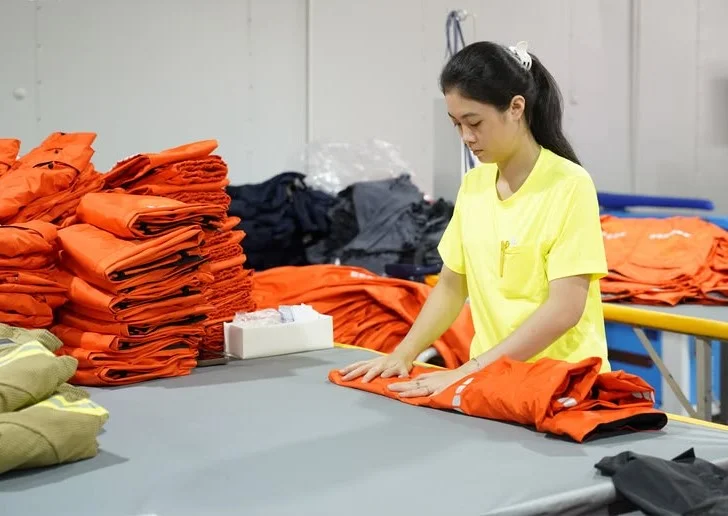
Beyond order-specific packing requirements, packaging specifications for exported garment products must simultaneously meet three groups of requirements:
- Domestic legal requirements: Decree 37/2026/ND-CP dated January 23, 2026 on goods labeling; the Law on Product and Goods Quality as amended by Law No. 78/2025/QH15 (effective from January 1, 2026).
- Technical standard requirements: TCVN 4896:2009 on woven fabric labeling, TCVN 2106:2007 (ISO 3758:2005) on pictorial care label symbols (washing, bleaching, drying, ironing, dry cleaning).
- Importing country requirements: Each market’s own fiber content and care labeling regulations (the Textile Fiber Products Identification Act and the Care Labeling Rule in the US, Regulation (EU) 1007/2011 on textile fiber names in the EU), plastic bag safety warnings for airtight packaging, and chemical restrictions such as azo dyes and formaldehyde under REACH in the EU.
Important note: From January 23, 2026, Decree 37/2026/ND-CP replaces Decree 43/2017/ND-CP and Decree 111/2021/ND-CP on goods labeling. Commercial packaging already printed in compliance with the old regulations before January 23, 2026 may continue to be used, but for no more than two years from that date. Garment businesses still holding stock of cartons or paper tags printed with the old template need to review the label content before packing new shipments, because packaging specifications for exported garment products that meet technical standards can still be rejected by the customer if the labeling does not match the order and the approved technical specification (tech pack).
2. Product Quality Inspection Before Packing
Packaging specifications for exported garment products only matter once the products going into packing have passed final line quality control (final QC) and met the technical criteria in the customer’s tech pack. Many shipments are rejected by customers not because of sewing quality but because of packing errors not carefully checked before shipment.
| Criterion | Standard Requirement | Rejected / Downgraded When |
|---|---|---|
| Visual inspection (final QC) | Seams, fit, and color matching the approved sample; the acceptable quality level (AQL) agreed with the customer is applied, typically AQL 2.5 for minor defects | Exceeding the number of defects permitted under the agreed AQL – the shipment is rejected for shipping or a full 100% re-inspection is required |
| Metal and foreign objects (metal detection) | 100% metal detector scanning of products before packing, especially for children’s goods and shipments to the US and Japan; scanning results recorded for each batch | A broken needle or foreign metal object detected in the product – a serious safety violation, especially for children’s goods |
| Shrinkage and colorfastness | Meeting the shrinkage-after-washing and colorfastness-to-light-and-washing criteria per the customer’s technical requirements (typically referencing the corresponding AATCC or ISO standard) | Failing the shrinkage criterion or fading beyond the threshold – goods are returned or compensation is demanded after being sold on the market |
| Restricted chemicals | Free of, or below the permitted threshold for, restricted substances required by the target market, such as azo dyes that break down into aromatic amines, free formaldehyde, and heavy metals in zippers and buttons | Exceeding the restricted chemical threshold under REACH (EU) or the corresponding US regulation – the shipment is recalled or denied import |
| Correct size/color ratio per the order | The quantity per size and color exactly matches the purchase order and the confirmed size/color ratio breakdown | A shortage or excess in quantity by size/color – creates difficulty for the customer distributing goods to each store per the sales plan |
3. Packaging Material Standards for Exported Garment Products
This is the core part of packaging specifications for exported garment products. There is no single TCVN specifying the detailed packing method for garments; in practice, the packing method is set out by the customer in the packing guideline that accompanies the order, and the Vietnamese factory follows this document combined with the importing country’s mandatory safety regulations.
| Packaging Parameter | Specific Requirement | Reason / Notes |
|---|---|---|
| Product folding | Folded to the customer’s standard size and method (flat pack or hanging), with plastic pins or backing paper/chipboard inserted to hold the form as required | Incorrect folding or a missing insert causes the product to wrinkle and lose shape by the time it reaches the customer, especially for shirts and jackets |
| Polybag | A clear PE bag packing each product; for the US market, a bag with an opening larger than 127 mm (5 inches) or used for children’s products must have a suffocation warning printed on it | A missing plastic bag safety warning is a common error caught immediately by customs or the US customer’s quality inspection team upon receipt |
| Assortment packing by size ratio | Each carton packed to a fixed size ratio (e.g. 2-S/4-M/4-L/2-XL) per the customer’s breakdown; colors or different product codes are not mixed within the same carton unless a size-solid pack is specified | An incorrect ratio prevents the customer from distributing goods to stores per the predetermined sales plan |
| Outer carton | 3-ply or 5-ply carton depending on weight, sized to the customer’s standard to optimize container loading; a shipping mark including order code, carton number, total carton count, and destination port printed on two side panels | A clear shipping mark aids quick identification during loading and avoids confusion between different orders at a transshipment port |
| Stowage inside the container | Stacked firmly, with corner and inter-layer dunnage to prevent shifting; for hanging goods (Garment on Hanger – GOH), a dedicated hanging bar attached to the container ceiling is used instead of cartons | GOH goods retain their hanging form, reducing re-ironing at the customer’s warehouse, but require a specialized container and cost more than boxed goods |
| Moisture control inside the container | Desiccant bags placed inside the container for long journeys or routes passing through humid climate zones, especially for cotton or wool-content goods prone to absorbing moisture and developing a musty odor | Goods that develop mold in a sealed container may need to be rewashed entirely before being sold, incurring cost and delaying delivery |
4. Mandatory Labeling Requirements on Exported Garment Products
Labels on garment products must simultaneously meet Decree 37/2026/ND-CP, TCVN 4896:2009, TCVN 2106:2007, and the importing country’s specific fiber content and care labeling regulations. Under Decree 37/2026/ND-CP, the labeling of exported goods follows the importing country’s law, the contract, and international treaties to which Vietnam is a party, and must not display images or content related to sovereignty disputes or other sensitive content.
| Label Information | Mandatory Content | Practical Notes |
|---|---|---|
| Fiber content | The percentage of each fiber type in descending order (e.g. 95% Cotton, 5% Elastane); per the Textile Fiber Products Identification Act in the US, per Regulation (EU) 1007/2011 on textile fiber names in the EU | Stating the wrong ratio or using a fiber name not on the target market’s approved list is the most common labeling violation penalized for textile imports into the US and EU |
| Country of origin | “Made in Vietnam” permanently and durably affixed to the product (sewn or printed directly, not an easily peeled sticker) | Origin must correctly reflect the actual manufacturing process in Vietnam per the importing country’s rule of origin, not simply where the label is placed |
| Care label | Washing, bleaching, drying, ironing, and dry-cleaning symbols per TCVN 2106:2007 (ISO 3758:2005) or the corresponding symbol system of the target market (e.g. ASTM in the US); the label must be durable and not fade throughout the product’s lifespan | Some markets (the US) accept international symbols but have their own requirements on label language and durability under the Care Labeling Rule |
| Manufacturer’s and importer’s name and address | The name or registration number (RN/CA Number in the US) of the manufacturer, importer, or retailer responsible for the product | For contract manufacturing per a foreign brand’s order, this information is typically already supplied by the customer in the tech pack |
| Barcode and SKU | A UPC/EAN barcode printed on the hangtag or sticker, matching the customer’s warehouse management system; a distinct SKU for each size and color | An incorrect or unscannable barcode prevents the customer from entering the goods into their retail system, even if the product quality meets requirements |
| Prohibited content | No images or content related to sovereignty disputes or other sensitive content, per Decree 37/2026/ND-CP | Review any graphics printed on the neck label, hangtag, and packaging before mass printing, as an incorrectly printed label is very difficult to reprocess in large volumes |
5. Packaging Specifications for Exported Garment Products by Market
Packaging specifications for exported garment products differ significantly by the specific requirements of each market and each customer. The factory needs to carefully review the packing guideline attached to each order, since the same customer may have different requirements between seasons or distribution markets.
Exporting to the US (Textile Labeling and Tariff Policy)
The US is Vietnam’s largest textile market. On labeling, goods must comply with the Textile Fiber Products Identification Act and the Care Labeling Rule regarding fiber content, origin, and care instructions; the polybag packing the product needs a safety warning per federal regulations. On tariffs, from August 7, 2025, the US applied a 20% reciprocal tariff on most Vietnamese textile goods; following the US Supreme Court’s ruling on February 20, 2026 on the scope of authority under IEEPA, from July 24, 2026 the US shifted to applying an additional 12.5% tariff under Section 301 (replacing the previous temporary 10% surcharge under Section 122), except for certain HTSUS codes exempted under Annex I and Annex II Part A. Businesses need to keep track of the exempted HTSUS code list and monitor the potential application of a preferential quota for cotton and yarn of US origin once that mechanism officially takes effect.
Exporting to the EU (REACH and Textile Fiber Name Labeling)
Goods to the EU must comply with Regulation (EU) 1007/2011 on textile fiber names and composition labeling on the product label, while also controlling restricted substances under REACH such as azo dyes that break down into carcinogenic aromatic amines, free formaldehyde, and heavy metals in metal accessories (zippers, buttons, rivets). Businesses should require fabric and accessory suppliers to provide Oeko-Tex certification or equivalent chemical test results to reduce the risk of shipment rejection during random inspection at the destination port.
Exporting to Japan and South Korea (Specific Labeling Regulations)
Japan applies the Household Goods Quality Labelling Law, with specific labeling requirements for each product group (pants, hats, towels, blankets, etc.), including the fiber content of the lining and care symbols per the JIS standard. South Korea has similar labeling regulations under its own national standard. For these two markets, the factory needs to carefully cross-check the label sample with the customer before mass printing, since Japan’s care symbol system and ISO are not entirely identical.
From 3W Logistics’ practical experience: For exported garments, most issues arising at the destination port do not come from sewing quality but from packing and labeling: an incorrect size ratio versus the customer’s breakdown, a missing safety warning on the polybag for US-bound shipments, and a shipping mark on the carton not matching the packing list sent to the customer beforehand. All three of these errors are preventable if the packing department carefully cross-checks the customer’s packing documentation before mass cartoning. – Ms. Apple, CCO, 3W Logistics
6. Common Errors in Exported Garment Packaging Specifications
| Common Error | Practical Consequence | Prevention |
|---|---|---|
| Incorrect size/color ratio packed in the carton | The customer cannot distribute goods to each store per the predetermined sales plan, requiring cartons to be reopened and resorted, wasting time and cost | Cross-check the size/color breakdown against the packing list before cartoning, and randomly verify the actual quantity in some cartons before shipping |
| Missing safety warning on the polybag | The shipment is held at a US port or rejected immediately by the customer’s quality inspection team upon receipt, requiring the entire batch to be repacked | Have the suffocation warning pre-printed on the polybag mold per exactly the customer-supplied template, and check before ordering bags in bulk |
| Incorrect fiber content ratio or fiber name on the label | Violates US or EU labeling regulations, potentially resulting in penalties or a required recall and relabeling before the goods can be sold | Cross-check the actual fiber content test result against the content printed on the label, especially for fabric blended from multiple fibers |
| Shipping mark on the carton not matching the packing list | Causes confusion during unloading at a transshipment port, prolonging inspection and clearance time at the destination port | Cross-check the carton number and order code printed on the carton against the packing list before sealing the container |
| No moisture or odor control inside the container | Goods develop mold or absorb odor after the long journey, requiring the entire batch to be rewashed before being sold, incurring cost and delaying delivery | Place desiccant bags inside the container for long journeys, and check that the container has no foreign odor and no water leaks before loading |
FAQ – Frequently Asked Questions About Exported Garment Packaging Specifications
Question 1: Is there a mandatory TCVN specifically for how exported garment products are packed?
There is no single TCVN specifying the detailed method for cartoning, size ratio, or folding – this content is set out specifically by the customer in the packing guideline attached to the order. Vietnam has TCVN 4896:2009 on woven fabric labeling and TCVN 2106:2007 on care label symbols, which are the technical basis for the labeling portion, while the physical packing portion must follow the contract requirements and the importing country’s safety regulations.
Question 2: Which Decree currently governs labeling for exported garment products?
From January 23, 2026, Decree 37/2026/ND-CP replaces Decree 43/2017/ND-CP and Decree 111/2021/ND-CP on goods labeling. Labels for exported goods follow the importing country’s law, the contract, and international treaties to which Vietnam is a party, and must not contain images or content related to sovereignty disputes. Packaging printed under the old regulations before January 23, 2026 may continue to be used, but for no more than two years from that date.
Question 3: What tariff rate currently applies to garment exports to the US?
From August 7, 2025, the US applied a 20% reciprocal tariff on most textile goods imported from Vietnam. Following the US Supreme Court’s ruling on February 20, 2026 on the scope of tariff authority under IEEPA, from July 24, 2026 the US shifted to applying an additional 12.5% tariff under Section 301 on goods of Vietnamese origin, replacing the previous temporary 10% surcharge under Section 122, except for certain exempted HTSUS codes. Since this policy may still be adjusted, businesses need to check updates from the Vietnam Textile and Apparel Association (VITAS) or a tariff consulting unit right before quoting a price.
Question 4: What is the HS code for exported garment products and the current export tax rate?
Garment products fall under Chapter 61 (knitted or crocheted goods) and Chapter 62 (non-knitted woven goods) of the tariff schedule, with a detailed HS code for each product type (shirt, pants, jacket, underwear, etc.) and main fabric material. Under the current export tariff schedule, exported garment products are subject to a 0% export tax rate; businesses need to apply the correct 8-digit HS code per the tech pack and invoice to accurately declare customs and take advantage of import tariff preferences under FTAs in the destination country.
How Does 3W Logistics Support Garment Exports?
As a freight forwarding company registered as an OTI-NVOCC with an FMC (Federal Maritime Commission) bond in the United States, with over 10 years of experience shipping exported textile and garment goods, 3W Logistics provides an end-to-end service for garment factories, businesses, and traders exporting garment products – from consulting on packaging specifications for exported garment products, through to customs clearance and delivery to the customer’s warehouse in the importing country.
End-to-end export solutions from 3W Logistics:
- Packaging specification consulting and documentation review before packing: Reviewing the size/color ratio, polybags, labeling, and shipping mark against the customer’s packing guideline before container loading.
- Container booking and stowage planning by transport type: Advising between standard boxed goods and hanging goods (Garment on Hanger), optimizing quantity based on the container’s weight capacity and volume.
- Sea freight and air freight shipping to the US, EU, Japan, South Korea, and other markets: Optimizing routes, transit times, and costs per the fashion season and the customer’s delivery requirements.
- Customs declaration and tariff policy updates: Support in declaring the correct HS code, C/O per each FTA, and keeping up to date with tariff changes in the US and EU markets.
- Support with packing complaint handling and delayed delivery: Coordinating with the factory and customer when issues arise regarding size ratio, labeling, or delays due to customs procedures.
Why choose 3W Logistics for exported garment shipments? Correct packaging specifications are only a necessary condition. A batch of good-quality garments can still be held at port or rejected by the customer if the size ratio is wrong, the polybag lacks a safety warning, or the fiber content label does not meet the target market’s standard. We control the entire chain from the factory warehouse through to delivery, not just booking the vessel and filing the declaration. Contact 3W for specific guidance on the route and cost for your next garment export shipment.
Address: 34 Bach Dang, Tan Son Hoa Ward, Ho Chi Minh City
Hotline: +84 28 3535 0087
____________________________
3W Logistics Hanoi Branch
Address: 81A Tran Quoc Toan, Cua Nam Ward, Hanoi
Hotline: +84 24 3202 0482
____________________________
3W Logistics Hai Phong Branch
Address: 8A Lot 28 Le Hong Phong, Gia Vien Ward, Hai Phong
Hotline: +84 225 355 5939
____________________________
3W LOGISTICS CO., LTD – We here serve you there!
Email: info@3w-logistics.com
Website: www.3w-logistics.com

Ms. Apple is the CCO (Chief Commercial Officer) at 3W Logistics, with over 10 years of experience in sales and business operations management.
At 3W Logistics, Ms. Apple is responsible for commercial strategy, corporate customer development, managing a team of more than 50 sales professionals, and improving business performance in the logistics sector.
With practical experience in sales management and market development, Ms. Apple shares professional insights on business logistics solutions, international transportation, freight forwarding, customer management, trade lane development, and growth strategies in the logistics industry.


