
Importing packaging machines is a common need among food, pharmaceutical, consumer goods, and industrial manufacturing enterprises in Vietnam, particularly as the trend toward production line automation continues to accelerate.
However, many businesses only begin researching packaging machine import procedures after they have already signed a purchase contract, leaving them unprepared on documentation, miscalculating taxes, and losing additional time on customs clearance.

This article provides a comprehensive overview of the entire packaging machine import procedure process under current regulations – covering legal requirements, HS codes, required documentation, tax calculation, and practical risks to guard against from the perspective of a freight forwarding company with over 10 years of experience handling machinery and equipment imports.
1. Are Packaging Machines Subject to Special Controls?
This is the first question businesses must clarify before placing an order. The answer depends on one critical factor: whether the packaging machine is new or used.
New packaging machines (unused) are imported through the standard procedure – customs declaration, tax payment, and clearance like any other ordinary goods. There is no mandatory technical inspection requirement and no special permit needed prior to import.
Used packaging machines must comply in full with the provisions of Decision 18/2019/QĐ-TTg issued by the Prime Minister on the import of used machinery and equipment, including criteria for machine age, remaining performance, and a mandatory technical inspection certificate. This is the most complex part of the packaging machine import procedure and will be covered in a dedicated section below.
Additionally, for packaging machines used in the pharmaceutical or food industries, businesses should note additional requirements for regulatory conformity declaration or sector-specific inspection depending on the specific circumstances.
2. HS Codes and Import Duties for Packaging Machines
Correctly identifying the HS code is the foundational step of the entire packaging machine import procedure. An incorrect HS code not only leads to miscalculated taxes but also results in tax recovery demands, administrative penalties, and unnecessary delays in customs clearance.
Packaging machines are classified primarily under Chapter 84 of the Import-Export Tariff Schedule, specifically heading 84.22 – dishwashing machines; machinery for cleaning or drying bottles or other containers; machinery for filling, closing, sealing, labelling or capsulating containers, bags or other containers; machinery for aerating beverages; dish washing and drying machines.
Common HS codes for imported packaging machines:
- HS Code 8422.30 applies to: Machinery for filling, closing, sealing, labelling or packaging bottles, cans, bags or other containers – including flexible packaging machines, bag sealing machines, and automatic filling machines
- HS Code 8422.40 applies to: Other packing or wrapping machinery – including carton packaging machines, shrink wrap machines, and blister packaging machines
- HS Code 8422.90 applies to: Parts and accessories of machinery in heading 8422 – applicable when importing individual spare or replacement components
- 8441, 8443, 8477: May apply depending on the operating principle and specific packaging materials of each machine type – refer to the lookup guidance below for details.
Each type of packaging machine and its intended use may carry a different HS code – do not attempt to determine the HS code based solely on the product name. Authoritative lookup tools include:
- General Department of Vietnam Customs: customs.gov.vn – search by name or code number
- VNACCS/VCIS System: Direct lookup when filing electronic declarations
- Tariff Classification Consultation: Businesses may submit a written request to the Provincial/City Customs Department for official HS code confirmation before shipment to avoid future disputes
- HS Code Lookup Tool: https://caselaw.vn/tra-cuu-ma-hs – search by name or code number
Practical note: Packaging machines come in many variants in terms of construction and operating principles – vertical form-fill-seal machines, vacuum packaging machines, flow-pack machines, secondary packaging machines, and more – each may fall under a different HS code. Do not determine the HS code based on commercial names or the supplier’s catalogue. Businesses should consult an experienced freight forwarder or submit a formal advance ruling request to the Customs Department before filing, to avoid classification disputes after goods have arrived.
Import Duty Rates for Packaging Machines
Import duties on packaging machines depend on the country of origin and the applicable free trade agreement (FTA):
| Country of Origin | C/O Type | Reference Import Duty Rate | Notes |
|---|---|---|---|
| China | C/O Form E (ACFTA) | 0% | Applicable to most HS codes under heading 8422; a valid C/O Form E is required |
| Japan | C/O Form JV (VJEPA) | 0% | Preferential treatment under VJEPA or AJCEP depending on the HS code |
| South Korea | C/O Form KV (VKFTA) | 0% | Preferential treatment under VKFTA |
| EU (Germany, Italy, Netherlands, etc.) | C/O Form EUR.1 (EVFTA) | 0% | Phased reduction under EVFTA roadmap; many HS codes have already reached 0% |
| No FTA C/O | None or standard C/O | 0–10% (MFN) | Depending on the specific HS code; plus VAT of 8–10% |
3. Documentation for Packaging Machine Import Procedures
The documentation set for packaging machine import procedures is divided into two clear groups: commercial documents prepared before goods are loaded, and sector-specific documents generated after goods arrive at port. Missing or incorrect documents of any kind will result in customs clearance delays and additional container detention costs.
| Document | When to Prepare | Important Notes |
|---|---|---|
| Sales Contract | Before placing a deposit | Clearly specify model, year of manufacture (for used machines), Incoterms, and the supplier’s responsibility to obtain a C/O |
| Commercial Invoice | Before goods are exported | Product description, HS code, unit price, and total value must be consistent with the Packing List and C/O – a single discrepancy will result in the C/O being rejected |
| Packing List | Before goods are exported | Clearly state weight, dimensions, and number of packages – especially important for bulky multi-module packaging lines with many crates |
| Bill of Lading / AWB | After goods are loaded on vessel or aircraft | Consignee information and port of destination must match the customs declaration exactly – a mismatched name or address is the most common reason for clearance delays |
| Certificate of Origin (C/O) | Before goods are exported (obtained by supplier) | Determines whether the FTA preferential rate or MFN rate applies – must be requested from the supplier at the contract negotiation stage; cannot be supplemented after goods have left the port |
| Catalogue / Technical Documentation | Before goods are exported | Customs may request this to accurately determine the HS code; for used machines, original documentation is mandatory for the inspector to cross-reference design specifications |
| Electronic Customs Declaration (VNACCS) | When full documentation is ready | Declare the correct HS code and customs value – an incorrect HS code is the most serious error, potentially resulting in penalties and tax recovery demands |
| Technical Inspection Certificate (used machines only) | Within 30 days of goods arriving at the storage warehouse | Mandatory under Decision 18/2019 for used packaging machines – Customs will not clear goods if this certificate is missing or if results do not meet requirements |
4. Step-by-Step Packaging Machine Import Procedure
Step 1: Determine Machine Condition and HS Code Before Signing the Contract
Before placing a deposit, businesses must clearly establish whether the packaging machine they intend to purchase is new or used, as this determines the entire import procedure roadmap.
At the same time, the correct HS code must be identified based on the operating principle, type of packaging material, and machine configuration. If this step is performed incorrectly, it will lead to miscalculated taxes and the risk of penalties at customs clearance.
Step 2: Sign the Contract and Request a C/O From the Outset
When negotiating the purchase contract for a packaging machine, businesses must include a contractual clause requiring the supplier to provide a C/O in the FTA format corresponding to the goods’ country of origin. For machines from China, this is C/O Form E; from Japan, Form JV; from the EU, EUR.1.
Additionally, request the supplier to provide an original catalogue, photos of the nameplate showing the year of manufacture (for used machines), and technical drawings if available.
Step 3: Packaging, Shipping, and Receiving the Bill of Lading
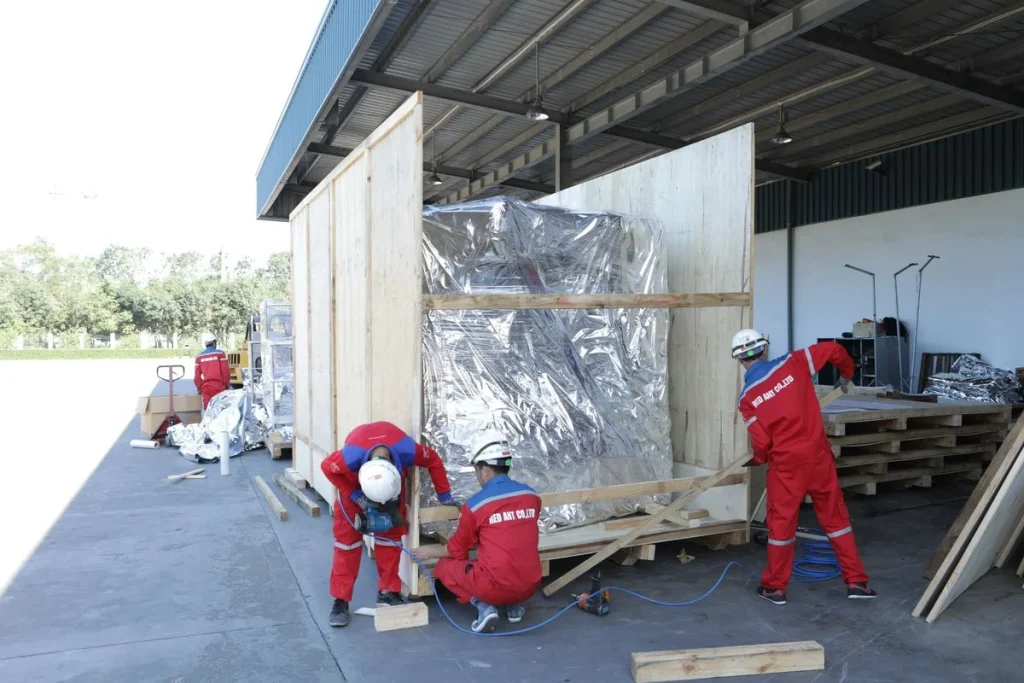
Packaging machines are often large, bulky, and sensitive to impact. Businesses must confirm the wooden crating, moisture-proofing, and internal container securing plan before loading. For multi-module packaging lines, a detailed item-by-item packing list (per crate) should be prepared to avoid confusion upon receipt. The forwarder will book FCL or LCL depending on cargo volume and issue a Bill of Lading after loading is complete.
Step 4: Receive the Arrival Notice and Open the Customs Declaration
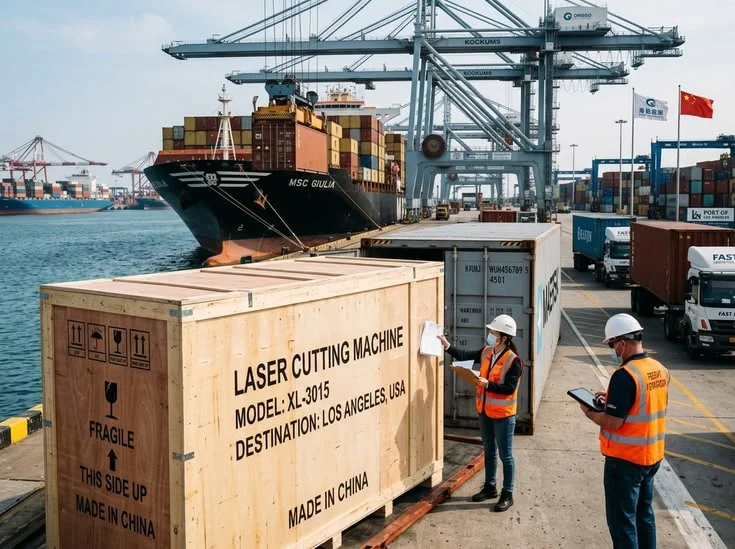
When the vessel arrives at a Vietnamese port (Hai Phong, Cat Lai, Da Nang, etc.), the forwarder receives the Arrival Notice from the shipping line and opens the electronic customs declaration on VNACCS. Machinery and equipment cargo is typically classified under the Yellow channel (document review) or the Red channel (physical inspection). Used packaging machines are mandatorily placed in the Red channel due to the required sector-specific inspection.
Step 5: Transfer Goods to Storage Warehouse and Register for Inspection
Customs permits used packaging machines to be transferred to a bonded storage warehouse while awaiting inspection. As soon as the goods arrive at the warehouse, the business must register with a technical inspection organization designated by the Ministry of Science and Technology (Vinacontrol, Quatest 1/2/3, TÜV Rheinland Vietnam, etc.). The deadline for submitting the inspection certificate to Customs is a maximum of 30 days from the date goods arrive at the warehouse – if this deadline is missed, Customs may order re-export.
Step 6: Customs Clearance, Tax Payment, and Cargo Collection
Once the documentation is complete (and the inspection certificate is satisfactory for used machines), Customs confirms the tax obligations and grants clearance authorization. The business pays the import duty and VAT, obtains the Delivery Order (D/O) from the shipping line, and transports the packaging machine to the installation warehouse or factory.
5. Special Conditions for Importing Used Packaging Machines
If a business opts to purchase a used packaging machine to reduce capital expenditure, it must be fully aware of the three mandatory criteria under Article 6, Decision 18/2019/QĐ-TTg:
- Machine age must not exceed 10 years from the year of manufacture to the year of import – packaging machines manufactured in 2015 or earlier (as of 2025) do not meet the standard import eligibility requirements.
- Remaining performance must be at least 85% of the original manufacturer’s design specifications, as determined through a physical technical inspection – a machine that operates does not necessarily meet this criterion.
- Energy consumption must not exceed 15% above the original design specifications – the manufacturer’s original catalogue is required for the inspector to cross-reference.
Practical insight from 3W Logistics: In over 10 years of handling machinery and equipment imports, we have observed that used packaging machines from China are the group most frequently encountering issues at the inspection stage – not because the machines fail to meet the criteria, but because nameplates have faded or been painted over during refurbishment prior to sale. Without a legible nameplate, the inspector has no basis for determining the year of manufacture, the certificate cannot be issued, and Customs refuses clearance. The shipment is forced into re-export. The business loses both the cost of the goods and logistics expenses. Requiring the supplier to photograph the nameplate clearly before loading is a step that must never be skipped. – Ms. Apple, CCO, 3W Logistics
6. How to Calculate Import Duties on Packaging Machines
To plan finances accurately, businesses need a clear understanding of the tax calculation formula. The following example uses an automated packaging machine imported from China with a CIF value of USD 50,000, HS code 8422.30, and an ACFTA duty rate of 0%:
| Tax Item | Without C/O Form E (ACFTA) | With C/O Form E (ACFTA) |
|---|---|---|
| CIF Value | USD 50,000 | USD 50,000 |
| Import Duty | 10% × 50,000 = USD 5,000 | 0% × 50,000 = USD 0 |
| VAT (10%) | 10% × 55,000 = USD 5,500 (~VND 145 million) | 10% × 50,000 = USD 5,000 (~VND 127 million) |
| Total Tax Payable | USD 10,500 | USD 5,000 |
In the example above, the import duty on packaging machines from China is already 0% under ACFTA – the mandatory cost is the 10% VAT. However, for HS codes with higher MFN rates (5–10%), C/O Form E remains a significant cost-saving factor. Businesses can claim a VAT input credit refund after the machine is placed into taxable commercial production.
7. Common Risks in Packaging Machine Import Procedures
| Risk | How It Manifests | Prevention Measures |
|---|---|---|
| Incorrect HS Code Declaration | Customs discovers a misclassification – tax shortfall is recovered, administrative penalties are issued, and customs clearance is prolonged | Consult an experienced freight forwarder or submit a formal advance ruling request to the Customs Department before filing the declaration |
| Missing or Invalid C/O | MFN duty rate applied instead of FTA rate; or C/O rejected by Customs due to information not matching the Invoice or B/L | Request C/O at the contract negotiation stage; carefully verify the C/O before accepting – ensure 100% consistency with the Invoice and B/L |
| Used Machine Fails Inspection | Machine age exceeds 10 years, remaining performance below 85%, or nameplate is faded or missing – Customs refuses clearance and orders re-export | Thoroughly verify year of manufacture and nameplate condition before signing the contract; require a test-run video before loading |
| Damage Due to Inadequate Transport Packaging | Multi-module packaging line machines are prone to shifting or electronic component damage if packaging does not meet standards | Require wooden crating, moisture-proofing, and secure internal bracing; photograph before crating; purchase comprehensive cargo insurance |
| Customs Value Adjustment | Customs suspects the declared value is below the actual transaction value – requests additional supporting evidence and prolongs the inspection process | Declare the actual transaction value correctly; have supporting documents ready in advance (L/C, payment records) in case they are requested |
FAQ – Frequently Asked Questions About Packaging Machine Import Procedures
Question 1: Does importing a new packaging machine require advance permission?
New packaging machines (unused) do not require advance import permits. Businesses simply file an electronic customs declaration on VNACCS, submit a complete set of commercial documents, and pay the applicable taxes to proceed with customs clearance. However, it is important to correctly identify the HS code and prepare an FTA C/O to benefit from preferential duty rates.
Question 2: Are used packaging machines permitted for import?
Yes, provided the machine fully meets the criteria set out in Article 6 of Decision 18/2019/QĐ-TTg: the machine age must not exceed 10 years from the year of manufacture, remaining performance must be at least 85% of original design specifications, energy consumption must not exceed 15% above the original design, and a technical inspection certificate from an organization designated by the Ministry of Science and Technology is required.
Question 3: What is the HS code for packaging machines?
Packaging machines fall primarily under heading 8422 of Chapter 84, specifically 8422.30 (filling, closing, sealing, labelling, and packaging machines for bottles, bags, etc.) and 8422.40 (other packing or wrapping machinery). However, depending on the specific construction and operating principle, the applicable HS code may differ. Businesses should consult a specialist before filing a declaration.
Question 4: What are the import duties on packaging machines?
Most HS codes for packaging machines under heading 8422 carry an MFN rate of 0%, meaning import duty is zero even without an FTA C/O. The mandatory payment is VAT of 8–10% calculated on the CIF value. For HS codes with higher MFN rates, an FTA C/O can deliver significant cost savings.
Question 5: How long do packaging machine import procedures take?
For new machines, the entire process from port arrival to customs clearance typically takes 3–7 working days if documentation is complete and the shipment is assigned to the Yellow channel. For used machines, an additional 15–25 days are required for the technical inspection – bringing the total time from port arrival to clearance to potentially 20–30 days.
How Does 3W Logistics Support Packaging Machine Import Procedures?
As a freight forwarding company registered as an OTI-NVOCC with an FMC Bond (Federal Maritime Commission) in the US and with over 10 years of experience handling machinery and equipment imports, 3W Logistics provides end-to-end services for businesses regarding packaging machine import procedures – from pre-contract consultation through to delivery at the installation warehouse or factory.
- HS code and import condition consulting before ordering: Accurately identify the HS code for each type of packaging machine, verify eligibility conditions for used machines under Decision 18/2019, and calculate actual tax costs – so businesses have a complete cost picture before negotiating prices with suppliers.
- C/O procurement support from the supplier: Guide and remind the supplier to obtain a C/O in the correct FTA format; verify the C/O before acceptance to ensure 100% consistency with the Invoice and B/L – preventing the risk of Customs rejection.
- Vessel booking and freight from the port of export to Vietnam: Arrange FCL or LCL shipments depending on cargo volume, from ports in China, Japan, South Korea, and Europe to Hai Phong, Da Nang, and Cat Lai (Ho Chi Minh City).
- Technical inspection coordination (for used machines): Connect businesses with the appropriate inspection organization, assist in preparing documentation, and monitor progress to ensure the inspection certificate is issued within the mandatory 30-day window.
- Electronic customs declaration (VNACCS): A professional team handles the import declaration for packaging machines, monitors the customs channel, and resolves any requirements raised by Customs as quickly as possible.
- Domestic transport to warehouse or factory: Arrange appropriate transport vehicles for the machine’s dimensions, including oversized cargo trucks, cranes, and installation teams if needed – ensuring the packaging machine arrives safely and on schedule.
Why choose 3W Logistics for your packaging machine import? We don’t just book vessels – we advise from the HS code identification stage, assist in obtaining the correct C/O, coordinate technical inspections for used machines, and handle Red channel processing during physical Customs inspections. With over 10 years of experience processing hundreds of machinery and equipment shipments, we understand precisely where bottlenecks occur and how to resolve them to clear your cargo as quickly and cost-effectively as possible. Contact 3W before signing your purchase contract — that is when we can provide the most value to your business.
Address: 34 Bach Dang, Tan Son Hoa Ward, Ho Chi Minh City
Hotline: +84 28 3535 0087
____________________________
3W Logistics Hanoi Branch
Address: 81A Tran Quoc Toan, Cua Nam Ward, Hanoi
Hotline: +84 24 3202 0482
____________________________
3W Logistics Hai Phong Branch
Address: 8A Lot 28 Le Hong Phong, Gia Vien Ward, Hai Phong
Hotline: +84 225 355 5939
____________________________
3W LOGISTICS CO., LTD – We here serve you there!
Email: quote@3w-logistics.com
Website: www.3w-logistics.com

Ms. Apple is the CCO (Chief Commercial Officer) at 3W Logistics, with over 10 years of experience in sales and business operations management.
At 3W Logistics, Ms. Apple is responsible for commercial strategy, corporate customer development, managing a team of more than 50 sales professionals, and improving business performance in the logistics sector.
With practical experience in sales management and market development, Ms. Apple shares professional insights on business logistics solutions, international transportation, freight forwarding, customer management, trade lane development, and growth strategies in the logistics industry.


