
Import procedures for used machinery from China are considered quite complex but remain a popular choice among many Vietnamese manufacturing companies due to lower investment costs compared to new equipment. However, this product category is also subject to the strictest technical controls under customs law.
Under Decision 18/2019/QĐ-TTg, used machinery must simultaneously meet three criteria: equipment age (no more than 10 years), remaining performance (at least 85%), and energy consumption levels. A technical inspection certificate from an organization designated by the Ministry of Science and Technology is also mandatory.
This process applies to all enterprises importing used machinery through official channels, and is especially important for goods of Chinese origin – where the C/O Form E criteria directly determines the applicable import tax rate.
1. Conditions for Used Machinery Imported from China to Be Permitted
Not all machines are eligible for import. Before negotiating prices or booking shipments, businesses must carefully verify that the machinery they intend to purchase meets Vietnam’s legal requirements. If goods have already arrived at the port but fail to comply, the consequence is re-export or destruction – with all resulting costs borne by the importer.
Mandatory Criteria Under Decision 18/2019/QĐ-TTg
Article 6 of Decision 18/2019/QĐ-TTg stipulates that used machinery and equipment permitted for import must simultaneously satisfy all of the following conditions:
- Equipment age must not exceed 10 years, calculated from the year of manufacture to the year of import. This is the first and strictest criterion – machinery manufactured in 2014 or earlier (as of 2025) will not meet the standard conditions for import.
- Remaining performance of at least 85% compared to the manufacturer’s original design, as determined through actual technical inspection.
- Energy consumption must not exceed 15% above the original design specifications – this criterion is particularly important for electrical machinery and energy-intensive industrial equipment.
- Must not be on the prohibited import list – meaning the equipment must not be a device that exporting countries have publicly declared obsolete, environmentally polluting, or unsafe for workers.
- Must meet applicable technical standards – conforming to QCVN (Vietnam National Technical Regulations), or to the standards of G7 countries or South Korea if no corresponding QCVN exists.
Categories of Used Machinery from China That Are Not Permitted for Import
| Prohibited Case | Legal Basis | Practical Notes |
|---|---|---|
| Equipment age over 10 years | Article 6, Decision 18/2019 | There is a special exemption mechanism under Article 9, but it is complex and approval is not guaranteed |
| Remaining performance below 85% | Article 6, Decision 18/2019 | Determined through actual inspection – a machine that runs does not necessarily meet 85% performance per design specs |
| Machinery declared obsolete by China | Article 4, Decision 18/2019 | China periodically publishes lists of obsolete technologies – these must be checked before purchasing |
| Year of manufacture cannot be proven | Article 10, Decision 18/2019 | Faded or missing nameplates are the most common reason goods are held up – take photos of the nameplate before loading |
| Energy consumption exceeds 15% | Article 6, Decision 18/2019 | Strictly applied to high-capacity electrical equipment – original manufacturer catalogs are needed for reference |
Important note on equipment age: Decision 18 calculates equipment age based on the year of manufacture, not the year of purchase or first use. A machine manufactured in 2014 but brand new and still in its original packaging is still considered 11 years old in 2025 and does not meet the standard import conditions. This is a common mistake businesses make when purchasing “stockpiled” goods from China.
Looking Up HS Codes for Imported Used Machinery
Importing used machinery from China to Vietnam is a fairly complex area, largely governed by Decision No. 18/2019/QĐ-TTg (which requires used machinery to have an equipment age of no more than 10 years).
Below is a summary table of the most common HS code groups for used machinery and equipment typically imported from China. These groups are mainly found in Chapter 84 and Chapter 85 of the Import-Export Tariff Schedule.
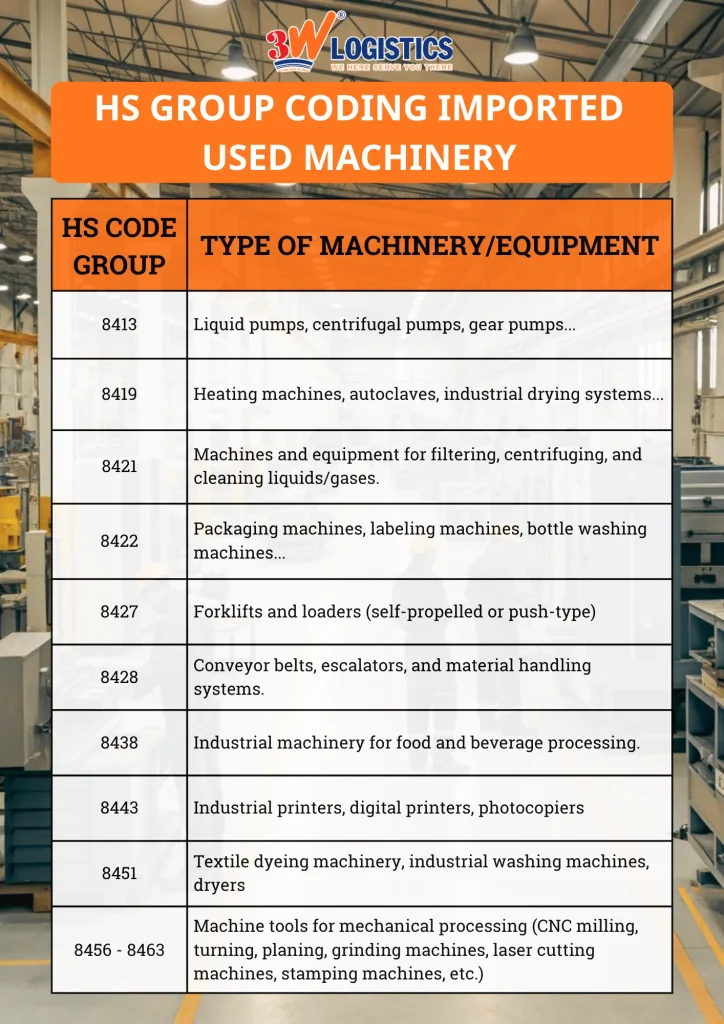
In addition, each type of machinery with different intended uses will have a different HS code – do not guess the HS code based solely on the product name. Official lookup tools include:
- Vietnam General Department of Customs: customs.gov.vn – search by name or code
- VNACCS/VCIS System: Direct lookup when filing electronic declarations
- HS Classification Consultation: Businesses can submit a written request to the Provincial/Municipal Customs Department for HS code confirmation before shipment to avoid future disputes
- HS Code Lookup System: https://caselaw.vn/tra-cuu-ma-hs – search by name or code
Note: Declaring an incorrect HS code may result in back-taxes, goods being held pending reclassification, and increased storage costs. If unsure, businesses can submit a written request for advance HS determination to the General Department of Customs.
2. Documents Required for Used Machinery Import Procedures
The import documentation set for used machinery from China consists of two groups: commercial documents prepared before goods are loaded, and specialized documents that arise after goods arrive at the port. Missing any document will result in delayed customs clearance or detained goods.
| Document | When to Prepare | Important Notes |
|---|---|---|
| Sales Contract | Before deposit payment | Clearly state year of manufacture, model, machine condition, Incoterms, and responsibility for obtaining C/O |
| Commercial Invoice | Before goods are exported | Goods description, HS code, and value must be consistent with the Packing List and C/O — any discrepancy will result in C/O rejection |
| Packing List | Before goods are exported | Clearly state weight, dimensions, number of packages — especially important for oversized and overweight machinery |
| Bill of Lading / AWB | After goods are loaded on vessel | Consignee information and destination port must exactly match the customs declaration |
| C/O Form E (ACFTA) | Before goods are exported (supplier applies) | Determines import tax rate: 0% vs. 5–20% – must request the supplier to obtain C/O from the outset |
| Catalog / Technical Documentation | Before goods are exported | Original manufacturer documentation showing design specifications – needed for inspection and verifying the 85% performance criterion |
| Copy of Business Registration Certificate (stamped) | When registering customs declaration | Mandatory under Article 8 of Decision 18/2019 – proves legal entity status of the importing enterprise |
| Inspection Registration Form | When goods arrive at port | Submit to an inspection organization designated by the Ministry of Science and Technology – can register in advance to reduce waiting time |
| Technical Inspection Certificate | Within 30 days after goods are placed in storage | The most critical document specific to used machinery – customs will not clear goods if this is missing or if the result is unsatisfactory |
| Electronic Customs Declaration (VNACCS) | When all documents are ready | Filed through the VNACCS system – HS code must be accurate; an incorrect HS code is the most serious error in customs declaration |
3. Step-by-Step Import Procedures for Used Machinery from China
Step 1: Check eligibility conditions and determine HS code before purchasing
Before signing a contract with a Chinese supplier, businesses must verify that the machinery meets the conditions of Decision 18/2019 – particularly the year of manufacture and technical condition. At the same time, accurately identify the HS code (Chapter 84 or 85) to calculate taxes and check sector-specific management policies. Skipping this step risks purchasing machinery that is ineligible for import.
Step 2: Sign contract and request C/O Form E
When negotiating the contract, businesses must require the Chinese supplier to provide a C/O Form E (ACFTA Certificate of Origin) as a contractual term from the outset. This is the “key” that reduces the import tax rate to 0% instead of 5–20% under MFN rates. Additionally, request that the supplier provide the original catalog, photos of the nameplate showing the year of manufacture, and complete technical documentation.
Step 3: Deposit, packaging, and transportation
After the contract is signed, the supplier proceeds with preparing the goods. For bulky machinery, businesses must confirm the packaging method (wooden crate, moisture protection, impact protection) and appropriate mode of transport – typically FCL (full container load) for large machinery or LCL (less than container load) for smaller equipment. The freight forwarder will book the vessel and issue a B/L after the goods are loaded at the Chinese port (Shanghai, Guangzhou, Shenzhen, Qingdao, etc.).
Step 4: Receive arrival notice and open customs declaration
When the vessel arrives at a Vietnamese port (Hai Phong, Cat Lai, Da Nang, etc.), the business or forwarder receives an Arrival Notice from the shipping line and proceeds to file an electronic customs declaration on the VNACCS system. Used machinery shipments will always be directed to the yellow or red lane – never the green lane – due to the mandatory specialized inspection requirements.
Step 5: Move goods to storage warehouse and register for inspection
Customs allows businesses to move goods to a storage warehouse while awaiting inspection results. As soon as the goods are in the warehouse, the business must register for inspection with an organization designated by the Ministry of Science and Technology (Vinacontrol, Quatest 1/2/3, TÜV Rheinland Vietnam, etc.). The deadline for submitting the inspection certificate to customs is a maximum of 30 days from the date goods are placed in storage.
Step 6: Technical inspection and receipt of certificate
The inspection organization conducts an actual examination of the machinery: determining the year of manufacture via nameplate and documents, measuring operational performance, checking energy consumption levels, and assessing the overall technical condition. If all criteria are met, the inspection organization issues a Satisfactory Technical Inspection Certificate. If the criteria are not met, the goods must be re-exported or destroyed as required.
Step 7: Submit inspection certificate, clear customs, and take delivery
After obtaining a satisfactory inspection certificate, the business submits it to customs to complete the process. Customs reviews the complete file, confirms tax obligations (import duty + VAT), and issues a customs clearance declaration. The business pays taxes, receives a Delivery Order (D/O) from the shipping line, and transports the machinery to the production facility.
4. How to Calculate Import Tax on Used Machinery from China
This is an area many businesses overlook when drawing up financial plans, leading to surprises about actual costs. The import tax structure for used machinery from China consists of two main types of tax, and the difference between “with C/O” and “without C/O” can amount to tens of millions of VND per shipment.
Applicable Tax Structure
Import duty is calculated on the CIF value (goods value + freight + insurance) at three different tax rates depending on origin and documentation:
- MFN Tax (Most Favored Nation) – applied when a standard C/O is presented or when no C/O is available, typically ranging from 0–20% depending on HS codes in Chapters 84–85. This is the “default” rate if the business fails to provide a valid C/O Form E.
- ACFTA Tax (C/O Form E) – applied when a valid C/O Form E is presented under the ASEAN–China Free Trade Agreement. The vast majority of machinery HS codes in Chapters 84–85 qualify for a 0% import duty with C/O Form E.
- VAT (Value Added Tax) – calculated on (CIF Value + Import Duty), typically 8–10% depending on the Government’s VAT reduction policy at the time.
Specific Tax Calculation Example
Suppose a business imports a used CNC machine from China with a CIF value of USD 200,000 (approximately VND 5 billion), HS code 8457.10.00 (machining centers for working metal), MFN duty 5%, ACFTA duty 0%:
| Tax Item | Without C/O Form E (MFN 5%) | With C/O Form E (ACFTA 0%) |
|---|---|---|
| CIF Value | USD 200,000 | USD 200,000 |
| Import Duty | 5% × 200,000 = USD 10,000 | 0% × 200,000 = USD 0 |
| VAT (10%) | 10% × (200,000 + 10,000) = USD 21,000 | 10% × (200,000 + 0) = USD 20,000 |
| Total Tax Payable | USD 31,000 (~VND 790 million) | USD 20,000 (~VND 510 million) |
| Savings with C/O Form E | USD 11,000 (~VND 280 million) – from just one C/O document obtained free of charge from the supplier | |
From the practical experience of 3W Logistics: In over 60% of used machinery shipments we handled last year, clients initially did not request C/O Form E from their Chinese suppliers – simply because they were unaware of it or hadn’t thought about it. Once goods have left the port of origin, supplementary C/O cannot be obtained. One phone call asking the supplier to apply for C/O before loading can save hundreds of millions of VND in taxes on a high-value machinery shipment. – Ms. Apple, CCO, 3W Logistics
5. Used Machinery Inspection Process
Technical inspection is the single biggest differentiator between import procedures for used machinery versus new machinery. It is also the step most prone to complications if not carefully prepared. Many businesses only learn of the inspection requirement after goods have arrived at port – by then, dealing with any complications incurs additional container detention costs and delays.
Who Is Authorized to Conduct Inspections?
Only inspection organizations designated by the Ministry of Science and Technology have the authority to issue valid Technical Inspection Certificates for customs purposes. The list of designated inspection organizations is periodically published and updated by the Ministry. Commonly used organizations in Vietnam include Vinacontrol, Quatest 1 (Hanoi), Quatest 2 (Da Nang), Quatest 3 (Ho Chi Minh City), TÜV Rheinland Vietnam, and certain designated international organizations.
Inspection at Country of Export or in Vietnam?
Under regulations, individual pieces of machinery and equipment may be inspected in Vietnam after goods arrive at port. However, for technological production lines, inspection must be carried out at the country of export while the line is in operational condition. For individual machinery from China, many businesses proactively invite inspectors to China before loading to identify issues early – though this is not mandatory, it is an effective risk prevention measure.
Common Inspection Complications
- Faded or missing nameplates: Decision 18 requires inspection certificates to include photographs of nameplates showing the year of manufacture. If the nameplate is torn, faded, or painted over, the inspector has no basis for determining the year of manufacture and cannot issue the certificate. Consequence: customs refuses clearance and requires re-export. Prevention: Require the supplier to take clear photographs of the machine’s nameplate before packaging and loading – if the nameplate is faded, request the seller to re-engrave it or obtain official manufacturer confirmation.
- No original manufacturer catalog: Inspectors need original documentation to compare design specifications against actual measurements. Machinery with unclear branding or from small Chinese manufacturers with no English-language catalog creates significant difficulties.
- Performance below 85%: A machine that runs does not necessarily meet 85% performance per original design specs. Worn-out machinery with significant mechanical wear and actual productivity below original specifications will be assessed as non-compliant – resulting in customs refusing to clear the goods.
Forwarder perspective from 3W Logistics: We have witnessed numerous cases where machinery worth hundreds of millions to billions of VND was forced to be re-exported simply because the nameplate had been painted over during refurbishment prior to sale. Vietnamese buyers didn’t know; Chinese sellers didn’t say. When the inspector asked to photograph the nameplate, there was nothing to photograph – the certificate could not be issued. The only solution at that point was to re-export to China to clarify the origin, or obtain confirmation from the original manufacturer – if the manufacturer still existed. Check the nameplate before signing the purchase contract – this is a step that cannot be skipped. – Ms. Apple, CCO, 3W Logistics
6. Risks When Importing Used Machinery from China and How to Handle Them
Importing used machinery from China differs significantly from importing from Japan, Germany, or South Korea in that: the Chinese used machinery market is highly fragmented, with many layers of intermediaries and inconsistent quality control. Below are the specific risks and how to handle them, from the perspective of an experienced freight forwarder.
| Risk | How It Manifests | Prevention |
|---|---|---|
| Falsified year of manufacture | Seller states 2016 on the Invoice but the machine was actually manufactured in 2012 – discovered when the inspector checks the serial number | Require official manufacturer confirmation or look up the serial number directly with the original manufacturer before signing the contract |
| Refurbished machinery concealing damage | Freshly painted, rust removed, external parts replaced – looks good but core components are faulty; discovered after installation and operation | Request a video of a test run before loading; consider sending an engineer or inviting an inspector to carry out an on-site inspection |
| Invalid C/O Form E | Information on C/O does not match Invoice or B/L; customs rejects C/O – must pay MFN tax instead of ACFTA | Carefully review C/O before accepting goods; ensure the product name, quantity, and value on the C/O match 100% with the Invoice and B/L |
| Customs discovers incorrect HS code | Business declares an incorrect HS code to obtain a lower tax rate, or does so by mistake – results in heavy penalties and prolonged clearance time | Consult customs (advance ruling) or an experienced forwarder to accurately determine the HS code before making the declaration |
| Damage during transport | Used machinery is already worn; improper packaging causes further damage during transport – leading to insurance disputes | Require wooden crate packaging meeting standards, moisture protection, and secure bracing; purchase comprehensive cargo insurance; photograph condition before packaging |
7. Procedures for Obtaining Special Permits for Machinery Over 10 Years Old (Article 9)
An industry reality: many pieces of heavy industrial machinery – press brakes, stamping machines, large lathes, hydraulic presses – have a designed service life of 30–40 years and still operate well at 15–20 years of age. The 10-year rule in Decision 18 is sometimes inconsistent with the technical reality of certain equipment categories. To address this, Article 9 establishes a special exemption mechanism.
Conditions for Applying Under Article 9 of Decision 18/2019/QĐ-TTg
Businesses wishing to import used machinery over 10 years old must demonstrate two conditions: (1) the import is necessary to maintain production operations (cannot be replaced by new machinery or used machinery under 10 years old), and (2) the machinery has a remaining performance of over 85% and energy consumption does not exceed 15% above original design specifications.
Application Process
The business prepares a dossier and submits it directly to the Ministry of Science and Technology, along with an inspection certificate from a designated organization confirming the machinery meets technical criteria, and a written justification for the necessity of importing this type of machinery. The Ministry of Science and Technology reviews the application and responds in writing with approval or refusal. Processing time and outcome are not guaranteed – this is the greatest risk of this mechanism.
Practical insight from 3W Logistics: The Article 9 mechanism works but is not a quick path. The application dossier is complex, the waiting period sometimes stretches 2–3 months, and outcomes are not guaranteed. Businesses should carefully weigh the benefit of obtaining that particular machine against the time cost and uncertainty of the exemption process. In many cases, ordering equivalent machinery under 10 years old from another market (Japan, South Korea) is actually faster and more certain. – Ms. Apple, CCO, 3W Logistics
8. Actual Cost and Timeline Comparison for Importing Used Machinery from China
To draw up accurate financial plans and project schedules, businesses need a clear picture of actual cost milestones and timelines – not just the tax component, but the full scope of logistics and procedural costs that arise.
| Cost Item | Reference Cost Range | When It Arises |
|---|---|---|
| Ocean freight (FCL 20′) China–Vietnam | USD 800–2,000 depending on port and timing | When booking the vessel |
| Destination port charges (THC, D/O, port fees, etc.) | USD 150–400 depending on port and shipping line | When goods arrive at port |
| Used machinery inspection fee | VND 3–15 million depending on machine type and inspection organization | After goods arrive in storage warehouse |
| Customs declaration fee (forwarder) | VND 1–3 million per declaration | When opening the declaration |
| Import duty (ACFTA with C/O Form E) | 0% on CIF value (majority of HS codes in Chapters 84–85) | At customs clearance |
| VAT | 8–10% on (CIF Value + Import Duty) | At customs clearance (refundable for businesses with valid invoices in production/trading activities) |
| Container detention fee (if prolonged) | USD 30–100 per container per day after free time | Arises when inspection is delayed or waiting for the certificate |
Total process timeline (from when goods leave the Chinese port to when machinery arrives at the factory) typically takes 25–45 working days, broken down as: sea transit time 5–10 days, customs clearance and inspection procedures 15–25 days (provided documents are complete and inspection is straightforward), and domestic transport 1–3 days.
FAQ – Frequently Asked Questions About Importing Used Machinery from China
Q1: Is used machinery from China permitted for import into Vietnam?
Yes, used machinery from China is permitted for import into Vietnam provided it fully meets the criteria in Article 6 of Decision 18/2019/QĐ-TTg: equipment age not exceeding 10 years from the year of manufacture to the year of import, remaining performance of at least 85% compared to the original design, energy consumption not exceeding 15% above design specifications, and not appearing on the prohibited import list. Certain categories of machinery, such as construction equipment, are subject to separate age regulations.
Q2: Where is the inspection of imported used machinery conducted, and how long does it take?
Inspections of imported used machinery are carried out by inspection organizations designated by the Ministry of Science and Technology (such as Vinacontrol, Quatest, TÜV Rheinland, etc.). Inspection may be conducted at the country of export (before goods are loaded) or in Vietnam after goods arrive at port. The deadline for submitting the inspection certificate to customs is a maximum of 30 days from the date goods are placed in storage. Actual inspection time ranges from 3–10 working days depending on machine type and the inspection organization.
Q3: What is the import duty rate for used machinery from China?
The import duty on used machinery from China depends on the HS code and type of C/O. Without a C/O, the MFN (WTO preferential) duty typically ranges from 0–20% depending on the HS code. With a valid C/O Form E (under the ACFTA agreement), the vast majority of machinery HS codes in Chapters 84–85 qualify for a 0% import duty. VAT of 8–10% is also applicable, calculated on the CIF value plus import duty. The presence or absence of C/O Form E can create a very significant cost difference in duties for a high-value machinery shipment.
Q4: Is there any way to import used machinery that is over 10 years old?
Under Article 9 of Decision 18/2019/QĐ-TTg, businesses may prepare a dossier and submit it directly to the Ministry of Science and Technology to apply for an exceptional import permit, provided they can demonstrate that the import is necessary to maintain production, and that despite its age, the machinery has remaining performance above 85% and energy consumption within 15% of original design specifications. This is a special exemption procedure with a complex dossier, a processing time of 2–3 months, and no guarantee of approval.
Q5: What documents are required to import used machinery from China?
The documentation set for importing used machinery from China includes: Sales Contract; Commercial Invoice; Packing List; Bill of Lading or Airway Bill; C/O Form E (if preferential ACFTA tax is desired); a stamped copy of the Business Registration Certificate; an inspection registration form with a Ministry of Science and Technology-designated organization; a satisfactory Technical Inspection Certificate; the machine’s catalog/technical documentation; and an electronic customs declaration filed through the VNACCS system.
Q6: Why are many used machinery shipments held up at port or forced to re-export?
The most common causes include: equipment age exceeding 10 years; inability to prove the year of manufacture due to faded or missing nameplates; failed inspection – remaining performance below 85% or energy consumption exceeding 15%; an invalid C/O Form E where information does not match the Invoice or B/L; incorrect HS code declaration; or machinery appearing on the prohibited import list. Thorough pre-loading checks and preparation of complete documentation are the most effective preventative measures.
Q7: What role does a freight forwarder play in the used machinery import process from China?
A freight forwarder plays a role throughout the entire process: advising on import conditions and checking whether the machinery is eligible; booking vessels and arranging transport from Chinese ports to Vietnam; assisting in obtaining C/O Form E from the supplier; coordinating with the inspection organization; filing electronic customs declarations on VNACCS; assisting in resolving physical examination requests from customs; and handling clearance procedures and delivery to the warehouse. Choosing a forwarder with experience in used machinery from China significantly reduces risks and saves considerable time.
How Does 3W Logistics Support Used Machinery Imports from China?
As a freight forwarding company registered as an OTI-NVOCC with FMC bond (Federal Maritime Commission) in the United States with over 10 years of experience handling sea freight import and export, 3W Logistics provides an end-to-end service for businesses importing used machinery from China — from pre-purchase consultation to delivery at the production facility.
- Pre-contract eligibility consultation: Checking whether the machinery intended for purchase meets the criteria of Decision 18/2019, accurately identifying the HS code, and calculating actual tax costs – so businesses have complete figures before negotiating price with the Chinese supplier.
- Assistance obtaining C/O Form E from the supplier: Guiding and reminding Chinese suppliers to obtain a compliant C/O Form E, and reviewing the C/O before acceptance to ensure information matches 100% with the Invoice and B/L – avoiding the risk of C/O rejection by customs.
- Vessel booking and transport from China: Arranging FCL or LCL transport from major Chinese ports (Shanghai, Guangzhou, Shenzhen, Qingdao, Ningbo, etc.) to Vietnamese ports (Hai Phong, Da Nang, Cat Lai Ho Chi Minh City).
- Coordination with inspection organizations: Connecting businesses with an appropriate inspection organization, supporting preparation of inspection documentation, and monitoring the process to ensure the certificate is issued within the 30-day deadline.
- Electronic customs declaration (VNACCS): A professional customs declaration team handles import declarations, verifies HS codes, and monitors clearance status – minimizing processing time when customs requests additional information.
- Handling yellow/red lane customs inspections: Used machinery shipments are always subject to physical inspection – 3W Logistics helps businesses prepare comprehensively and addresses any customs requirements as quickly as possible.
- Domestic transport from port to warehouse/factory: Arranging oversized and overweight vehicles, cranes, and specialized equipment appropriate to the size and weight of the machinery – particularly important for large industrial equipment.
Why choose 3W Logistics for your used machinery shipment from China? We don’t just book vessels – we accompany you from the pre-purchase eligibility check through to the moment machinery is running at your facility. With used machinery, knowing the procedural “bottlenecks” – nameplates, C/O Form E, inspection, HS codes – is what determines whether goods clear customs smoothly. That knowledge comes from hundreds of shipments handled in real-world practice. Contact 3W for consultation before signing your machinery purchase contract.
Address: 34 Bach Dang Street, Tan Son Hoa Ward, Ho Chi Minh City
Hotline: +84 28 3535 0087
____________________________
3W Logistics Hanoi Branch
Address: 81A Tran Quoc Toan Street, Cua Nam Ward, Hanoi
Hotline: +84 24 3202 0482
____________________________
3W Logistics Hai Phong Branch
Address: 8A Lot 28 Le Hong Phong Street, Gia Vien Ward, Hai Phong
Hotline: +84 225 355 5939
____________________________
3W LOGISTICS CO., LTD – We here serve you there!
Email: quote@3w-logistics.com
Website: www.3w-logistics.com

Ms. Apple is the CCO (Chief Commercial Officer) at 3W Logistics, with over 10 years of experience in sales and business operations management.
At 3W Logistics, Ms. Apple is responsible for commercial strategy, corporate customer development, managing a team of more than 50 sales professionals, and improving business performance in the logistics sector.
With practical experience in sales management and market development, Ms. Apple shares professional insights on business logistics solutions, international transportation, freight forwarding, customer management, trade lane development, and growth strategies in the logistics industry.


