

Importing lithium batteries is a growing need for businesses manufacturing electronics, electric vehicles, medical devices, and energy storage systems in Vietnam. However, it is also the commodity group with the most complex and distinctive lithium battery import procedures in the logistics industry because lithium batteries are classified as Dangerous Goods (DG) under international transport standards, and are simultaneously subject to mandatory quality inspection at Vietnamese ports of entry.
Many businesses only begin researching lithium battery import procedures after a shipment has already been refused by the carrier at the origin port due to missing dangerous goods declarations, or after cargo arrives at port and is held due to missing conformity certification. Both situations result in serious schedule delays and unnecessary additional costs.
In this article, 3W Logistics presents the complete lithium battery import procedure process under current regulations from dangerous goods classification, transport conditions, conformity certification, HS codes, and tax calculations to the most common real-world risks, as seen from a freight forwarder with over 10 years of experience handling dangerous goods imports.
1. What Factors Affect Lithium Battery Import Procedures?
There are fundamental facts businesses must understand before taking any step in the lithium battery import procedure. Lithium batteries are classified as dangerous goods across all three international transport modes:
- Sea freight: Class 9 – Miscellaneous Dangerous Goods, under the IMDG Code (International Maritime Dangerous Goods Code). Specific UN Numbers:
- UN 3480: Lithium ion batteries (transported standalone, not installed in equipment)
- UN 3481: Lithium ion batteries installed in or packed with equipment
- UN 3090: Lithium metal batteries (transported standalone)
- UN 3091: Lithium metal batteries installed in or packed with equipment
- Air freight: Governed by IATA Dangerous Goods Regulations (DGR) – significantly stricter than sea freight; many types of lithium batteries are completely prohibited on passenger aircraft and are only permitted on cargo-only aircraft under strict conditions.
- Domestic road transport: After customs clearance, domestic transport must comply with Decree 42/2020/ND-CP on the transport of dangerous goods by road motor vehicles.
The direct consequence for lithium battery import procedures: the freight forwarder handling these shipments must hold a Dangerous Goods Agent (DG Agent) certification, cargo must be packaged to UN packaging standards, a complete Dangerous Goods Declaration (DGD) is required, and the carrier must confirm acceptance of this cargo type before booking. This is a requirement many smaller forwarders cannot meet.
2. Mandatory Requirements in Vietnam’s Lithium Battery Import Procedures
In addition to dangerous goods transport requirements, lithium battery import procedures in Vietnam also require mandatory conformity certification under regulations of the Ministry of Science and Technology.
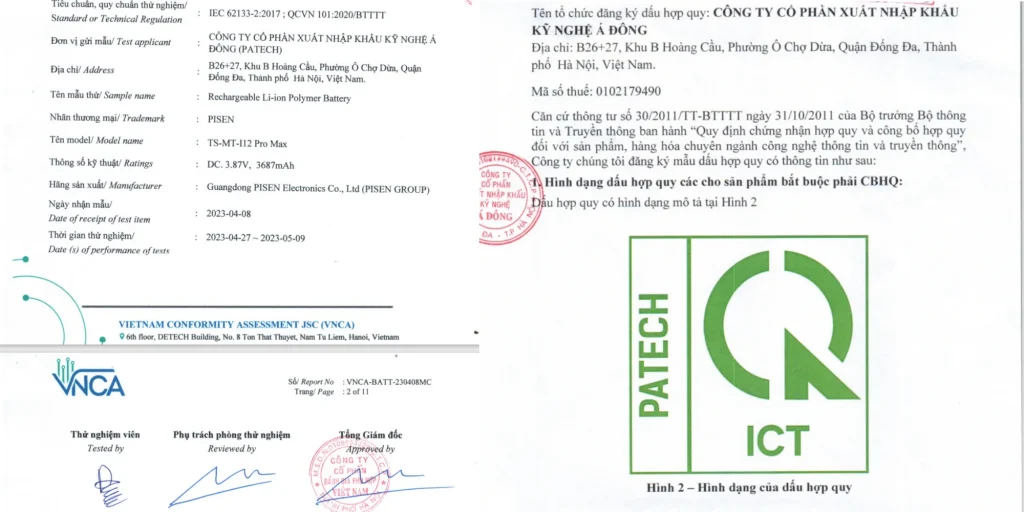
Lithium batteries (lithium accumulators, lithium-ion rechargeable batteries, lithium polymer batteries) fall under the category of products and goods capable of causing unsafe conditions under Circular 28/2012/TT-BKHCN and its amendments, requiring:
- Conformity certification (CR) under QCVN 4:2009/BKHCN (Batteries and Accumulators) or the applicable regulation in force at the time of import, conducted by a certification body designated by the Ministry of Science and Technology.
- Conformity declaration filed with the provincial/city Department of Science and Technology before the product is permitted to circulate on the market.
- Affixing the CR conformity mark to the product or packaging before it enters the market.
- State quality inspection at the port of entry – customs will require conformity documentation before granting clearance.
Note on lithium batteries used inside devices: For lithium batteries imported together with electronic devices (pre-installed in laptops, mobile phones, tablets, etc.), the conformity certification requirement may be integrated into the conformity documentation for the entire device rather than the battery alone but this must be confirmed specifically with the certification body on a case-by-case basis. For lithium batteries imported standalone (not bundled with devices) for assembly, replacement, or independent distribution, the full conformity certification requirement for the battery applies without exception in the lithium battery import procedure.
3. HS Codes and Import Duties for Lithium Batteries
Correctly identifying the HS code is a non-negotiable step in the lithium battery import procedure. Lithium batteries are primarily found in Chapter 85 of the import-export tariff schedule – Electrical machinery and equipment and parts thereof.
- HS Code Lithium batteries for laptops and tablets: 8507.60.10
- HS Code Lithium batteries for mobile phones: 8507.60.20
- HS Code Lithium batteries for electric motorcycles or electric bicycles: 8507.60.31
- HS Code Lithium batteries for electric automobiles: 8507.60.32
- HS Code Power banks containing lithium batteries: 8507.60.90
HS code classification note: The boundary between “lithium batteries” (8507), “battery chargers” (8504), and “electrical energy storage devices” can cause classification confusion, particularly for integrated BESS systems. An incorrect HS code declaration in the lithium battery import procedure not only results in back taxes but can also prompt customs to request additional conformity documentation under a different chapter, causing serious delays. Consult an experienced forwarder or request an advance ruling from the Customs Department before filing.
Lithium Battery Import Duty Rates by Country of Origin
| Country of Origin | Applicable C/O | Import Duty | Notes |
|---|---|---|---|
| China | C/O Form E (ACFTA) | 0% | World’s largest lithium battery manufacturer; most HS 8507 codes reach 0% with a valid C/O Form E |
| South Korea | C/O Form KV (VKFTA) | 0% | Samsung SDI, LG Energy Solution — premium Korean batteries; 0% under VKFTA |
| Japan | C/O Form JV (VJEPA) | 0% | Panasonic, Murata — high-tech Japanese batteries; 0% under VJEPA |
| USA, EU, and other non-FTA countries | No FTA C/O | 0–5% (MFN) | Relatively low MFN duty on lithium batteries; plus 10% VAT calculated on CIF value plus import duty |
4. Required Documents for Lithium Battery Import Procedures
The documentation set for lithium battery import procedures is distinctive in that it consists of three parallel layers: standard commercial documents, dangerous goods documentation (DG documentation), and conformity certification documents. A deficiency in any one layer will result in the cargo being refused for transport or unable to clear customs.
| Document | When to Prepare | Important Notes |
|---|---|---|
| Conformity Certificate (CR) | Before cargo arrives at port | Mandatory under Ministry of Science and Technology regulations; can be processed based on samples sent in advance; testing and CR issuance typically takes 15–25 working days |
| Dangerous Goods Declaration (DGD) | Before cargo is loaded onto vessel / aircraft | Mandatory for every commercial lithium battery shipment; must correctly state the UN Number, technical name, Packing Group, net weight, and quantity; the person preparing the DGD must hold a DG Agent certification |
| UN testing certification / IEC 62133 or equivalent | Before vessel/aircraft booking | Many carriers require evidence that the battery has been safety-tested to UN standards, particularly for large shipments or high-capacity batteries |
| Sales Contract | Before deposit payment | Must clearly state battery chemistry, capacity (Wh/Ah), voltage, form factor, intended use, Incoterms, and the supplier’s obligation to provide C/O and DG documentation |
| Commercial Invoice & Packing List | Before cargo departs origin | Must clearly state the UN Number, battery type, and capacity in Wh – missing this information will result in refusal by both customs and the carrier |
| Bill of Lading (B/L) | After cargo is loaded | The B/L must fully reflect the UN Number, IMO Class 9, and the precise technical name – this is a mandatory IMDG requirement, not optional |
| C/O (Certificate of Origin) | Before cargo departs origin (supplier to apply) | Determines the applicable FTA duty rate; must be requested at the contract negotiation stage – cannot be supplemented after cargo leaves the origin port |
| Electronic customs declaration (VNACCS) | When full documentation is ready | Accurately declare the HS code, CR Certificate number, and dangerous goods information as required by the VNACCS system |
5. Step-by-Step Lithium Battery Import Procedure
Step 1: Identify the Battery Type and UN Number Before Placing an Order
Before signing a contract, the business must precisely identify the lithium battery type by chemistry (Li-ion, LiPo, LiFePO4, etc.), capacity (Wh), form factor (cylindrical, prismatic, pouch), and packaging arrangement (standalone, installed in equipment, or packed with equipment). This information determines the applicable UN Number, permitted transport modes, and specific packaging requirements. At the same time, identify the correct HS code for tax calculation and verify the required conformity certification – this is the foundation of the entire lithium battery import procedure.
Step 2: Send Sample for Testing and Obtain the Conformity Certificate (CR)
In parallel with contract negotiations, the business sends a battery sample to Vietnam for testing at a certification body designated by the Ministry of Science and Technology. Only after the sample passes testing and the CR Certificate is issued should the business place the main order – this is the most costly lesson that first-time lithium battery importers typically overlook. Testing and CR issuance typically takes 15–25 working days.
Step 3: Sign the Contract, Place the Order, and Request DG Documentation + C/O
Once the CR is in hand, the business signs the contract and simultaneously requires the supplier to prepare: the applicable FTA C/O, UN testing or IEC 62133 certification for the production lot, and packaging to UN packaging standards compliant with IMDG. All three requirements must be written into the contract terms at this stage – they cannot be requested after cargo has been loaded into the container.
Step 4: Prepare the DGD and Book a Carrier That Accepts Dangerous Goods
A DG Agent-certified forwarder prepares the complete Dangerous Goods Declaration (DGD) to IMDG standards and books with a carrier that accepts lithium battery shipments. Not every carrier accepts all types of lithium batteries – some refuse to carry high-capacity lithium batteries or batteries with an incident history. The forwarder must confirm acceptance before committing to a sailing schedule with the customer in the lithium battery import procedure.
Step 5: Customs Declaration and Specialized Inspection at the Port of Entry
When cargo arrives at port, the forwarder files the VNACCS customs declaration with full UN Number, battery type, Wh capacity, and CR Certificate number. Lithium battery imports are always assigned yellow or red channel – customs cross-references the dangerous goods information and conformity documentation. The quality inspection authority may take random samples for re-testing at a laboratory, particularly for the first shipment from a new supplier.
Step 6: Customs Clearance, Tax Payment, and Compliant Domestic Transport Under DG Regulations
After clearance, the business pays taxes and collects the D/O. An important note: transporting lithium batteries from port to warehouse/factory must comply with Decree 42/2020/ND-CP on road dangerous goods transport – vehicles must display dangerous goods placards and drivers must be trained accordingly. This is a step many businesses overlook once customs clearance has been completed.
6. How to Calculate Lithium Battery Import Taxes
A practical example: a shipment of lithium-ion battery packs (Li-ion packs) imported from China, CIF value USD 40,000, HS code 8507.60.90, MFN duty 5%, ACFTA duty 0%:
| Tax Item | Without C/O Form E (MFN 5%) | With C/O Form E (ACFTA 0%) |
|---|---|---|
| CIF Value | USD 40,000 | USD 40,000 |
| Import duty | 5% × 40,000 = USD 2,000 | 0% × 40,000 = USD 0 |
| VAT (10%) | 10% × (40,000 + 2,000) = USD 4,200 | 10% × (40,000 + 0) = USD 4,000 |
| Total tax payable | USD 6,200 (~VND 158 million) | USD 4,000 (~VND 102 million) |
| Savings with C/O Form E | USD 2,200 (~VND 56 million) — for businesses importing lithium batteries regularly for production, this figure accumulates very significantly over the course of a year. | |
From 3W Logistics’ practical experience: Lithium batteries are the commodity group where we most frequently see shipments held up at the origin port – not the destination port because the carrier discovers that the DGD states an incorrect UN Number or the packaging does not meet UN packaging standards. Specifically, a shipment of Li-ion packs for electric vehicles (UN 3480) was packed by the exporter to domestic standards rather than IMDG-compliant UN packaging – the carrier refused to load the cargo at Shenzhen port, the entire shipment had to be repacked from scratch in China, causing a 3-week delay and additional repackaging costs plus origin port storage fees. This mistake is entirely preventable by requiring the supplier to send packaging photos and a draft DGD for review before loading. – Ms. Apple, CCO, 3W Logistics
7. Common Risks in Lithium Battery Import Procedures
| Risk | How It Manifests | Prevention |
|---|---|---|
| Carrier refuses to load due to incorrect DGD or substandard packaging | Shipment refused at origin port – requires repackaging or DGD correction, 1–3 week delay, and origin port storage fees | Require the supplier to send packaging photos and a draft DGD before loading; DG Agent forwarder reviews and confirms compliance before cargo enters the container |
| Missing CR Certificate when cargo arrives at port | Customs refuses clearance – cargo held at port incurring container storage fees and potentially cold storage fees (for temperature-sensitive batteries); waiting for testing and CR issuance may take 3–5 weeks | Send sample for testing and receive the CR before placing the main order; do not sign high-volume contracts without the CR in hand |
| Incorrect UN Number or inaccurate technical description | Customs and inspection authority discover a discrepancy – shipment held for verification and may be penalized for dangerous goods regulation violations | Confirm the UN Number and technical specifications with the supplier before preparing the DGD; only use a DG Agent-certified forwarder to prepare and verify the DGD |
| Battery damage or fire/explosion during transport | Battery short-circuits inside the container due to improper packaging or severe impact – fire and explosion risk in the container; the carrier has the right to jettison the container overboard upon detection | Require a State of Charge (SoC) of ≤30% during transport; use IMDG-compliant UN packaging; purchase specialized cargo insurance for dangerous goods shipments |
| Violation of domestic transport regulations after clearance | Transporting lithium batteries in ordinary vehicles without DG permits results in traffic police fines and vehicle impoundment | Use a domestic carrier certified for dangerous goods transport under Decree 42/2020/ND-CP; ensure proper dangerous goods placards are affixed to the transport vehicle |
FAQ – Frequently Asked Questions About Lithium Battery Import Procedures
Question 1: What documents are required for lithium battery import procedures?
The complete documentation set for lithium battery import procedures includes: Conformity Certificate (CR); Dangerous Goods Declaration (DGD) compliant with IMDG standards; UN testing certification or IEC 62133; Sales Contract, Commercial Invoice (clearly stating UN Number and Wh capacity), Packing List; Bill of Lading with full dangerous goods information; C/O under the applicable FTA; and an electronic customs declaration via VNACCS.
Question 2: Can lithium batteries be transported by air freight?
Yes, but under very strict conditions per IATA DGR. High-capacity lithium batteries (above 100Wh per single cell or above 300Wh per battery pack) are only permitted on cargo-only aircraft and are prohibited on passenger aircraft. Smaller batteries are permitted on passenger aircraft subject to strict quantity limits and packaging requirements. Confirmation with the specific airline is required before booking in the lithium battery import procedure via air freight.
Question 3: Are imported lithium batteries required to have conformity certification?
Yes — mandatory for lithium batteries imported standalone (not pre-installed in devices). Batteries must be certified for conformity under the applicable national technical regulation issued by the Ministry of Science and Technology, conducted by a designated certification body. This is a non-negotiable requirement in Vietnam’s lithium battery import procedure.
Question 4: What are the UN Numbers for lithium batteries?
The UN Number for lithium batteries depends on the battery type and packaging arrangement: UN 3480 (Li-ion batteries transported standalone), UN 3481 (Li-ion batteries installed in or packed with equipment), UN 3090 (lithium metal batteries transported standalone), UN 3091 (lithium metal batteries installed in or packed with equipment). Correctly identifying the UN Number is the mandatory first step when preparing the DGD in the lithium battery import procedure.
Question 5: How long does the lithium battery import procedure take in total?
Total time from sending the sample for testing to cargo arriving at the warehouse is typically 45–60 days — comprising 15–25 days for testing and CR issuance, 5–7 days for the conformity declaration, plus production time and sea freight transit of 7–15 days depending on the trade lane. Lithium battery import procedures require significantly more lead time than ordinary goods.
How Does 3W Logistics Support Lithium Battery Import Procedures?
As a freight forwarding company registered as an OTI-NVOCC with an FMC Bond (Federal Maritime Commission) in the United States, with a team holding Dangerous Goods Agent certifications (IATA/IMDG) and over 10 years of experience handling dangerous goods imports, 3W Logistics provides end-to-end services for businesses navigating lithium battery import procedures – from classification consulting and DG documentation preparation to conformity certification coordination and delivery of batteries to the production warehouse.
- Battery classification consulting and UN Number identification before ordering: Accurately identify the UN Number by battery type and packaging arrangement; determine the correct HS code; verify which carriers accept the intended battery type and under what specific transport conditions.
- Conformity certification (CR) coordination support: Connect businesses with an appropriate certification body; track the testing and CR issuance process to ensure documentation is in place before the main shipment arrives at port.
- Preparation of IMDG/IATA-compliant Dangerous Goods Declarations (DGD): Certified DG Agent team prepares accurate DGDs; verifies the supplier’s UN packaging before loading; books with carriers that accept lithium battery shipments.
- Assistance obtaining FTA C/O from the supplier: Guide Chinese suppliers through the C/O Form E application, Korean suppliers through Form KV, and Japanese suppliers through Form JV; verify the C/O before acceptance to ensure 100% consistency with the Invoice and B/L.
- Electronic customs declaration (VNACCS) and specialized inspection handling: Accurately declare the HS code, UN Number, Wh capacity, and CR Certificate number; monitor channel assignment and coordinate rapid response when customs requests physical inspection or sample collection.
- Compliant domestic transport arrangements under DG regulations: Connect businesses with domestic carriers certified for dangerous goods transport under Decree 42/2020/ND-CP; ensure vehicles and domestic transport procedures comply with regulations from port to warehouse/factory.
Why choose 3W Logistics for your lithium battery import shipments? Lithium battery import procedures require specialized capability across three simultaneous layers: IMDG-compliant DG documentation to get the cargo onto the vessel, a CR conformity certificate to clear customs, and compliant domestic transport to avoid post-clearance violations. All three layers must be managed in parallel and in sync – a weak link at any one layer delays the entire shipment. Our team of certified DG Agents understands the Ministry of Science and Technology’s conformity requirements and has hands-on experience with lithium batteries from China, South Korea, and Japan. Contact 3W for specific consultation before signing your battery purchase contract.
Address: 34 Bach Dang Street, Tan Son Hoa Ward, Ho Chi Minh City
Hotline: +84 28 3535 0087
____________________________
3W Logistics Hanoi Branch
Address: 81A Tran Quoc Toan Street, Cua Nam Ward, Hanoi
Hotline: +84 24 3202 0482
____________________________
3W Logistics Hai Phong Branch
Address: 8A Lot 28 Le Hong Phong Street, Gia Vien Ward, Hai Phong
Hotline: +84 225 355 5939
____________________________
3W LOGISTICS CO., LTD – We here serve you there!
Email: quote@3w-logistics.com
Website: www.3w-logistics.com

Ms. Apple is the CCO (Chief Commercial Officer) at 3W Logistics, with over 10 years of experience in sales and business operations management.
At 3W Logistics, Ms. Apple is responsible for commercial strategy, corporate customer development, managing a team of more than 50 sales professionals, and improving business performance in the logistics sector.
With practical experience in sales management and market development, Ms. Apple shares professional insights on business logistics solutions, international transportation, freight forwarding, customer management, trade lane development, and growth strategies in the logistics industry.


