
Instant noodle import procedures fall under the simultaneous oversight of three agencies: customs, the food safety authority (FSA), and the product labeling authority. Instant noodles are processed pre-packaged food products, meaning they are subject to mandatory state inspection for food safety before clearance and must have a valid product declaration before being placed on the market. Without either of these two documents, a shipment cannot clear customs even if all customs paperwork is complete.
A critically important point as of September 2026 is that the legal framework is currently in a transitional period: Decree 46/2026/ND-CP (issued January 26, 2026, replacing Decree 15/2018) has been temporarily suspended under Resolution 15/2026/NQ-CP until the amended Law on Food Safety takes effect. Therefore, instant noodle import procedures are currently still governed by Decree 15/2018/ND-CP – a fact that many businesses and forwarders have yet to update, leading them to prepare documentation under the procedures of the now-suspended Decree 46.
In this article, 3W Logistics presents the complete instant noodle import procedure in accordance with regulations current as of September 2026 – covering import policy, HS codes, import duties, product declaration, food safety inspection, step-by-step process, and practical risks from the perspective of a freight forwarder with over 10 years of experience handling imported processed food.
1. Legal Conditions and Import Policy for Instant Noodles
To complete the instant noodle import procedure in full compliance, businesses need to understand three layers of regulatory policy that apply simultaneously to each shipment.
| Condition | Details |
|---|---|
| General import policy | Instant noodles are not listed in the Prohibited Imports Schedule under Annex I of Decree 292/2026/ND-CP and do not require a separate import license. However, as a processed pre-packaged food product, they are subject to mandatory state food safety inspection before customs clearance — with no exceptions. |
| Mandatory food safety (FSA) inspection | Under Decree 15/2018/ND-CP (currently in force): instant noodles are processed pre-packaged food products listed under Annex 3.4 subject to food safety specialized inspection. The inspection authority is the Vietnam Food Administration (Ministry of Health) or the State Food Inspection Sub-department. Standard inspection method: document review and sampling; reduced inspection: document review only for shipments that have passed 3 consecutive times or more. |
| Status of Decree 46/2026 – important note | Decree 46/2026/ND-CP, issued January 26, 2026 to replace Decree 15/2018, is currently suspended under Resolution 15/2026/NQ-CP (dated April 6, 2026) until the amended Law on Food Safety takes effect. The key change under Decree 46 was replacing the “self-declaration” mechanism with a “conformity declaration registration” requirement. At present, businesses must follow Decree 15/2018 – not Decree 46. A specific announcement will be made when Decree 46 is reinstated. |
| Product declaration under Decree 15/2018 | Instant noodles are ordinary processed food products, requiring a self-declaration under Articles 4–5 of Decree 15/2018/ND-CP. Businesses take full responsibility for the product, prepare a Self-Declaration Document, publish it on the electronic portal of the local regulatory authority, and obtain test results from a designated laboratory. No prior approval from a state authority is required before importing. |
| Product labeling | Under Decree 37/2026/ND-CP: a Vietnamese supplementary label must be in place before the product enters the market, stating the product name, ingredients, expiry date, country of origin, manufacturer, importer, and usage and storage instructions. The original label must comply with the exporting country’s labeling regulations; the supplementary label must not cover any information on the original label. |
| VAT | Instant noodles are processed food products benefiting from a VAT rate of 8% through December 31, 2026 under Decree 174/2025/ND-CP; reverting to 10% from January 1, 2027 unless a new extension policy is issued. |
| Animal quarantine | Instant noodles are industrially processed food products with no origin from live animals – animal quarantine is not required. This is an important distinction from imported meat and seafood. |
Practical note: The biggest source of confusion in the instant noodle import procedure today is the legal status of Decree 46/2026/ND-CP. This decree caused hundreds of thousands of tonnes of food to be held up at ports immediately upon taking effect (January 26, 2026) due to overly complex pre-inspection requirements. After the Government suspended it, the entire process reverted to Decree 15/2018/ND-CP. Businesses and forwarders who have not updated on this are at high risk of preparing documentation under the old Decree 46 process – resulting in incorrect forms and extended clearance times.
2. HS Code and Import Duty for Instant Noodles
Identifying the correct HS code is a critical step in the instant noodle import procedure – not only because it affects the duty rate, but also because the HS code determines which specialized inspection category the product falls under. Instant noodles fall under Chapter 19, heading 1902 (pasta products). The MFN duty on instant noodles is high at 30%, making a valid FTA Certificate of Origin (C/O) the single most important cost-saving factor in the entire instant noodle import procedure.
| HS Code | Product Description | MFN Import Duty |
|---|---|---|
| Heading 1902 — Pasta products (pasta, noodles, vermicelli…) | ||
| 1902.30.20 | Fried instant noodles (deep-fried/oil-fried during production, packaged with seasoning) | 30% |
| 1902.30.40 | Other instant noodles (air-dried, non-fried, packaged with seasoning) | 30% |
| 1902.30.10 | Uncooked, unstuffed, unprocessed pasta — standard dry noodles (not instant noodles) | 30% |
| 1902.40.00 | Couscous and other wheat flour preparations | 30% |
| Classification notes | ||
| 1902.11.00 / 1902.19.00 | Pasta not containing eggs / pasta containing eggs, uncooked – rarely seen in mainstream commercial imports | Refer to tariff schedule |
Important note on instant noodle HS codes: Code 1902.30.40 (other instant noodles) is the most common code in the instant noodle import procedure for products packaged with seasoning sachets. Code 1902.30.20 applies when the product is deep-fried in oil during production. Customs may request a catalogue or production process description to distinguish between the two codes. The MFN duty of 30% is very high – obtaining an FTA C/O bringing it to 0% represents the single largest saving across the entire instant noodle import cost structure. Always cross-check with the official Tariff Schedule at the time of declaration to confirm the applicable rate.
Import Duty Rates for Instant Noodles by Country of Origin
| Origin | Applicable C/O | Import Duty | Notes |
|---|---|---|---|
| ASEAN (Thailand, Indonesia, Malaysia…) | C/O Form D (ATIGA) | 0% | Major instant noodle import sources: MAMA from Thailand, Indomie from Indonesia; 0% with a valid C/O Form D |
| China | C/O Form E (ACFTA) or RCEP | 0% | Many Chinese noodle brands are commercially imported; 0% under ACFTA with C/O Form E |
| Japan | C/O Form AJ, Form VJ or CPTPP | 0% | Nissin, Maruchan; CPTPP brings rate to 0%; short transit time, premium brand segment |
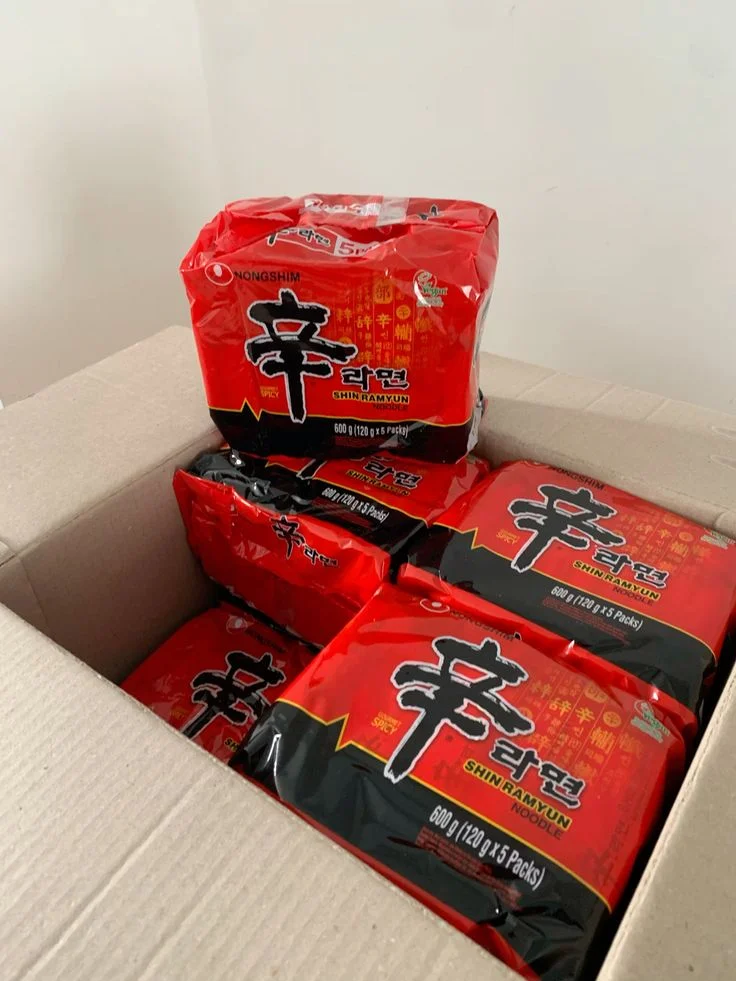
| South Korea | C/O Form AK (AKFTA), Form KV or RCEP | 0% | Shin Ramyeon, Samyang, Nongshim; 0% under AKFTA with valid C/O |
| EU, UK | EVFTA / UKVFTA origin documents | 0% | Less common; EVFTA brings rate to 0% under completed phase-out schedule |
| Non-FTA countries | Not applicable | 30% (MFN) | Subject to the highest MFN rate; a C/O from the country of origin is required to claim preferential treatment |
With the MFN rate at 30% and most FTA rates at 0%, the duty differential by origin is the most significant factor to account for when planning the instant noodle import procedure.
3. Documentation for the Instant Noodle Import Procedure
The full document set for the instant noodle import procedure consists of two layers: standard customs documents and food safety specialized documents. The specialized documents – particularly the test results and self-declaration – must be completed before registering for FSA inspection at the port of entry; they cannot be processed in parallel with or after the arrival of the shipment.
| Document | When to Prepare | Key Notes |
|---|---|---|
| Sales Contract | Before placing deposit | Clearly state product name, brand, ingredients, packaging specifications, Incoterms, and provisions requiring the supplier to provide the C/O and product samples for testing |
| Commercial Invoice and Packing List | Before shipment | Must include: product name and brand, key ingredients, packaging specifications, packs per carton, expiry date; must be consistent with product labeling |
| Bill of Lading / AWB | After goods are loaded | Goods description must be consistent with the Invoice and Packing List; instant noodles are dry cargo and do not require refrigerated containers |
| Certificate of Origin (C/O) | Before shipment (supplier applies) | The most critical document in the instant noodle import procedure given the 30% MFN duty; must be on the correct FTA form and match 100% with the Invoice and B/L; must be requested at contract stage |
| Product sample and food safety test results | Receive sample before shipment arrives; submit for testing early | Submit product sample to a Ministry of Health/MARD-designated laboratory for food safety indicator testing. Testing typically takes 5–10 working days – this is the longest single step in the entire instant noodle import procedure |
| Self-Declaration Document | Before importing | Prepared under Articles 4–5 of Decree 15/2018/ND-CP; published on the electronic portal of the local FSA authority; submitted together with test results; no prior approval required – the business self-declares and bears full responsibility |
| FSA inspection registration dossier | Before shipment arrives at port | FSA inspection registration form; Invoice; C/O; Self-Declaration Document; test results (if already available); product label samples. Register via the National Single Window system or submit directly to the Vietnam Food Administration / State Inspection Sub-department |
| Original label and Vietnamese supplementary label sample | Before market circulation | Supplementary label under Decree 37/2026/ND-CP: product name, ingredients, expiry date, country of origin, manufacturer, importer, usage and storage instructions |
| Electronic customs declaration (VNACCS) | Once dossier is complete | Declare the correct 8-digit HS code, C/O reference number, and FSA inspection registration number; include complete product name and brand description |
4. Step-by-Step Instant Noodle Import Procedure
The instant noodle import procedure is characterized by the need to run two documentation streams in parallel: customs and food safety. These cannot be handled sequentially – testing must begin very early, and failure to plan ahead is the primary reason shipments are delayed.
Step 1: Determine the HS code, select the supplier, and request test samples at the time of ordering
This step determines the timeline for the entire instant noodle import procedure. The business requests product samples, original labels, and ingredient lists from the supplier in order to: determine the correct 8-digit HS code (1902.30.20 or 1902.30.40), verify that labeling contains all required information, and submit samples to a designated laboratory before the goods are loaded. With testing taking 5–10 working days, this must be initiated in parallel with the production process.
Step 2: Prepare the Self-Declaration Document and sign the contract
Once satisfactory test results are obtained, the business prepares the Self-Declaration Document under Articles 4–5 of Decree 15/2018/ND-CP, attaches the test results, and publishes both on the electronic portal of the local regulatory authority. In the instant noodle import procedure, this step requires no prior approval – the business self-declares and bears full responsibility. Simultaneously, the contract is signed with a clause requiring the supplier to provide the C/O under the applicable agreement.
Step 3: Ship and track the consignment
Instant noodles are dry food products shipped in cartons on pallets, typically in 20-foot or 40-foot standard containers. Small consignments move LCL (less-than-container-load). In the instant noodle import procedure, key actions at this stage include: obtaining the C/O from the supplier before vessel departure; and receiving the full document set (Invoice, Packing List, C/O, B/L) in advance to prepare the FSA inspection registration.
Step 4: Register for FSA inspection before the shipment arrives at port
The business registers for state food safety inspection via the National Single Window system or submits the dossier to the Vietnam Food Administration / State Inspection Sub-department at least 3–5 working days before the shipment arrives at port. The dossier includes: registration form, self-declaration, test results, Invoice, C/O, and label samples. The inspection authority issues a sampling order – inspectors collect samples at the port or a designated warehouse. This is the core step of the instant noodle import procedure at the port of entry.
Step 5: File customs declaration, pay duties, and clear customs
In parallel with the FSA inspection, the forwarder opens a VNACCS declaration with the 8-digit HS code, C/O reference, and FSA inspection registration number. Customs typically places the declaration on hold pending FSA inspection results before authorizing clearance. Once the Vietnam Food Administration issues a Notice of Satisfactory Inspection Results, customs confirms the duty amount and the business pays import duty and 8% VAT.
Step 6: Take delivery, apply supplementary labels, and distribute
The final step completing the instant noodle import procedure: collect the Delivery Order, transport goods to warehouse, and apply Vietnamese supplementary labels under Decree 37/2026/ND-CP before the products enter circulation. All shipment records (self-declaration, test results, FSA clearance notice) must be retained for market inspection by regulatory authorities.
5. How to Calculate Import Duties on Instant Noodles
In the instant noodle import procedure, instant noodles are subject to two layers of taxation: import duty and 8% VAT. With the MFN rate at 30% and FTA C/Os reducing this to 0%, the differential is substantial. Example: a consignment of instant noodles (HS code 1902.30.40) with a CIF value of VND 500 million imported from Thailand, comparing without and with a C/O Form D:
| Tax / Cost Item | Without C/O Form D (MFN 30%) | With C/O Form D ATIGA (0%) |
|---|---|---|
| CIF Value | VND 500,000,000 | VND 500,000,000 |
| Import duty | 30% × 500M = VND 150,000,000 | 0% × 500M = VND 0 |
| VAT (8%) | 8% × (500 + 150)M = VND 52,000,000 | 8% × (500 + 0)M = VND 40,000,000 |
| Total tax payable | VND 202,000,000 | VND 40,000,000 |
| Savings with C/O Form D | VND 162,000,000 from a single valid C/O. If clearance occurs after January 1, 2027 when VAT reverts to 10%, total tax would be VND 215 million (without C/O) versus VND 50 million (with 0% C/O) – a difference of VND 165 million. A C/O is the top priority in any instant noodle import shipment. | |
From the practical experience of 3W Logistics: In the instant noodle import procedure, the three most common causes of customs delays and excess costs that we encounter are as follows. First, submitting product samples for testing too late – samples should be sent at the time of ordering, not when the goods have already arrived at port. Second, not obtaining a C/O Form D from Thai or Indonesian suppliers because it was not requested upfront – on a CIF value of VND 500 million, this adds over VND 150 million in duty. Third, confusing the FSA procedures under Decree 46 (currently suspended) and Decree 15/2018 (currently in force), leading to incorrect forms that require the entire dossier to be redone – the single most common error in the instant noodle import procedure at present. – Ms. Apple, CCO, 3W Logistics
6. Common Risks in the Instant Noodle Import Procedure
The majority of risks in the instant noodle import procedure do not arise from customs but from FSA document preparation and testing timeline management.
| Risk | How It Manifests | How to Prevent It |
|---|---|---|
| Submitting test samples too late | Goods arrive at port before test results are available – shipment must be moved to cold storage or a bonded warehouse, generating storage costs while the product’s shelf life continues to run | Request samples and product documentation from the supplier at the time of ordering; submit for testing in parallel with the production process; factor in 5–10 working days for testing |
| Missing or invalid C/O | Must pay MFN duty of 30% instead of 0% under FTA – on every VND 500 million CIF, this adds over VND 150 million in duty | Include C/O provisions in the contract from the outset; verify the C/O received from the supplier before vessel departure; ensure 100% consistency with the Invoice and B/L |
| Confusing FSA procedures between Decree 46 and Decree 15 | Dossier prepared under the “conformity declaration registration” process of Decree 46 (currently suspended) instead of the “self-declaration” process of Decree 15/2018 – incorrect forms, entire dossier must be redone | Confirm the applicable procedure with the FSA authority or your forwarder; monitor official announcements for when Decree 46 is reinstated |
| Incorrect or incomplete Vietnamese supplementary label | Products circulating without a fully compliant supplementary label under Decree 37/2026/ND-CP – subject to administrative penalties, mandatory recall, and distribution disruption | Prepare the supplementary label draft before the goods arrive; verify all 8 mandatory fields are present; apply labels before releasing from warehouse |
| Failed food safety test results | One FSA indicator exceeds the permitted threshold – the entire shipment is placed on hold, potentially subject to re-export or destruction, with total loss of the shipment’s value | Require the supplier to provide factory test results before shipment; select suppliers with ISO 22000, HACCP or equivalent certification; conduct pre-shipment and post-delivery sampling |
| Misclassification between HS 1902.30.20 and 1902.30.40 | Confusing oil-fried noodles with air-dried noodles – subject to reclassification, back-duty assessment, and penalties; even though MFN rates are the same, misclassification affects post-clearance audit outcomes | Confirm the production method (fried or air-dried) from the catalogue; clearly describe on the Invoice; consult your forwarder if uncertain |
FAQ — Frequently Asked Questions About the Instant Noodle Import Procedure
Question 1: What documents are required for the instant noodle import procedure?
The complete document set for the instant noodle import procedure includes:
- Sales Contract, Commercial Invoice, and Packing List;
- Bill of Lading or AWB;
- C/O under the applicable free trade agreement (most critical, given the 30% MFN duty);
- Product sample and food safety test results from a designated laboratory;
- Self-Declaration Document under Decree 15/2018/ND-CP;
- FSA state inspection registration dossier;
- Original label and Vietnamese supplementary label sample under Decree 37/2026/ND-CP;
- Electronic customs declaration via VNACCS with the full 8-digit HS code.
Question 2: Is animal quarantine required for importing instant noodles?
No. This is an important distinction between the instant noodle import procedure and that for meat, seafood, or animal-origin food products. Instant noodles are processed products made from wheat flour and starch, with no origin from live animals, and therefore do not fall under animal quarantine requirements. The only specialized document required is food safety inspection under Decree 15/2018/ND-CP.
Question 3: How is the self-declaration process for imported instant noodles carried out?
Under the current instant noodle import procedure, businesses carry out product self-declaration under Articles 4–5 of Decree 15/2018/ND-CP. The process involves 3 steps: (1) obtain passing food safety test results from a designated laboratory; (2) prepare the Self-Declaration Document stating the product name, ingredients, expiry date, manufacturer, importer, and safety indicators; (3) publish the document on the electronic portal of the local FSA regulatory authority and retain records. No prior approval is required. Note: Decree 46/2026 will replace this process with a “conformity declaration registration” requirement once it is reinstated.
Question 4: What is the current import duty rate for instant noodles?
This is one of the most important figures to calculate carefully before proceeding with the instant noodle import procedure. Instant noodles are subject to two layers of taxation:
- Import duty: calculated on the CIF value; MFN rate is 30% – very high compared to many other product categories; reduced to 0% with a valid C/O under ATIGA (Thailand, Indonesia), ACFTA (China), AKFTA (South Korea), AJCEP/CPTPP (Japan), and other FTAs;
- VAT: 8% through December 31, 2026 under Decree 174/2025/ND-CP; reverting to 10% from January 1, 2027 unless a new extension policy is issued.
How Does 3W Logistics Support the Instant Noodle Import Procedure?
As a freight forwarding company registered as an OTI-NVOCC with FMC bond (Federal Maritime Commission) in the United States and with over 10 years of experience handling imported processed food and consumer goods, 3W Logistics provides end-to-end services for businesses navigating the instant noodle import procedure – from pre-order consultation through to delivery at warehouse and readiness for distribution.
- HS code determination and actual duty calculation before ordering: Distinguishing between codes 1902.30.20 and 1902.30.40, calculating import duty and VAT by origin – so businesses have accurate cost figures for the instant noodle import procedure before negotiating the supply contract.
- Supporting correct FTA C/O applications from suppliers: Guiding Thai and Indonesian suppliers through obtaining C/O Form D; Chinese suppliers through C/O Form E; Japanese suppliers through Form AJ/CPTPP; Korean suppliers through Form AK and verifying the C/O before vessel departure.
- FSA documentation and self-declaration advisory: Guiding businesses through the self-declaration process under Decree 15/2018/ND-CP (currently in force); connecting with designated laboratories; providing immediate updates when Decree 46 is reinstated so businesses experience no disruption.
- Ocean and air freight booking from Thailand, China, Japan, and South Korea: Arranging FCL or LCL container shipments based on consignment size; monitoring vessel schedules and freight rates to Hai Phong, Da Nang, and Cat Lai ports.
- Electronic customs declaration and channel management: Declaring the correct 8-digit HS code, C/O reference, and FSA inspection registration number; monitoring declarations and FSA inspection outcomes; handling supplementary document requests from customs efficiently.
- Supplementary label support and shipment record retention: Advising on Vietnamese supplementary label content under Decree 37/2026/ND-CP; retaining complete records of self-declaration, test results, and FSA clearance notices for market inspection by regulatory authorities.
Why choose 3W Logistics for your instant noodle import shipment? The instant noodle import procedure is characterized by the need to run customs and FSA documentation in parallel while the product’s shelf life is actively counting down – every day of delay is a day of lost shelf life and additional warehousing costs. The regulatory environment is also in flux (Decree 46 suspended, Decree 15/2018 in force, Decree 46 to be reinstated), requiring a forwarder who stays current so your operations are never disrupted. We are with you from the first sample submission through to the moment your goods are ready for distribution. Contact 3W for tailored advice before signing your supply contract.
Address: 34 Bach Dang, Tan Son Hoa Ward, Ho Chi Minh City
Hotline: +84 28 3535 0087
____________________________
3W Logistics Hanoi Branch
Address: 81A Tran Quoc Toan, Cua Nam Ward, Hanoi
Hotline: +84 24 3202 0482
____________________________
3W Logistics Hai Phong Branch
Address: 8A Lot 28 Le Hong Phong, Gia Vien Ward, Hai Phong
Hotline: +84 225 355 5939
____________________________
3W LOGISTICS CO., LTD – We here serve you there!
Email: info@3w-logistics.com
Website: www.3w-logistics.com

Ms. Apple is the CCO (Chief Commercial Officer) at 3W Logistics, with over 10 years of experience in sales and business operations management.
At 3W Logistics, Ms. Apple is responsible for commercial strategy, corporate customer development, managing a team of more than 50 sales professionals, and improving business performance in the logistics sector.
With practical experience in sales management and market development, Ms. Apple shares professional insights on business logistics solutions, international transportation, freight forwarding, customer management, trade lane development, and growth strategies in the logistics industry.


