Vietnam’s incense stick (joss stick) export procedure is closely tied to a special market: India – the world’s largest consumer of incense sticks for daily religious and spiritual activities. According to Ministry of Industry and Trade figures, Vietnam currently accounts for approximately 90% of India’s incense import market share, with export volume reaching 10,000-12,000 tons/month and turnover of approximately USD 7 million/month – an impressive figure for a traditional handicraft industry that provides livelihoods for many rural households in Vietnam.
Fortunately for businesses, the incense export procedure is relatively simple compared to many other agricultural and food products, as this commodity is not subject to specialized management or mandatory quarantine requirements. However, businesses still need to understand how to classify the HS code based on composition, especially in the case of incense with a bamboo core or containing agarwood (trầm hương) components – a raw material subject to separate control.
The article below summarizes all the legal basis, HS codes, procedures, costs, and common risks in the incense export procedure, updated according to regulations current as of September 2026.
1. Potential and Main Incense Export Markets
The traditional craft of making incense sticks by hand has existed for a long time in many Vietnamese craft villages, concentrated in the northern provinces and some central and southern provinces. The product is made from bamboo or reed splints combined with fragrant powder from herbs, cinnamon wood, and bời lời wood, sometimes combined with additional agarwood powder to create a distinctive scent, serving the incense export procedure to markets around the world.
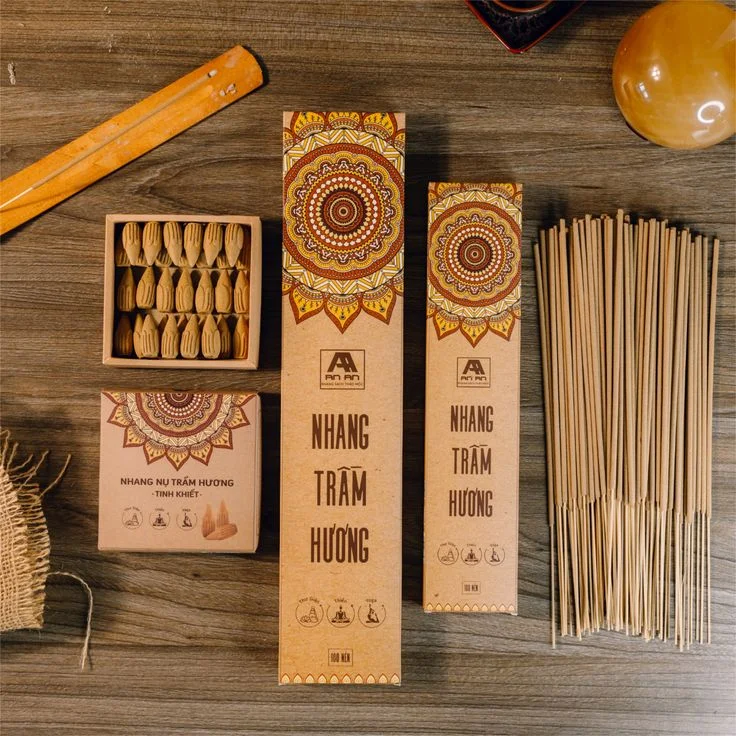
India is the dominant consumption market, however businesses can also expand into other markets such as Taiwan, China, Southeast Asian Buddhist countries (Thailand, Laos, Cambodia, Myanmar), the Middle East, and Asian communities in the US and Europe – where demand for incense used in worship, meditation, and yoga is increasingly growing.
2. Legal Basis Governing the Incense Export Procedure
| Legal Document | Regulatory Content |
|---|---|
| Decree 292/2026/ND-CP (effective from September 5, 2026, replacing Decree 69/2018/ND-CP) | Incense is not on the list of goods banned from export or requiring an export license, and may be freely exported |
| Decree 06/2019/ND-CP, Decree 84/2021/ND-CP | Management of endangered, precious, and rare forest flora under CITES; applies specifically when incense contains natural agarwood harvested from the Dó bầu (Aquilaria) tree |
| Decree 102/2020/ND-CP (VNTLAS) | Applies when the incense core made from bamboo or reed is considered a forestry-derived product, requiring proof of legal origin |
| Circular 38/2015/TT-BTC, amended by Circular 39/2018/TT-BTC | Customs procedures, customs inspection and supervision for exported goods |
This is the foundational legal framework businesses need to understand to correctly carry out the incense export procedure, the most important part being clearly determining whether the incense is ordinary or contains natural agarwood components.
3. Conditions for Businesses and Exported Incense Products
| Condition | Issuing/Managing Authority | Notes |
|---|---|---|
| No specialized export license required | Not applicable | Ordinary incense is freely exportable under Decree 292/2026/ND-CP |
| CITES Permit (if containing agarwood from wild-harvested Dó bầu) | Vietnam CITES Management Authority | Only applies when the agarwood component is sourced from cultivation/harvesting subject to control |
| Certificate of Free Sale (CFS) | Competent licensing authority | Not mandatory under Vietnamese law, only obtained when the importer requires proof the product is legally circulated in Vietnam |
| Control of scent-creating chemicals and binding agents | Self-controlled by the business | Some markets such as the EU and US have specific regulations on chemicals in products that create smoke/scent when burned |
4. HS Code and Incense Export Tax
Incense falls under Chapter 33 – “Essential oils and resinoids; perfumery, cosmetic or toilet preparations,” heading 33.07 – within which subheading 3307.41 is specifically designated for “Incense sticks” and preparations that produce a fragrance when burned. Correctly determining the HS code is an important step in the incense export procedure.
| Item Description | HS Code (Vietnam) | Vietnam Export Tax | Notes |
|---|---|---|---|
| Fragrant powder (incense) used in religious rituals | 3307.41.10 | 0% | Applies to fragrant powder not yet formed into sticks |
| Incense sticks and other stick-type incense | 3307.41.90 | 0% | The most common code group, applying to traditional bamboo-splint incense sticks exported to India |
| Raw agarwood material (wood, powder, agarwood essential oil) | 4401.90/1301.90/3301.29 | 0% | Different from finished incense products, requires separate cross-checking by raw material type and origin |
Practical note: Vietnam’s incense export tax is currently 0% for most HS codes under heading 3307.41. Businesses should note that the Vietnamese government does not require a mandatory “Made in Vietnam” certificate of origin for export; however, many importers – especially in markets with an FTA with Vietnam – still require a C/O under the corresponding form to enjoy preferential import tax in their country.
5. Documentation Set for the Incense Export Procedure
| Document | When to Prepare | Important Notes |
|---|---|---|
| Sales Contract | Before production and packaging | Clearly state Incoterms and product specifications (stick length, scent, bundle weight) |
| Commercial Invoice and Packing List | Before customs declaration | The value must match the contract and the bill of lading |
| Phytosanitary Certificate | Before the goods leave the port (if required by the partner) | Not mandatory under Vietnamese law but some importers require it since the incense core is made from bamboo or reed |
| Certificate of Free Sale (CFS – if required by the partner) | Before signing a contract with a market that requires it | Not a mandatory document in Vietnam’s customs clearance procedure |
| CITES Permit (if containing regulated agarwood) | Before the goods leave the port | Only applies to products containing natural agarwood from a species under the CITES Appendices |
| Certificate of Origin (C/O) | After the export declaration is issued (if required by the partner) | Necessary for the importer to enjoy tariff preferences under the FTA corresponding to the destination market |
| Export Customs Declaration (VNACCS) | Before customs clearance | Declare the correct HS code according to whether it’s fragrant powder or finished incense sticks |
6. Incense Export Procedure Step by Step
Step 1: Determine the Product Type and Composition
The business clearly determines whether the product is ordinary fragrant powder or incense sticks, or incense containing natural agarwood components – this is the foundational first step in the incense export procedure, determining whether additional CITES documentation is needed.
Step 2: Production and Packaging According to Export Standards
Bamboo/reed splints are combined with fragrant powder, rolled into sticks, and dried to the appropriate moisture level, then packaged according to the bundle/box specifications agreed with the importer.
Step 3: Sign the Contract and Determine Additional Market Requirements
Agree with the importer on scent, stick length, and bundle weight, while confirming whether a C/O, CFS, or phytosanitary certificate is needed depending on the target market.
Step 4: Apply for a CITES Permit (If the Product Contains Regulated Agarwood)
For products containing natural agarwood harvested from a Dó bầu species under the CITES Appendices, the business submits documentation to the Vietnam CITES Management Authority to obtain a permit before export.
Step 5: Finalize the Documentation Set and File the Export Customs Declaration
The business or forwarding company prepares the Invoice and Packing List, files the electronic customs declaration on the VNACCS system, and attaches any additional documents required by the importer (C/O, CFS, Phytosanitary Certificate).
Step 6: International Transport and Import Clearance at the Destination Country
Once the declaration clears customs, the goods are handed over to the carrier by sea (most common due to high volume and low value per unit) or by air for small, higher-value shipments such as premium agarwood incense.
7. Transport Methods and Risk Notes
Sea transport by container: The most common method for incense exported to India and other Asian markets, suitable for large volumes (10,000-12,000 tons/month industry-wide), with low cost per unit of product.
Air transport: Applied to small, high-value shipments such as premium agarwood incense and finely packaged handmade incense serving niche markets in the US and Europe.
| Risk | Manifestation | Prevention Method |
|---|---|---|
| Dampness, mold, or breakage due to non-compliant moisture level | Product quality declines, uneven burning upon arrival | Control moisture during drying, use moisture-resistant packaging before dispatch |
| Missing CITES certification for agarwood-containing incense | Goods held or confiscated at the importing country’s border gate | Carefully check the origin of the agarwood component before signing the contract |
| Confusing the HS code between finished incense and raw agarwood material | Tax arrears collection, delayed customs clearance, need to amend the declaration | Carefully cross-check the HS code with a customs authority experienced in handicraft products |
| Missing C/O when the customer needs to enjoy tariff preferences | Affects the long-term partnership, customer switches to another supplier | Confirm the C/O requirement with the customer early, right from contract negotiation |
8. FAQ – Frequently Asked Questions About the Incense Export Procedure
Question 1: Does exporting incense require a special license?
No, for ordinary incense. Incense is not on the list of goods banned from export or requiring an export license under Decree 292/2026/ND-CP. Only products containing natural agarwood subject to CITES control need an additional permit.
Question 2: What is the current incense export tax in Vietnam?
Incense (HS codes under heading 3307.41) enjoys a 0% export tax rate in Vietnam.
Question 3: Is a C/O mandatory when exporting incense?
Not mandatory under Vietnamese regulations. However, many importers in countries with an FTA signed with Vietnam typically require a C/O to enjoy preferential import tax in their country, so businesses should confirm this with their partner early.
Question 4: Why is India Vietnam’s largest incense export market?
India is a country with very high demand for incense for daily religious and spiritual activities, while its domestic production capacity for bamboo splints and fragrant powder does not meet demand, creating significant room for Vietnam’s incense export procedure – currently accounting for approximately 90% of this market’s import share.
How Does 3W Logistics Support the Incense Export Procedure?
As a freight forwarding company registered as an OTI-NVOCC with an FMC bond in the US, holding a SCAC Code to self-file AMS/ISF directly, along with experience handling traditional handicraft exports to diverse markets, 3W Logistics provides a comprehensive service for businesses regarding the incense export procedure – from HS code consulting, CITES documentation (if applicable), to the goods clearing customs at the importing country.
- Consulting on HS codes and export conditions by product composition: Helping businesses distinguish ordinary incense from products containing regulated agarwood.
- Support connecting for C/O, CFS as required by the partner: Guiding businesses to properly prepare documentation, coordinating with competent authorities to obtain certification on time.
- Booking and container transport to India and other Asian markets: Arranging cost-optimized sea transport for large volumes, ensuring the goods do not become damp or moldy during the journey.
- Electronic customs declaration (VNACCS): A professional team handles declarations and verifies the correct HS code; as an OTI-NVOCC with FMC and SCAC Code status, independently issues HBLs and self-files AMS/ISF for shipments to the US.
Why choose 3W Logistics: With offices in Ho Chi Minh City, Hanoi, and Hai Phong, along with a team well-versed in the specific characteristics of the traditional handicraft industry, 3W Logistics ensures incense shipments clear customs on time and to standard from the very first export. – Ms. Apple, CCO 3W Logistics
Head Office – 3W Logistics Ho Chi Minh City Branch
Address: 34 Bach Dang, Tan Son Hoa Ward, Ho Chi Minh City
Hotline: +84 28 3535 0087
____________________________
3W Logistics Hanoi Branch
Address: 81A Tran Quoc Toan, Cua Nam Ward, Hanoi
Hotline: +84 24 3202 0482
____________________________
3W Logistics Hai Phong Branch
Address: 8A Lot 28 Le Hong Phong, Gia Vien Ward, Hai Phong
Hotline: +84 225 355 5939
____________________________
3W LOGISTICS CO., LTD – We here serve you there!
Email: info@3w-logistics.com
Website: www.3w-logistics.com

Ms. Apple is the CCO (Chief Commercial Officer) at 3W Logistics, with over 10 years of experience in sales and business operations management.
At 3W Logistics, Ms. Apple is responsible for commercial strategy, corporate customer development, managing a team of more than 50 sales professionals, and improving business performance in the logistics sector.
With practical experience in sales management and market development, Ms. Apple shares professional insights on business logistics solutions, international transportation, freight forwarding, customer management, trade lane development, and growth strategies in the logistics industry.


