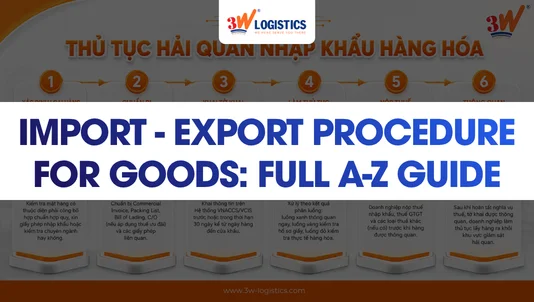
Import-Export Procedure for Goods: Full A-Z Guide
Import-export procedure for goods is the entire set of tasks that businesses and the customs authority must carry out so that goods are permitted to leave or enter Vietnamese territory in accordance with the law, including preparing documentation, declaring customs, undergoing specialized inspection, and fulfilling tax obligations. This is a mandatory process for every import-export of goods across the national border.
Many businesses new to import-export are often unclear on the conditions required to be permitted to import or export, cannot distinguish between the different types of import-export activity, or confuse the export procedure with the import procedure. The article below sets out the full definition, conditions, types, detailed procedure, and current legal basis for import-export procedures in Vietnam.
1. What Is the Import-Export Procedure for Goods?
The import-export procedure is the complete set of tasks that the customs declarant (business or individual) and the customs authority must carry out under the law so that goods are permitted to be exported abroad or imported into Vietnam, including declaration, document submission, inspection, and fulfilling tax obligations.
Under Clause 23, Article 4 of Customs Law No. 54/2014/QH13, customs procedure refers to the tasks that the customs declarant and customs officer must carry out as required by this Law with respect to goods and means of transport.
Real-world example: A business wanting to export a shipment of coffee to Europe must complete the full import-export procedure: preparing the contract, invoice, and certificate of origin, filing the electronic customs declaration, waiting for channel classification, and completing customs clearance before the goods are loaded onto the vessel.
2. Export and Import Under Vietnamese Law
Under Article 28 of the Commercial Law No. 36/2005/QH11, export of goods means goods being taken out of Vietnamese territory, or brought into a special area located within Vietnamese territory that is treated as a separate customs zone under the law; import of goods means goods being brought into Vietnamese territory from abroad or from the special area mentioned above.
The export and import of goods must be carried out on the basis of an international sale-of-goods contract, in compliance with Vietnamese law and international trade custom.
3. Conditions for a Business to Import or Export Goods
A business wishing to carry out import-export activities must meet conditions on business registration, an appropriate industry code, and specialized licensing for certain categories of goods.
- Holding an Enterprise Registration Certificate: a trader that is a business legally established in Vietnam has the right to export and import goods regardless of its registered business lines, except for goods on the prohibited or restricted list.
- Registering a tax code and import-export code: a business’s tax code also serves as its import-export code when declaring customs.
- Specialized license (if applicable): certain goods such as pharmaceuticals, functional foods, chemicals, and medical devices require a license from the relevant specialized-management ministry or sector before import or export.
- Not falling under the prohibited export/import list: businesses need to check the current list of prohibited or restricted goods before carrying out a transaction.
Note: For a foreign trader without a presence in Vietnam, the right to import or export is governed by separate regulations set out in the legal documents on international goods-trading activities of foreign traders.
4. Common Types of Import-Export Activity
Import-export activity in Vietnam is carried out under several different types, each with its own procedural characteristics and scope of application.
- Official (formal) import-export: goods are transported through international checkpoints or main border gates, with the full customs procedure, foreign trade contract, and required documents completed.
- Informal (small-scale border) import-export: a form of border trade between border residents, applied at certain secondary checkpoints or border crossing points under separate management policies, usually limited in value and product type.
- Entrusted import-export: a business does not appear directly on the foreign trade contract but authorizes another entity (usually a professional import-export company) to act on its behalf.
- On-spot import-export: goods are delivered directly within Vietnam as designated by the foreign buyer, without the goods crossing the border.
- Processing/export-manufacturing import-export: applies to businesses that import raw materials for processing or manufacturing export goods, and that enjoy certain preferential tax policies.
5. Procedure for Exporting Goods
The export procedure consists of 6 main steps, from checking the commodity policy to confirming the actual export of the goods at the port.
Step 1: Check the commodity policy and prepare the contract
Determine whether the goods are on the prohibited or restricted list or require a specialized license, and sign the foreign trade contract with the partner.
Step 2: Prepare the export documentation
Prepare the Commercial Invoice, Packing List, contract, and any specialized documents before declaring customs.
Step 3: File the electronic customs declaration
Declare the shipment’s information on the VNACCS/VCIS System; the system automatically issues a declaration number and returns the channel-classification result (green, yellow, or red).
Step 4: Complete customs procedures at the Customs Sub-Department
Depending on the channel-classification result, the business submits paper documents (yellow channel) or presents the goods for physical inspection (red channel).
Step 5: Clear customs and transport the goods to the port
Once the documents/goods are confirmed compliant, the declaration is cleared, and the business transports the goods to the port for loading onto the means of transport.
Step 6: Confirm actual export
After the goods have been loaded onto the vessel/aircraft, the business submits the declaration along with the Bill of Lading information for the supervising customs authority to confirm actual export, completing the export procedure.
6. Procedure for Importing Goods
The import procedure consists of 6 main steps, from determining the type of imported goods to fulfilling tax obligations and receiving the goods.
Step 1: Determine the type of goods and the import policy
Check whether the goods must be declared conformant to standards/technical regulations, require an import license, or are subject to specialized inspection.
Step 2: Prepare the import documentation
Prepare the Commercial Invoice, Packing List, Bill of Lading, Certificate of Origin (if applying preferential tax rates), and any related licenses.
Step 3: File the import customs declaration
Declare the information on the VNACCS/VCIS System before, or within 30 days from the date the goods arrive at the checkpoint.
Step 4: Complete document/goods inspection according to channel classification
Process according to the channel-classification result: the green channel clears immediately, the yellow channel requires document inspection, and the red channel requires physical inspection of the goods.
Step 5: Pay import duty and any related taxes
The business pays import duty, VAT, and any other applicable taxes before the goods are cleared.
Step 6: Clear customs and receive the goods
Once the tax obligations are fulfilled, the declaration is cleared, and the business completes the procedure to take the goods out of the customs-supervised area.
7. Documents to Prepare for the Import-Export Procedure
The basic import-export dossier under Circular 38/2015/TT-BTC (as amended by Circular 39/2018/TT-BTC and updated by Circular 121/2025/TT-BTC) includes the following documents:
- Electronic customs declaration (filed on the VNACCS/VCIS System)
- Commercial Invoice
- Packing List
- Bill of Lading/Airway Bill
- Sales Contract
- Certificate of Origin (C/O), if seeking a preferential tax rate under an FTA
- Specialized license (if the goods fall under specialized management)
8. Distinguishing Export from Import
Export means taking goods from Vietnam abroad, while import means bringing goods from abroad into Vietnam — two opposite directions of goods flow, each of which must follow its corresponding customs procedure.
| Criteria | Export | Import |
|---|---|---|
| Direction of goods | From Vietnam abroad | From abroad into Vietnam |
| Main tax obligation | Export duty (for certain goods) | Import duty, VAT |
| Declaration deadline | After the goods are gathered at the designated location | Before, or within 30 days from the date the goods arrive at the checkpoint |
| Final step of the process | Confirming actual export once the goods are loaded onto the means of transport | Clearance and taking the goods out of the customs-supervised area |
| Legal basis | Article 28, Commercial Law 2005; Article 32, Customs Law 2014 | Article 28, Commercial Law 2005; Article 25, Customs Law 2014 |
9. A Real-World Example of the Import-Export Procedure
A furniture manufacturer in Vietnam imports raw timber from Africa (the import procedure); after processing it into finished products, the business exports the finished goods to the US market (the export procedure). Both directions of goods must go through the process of preparing documentation, declaring customs, and fulfilling the corresponding tax obligations, even though the two directions differ somewhat in deadlines and the type of tax applied.
10. Common Mistakes Businesses Make with the Import-Export Procedure
The most common mistakes when carrying out the import-export procedure are failing to check the commodity policy before signing a contract, missing a specialized license, or choosing the wrong type of import-export.
| Common Mistake | Consequence | How to Fix It |
|---|---|---|
| Not checking the commodity policy before signing the contract | Signing a contract for goods on the prohibited/restricted list, making the transaction impossible to complete | Check the commodity policy before negotiating and signing the foreign trade contract |
| Missing a specialized license | Goods are held at the port and cannot be cleared on time | Determine whether the goods require a specialized license and apply for it before the goods arrive |
| Choosing the wrong type of import-export | Missing out on tax incentives or having to redeclare under the correct type | Clearly determine the purpose of the transaction (trading, processing, on-spot, etc.) before declaring |
| Documents not matching between parties | Pushed into the yellow/red channel, extending clearance time | Carefully cross-check the Commercial Invoice, Packing List, and Bill of Lading before declaring |
Real-world example: A business signed a contract to import medical equipment but had not yet obtained the specialized import license from the Ministry of Health, resulting in the shipment being held at the port for more than two weeks to complete the additional licensing procedure.
11. Current Legal Regulations on the Import-Export Procedure
The import-export procedure for goods in Vietnam is currently governed directly by the Commercial Law No. 36/2005/QH11, Customs Law No. 54/2014/QH13, Decree 08/2015/ND-CP, and the Ministry of Finance’s guiding Circulars, most recently Circular 121/2025/TT-BTC, effective from February 1, 2026.
- Customs Law No. 54/2014/QH13 — sets the overall framework for customs procedures, inspection, and supervision.
- Commercial Law No. 36/2005/QH11 — Article 28 defines the export and import of goods.
- Decree 08/2015/ND-CP — provides detailed provisions on customs procedures, inspection, and supervision.
- Circular 38/2015/TT-BTC (amended by Circular 39/2018/TT-BTC) — guides customs procedures, documentation, and import-export tax.
- Circular 121/2025/TT-BTC (effective from February 1, 2026) — updates the electronic customs declaration procedure.
12. Frequently Asked Questions About the Import-Export Procedure (FAQ)
Can a newly established business import or export right away?
Yes. A business legally established in Vietnam has the right to import and export goods regardless of its registered business lines, except for goods on the prohibited or restricted list.
Are the export and import procedures the same?
Broadly, both involve preparing documentation, declaring customs, and fulfilling tax obligations, but they differ in the declaration deadline, the type of tax applied, and the final confirmation step of the process.
Is informal (small-scale border) import-export legal?
Yes, but it only applies to certain secondary checkpoints or border crossing points under separate regulations, and is usually limited in value and product type compared to official import-export.
Can an individual carry out the import-export procedure in their own name?
An individual can carry out certain non-commercial import-export transactions within a given tax-exemption threshold, but regular import-export business activity must be carried out through a registered business.
How does entrusted import-export work?
A business that wants to use entrustment authorizes a professional import-export company to appear on the foreign trade contract and carry out the customs procedure on its behalf, based on an entrustment contract between the two parties.
How long does it take to complete the import-export procedure for a shipment?
For the green channel, clearance takes only a few hours; the yellow channel takes about 1 day; the red channel can take 2-3 days due to physical inspection of the goods.
What goods are not permitted to be imported or exported?
Goods on the current legal list of prohibited exports/imports, or goods with a counterfeit origin or that endanger security or the environment.
What should a business keep in mind the first time it carries out the import-export procedure?
The business should correctly identify the type of import-export, carefully check the commodity policy, fully prepare its documentation, and work with an experienced logistics provider to avoid errors on its first transaction.
3W Logistics – Supporting Import-Export Businesses
Carrying out the import-export procedure requires a business to understand the conditions, type, and process suited to each shipment. 3W Logistics works alongside businesses to handle the entire export and import procedure quickly and in full compliance.
- Consulting on the right type and conditions for import-export: helps businesses identify the correct type and the conditions to meet before transacting.
- Professional documentation and customs declaration handling: an experienced team handles both the export and import process, minimizing errors.
- Global shipping network: combines sea, air, and road transport capability, supporting a seamless import-export procedure from start to finish.
Businesses needing to carry out the import-export procedure for goods, please contact 3W Logistics directly for tailored consulting solutions.
CONTACT INFORMATION:
Head Office – 3W Logistics Ho Chi Minh Branch
Address: 34 Bach Dang, Tan Son Hoa Ward, Ho Chi Minh City
Hotline: +84 28 3535 0087
3W Logistics Hanoi Branch
Address: 81A Tran Quoc Toan, Cua Nam Ward, Hanoi
Hotline: +84 24 3202 0482
3W Logistics Hai Phong Branch
Address: 8A Lot 28 Le Hong Phong, Gia Vien Ward, Hai Phong
Hotline: +84 225 355 5939
3W LOGISTICS CO., LTD – We here serve you there!
Email: info@3w-logistics.com
Website: www.3w-logistics.com

Hello, I’m Nguyen Phuong Nhan (Ms. Nina)
I currently serve as Trade Lanes Supervisor at 3W Logistics, with more than 10 years of experience in international logistics and freight forwarding.
My primary responsibility is developing and managing global logistics partnerships, building strategic trade lanes, and working closely with overseas agents to provide reliable and competitive transportation solutions for customers.
I regularly collaborate with agents and logistics partners worldwide to explore new business opportunities, negotiate freight rates, develop trade routes, and support import-export shipments. I also work closely with our sales team to design logistics solutions tailored to specific markets and customer requirements.
My expertise includes Ocean Freight, Air Freight, Trade Lane Development, Global Agent Network Management, International Logistics Solutions, and Import-Export Support.
Through the articles I share on the 3W Logistics website, I aim to provide practical insights into the international logistics industry, global transportation trends, overseas agent cooperation, and effective logistics strategies that help businesses optimize their supply chain operations.
I believe that strong global partnerships and well-developed trade lanes are essential to delivering sustainable logistics solutions and long-term value to customers worldwide.


