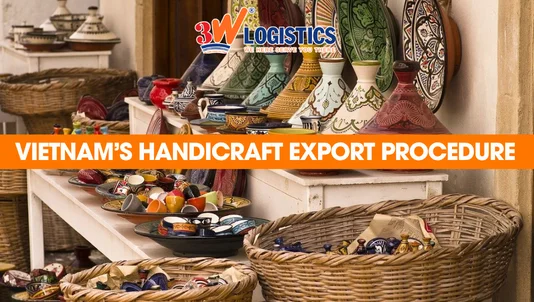
Vietnam’s handicraft export procedure is significantly more specific than many other commodities, since this industry brings together countless different materials – from rattan, bamboo, sedge, and buon leaf to wood, ceramics, lacquer, metal, and brocade – each material carrying its own HS code, quarantine requirements, and management standards. In 2026, Vietnam’s handicraft industry continues to rank in the Top 10 high-value export commodities, with turnover expected to reach approximately USD 4.5-5 billion, present in 163 countries and territories, accounting for nearly 10% of global demand.
Unlike agricultural or seafood products, the handicraft export procedure has no single unified set of regulations applying to the whole industry – instead, businesses must correctly identify the material group making up their product to look up the corresponding policy. The article below summarizes all the legal basis, HS codes by material group, procedures, costs, and common risks in the handicraft export procedure, updated according to regulations current as of September 2026.
1. Potential and Key Handicraft Product Groups
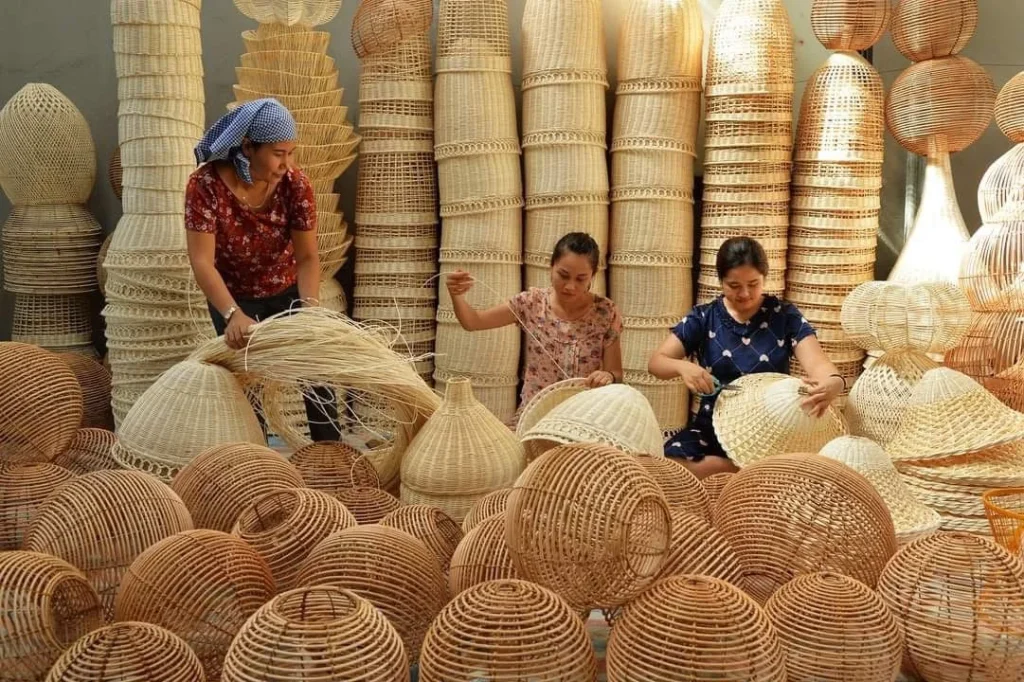
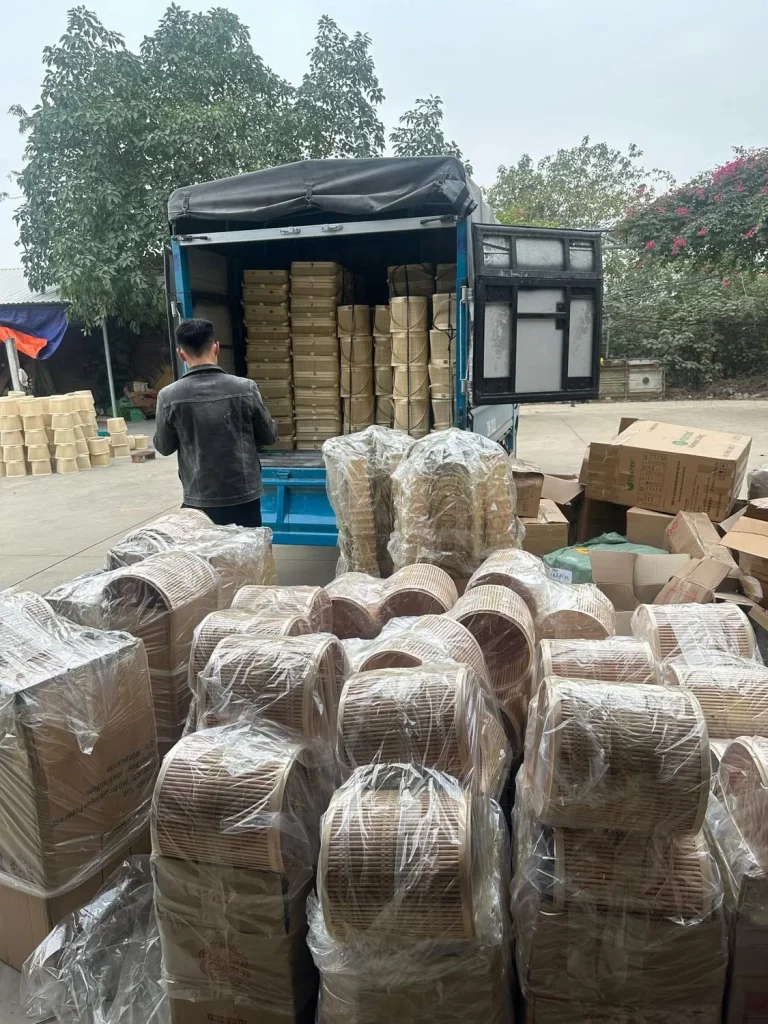
Vietnam has thousands of traditional craft villages spread across the country, each region with its own strengths: rattan and bamboo weaving and lacquer concentrated in Dong Nai, Hanoi, and Nam Dinh; ceramics in Bat Trang, Binh Duong, and Dong Nai; brocade and hand-woven textiles in the northern mountainous provinces and the Central Highlands. This is the foundation enabling the industry to carry out the handicraft export procedure at an increasingly large scale.
The US, EU, Japan, and South Korea are the main consumption markets, and at the same time are markets with strict requirements regarding material origin, labor conditions, and product safety. A single small documentation error can result in goods being returned, or the business being placed under stricter monitoring for subsequent shipments.
2. Legal Basis Governing the Handicraft Export Procedure
| Legal Document | Regulatory Content |
|---|---|
| Decree 292/2026/ND-CP (effective from September 5, 2026, replacing Decree 69/2018/ND-CP) | Provides detailed regulations under the Law on Foreign Trade Management; handicrafts in general are not on the list of banned goods or conditional exports under Appendix III |
| Circular 31/2022/TT-BTC | Vietnam’s Import-Export Goods Nomenclature, serving as the basis for determining the HS code by product material |
| Decree 102/2020/ND-CP (VNTLAS) | Applies specifically to handicrafts with wood components, requiring proof of legal wood origin |
| Decree 06/2019/ND-CP, Decree 84/2021/ND-CP | Management of endangered, precious, and rare wild flora and fauna under the CITES Convention; applies to handicrafts made from ivory, horn, shell, and rare timber |
| Circular 38/2015/TT-BTC, amended by Circular 39/2018/TT-BTC | Customs procedures, customs inspection and supervision for exported goods |
This is the foundational legal framework businesses need to understand in order to correctly carry out the handicraft export procedure, the most important part being correctly identifying the material to know which additional specialized regulations apply.
3. Conditions by Product Material Group
| Material Group | Export Condition | Notes |
|---|---|---|
| Rattan, bamboo, sedge, buon leaf, straw | No special license needed; some markets require a fumigation certificate | The most common product group, accounting for a large share of the industry’s export turnover |
| Wood, wood-based lacquerware | Requires legal wood origin documentation under VNTLAS; rare timber requires a CITES permit | Particular attention needed for exports to the EU due to the EUDR Deforestation Regulation |
| Ceramics, glass, ornamental stone | No special license needed | Requires thorough shockproof packaging due to fragility during transport |
| Shell, seashell, horn, animal bone | Requires cross-checking against the CITES list before export, applying for a permit if regulated | High risk if the species check step is skipped, especially for the US market |
| Brocade, hand-woven textiles, hand embroidery | No special license needed; some markets require certification of no child labor | Requires preparing transparent documentation on labor conditions when working with major partners |
4. HS Code and Handicraft Export Tax
Due to the multi-material nature of the products, handicrafts do not fall neatly under one chapter of the Import-Export Goods Nomenclature but spread across many different chapters depending on the main material making up the product. Correctly determining the HS code is the most important step in the handicraft export procedure.
| Product Type | HS Code (Vietnam) | Vietnam Export Tax | Notes |
|---|---|---|---|
| Woven/plaited products from rattan, bamboo, sedge (baskets, decorations) | 4602.19 | 0% | The most common code group across the entire handicraft industry |
| Furniture, statues, decorative wooden trays (including lacquerware) | 4420.10/9403.60 | 0% | Requires accompanying wood origin documentation under VNTLAS |
| Decorative ceramics | 6913.90 | 0% | Includes ceramic statues, vases, and decorative items |
| Embroidered goods, brocade, hand-woven textiles | 5805.00/6304.99 | 0% | Classified by specific product: wall-hanging tapestries, tablecloths, embroidered fabric |
| Handicraft jewelry (silver, bronze, stone) | 7113.11/7117.19 | 0% | Requires careful cross-checking between fine (precious metal) jewelry and ordinary costume jewelry |
Practical note: Vietnam’s handicraft export tax is currently 0% for most HS codes across all material groups. This is one of the industry’s major advantages; however, since the HS codes span many different chapters, businesses should keep catalogues, product photos, and a material composition breakdown on hand for accurate lookup, avoiding classification disputes with customs authorities – for complex products, requesting an advance ruling on the commodity code may be worthwhile.
5. Specific Requirements by Export Market
| Market | Main Requirement | Notes |
|---|---|---|
| US | Strict control of products of wild animal origin under CITES/the Lacey Act | Goods containing banned materials are confiscated and destroyed right at the border gate |
| EU | Requirements on chemicals in paints and adhesives (REACH regulation); wood goods are subject to EUDR | Priority given to products with Fair Trade, FSC, or Organic certification |
| Japan, South Korea | High requirements for craftsmanship, packaging, and pest control for plant-origin goods | A fumigation certificate is nearly mandatory for rattan, bamboo, sedge, and wood |
| Middle East | Favors intricately carved products, some countries require Halal certification if accompanied by food-related accessories | Focuses on shelf/storage stability during long-distance transport |
6. Documentation Set for the Handicraft Export Procedure
| Document | When to Prepare | Important Notes |
|---|---|---|
| Sales Contract | Before production and packaging | Clearly state Incoterms, materials, designs, dimensions, and packaging specifications |
| Commercial Invoice and Packing List | After packaging, before customs declaration | The value must match the contract and the bill of lading |
| Fumigation Certificate | After container loading, before yard drop-off | Mandatory for plant-origin goods (rattan, bamboo, sedge, wood) under the ISPM 15 standard |
| Legal wood origin documentation/CITES permit (if applicable) | Before the goods leave the port | Only mandatory for products containing regulated wood, shell, horn, or bone |
| Certificate of Origin (C/O) | After the export declaration is issued | Not legally mandatory, but many importers require it to prove “Made in Vietnam” and enjoy FTA preferences |
| Export Customs Declaration (VNACCS) | Before customs clearance | Declare the correct HS code according to each specific material group |
7. Handicraft Export Procedure Step by Step
Step 1: Identify the Main Material and the Corresponding HS Code
The business identifies the main material making up the product (rattan/bamboo, wood, ceramics, metal, fabric…) to look up the correct HS code and related specialized policy – this is the foundational first step in the handicraft export procedure.
Step 2: Check Whether the Material Is Subject to Special Control
Cross-check the scientific name of the material (wood, shell, horn, bone) against the CITES list and VNTLAS regulations to determine whether an additional permit or origin documentation is needed.
Step 3: Sign the Contract and Produce According to the Order
Agree with the importer on the design, dimensions, material, and packaging specifications, then proceed with production and finishing the product to the agreed standard.
Step 4: Fumigation (For Plant-Origin Goods) and Quality Check
For products made from rattan, bamboo, sedge, or wood, the business carries out fumigation after container loading to prevent insects and pests, in accordance with the ISPM 15 standard required by many markets.
Step 5: Finalize the Documentation Set and File the Export Customs Declaration
The business or forwarding company prepares the Invoice and Packing List, files the electronic customs declaration on the VNACCS system, and attaches the fumigation certificate, origin documentation (if applicable), and C/O as required by the importer.
Step 6: International Transport and Import Clearance at the Destination Country
Once the declaration clears customs, the goods are handed over to the carrier by sea (most common due to the bulky nature of the goods) or by air for small, high-value shipments. The importer coordinates with the local customs authority to complete import procedures.
8. Common Risks in the Handicraft Export Procedure
| Risk | Manifestation | Prevention Method |
|---|---|---|
| Overlooking material subject to CITES | Goods are confiscated and destroyed at the importing country’s border gate, especially in the US | Carefully check the scientific name of every material (wood, shell, horn…) before signing the contract |
| Incorrect HS code due to a product combining multiple materials | Tax arrears collection, delayed customs clearance, need to amend the declaration | Determine the material that makes up the main share by weight/value, and request an advance ruling if needed |
| Pests, insects in plant-origin goods | Goods refused entry at the destination port due to quarantine violations | Carry out complete, properly-conducted fumigation before export |
| Breakage, damage during transport | Ceramic, glass, and ornamental stone products lose value upon arrival | Use multi-layer shockproof packaging, firmly filling empty spaces in cartons and containers |
9. FAQ – Frequently Asked Questions About the Handicraft Export Procedure
Question 1: Does exporting handicrafts require a special license?
No, for most products. Handicrafts in general are not on the list of banned goods or conditional exports under Decree 292/2026/ND-CP. Only products containing regulated materials such as rare timber, shell, horn, or animal bone require an additional CITES permit or VNTLAS origin documentation.
Question 2: What is the current handicraft export tax in Vietnam?
Most handicraft products, regardless of material group (rattan/bamboo, wood, ceramics, textiles, metal), enjoy a 0% export tax rate in Vietnam.
Question 3: Is a “Made in Vietnam” C/O mandatory when exporting handicrafts?
Not mandatory under Vietnamese government regulations. However, in many cases, importers will require a Made in Vietnam certificate of origin to prove the product’s origin or to enjoy import tax preferences under an FTA in their country.
Question 4: Why do rattan, bamboo, and sedge require a fumigation certificate while ceramics do not?
Because rattan, bamboo, sedge, and wood are plant-origin materials, easily carrying harmful insects or mold, requiring fumigation under the ISPM 15 standard before export; whereas ceramics, glass, and metal are not biological materials, so they are not subject to plant quarantine.
How Does 3W Logistics Support the Handicraft Export Procedure?
As a freight forwarding company registered as an OTI-NVOCC with an FMC bond in the US, holding a SCAC Code to self-file AMS/ISF directly, along with experience handling diverse handicraft materials exported to many markets, 3W Logistics provides a comprehensive service for businesses regarding the handicraft export procedure – from material-based HS code consulting to the goods clearing customs at the importing country.
- Consulting on material identification, HS code, and specialized policy: Helping businesses distinguish products needing additional CITES/VNTLAS documentation from ordinary export products.
- Support connecting for fumigation certificates and CITES permits (if needed): Coordinating with fumigation providers and CITES management authorities so shipments have complete documentation on time.
- Multimodal booking and transport suited to fragile, bulky goods: Arranging sea or air transport, advising on shockproof packaging for each type of material.
- Electronic customs declaration (VNACCS): A professional team handles declarations and verifies the correct HS code for each product group; as an OTI-NVOCC with FMC and SCAC Code status, independently issues HBLs and self-files AMS/ISF for shipments to the US.
Why choose 3W Logistics: With offices in Ho Chi Minh City, Hanoi, and Hai Phong, along with a team well-versed in the multi-material nature of the handicraft industry, 3W Logistics ensures shipments clear customs on time and to standard, avoiding the risk of confiscation in strictly controlled markets like the US and EU from the very first export. – Ms. Apple, CCO 3W Logistics
Head Office – 3W Logistics Ho Chi Minh City Branch
Address: 34 Bach Dang, Tan Son Hoa Ward, Ho Chi Minh City
Hotline: +84 28 3535 0087
____________________________
3W Logistics Hanoi Branch
Address: 81A Tran Quoc Toan, Cua Nam Ward, Hanoi
Hotline: +84 24 3202 0482
____________________________
3W Logistics Hai Phong Branch
Address: 8A Lot 28 Le Hong Phong, Gia Vien Ward, Hai Phong
Hotline: +84 225 355 5939
____________________________
3W LOGISTICS CO., LTD – We here serve you there!
Email: quote@3w-logistics.com
Website: www.3w-logistics.com

Ms. Apple is the CCO (Chief Commercial Officer) at 3W Logistics, with over 10 years of experience in sales and business operations management.
At 3W Logistics, Ms. Apple is responsible for commercial strategy, corporate customer development, managing a team of more than 50 sales professionals, and improving business performance in the logistics sector.
With practical experience in sales management and market development, Ms. Apple shares professional insights on business logistics solutions, international transportation, freight forwarding, customer management, trade lane development, and growth strategies in the logistics industry.


