
Frozen shrimp export procedures remain a top priority topic for Vietnamese seafood businesses, as shrimp is a strategic export item leading the entire seafood industry in export turnover.
According to industry data, Vietnam’s shrimp export turnover in 2025 reached a record high of nearly USD 4.6 billion, up about 19% year-on-year, with the US, EU, Japan, South Korea, and China continuing to be the key markets.
Unlike many ordinary agricultural products, frozen shrimp export procedures require businesses to simultaneously meet two groups of requirements: Vietnam’s food safety and quarantine regulations, and the technical standards and tariffs specific to each importing market.
Amid the US continuously adjusting anti-dumping duties, the EU tightening IUU regulations, and China managing imports under GACC Decrees 248/249, the article below compiles the complete legal basis, HS codes, procedures, costs, and common risks involved in frozen shrimp export procedures, updated according to the latest current regulations.
1. Potential and key export markets for frozen shrimp
Vietnamese frozen shrimp – mainly whiteleg shrimp and black tiger shrimp – is currently present in more than 100 countries and territories, concentrated in the key farming regions of Ca Mau, Bac Lieu, Soc Trang, and Ben Tre. This product group is directly affected by fluctuations in international trade policy, so understanding the specifics of each market is the first step in the entire frozen shrimp export procedure.
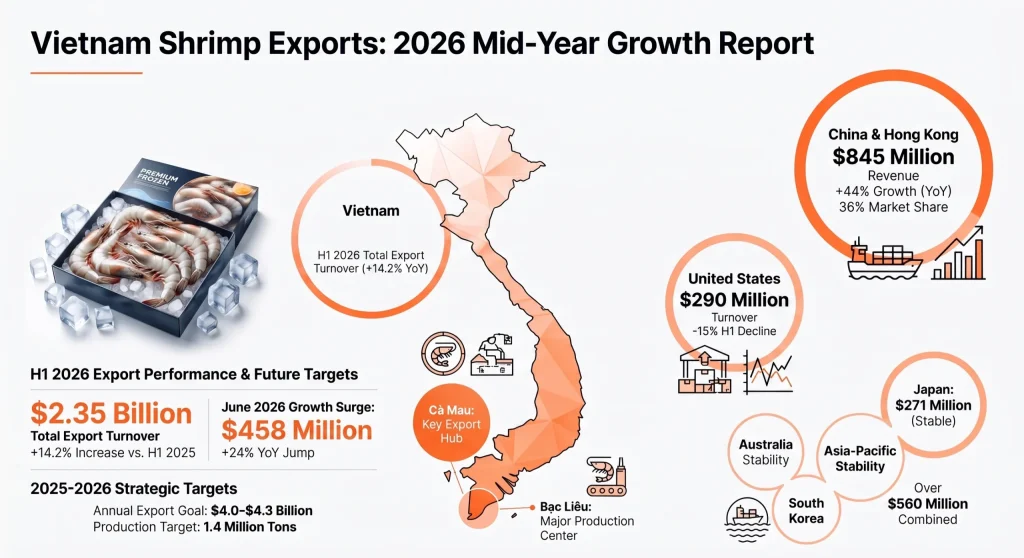
The US is the largest market by value (about USD 796 million in 2025) but is also the riskiest market due to periodic anti-dumping duty (ADD) reviews conducted annually by the US Department of Commerce (DOC); the EU requires strict compliance with IUU (illegal, unreported, and unregulated) fishing regulations and antibiotic residue controls; Japan and South Korea focus on JAS packaging standards and chemical residue inspections; China requires businesses to register under Decree 248 and register product codes under Decree 249 of the GACC.
2. Legal basis governing frozen shrimp export procedures
| Legal document | Content regulated |
|---|---|
| Fisheries Law 2017 (18/2017/QH14) | General regulations on aquaculture, fishing, processing, and seafood export |
| Decree 26/2019/ND-CP; Decree 37/2024/ND-CP | Guidance on implementing the Fisheries Law; list of seafood exports subject to conditions |
| Consolidated Document 02/VBHN-BNNPTNT (consolidating Circular 48/2013 and Circular 32/2022) | Inspection and certification of food safety for exported seafood; authority to issue Health Certificates by NAFIQAD/NAFIQUAST |
| Decree 69/2018/ND-CP | Frozen shrimp is not on the list of goods banned from export or requiring an export license |
| Circular 38/2015/TT-BTC, amended by Circular 39/2018/TT-BTC | Customs procedures and customs supervision for exported goods |
| Decree 128/2020/ND-CP | Administrative penalties in the customs sector (incorrect HS code or value declarations, etc.) |
This is the fundamental legal framework businesses need to understand in order to correctly carry out frozen shrimp export procedures and avoid issues during customs clearance.
3. Conditions for farming areas and processing plants
| Condition | Issuing/managing authority | Note |
|---|---|---|
| Farming area code (for farmed shrimp) | Local Fisheries Sub-department | Used for traceability; near-mandatory for the EU and US |
| DL code (export-qualified processing plant) | NAFIQAD/NAFIQUAST | The plant must be on the list recognized by each market (EU, China under GACC, South Korea, etc.) |
| HACCP/ISO 22000/BRC certification | Independent certification bodies | Near-mandatory condition for most major importers in the EU, US, and Japan |
| Registration for exporting to China (Decree 248) | GACC (General Administration of Customs of China) | Mandatory since 2022; without a GACC code, official export to China is not possible |
| FDA facility registration (US market) | US Food and Drug Administration | Accompanied by Prior Notice for each shipment before the goods arrive in the US |
4. HS codes and export duty for frozen shrimp
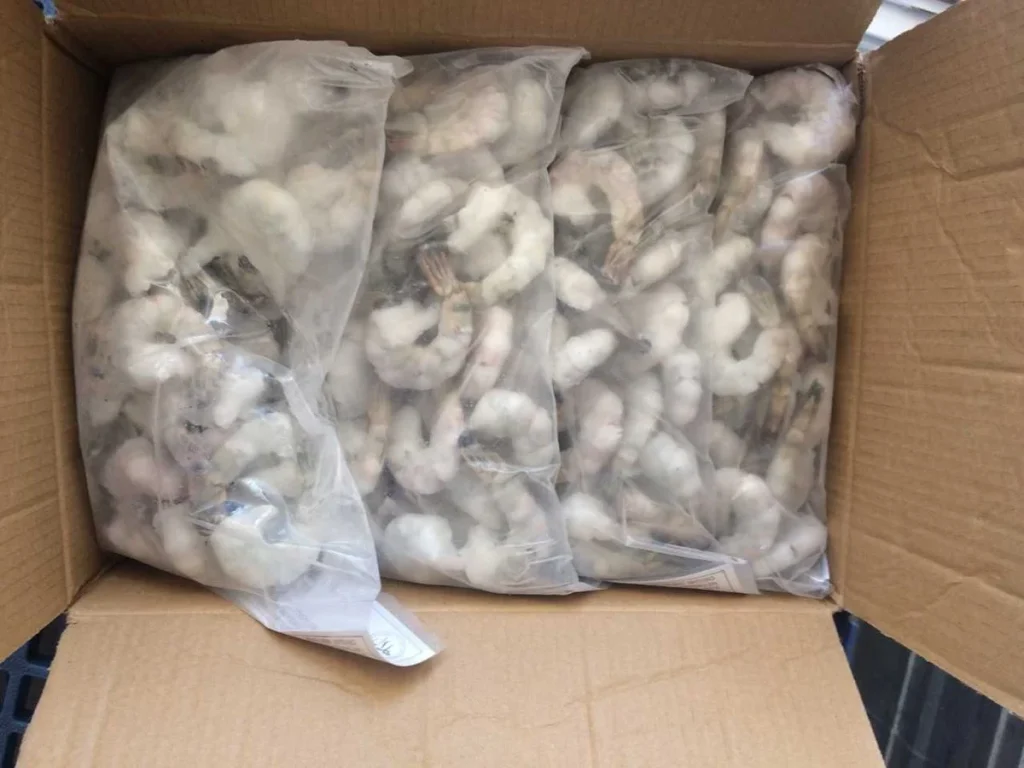
Frozen shrimp falls under Chapter 03 – “Fish and crustaceans, molluscs and other aquatic invertebrates,” heading 03.06 – “Crustaceans.” Correctly identifying the HS code based on the processing method (whole, peeled, PD, PTO, HLSO, etc.) directly affects declarations within frozen shrimp export procedures as well as the import duty in the destination country.
| Type of goods | HS code (Vietnam) | VN export duty | Note |
|---|---|---|---|
| Whole frozen black tiger/whiteleg shrimp | 0306.17 | 0% | Most common code group; refer to the detailed 8-digit subheading |
| Frozen lobster | 0306.11/0306.31 | 0% | Distinguished by saltwater lobster vs. rock lobster |
| Cooked, frozen processed shrimp (steamed/boiled) | 1605.21/1605.29 | 0% | Applies to shrimp that has undergone further processing (steamed, breaded, seasoned) |
Practical note: Vietnam’s export duty on frozen shrimp is currently 0% for most HS codes. However, import duties in the destination country – especially the US – may include additional anti-dumping duties (ADD) following each administrative review by the US Department of Commerce (DOC). According to the most recent administrative review (POR19, announced February 2026), the group of companies eligible for a separate rate faces a cash deposit rate of around 4.28%, while the preliminary results of the next review (POR20, announced mid-2026) set a significantly higher rate for certain mandatory respondents. Businesses should keep monitoring updates via VASEP and the Trade Remedies Authority before each shipment to the US.
5. Quarantine and food safety requirements by market
This is the most complex part and shows the greatest differences between markets within the entire frozen shrimp export procedure, as each country applies its own residue control and traceability mechanism.
| Market | Key requirements | Note |
|---|---|---|
| US | FDA facility registration, Prior Notice for each shipment, subject to ADD under annual POR reviews | ADD rates fluctuate significantly with each review; monitor closely |
| EU | SPS certification, antibiotic residue control, compliance with IUU regulations (catch certificate required for wild-caught marine shrimp) | The processing plant’s DL code must be on the EU-recognized list |
| China | Company registration under GACC Decree 248, product code registration under Decree 249 | Mandatory for both official trade and part of border trade |
| Japan, South Korea | JAS packaging standards, checks on chemical residues and preservative additives | Strict requirements on microbiological indicators and banned antibiotics |
| Middle East | Halal certification | Mandatory requirement for most importers in this region |
6. Documentation required for frozen shrimp export procedures
| Document | When to prepare | Important note |
|---|---|---|
| Sales Contract | Before production and packing | Clearly state Incoterms, processing specification (block/IQF), and shrimp size |
| Commercial Invoice | After packing, before customs declaration | Value must match the contract and the bill of lading |
| Packing List | Same time as the Invoice | Detail the number of packages and net/gross weight by shrimp size |
| Health Certificate | Before the goods reach the port | Issued by NAFIQAD/NAFIQUAST after the sample passes microbiological and antibiotic residue standards |
| Catch Certificate (for wild-caught shrimp) | Before exporting to the EU | Only applies to wild-caught raw material under IUU regulations; farmed shrimp does not need this document |
| Certificate of Origin (C/O) | After obtaining the export declaration | Needed to enjoy preferential tariffs under FTAs (EVFTA, CPTPP, RCEP, etc.) |
| Bill of Lading/Air Waybill (B/L, AWB) | After the container is dropped off/handed over to the carrier | Double-check consignee and destination port details to avoid delays |
| Export Customs Declaration (VNACCS) | Before customs clearance | Declare the correct HS code based on the processing method to avoid penalties under Decree 128/2020 |
7. Frozen shrimp export procedure workflow
Step 1: Standardize the farming area and processing plant
The business works with the local fisheries sub-department to register the farming area code, while ensuring the processing plant obtains the DL code, GACC code (if exporting to China), or FDA registration (if exporting to the US) appropriate to the target market.
Step 2: Sign the contract and determine specifications by market
Agree with the importer on the processing specification (whole HOSO, headless HLSO, peeled PD/PUD, PTO), shrimp size, freezing method (block or IQF), and any additional certifications required.
Step 3: Production, freezing, and packing
The shrimp raw material is pre-processed, sorted by size, frozen to HACCP standards, and packed according to the agreed specification, ensuring the product’s core temperature meets the standard before cold storage.
Step 4: Sample testing and applying for the Health Certificate
The business registers for inspection and sampling at NAFIQAD/NAFIQUAST to check microbiological indicators, banned antibiotics, and chemical residues; once the sample passes, the authority issues the Health Certificate for the shipment.
Step 5: Finalize documentation and declare export customs
The business or its forwarder prepares the Invoice and Packing List, and files the electronic customs declaration on the VNACCS/VCIS system, attaching the Health Certificate, Catch Certificate (if applicable), and C/O appropriate to the destination market’s FTA.
Step 6: International shipping and import clearance at the destination
After the declaration is cleared, the goods are handed over to the carrier via reefer container or air freight. The importer coordinates with the destination country’s customs authority, FDA, or GACC to complete import procedures.
8. Transport methods for frozen shrimp
Due to the deep-freeze storage requirement (-18°C or lower), frozen shrimp is mainly transported using two methods:
Sea freight in reefer containers: Accounts for the largest share, suited for distant markets like the US and EU, departing from Cat Lai and Cai Mep ports, with transit times of 20-35 days depending on the route, requiring a stable temperature of -18°C to -20°C throughout the journey.
Air freight: Used for small, high-value shipments or urgent deliveries to Japan and South Korea, shortening transit time but at a significantly higher cost than sea freight.
9. Time and cost involved in frozen shrimp export procedures
| Item | Reference price/time | Note |
|---|---|---|
| Sample testing, Health Certificate issuance | 1 – 2 days | Depends on the testing indicators required by each market |
| Export customs declaration (VNACCS) | 0.5 – 1 day | Faster if the declaration is routed to the green channel |
| Sea freight (reefer container) | 20 – 35 days | Depends on the market: EU, US |
| AMS/ISF fee (shipments to the US) | USD 30 – 50/shipment | Handled by the NVOCC holding the FMC bond |
| Additional cold storage fee | VND 150,000 – 300,000/ton/day | Best avoided by booking early |
Practical note: The costs above are for reference only and fluctuate with the season and shipping supply-demand conditions. For the US market in particular, businesses should also budget for the anti-dumping duty cash deposit at the current applicable separate rate, which can change after each DOC administrative review.
10. Common risks in frozen shrimp export procedures
| Risk | Symptom | Prevention |
|---|---|---|
| Banned antibiotic residue exceeding the threshold | Health Certificate denied or the shipment flagged in the importing country | Strictly control the farming area and conduct periodic sample testing before harvest |
| Incorrect HS code for the processing method | Duty reassessment and delayed clearance under Decree 128/2020 | Cross-check the HS code with an experienced customs broker/forwarder in seafood |
| Fluctuating anti-dumping duty in the US | Cash deposit rate changes significantly after each POR review | Closely monitor announcements from VASEP and the Trade Remedies Authority before signing long-term contracts |
| Cold chain break during transport | Shrimp loses quality, dehydrates, and affects appearance upon arrival | Use standard-compliant reefer containers and monitor temperature throughout the journey |
| Processing plant lacks the appropriate GACC/DL code for the market | Goods refused entry at the destination border checkpoint | Verify the validity of the plant’s code for each market before signing a contract |
FAQ – Frequently asked questions about frozen shrimp export procedures
Question 1: Does exporting frozen shrimp require an export license?
No. Under Decree 69/2018/ND-CP, frozen shrimp is not on the list of goods requiring an export license. Businesses only need to meet food safety and quarantine conditions and declare customs correctly.
Question 2: Which authority issues the Health Certificate in the frozen shrimp export procedure?
The Health Certificate is assessed and issued by NAFIQAD (now NAFIQUAST) after the shipment is sampled and inspected, meeting microbiological, banned antibiotic, and chemical residue standards.
Question 3: What is the current export duty on frozen shrimp in Vietnam?
Frozen shrimp (HS codes under heading 0306.17 and related subheadings) enjoys a 0% export duty rate in Vietnam. However, some markets such as the US may impose additional anti-dumping duty at the import stage, which changes with each administrative review.
Question 4: Does farmed shrimp need a catch certificate under IUU regulations?
No. The Catch Certificate under the EU’s IUU regulations only applies to raw material caught from the wild sea. Farmed shrimp requires traceability via the farming area code instead of a catch certificate.
Question 5: What does a business need to prepare to export frozen shrimp to China?
The business must register its processing plant under GACC Decree 248, and ensure the product is registered under Decree 249 before officially exporting to this market.
How does 3W Logistics support frozen shrimp export procedures?
As a freight forwarding company registered as an OTI-NVOCC with an FMC bond (Federal Maritime Commission) in the US, holding a SCAC Code to self-file AMS/ISF directly, and with experience handling frozen seafood exports to diverse markets, 3W Logistics provides a full-package service for businesses on frozen shrimp export procedures – from market consultation and coordinating inspections through to customs clearance in the importing country.
- Target market consultation and export conditions: Identify markets suited to the plant’s capacity, advise on testing requirements and country-specific codes (GACC, FDA, EU), and calculate costs and tariff risks in advance so businesses have full figures before signing a contract.
- Support connecting for the Health Certificate: Guide businesses in preparing correct testing registration documents, coordinate with NAFIQAD/NAFIQUAST so the shipment is sampled, inspected, and certified on time, matching the Invoice and Packing List.
- Updates on tariff policy changes: Closely monitor anti-dumping duty reviews in the US, IUU regulations in the EU, and changes from the GACC to help businesses proactively plan their export strategy.
- Booking and shipping in reefer containers: Arrange sea freight via reefer container or air freight depending on the market, from major Vietnamese ports to destinations worldwide, maintaining a stable temperature for frozen shrimp throughout the journey.
- Electronic customs declaration (VNACCS) and import procedures at the destination: A professional customs declaration team handles the export declaration and cross-checks the HS code against the processing method; as an OTI-NVOCC with FMC and SCAC Code, 3W Logistics issues its own House Bill of Lading (HBL) and self-files AMS/ISF directly for shipments to the US.
- Handling issues that arise upon arrival in the importing country: With an agent network across multiple markets, 3W Logistics helps businesses prepare complete documentation and quickly resolve any additional requirements from local customs or quarantine authorities.
Why choose 3W Logistics for frozen shrimp export shipments: Unlike many intermediary forwarders that must go through a third-party agent, 3W Logistics is a direct OTI-NVOCC with a bond and FMC certification in the US, holding a SCAC Code that allows it to self-file AMS/ISF – shortening documentation processing time and reducing the risk of delays, which is especially important for seafood shipments with strict time requirements. With offices in Ho Chi Minh City, Hanoi, and Hai Phong, and a team with hands-on experience handling frozen cargo to diverse markets, 3W Logistics is a suitable choice for businesses wanting to ensure their shipment clears customs on time and to standard from their very first export. – Ms. Apple, CCO of 3W Logistics
Head Office – 3W Logistics Ho Chi Minh City Branch
Address: 34 Bach Dang, Tan Son Hoa Ward, Ho Chi Minh City
Hotline: +84 28 3535 0087
____________________________
3W Logistics Hanoi Branch
Address: 81A Tran Quoc Toan, Cua Nam Ward, Hanoi
Hotline: +84 24 3202 0482
____________________________
3W Logistics Hai Phong Branch
Address: 8A Lot 28 Le Hong Phong, Gia Vien Ward, Hai Phong
Hotline: +84 225 355 5939
____________________________
3W LOGISTICS CO., LTD – We here serve you there!
Email: info@3w-logistics.com
Website: www.3w-logistics.com

Ms. Apple is the CCO (Chief Commercial Officer) at 3W Logistics, with over 10 years of experience in sales and business operations management.
At 3W Logistics, Ms. Apple is responsible for commercial strategy, corporate customer development, managing a team of more than 50 sales professionals, and improving business performance in the logistics sector.
With practical experience in sales management and market development, Ms. Apple shares professional insights on business logistics solutions, international transportation, freight forwarding, customer management, trade lane development, and growth strategies in the logistics industry.


