

Fresh chili pepper export procedures in Vietnam entered a new chapter in April 2025, when Vietnam and China officially signed the Protocol on phytosanitary requirements for exported fresh chili peppers — opening an official trade channel to one of the world’s largest chili-consuming markets.
This is a major turning point for key growing regions such as Quang Ngai, Tay Ninh, and An Giang, giving Vietnam’s distinctively spicy produce a stable, large-scale sales channel instead of relying mainly on unofficial cross-border trade as before.
Alongside this market opening, fresh chili pepper export procedures also require businesses to comply more strictly with growing area codes and packing facility codes under the newly issued Decree 38/2026/ND-CP, at a time when China has stepped up monitoring and issued non-compliance warnings for hundreds of Vietnamese growing area codes in recent times.
The article below compiles the full legal basis, conditions, HS codes, procedures, costs, and common risks involved in fresh chili pepper export procedures, updated according to the latest applicable regulations.
1. Potential and export markets for Vietnamese fresh chili pepper
Chili peppers are a common crop across many agricultural regions of Vietnam, concentrated heavily in Quang Ngai, Tay Ninh, An Giang, and several Mekong Delta provinces, known for their spiciness and wide variety. Before the April 2025 Protocol, Vietnamese fresh chili was mainly sold through border trade or exported to smaller markets; the opening of official trade with China has created strong momentum to standardize growing regions in support of fresh chili pepper export procedures.
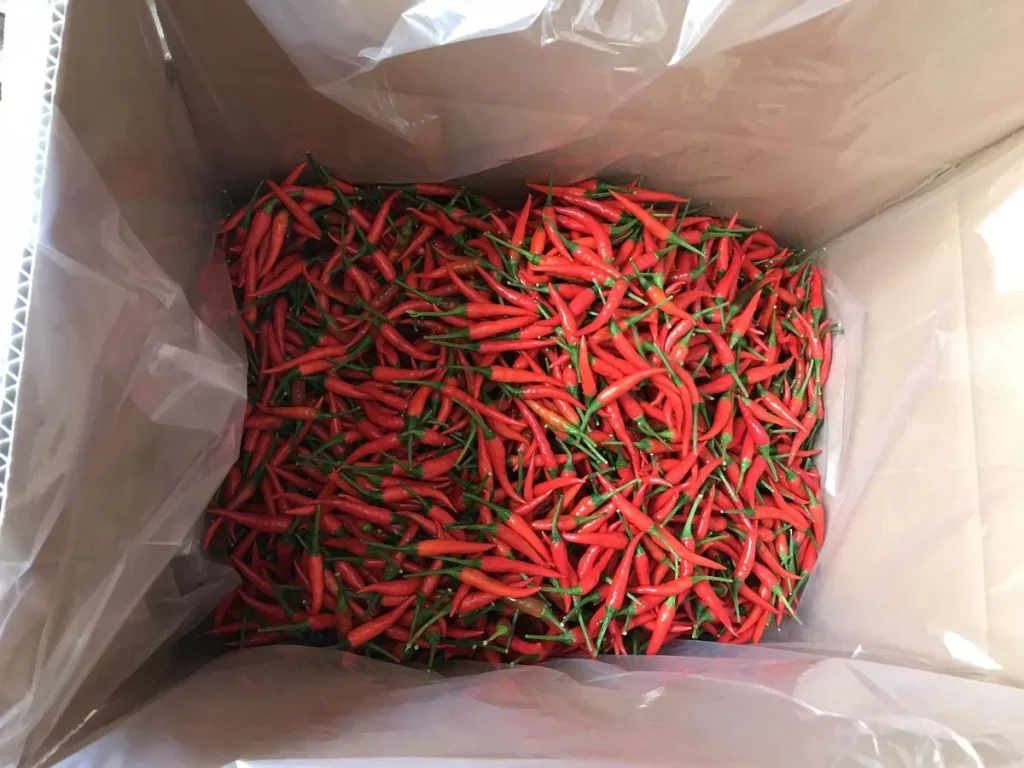
As of May 2026, the country has 9,546 growing area codes and 1,525 packing facility codes serving the export of fresh fruit and produce (including chili peppers) to major markets such as China, the U.S., Australia, New Zealand, South Korea, and Japan; China alone has approved 4,323 growing area codes and 1,332 packing facilities from Vietnam.
2. Legal basis governing fresh chili pepper export procedures
| Legal document | Content regulated |
|---|---|
| Protocol on phytosanitary requirements for fresh chili peppers exported from Vietnam to China (signed April 2025) | A bilateral document setting out quarantine conditions, growing area codes, packing facility codes, and the list of regulated pests requiring control |
| Decree 38/2026/ND-CP | New regulations on management, issuance, monitoring, and digitalization of growing area codes and packing facility codes for export |
| Crop Production Law 2018, Plant Protection and Quarantine Law 2013 | General regulations on growing area codes and phytosanitary quarantine for exported agricultural products |
| Circular 38/2015/TT-BTC, amended by Circular 39/2018/TT-BTC | Customs procedures and supervision for exported goods |
Important update: Decree 38/2026/ND-CP is not simply an administrative document governing growing area and packing facility codes — the entire process, from receiving applications, field inspections, and code issuance to monitoring, warnings, and violation handling, will be progressively digitalized and data-linked between central and local authorities. From 2025 to now alone, China has issued non-compliance warnings for 403 Vietnamese growing area codes and 240 packing facilities, showing that businesses and chili-growing regions need to take maintaining their registered conditions especially seriously.
3. Conditions for growing regions and fresh chili packing facilities
| Condition | Issuing/managing authority | Note |
|---|---|---|
| Chili growing area code | Sub-Department of Crop Production and Plant Protection, approved by GACC | Absolutely mandatory for official export to China, registered through the Ministry of Agriculture and Environment |
| Packing facility code | Sub-Department of Crop Production and Plant Protection, approved by GACC | The processing, sorting, and packing facility must meet hygiene conditions and be issued its own code |
| Control of the 5 regulated pests of concern to China | Self-monitored by the growing region under the guidance of the plant protection authority | Includes: Aleurodicus dispersus, Bactrocera correcta, Bactrocera latifrons, Phenacoccus solenopsis, Asphondylia capsicicola |
| Pesticide management and pre-harvest interval | Only use pesticides on the list permitted in Vietnam | Ensures residue levels do not exceed the importing market’s regulations |
4. HS codes and export duties for fresh chili pepper
Fresh chili pepper falls under Chapter 07 — “Edible vegetables and certain roots and tubers” — heading 07.09, “Other vegetables, fresh or chilled.” Correctly determining the HS code is a mandatory step in fresh chili pepper export procedures, while also clearly distinguishing it from dried chili to avoid confusion when declaring.
| Product type | HS code (Vietnam) | Vietnam export duty | Note |
|---|---|---|---|
| Fresh chili pepper (genus Capsicum) | 0709.60.10 | 0% | The most common code group, matching the scope of the fresh chili Protocol with China |
| Chilled chili pepper | 0710.80 | 0% | Applies when the product is pre-chilled before export |
| Dried chili (not ground or crushed) | 0904.21 | 0% | Not within the scope of the fresh chili Protocol; subject to separate regulations |
Practical note: Export duty on fresh chili pepper in Vietnam is currently 0% for HS codes under heading 0709.60. Businesses need to be especially careful, as fresh chili and dried chili are two products with entirely different HS codes and quarantine regulations when exporting to China — only fresh chili falls directly under the scope of the Protocol signed in April 2025.
5. Documentation package for fresh chili pepper export procedures
| Document | When to prepare | Important note |
|---|---|---|
| Sales Contract | Before harvest and packing | Must clearly state Incoterms, packing specifications, and chili variety |
| Commercial Invoice and Packing List | After packing, before customs declaration | Must clearly state the growing area code and packing facility code for each shipment |
| Phytosanitary Certificate | Before goods reach the port/border gate | Declaration content must include the additional information required by the fresh chili Protocol |
| Growing area code and packing facility code | Before harvest | Must be verified against the list published by GACC before each shipment |
| Certificate of Origin (C/O Form E) | After the export declaration is issued | Required to enjoy preferential tariffs under ACFTA when clearing customs in China |
| Export customs declaration (VNACCS) | Before customs clearance | Declare the correct HS code for fresh chili, attaching the quarantine certificate and growing area code |
6. Fresh chili pepper export procedure steps
Step 1: Register the growing area code
The grower submits a technical declaration requesting a growing area code, along with detailed documentation, to the Sub-Department of Crop Production and Plant Protection; the application is sent by the Ministry of Agriculture and Environment to GACC for approval — this is the foundational first step in fresh chili pepper export procedures.
Step 2: Standardize the growing region to meet China’s quarantine requirements
The growing region carries out pest management, controlling the 5 regulated pests of concern to China, using only pesticides on the permitted list, and complying with pre-harvest intervals.
Step 3: Register the packing facility code
The chili processing, sorting, and packing facility must meet hygiene conditions and be issued its own code, registered with GACC alongside the code for the source growing area.
Step 4: Sign the contract and determine packing specifications
Agree with the importer on chili variety, packing specifications, and quantity per box/bag before proceeding with harvest and processing.
Step 5: Harvest, pack, and register for phytosanitary quarantine
Harvest at the correct ripeness, pack at a facility with an approved code, ensuring the product is free from soil and plant residue, then register for quarantine to be issued a Phytosanitary Certificate.
Step 6: Complete the documentation package and declare customs export
The enterprise or its forwarder prepares the invoice and packing list, and declares the electronic customs declaration on the VNACCS system, attaching the phytosanitary certificate, the growing area/packing facility code, and a C/O Form E.
Step 7: Transportation and import clearance in China
Once the declaration is cleared, the goods are handed over to a road carrier through a border gate or a sea carrier. Chinese customs and quarantine authorities cross-check the growing area code and packing facility code before allowing clearance.
7. Timeline, costs, and common risks in fresh chili pepper export procedures
| Stage | Estimated time | Note |
|---|---|---|
| Registering the growing area and packing facility code | A few weeks to a few months (one-time) | Includes waiting time for GACC approval |
| Registration and sample collection for phytosanitary inspection | 0.5 – 1 day | Issuance of the Phytosanitary Certificate for each shipment |
| Export customs declaration (VNACCS) | 0.5 – 1 day | Faster if the declaration is routed to the green channel |
| Road transport through the border gate | 1 – 3 days | Suitable for keeping chili peppers maximally fresh |
| Risk | Manifestation | Prevention |
|---|---|---|
| Growing area/packing facility receives a non-compliance warning | Code suspended, shipment unable to be officially exported | Strictly maintain registered conditions, update regularly on the digital system |
| Live regulated pests detected | Shipment rejected for import due to violation of Protocol requirements | Fully implement prevention measures for the 5 regulated pests according to technical guidance |
| Pesticide residue exceeding the threshold | Goods held for inspection or rejected for import | Comply with pre-harvest intervals, only use pesticides on the permitted list |
| Buying, selling, or leasing out growing area codes | Damages the reputation of the entire growing region, easily leading to GACC warnings or code revocation | Only use the code for the actual registered growing area; do not transfer it to a third party |
8. FAQ – Frequently asked questions about fresh chili pepper export procedures
Question 1: Since when has Vietnamese fresh chili been officially exported to China?
Since April 2025, when Vietnam and China officially signed the Protocol on phytosanitary requirements for exported fresh chili peppers, opening a large-scale official export channel instead of relying mainly on border trade as before.
Question 2: Can a growing area without a registered code export fresh chili to China?
No. Growing areas and packing facilities must be approved by both the Ministry of Agriculture and Environment and GACC before official export — this is a prerequisite condition in fresh chili pepper export procedures.
Question 3: What is the current export duty on fresh chili to China?
Fresh chili (HS code under heading 0709.60) enjoys a 0% export duty rate in Vietnam. When clearing customs in China, businesses should have a C/O Form E to enjoy preferential import tariffs under the ACFTA agreement.
Question 4: Why is it especially important to pay attention to growing area codes when exporting fresh chili right now?
Because China has stepped up monitoring — from 2025 to now alone, it has issued non-compliance warnings for hundreds of Vietnamese growing area and packing facility codes — businesses need to proactively maintain their registered conditions to avoid code suspension, which could disrupt export plans.
How does 3W Logistics support fresh chili pepper export procedures?
As a freight forwarding company registered as an OTI-NVOCC with an FMC bond in the United States, holding an SCAC Code to self-file AMS/ISF declarations directly, 3W Logistics supports businesses through the entire fresh chili pepper export procedure — from growing area code advisory and quarantine coordination through to customs clearance at the Chinese border.
Full-package logistics service at 3W Logistics:
- Advisory on export conditions under the Protocol and Decree 38/2026/ND-CP: Guiding growing areas and packing facilities in preparing code registration documentation correctly, with continuous updates on changes from GACC.
- Support connecting to obtain the Phytosanitary Certificate: Coordinating with quarantine authorities so shipments are sampled, inspected, and certified on time.
- Verification of growing area and packing facility codes: Checking the validity of codes before each shipment, minimizing the risk of rejection at the Chinese border.
- Booking vessels and multimodal transport: Arranging road transport through border gates or sea transport using reefer containers, ensuring fast delivery to keep chili peppers fresh.
- Electronic customs declaration (VNACCS): A professional team handles declarations; as an OTI-NVOCC with FMC and an SCAC Code, 3W Logistics directly issues its own HBL and self-files AMS/ISF for shipments bound for the U.S.
Why choose 3W Logistics: With offices in Ho Chi Minh City, Hanoi, and Hai Phong, and a team that stays closely updated on changes from GACC and Decree 38/2026/ND-CP, 3W Logistics ensures fresh chili shipments clear customs on time and to standard, right from the very first export. – Ms. Apple, CCO of 3W Logistics
Head Office – 3W Logistics Ho Chi Minh City Branch
Address: 34 Bach Dang, Tan Son Hoa Ward, Ho Chi Minh City
Hotline: +84 28 3535 0087
____________________________
3W Logistics Hanoi Branch
Address: 81A Tran Quoc Toan, Cua Nam Ward, Hanoi
Hotline: +84 24 3202 0482
____________________________
3W Logistics Hai Phong Branch
Address: 8A Lot 28 Le Hong Phong, Gia Vien Ward, Hai Phong
Hotline: +84 225 355 5939
____________________________
3W LOGISTICS CO., LTD – We here serve you there!
Email: info@3w-logistics.com
Website: www.3w-logistics.com

Ms. Apple is the CCO (Chief Commercial Officer) at 3W Logistics, with over 10 years of experience in sales and business operations management.
At 3W Logistics, Ms. Apple is responsible for commercial strategy, corporate customer development, managing a team of more than 50 sales professionals, and improving business performance in the logistics sector.
With practical experience in sales management and market development, Ms. Apple shares professional insights on business logistics solutions, international transportation, freight forwarding, customer management, trade lane development, and growth strategies in the logistics industry.


