

Importing computer components is a recurring need for computer assembly businesses, distributors, data centers, and IT service providers in Vietnam. Compared to many other imported commodity groups, computer component import procedures are considered relatively straightforward.
Most computer components are not subject to import restrictions, do not require specialized permits, and import duties are largely low or at 0%. However, many businesses still encounter unnecessary complications due to incorrect HS code declarations, missing C/O, or a lack of awareness regarding specialized inspection requirements for certain specific component types.
In this article, 3W Logistics presents the complete computer component import procedure process under current regulations from HS code classification, required documents, and tax calculations to practical considerations, as seen from a freight forwarder with over 10 years of experience handling electronics and component imports.
1. Are Imported Computer Components Subject to Special Controls?
This is the first question businesses need to clarify before proceeding with computer component import procedures. The overall answer is relatively favorable, but there are a few specific component groups that warrant special attention.
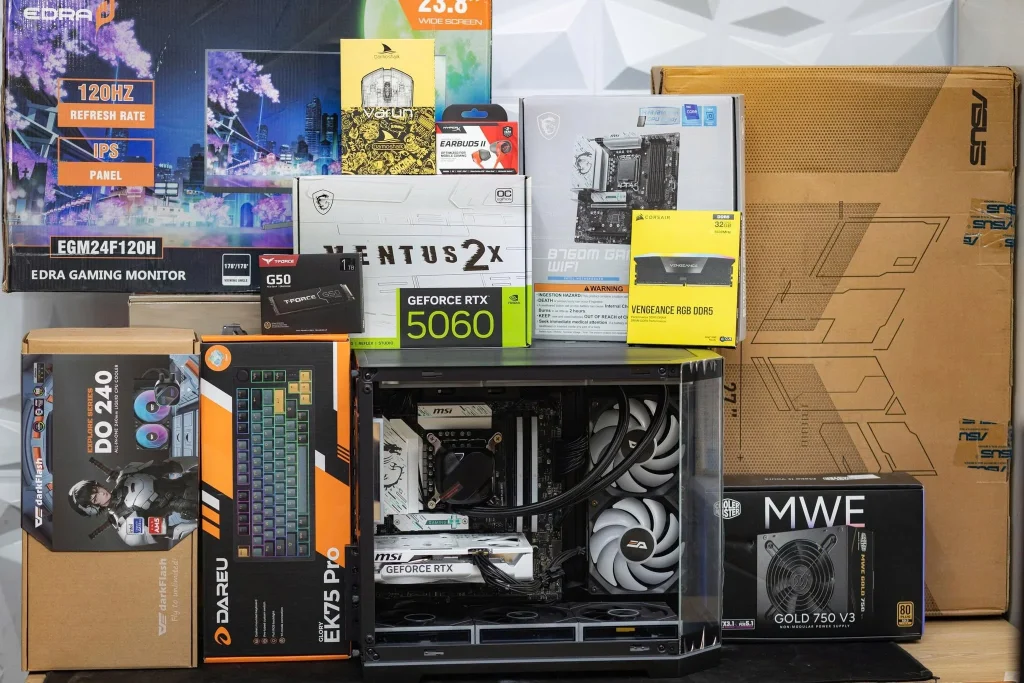
Standard computer components such as CPUs, RAM, motherboards, HDD/SSD drives, graphics cards, power supplies, computer cases, cooling fans, and computer monitors are not subject to import prohibitions or restrictions, do not require advance permits, and are not subject to mandatory conformity certification under current regulations. This is a major difference compared to household electrical equipment or medical devices – businesses can import computer components relatively smoothly if the commercial documentation is prepared correctly.
However, there are a few component groups that require special attention in computer component import procedures:
| Special Component Group | Examples | Legal Notes |
|---|---|---|
| Encryption and security devices | HSM (Hardware Security Module), TPM chips, dedicated encryption cards… | May fall under Decree 58/2016/ND-CP on civil cryptographic products and services – confirmation with the Government Cipher Committee is needed before importing |
| Components with integrated lithium batteries | Laptop battery packs, mini UPS units with integrated batteries, battery-powered IoT devices… | Lithium batteries are Class 9 dangerous goods under IMDG – a DGD and UN-compliant packaging are required for sea or air transport |
| Computer monitors | LCD monitors, LED monitors for retail sale to consumers… | Monitors sold at retail to end users may fall under conformity certification per the QCVN for household electrical equipment – a distinction must be made between B2B monitors used in assembly and retail monitors |
| Broadcasting devices and antennas | WiFi routers integrated into computers, wireless network cards, antennas… | Radio frequency transmitting devices may require a license from the Ministry of Information and Communications under the Law on Radio Frequencies – depending on the power output and frequency band used |
2. HS Codes for Imported Computer Components
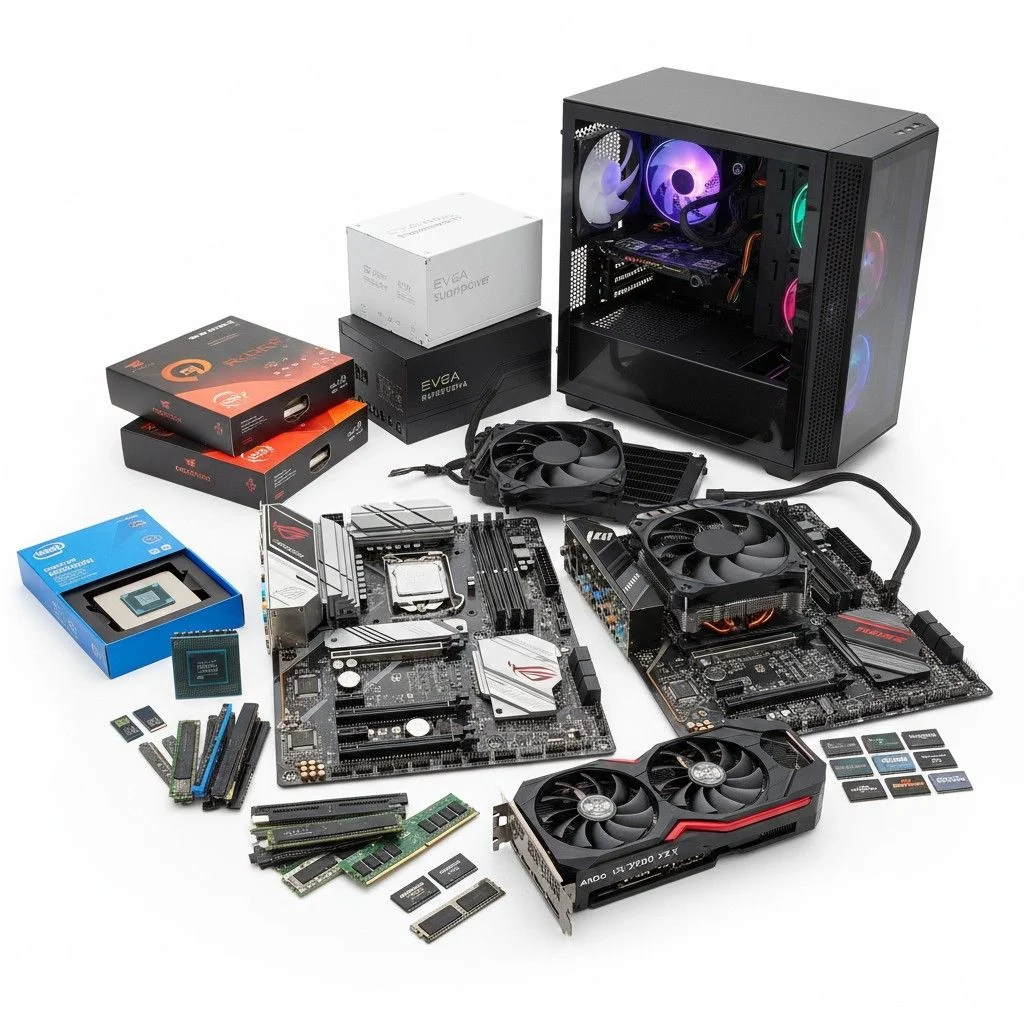
Correctly identifying the HS code is the most important step in the computer component import procedure. Computer components are primarily found in Chapter 84 (Automatic data processing machines and units thereof) and Chapter 85 (Electrical machinery and equipment). An incorrect HS code not only leads to back taxes but also triggers additional customs inspection channels and extends clearance time.
| Computer Component | Reference HS Code | Reference MFN Duty |
|---|---|---|
| CPU (Central Processing Unit) | 8542.31.00 | 0% |
| RAM (Random Access Memory) | 8473.30.39 | 0% |
| Motherboard | 8473.30.39 | 0% |
| HDD (Hard Disk Drive) | 8471.70.10 | 0% |
| SSD (Solid State Drive) | 8471.70.90 / 8473.30.39 | 0% |
| Graphics card (GPU) | 8473.30.39 | 0% |
| Power supply unit (PSU) | 8504.40.30 | 0–5% |
| Computer monitor | 8528.52.00 | 0–5% |
| Keyboard, mouse | 8471.60.10 / 8471.60.90 | 0–5% |
| Computer case / chassis | 8473.30.39 | 0–5% |
| Network card, WiFi card | 8471.80.90 / 8517.62.90 | 0% |
| CPU cooler fan / case fan | 8414.59.40 | 0–5% |
Additionally, each computer component with a different classification, composition, and intended use will carry a different HS code – do not attempt to infer the HS code from the product name alone. Official lookup resources include:
- General Department of Vietnam Customs: customs.gov.vn – search by name or code number
- VNACCS/VCIS System: Look up directly when filing electronic declarations
- Commodity Classification Consultation: Businesses may submit a written request to the provincial/city Customs Department for HS code confirmation before shipment to avoid future disputes
- HS Code Lookup Tool: https://caselaw.vn/tra-cuu-ma-hs – search by name or code number
HS code classification note: The boundary between “computer components/parts” (group 8473), “computer peripherals” (group 8471), and “electronic components” (group 8542) can sometimes be ambiguous for products such as NVMe SSDs, flash memory modules, or co-processor cards. Misclassifying the group in computer component import procedures can lead to customs requiring reclassification and significantly delaying clearance. For high-value or newly introduced components, consult an experienced forwarder or request an advance ruling from the Customs Department before filing.
3. Required Documents for Computer Component Import Procedures
Compared to many other specialized commodity groups, the documentation set for computer component import procedures is relatively streamlined – most standard components require no special permits or specialized declaration filings. This does not mean the standards are relaxed, however; absolute consistency across documents remains a non-negotiable principle.
| Document | When to Prepare | Important Notes |
|---|---|---|
| Sales Contract | Before deposit payment | Must clearly state the component name, exact model/part number, technical specifications, Incoterms, and the supplier’s obligation to provide the C/O |
| Commercial Invoice | Before cargo departs origin | Must clearly state: component name, part number/model, key technical specifications (capacity, speed, power rating…), unit price, and total value – a generic description such as “computer parts” is likely to result in a red-channel assignment requiring physical inspection |
| Packing List | Before cargo departs origin | Clearly state the quantity of each model, net weight, and total weight; for shipments with multiple different component types, a detailed Packing List is the first thing customs checks |
| Bill of Lading / AWB | After cargo is loaded onto vessel/aircraft | The goods description on the B/L should sufficiently describe the component types; for components with integrated lithium batteries, additional dangerous goods information per IMDG/IATA must be included |
| C/O (Certificate of Origin) | Before cargo departs origin (supplier to apply) | For components from China, C/O Form E enables ACFTA duty rates instead of MFN; for components from Japan/Korea already at 0% MFN, the C/O remains important for origin verification when requested by customs |
| Datasheet / Technical documentation | Before or at the same time cargo departs | Customs may request a datasheet to verify technical specifications and confirm the correct HS code – particularly for newly released components or specialized AI/HPC components |
| Electronic customs declaration (VNACCS) | When full documentation is ready | Accurately declare the HS code and customs value – declaring a value lower than the actual transaction value carries the risk of back taxes and severe penalties; electronic component values can easily be cross-referenced by customs against market data |
4. Step-by-Step Computer Component Import Procedure
Step 1: Identify the HS Code and Check Management Policies Before Ordering
Before signing a contract, the business must identify the correct HS code for each component type based on the technical name, part number, and key specifications. Since most computer components already have 0% MFN duty, this step matters more for avoiding misclassification that leads to back taxes than for optimizing duty rates. At the same time, check whether the intended components fall under any special management categories (encryption, broadcasting, etc.) to follow the correct process in computer component import procedures.
Step 2: Sign the Contract and Request the C/O from the Supplier
When negotiating the component purchase contract, the business must include a clause requiring the supplier to provide the C/O under the applicable FTA. For components from China, C/O Form E under ACFTA remains an important tax-saving document even though many component HS codes already have 0% MFN duty – some components such as PSUs, monitors, and computer cases still carry MFN duties of 5–10%. Additionally, require the supplier to fully state part numbers and technical specifications on the Invoice and Packing List.
Step 3: Shipping and Anti-Static Packaging Handling
Electronic components and circuit boards sensitive to static electricity — such as CPUs, RAM, motherboards, and graphics cards — must be packed in anti-static bags (ESD bags) before being placed in carton boxes. HDDs are sensitive to impact and magnetic fields. The business should confirm the packaging plan with the supplier and require photos before the container is sealed, particularly for high-value shipments such as server CPUs or AI GPUs.
Step 4: Receive the Arrival Notice and File the Customs Declaration
When cargo arrives at a Vietnamese port, the forwarder receives the Arrival Notice and files the electronic customs declaration on VNACCS. Standard computer components have a much higher green-channel rate than many other specialized commodity groups – if documentation is complete and consistent, and the business has a good compliance history, many shipments clear via green channel on the same day. However, the first shipment from a new supplier or high-value shipments are typically assigned yellow channel for document review.
Step 5: Customs Clearance, Tax Payment, and Cargo Pickup
After customs confirms the documentation is valid, the business pays the applicable tax (typically just 10% VAT, since import duty is mostly 0%) and collects the D/O from the carrier. Electronic components should be transported to the warehouse or factory under appropriate temperature and humidity control, particularly avoiding exposure to high-humidity environments that could affect circuit boards.
5. How to Calculate Computer Component Import Taxes
Computer components have the most favorable import duty structure among the commodity groups businesses commonly import, with most major HS codes (CPU, RAM, motherboard, HDD, SSD, graphics card, network card) carrying 0% MFN and 0% ACFTA duty. The main tax cost to account for in computer component import procedures is VAT.
A practical example: a shipment of server CPUs imported from Taiwan, CIF value USD 50,000, HS code 8542.31.00, MFN duty 0%, VAT 10%:
| Tax Item | Chapter 84/85 Components (MFN 0%) | Components with MFN 5% (cases, PSUs…) |
|---|---|---|
| CIF Value | USD 50,000 | USD 50,000 |
| Import duty | 0% × 50,000 = USD 0 | 5% × 50,000 = USD 2,500 |
| VAT (10%) | 10% × (50,000 + 0) = USD 5,000 | 10% × (50,000 + 2,500) = USD 5,250 |
| Total tax payable | USD 5,000 (~VND 127 million) | USD 7,750 (~VND 197 million) |
| Practical note | Businesses that assemble and manufacture for export can reclaim input VAT — the actual cost is only the cost of capital during the refund waiting period. For businesses retailing components, the 10% VAT is a real cost that must be factored into the selling price. | |
From 3W Logistics’ practical experience: Computer components are the commodity group where we most frequently see under-declared customs values – particularly for premium AI GPUs such as the NVIDIA H100, A100, or the latest generation Xeon server CPUs. Importers declare a lower-than-actual price hoping to save on VAT. In reality, customs has access to market price reference systems and can look up international transaction prices for most common electronic components – GPUs and server CPUs are products whose accurate prices can be checked within minutes. The shipment gets held for value verification, the value gets adjusted upward, and back taxes plus penalties follow. The costs arising from this situation always far exceed the VAT amount the importer was hoping to “save.” Declaring the actual transaction value is a principle with no exceptions in computer component import procedures. – Ms. Apple, CCO, 3W Logistics
6. Common Risks in Computer Component Import Procedures
| Risk | How It Manifests | Prevention |
|---|---|---|
| Under-declared customs value | Customs checks market price references and detects an under-declared value – value is adjusted upward, the VAT difference is back-taxed plus administrative penalties | Declare the actual transaction value on the Invoice; have payment documentation ready (T/T receipt, L/C) in case customs requests value verification |
| Insufficient goods description on the Invoice | Customs cannot determine the correct HS code from a generic description – red channel assignment for physical inspection, adding 3–7 days for verification | Require the supplier to fully state the technical name, part number/model, and key specifications on the Invoice and Packing List – do not accept generic descriptions such as “electronic components” |
| Incorrect HS code due to a new component with no precedent | AI/HPC components or newly released chips may not have a clear classification precedent – customs may classify them differently than declared, resulting in back taxes | Request an advance ruling from the Customs Department for new components with no classification precedent; or consult a forwarder who has previously handled similar component types |
| Components damaged by static electricity during transport | CPUs, RAM, and graphics cards not packed to ESD standards are damaged during transit – discovered after assembly, leading to difficult-to-resolve insurance disputes | Require ESD bag packaging for sensitive components; take packaging photos before the container is sealed; purchase All Risk cargo insurance for high-value shipments |
| Importing encryption components without proper declaration | A device with encryption functionality is determined to fall under civil cryptography management – the shipment is held for legal verification, which can take months to resolve | Confirm classification with the Government Cipher Committee before importing; consult a forwarder experienced with security devices before signing the contract |
FAQ – Frequently Asked Questions About Computer Component Import Procedures
Question 1: What documents are required for computer component import procedures?
The basic documentation set for computer component import procedures includes:
- Sales Contract (clearly stating part numbers and technical specifications)
- Commercial Invoice (with a detailed description of each component)
- Packing List
- Bill of Lading or AWB
- C/O under the applicable FTA
- Technical datasheets (when requested by customs)
- An electronic customs declaration via VNACCS. For components in special categories (encryption, broadcasting), the corresponding specialized permits are additionally required.
Question 2: Do imported computer components require an import license?
Most standard computer components (CPU, RAM, motherboard, HDD, SSD, GPU, etc.) do not require a special import license. However, components with strong encryption functions (dedicated HSM, TPM) may fall under civil cryptography management per Decree 58/2016, and radio frequency transmitting devices may require a license from the Ministry of Information and Communications. Businesses should confirm with the relevant authority before importing these specific component types.
Question 3: What is the import duty on computer components?
This commodity group has the most favorable import duty structure. CPU, RAM, motherboard, HDD, SSD, graphics cards, and network cards carry 0% MFN duty – the only real payment required is 10% VAT calculated on the CIF value. Some components such as PSUs, monitors, computer cases, and cooling fans carry MFN duties of 0–5%; a valid FTA C/O brings this to 0%. Businesses assembling for export may be eligible to reclaim input VAT.
Question 4: How long does the computer component import procedure take?
With complete documentation and a good compliance history, standard computer components can be assigned green channel and cleared within 1–3 working days from vessel arrival. Yellow channel adds 2–3 days. In cases of red channel assignment or customs requesting value verification, add 5–10 days. This is the fastest clearance time among commodity groups requiring specialized import procedures.
Question 5: Do GPUs and AI chips have different import procedures from standard components?
From a Vietnamese customs standpoint, GPUs and AI chips are currently processed under the standard computer component import procedure with HS codes in Chapter 84/85. However, businesses should note: the value of premium AI GPUs (NVIDIA H100, H200, B200, etc.) is very high and customs will scrutinize the declared value carefully; it is also necessary to confirm the device has no specialized encryption function subject to special management before importing.
How Does 3W Logistics Support Computer Component Import Procedures?
As a freight forwarding company registered as an OTI-NVOCC with an FMC Bond (Federal Maritime Commission) in the United States and with over 10 years of experience handling electronics and component imports, 3W Logistics provides end-to-end services for IT businesses, assemblers, and data centers navigating computer component import procedures – from HS code and customs value consulting before ordering through to components arriving at the assembly warehouse.
- HS code consulting and tax calculation before signing the contract: Identify the correct HS code for each component type based on part numbers and datasheets; calculate actual tax costs; flag special components requiring additional handling such as encryption devices or components with integrated lithium batteries.
- Assistance obtaining the correct FTA C/O from the supplier: Guide Chinese suppliers through the C/O Form E process, Taiwanese suppliers (where applicable), Korean suppliers through Form KV, and Japanese suppliers through Form JV; verify the C/O before acceptance to ensure 100% consistency with the Invoice and B/L.
- Invoice and Packing List consistency review before booking: Review the goods description on the Invoice for sufficient detail (part number, technical specifications) to avoid customs requesting physical inspection due to unclear descriptions.
- Vessel/air freight booking from major component manufacturing hubs: Arrange shipping from China (Shenzhen, Shanghai), Taiwan, South Korea, Japan, and the USA to Hai Phong, Da Nang, and Cat Lai Ho Chi Minh City; advise on ESD and impact-resistant packaging for sensitive components.
- Electronic customs declaration (VNACCS) and channel monitoring: Accurately declare the HS code and actual value; monitor channel assignment and coordinate rapid response when customs requests value verification or physical inspection.
- Support for first-time importers or businesses importing AI/HPC components: Full process consulting, assistance registering customs tax codes, and building a standardized documentation set – helping subsequent shipments clear faster with a strong compliance history.
Why choose 3W Logistics for your computer component import shipments? While computer component import procedures are not complex in terms of specialized permits, they demand high precision in goods description, customs value, and HS codes – particularly for new AI and HPC components where classification boundaries are not yet well established. A shipment of GPUs worth billions of VND held for value verification can cause serious project delays. We understand the specifics of each component type and have experience handling even the most complex shipments. Contact 3W for consultation before signing your component purchase contract.
Address: 34 Bach Dang Street, Tan Son Hoa Ward, Ho Chi Minh City
Hotline: +84 28 3535 0087
____________________________
3W Logistics Hanoi Branch
Address: 81A Tran Quoc Toan Street, Cua Nam Ward, Hanoi
Hotline: +84 24 3202 0482
____________________________
3W Logistics Hai Phong Branch
Address: 8A Lot 28 Le Hong Phong Street, Gia Vien Ward, Hai Phong
Hotline: +84 225 355 5939
____________________________
3W LOGISTICS CO., LTD – We here serve you there!
Email: quote@3w-logistics.com
Website: www.3w-logistics.com

Ms. Apple is the CCO (Chief Commercial Officer) at 3W Logistics, with over 10 years of experience in sales and business operations management.
At 3W Logistics, Ms. Apple is responsible for commercial strategy, corporate customer development, managing a team of more than 50 sales professionals, and improving business performance in the logistics sector.
With practical experience in sales management and market development, Ms. Apple shares professional insights on business logistics solutions, international transportation, freight forwarding, customer management, trade lane development, and growth strategies in the logistics industry.


