
Coffee Export Procedures to China are entering an important transition period, as China’s General Administration of Customs (GACC) officially applies Decree 280 from June 1, 2026, completely replacing Decree 248, which had been in effect since 2022.
This is a major reform in food safety management and foreign enterprise registration, shifting from an administrative management mechanism to a flexible risk-assessment model, opening up more favorable opportunities for Vietnamese coffee businesses.
As the world’s second-largest coffee exporter, behind only Brazil, while China is witnessing rapidly growing coffee consumption, this is a promising market that many Vietnamese businesses are actively pursuing. However, coffee export procedures to China require businesses to clearly understand the registration requirements under the new system and correctly distinguish between green coffee beans, roasted/ground coffee, and instant coffee, as each product group has different management requirements.
The article below compiles the complete legal basis, conditions, HS codes, procedures, costs, and common risks involved in coffee export procedures to China, updated according to the latest current regulations.
1. China Market Potential for Vietnamese Coffee
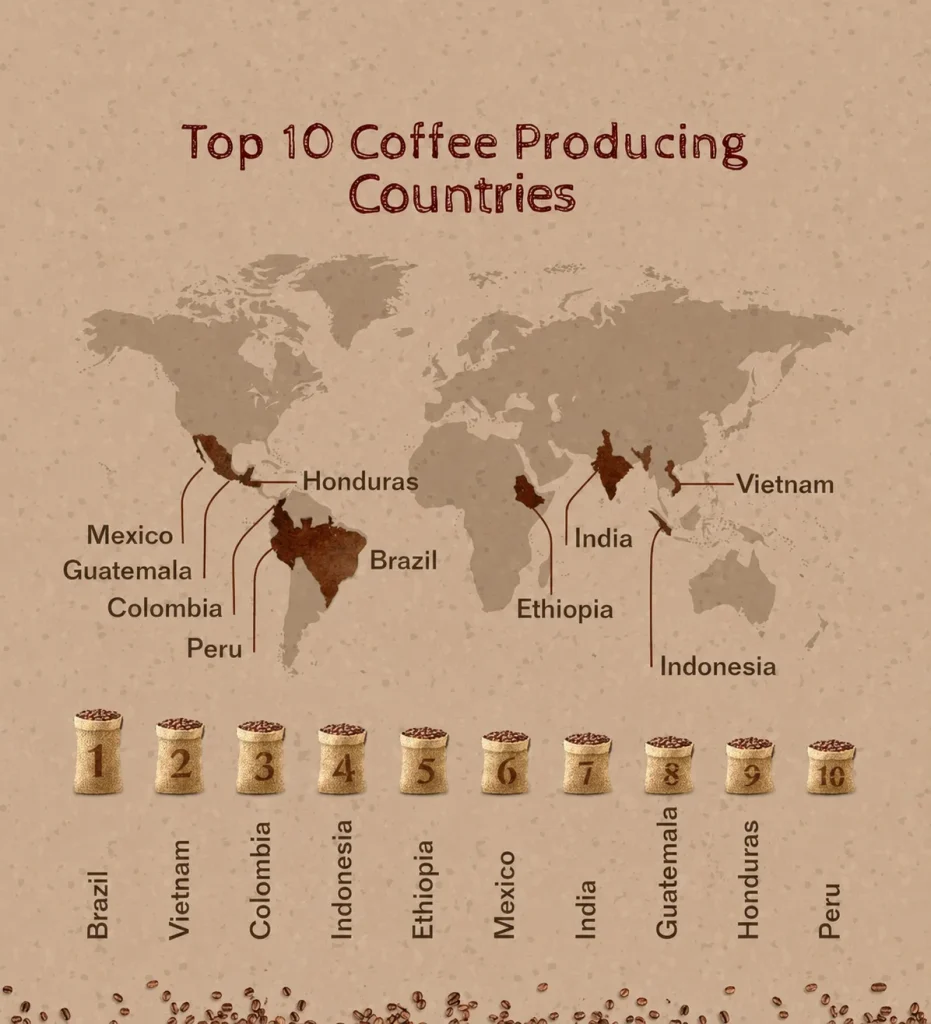
Vietnam is one of the world’s leading coffee producing and exporting countries, with growing areas concentrated mainly in the Central Highlands (Dak Lak, Lam Dong, Dak Nong, Gia Lai). Meanwhile, China – a neighboring country with a population of over 1 billion – is seeing rapidly growing coffee consumption, especially in major cities, creating substantial room for coffee export procedures to China to develop in the coming years.
Vietnamese coffee exported to China currently spans several segments: green coffee beans (robusta, arabica), whole roasted/ground coffee, and instant coffee – each group has its own management characteristics and HS code, and businesses need to clearly identify theirs before proceeding to the next steps.
2. Legal Basis Governing Coffee Export Procedures to China
| Legal Document | Content Governed |
|---|---|
| GACC Decree 280 (issued October 14, 2025, effective June 1, 2026) | New regulations on registration and management of foreign enterprises producing, processing, and storing food exported to China, completely replacing Decree 248 |
| GACC Decree 249 | Measures for the administration of food import and export safety, still in effect alongside Decree 280 |
| Law on Crop Production 2018, Law on Plant Protection and Quarantine 2013 | Vietnam’s general regulations on growing area codes and phytosanitary requirements for exported agricultural products |
| Circular 38/2015/TT-BTC, amended by Circular 39/2018/TT-BTC | Customs procedures, inspection and supervision for exported goods |
Important new point to note: According to an assessment by Vietnam’s SPS Office (Ministry of Agriculture and Environment), the most significant change under Decree 280 is the removal of the “equivalence assessment” requirement between Vietnam’s food safety system and China’s, with GACC instead shifting to risk-based classification management for each product group. In addition, a registration code that meets requirements will be automatically renewed for another 5 years without needing to redo the procedure as before, significantly reducing the administrative burden for coffee businesses in coffee export procedures to China.
3. Conditions for Coffee Exporting Businesses
| Condition | Issuing/Managing Authority | Notes |
|---|---|---|
| Exporting enterprise registration code (GACC/CIFER code) | Department of Plant Protection (focal point), approved by GACC | Mandatory for roasted/ground coffee and instant coffee (processed food); unroasted green coffee beans are registered via a hard-copy dossier submitted to the Department of Plant Protection |
| Food safety and hygiene certificate | Local Sub-Department of Food Safety and Hygiene | Mandatory for roasted/ground and instant coffee processing facilities |
| Quality control system (HACCP, ISO 22000) | Independent certification body | Recommended for processed coffee, improving the ability to satisfy the risk assessment under Decree 280 |
| Growing area code (recommended) | Department of Crop Production and Plant Protection | Not yet mandatory as it is for durian or coconut, but a significant advantage when GACC conducts its risk-based assessment |
4. HS Codes and Export Duty for Coffee Exported to China
Coffee falls under Chapter 09 – “Coffee, tea, maté, and spices,” heading 09.01 for green coffee beans, while instant coffee falls under heading 21.01. Correctly determining the HS code is a mandatory requirement in coffee export procedures to China, as GACC manages products separately down to a detailed 10-13 digit code (CIQ code).
| Goods Type | HS Code (Vietnam) | VN Export Duty | Notes |
|---|---|---|---|
| Unroasted, non-decaffeinated green coffee beans | 0901.11 | 0% | The most common code group, accounting for the majority of Vietnam’s green coffee bean export turnover |
| Decaffeinated green coffee beans | 0901.12 | 0% | Less common, requires careful cross-checking of the processing method before declaration |
| Roasted, non-decaffeinated coffee | 0901.21 | 0% | Applies to whole roasted coffee beans or ground coffee |
| Instant coffee | 2101.11 | 0% | Falls under the group of extracts, essences, and coffee-based preparations |
Practical note: Vietnam’s export duty on coffee is currently 0% for most HS codes. However, upon customs clearance in China, GACC requires declaration under a CIQ code that is more detailed than the standard HS code (for example, code 0901110000101 for unroasted coffee processed by extraction, pressing, cooking methods, etc.). Businesses should work with an experienced logistics provider to avoid CIQ code declaration errors that cause customs clearance delays.
5. Export Registration Process Under Decree 280
| Comparison Point | Decree 248 (before June 1, 2026) | Decree 280 (from June 1, 2026) |
|---|---|---|
| Management principle | Administrative management, requiring equivalence assessment of the food safety system | Assessment based on the risk level of each product group and the exporting country’s control capacity |
| Code validity and renewal | 5 years, must submit a renewal application 3-6 months before expiry | Facilities meeting requirements are automatically renewed for another 5 years, without needing to redo the procedure |
| Change of enterprise information | Regulations were unclear, prone to complications | If the location relocates, the legal representative changes, or the domestic registration number changes, the code in China automatically becomes invalid from the date of notification |
| Scope of registration subjects | No clear distinction between production facilities and storage facilities | Storage facilities (cold storage, transit warehouses) are published in a separate list, distinct from production/processing facilities |
6. Documentation Required for Coffee Export Procedures to China
| Document | When to Prepare | Important Notes |
|---|---|---|
| Sales Contract | Before manufacturing and packaging | Clearly state Incoterms, packaging specifications, and coffee type (beans/roasted-ground/instant) |
| Commercial Invoice and Packing List | After packaging, before customs declaration | Value must match the contract and bill of lading |
| Phytosanitary Certificate | Before the goods leave the port/border gate | Applies to green coffee beans in raw plant material form |
| Food safety and hygiene certificate | Before registering for the export code | Mandatory for roasted/ground and instant coffee processing facilities |
| Enterprise registration code (GACC/CIFER) | Before the first export shipment | Cross-check the code’s validity before each shipment per Decree 280 regulations |
| Certificate of Origin (C/O form E) | After obtaining the export customs declaration | Needed to enjoy preferential duty rates under ACFTA upon customs clearance in China |
| Export customs declaration (VNACCS) | Before customs clearance | Declare the correct HS code for beans/roasted-ground/instant coffee |
7. Coffee Export Procedure Process to China
Step 1: Determine the Product Type and Register the Export Code
The business identifies specifically whether the product is green coffee beans, roasted/ground coffee, or instant coffee to select the correct registration method; for unroasted coffee, submit the registration dossier via the Department of Plant Protection; for processed coffee (roasted/ground, instant), register the code on GACC’s CIFER system under Decree 280.
Step 2: Prepare the Registration Dossier Per the Prescribed Template
The business submits registration information and production facility information (translated into English) via the Department of Plant Protection or directly on the CIFER system, fully declaring the enterprise name, address, product type, and production process.
Step 3: Track the Appraisal Progress and Receive the Code
The Department of Plant Protection receives and processes the dossier, coordinating with GACC to conduct the risk-based assessment; the business tracks feedback notifications directly on the system before receiving the official code.
Step 4: Sign the Contract and Manufacture/Pack According to the Order
Once the code is obtained, the business signs the commercial contract, manufactures, and packs the coffee per the agreed specifications, ensuring no banned substances are used and pesticide residue does not exceed thresholds.
Step 5: Register for Phytosanitary Inspection (for green coffee beans)
For green coffee beans in raw material form, the business registers for quarantine inspection so the specialized authority can take samples, inspect, and issue the Phytosanitary Certificate before export.
Step 6: Complete Documentation and Declare Export Customs
The business or a forwarding partner prepares the Invoice and Packing List, declares the electronic customs declaration on the VNACCS system, and attaches the export registration code, quarantine certificate (if applicable), and C/O form E.
Step 7: Transport and Import Clearance in China
After the customs declaration is cleared, the goods are handed over to a road carrier crossing the border gate, or shipped by sea to Chinese ports; Chinese customs cross-checks the registration code and CIQ code before allowing customs clearance.
8. Modes of Transport for Coffee to China
Road transport (border trade): Common for large volumes of green coffee beans, crossing through the Lang Son and Lao Cai border gates, with short transit time and reasonable cost for large-volume shipments.
Sea transport: Suitable for containerized green coffee beans and roasted/ground coffee, departing from Cat Lai or Quy Nhon ports to southern Chinese ports such as Guangzhou and Shenzhen.
Air transport: Applied to premium roasted/ground coffee and instant coffee requiring fast delivery, or small quantities for market testing purposes.
9. Time and Cost for Coffee Export Procedures to China
| Stage | Estimated Time | Notes |
|---|---|---|
| Registering the export code (one-time) | Several weeks to several months | Automatically renewed for another 5 years under Decree 280 if requirements are still met |
| Registering and sampling for phytosanitary inspection | 0.5 – 1 day | Applies to green coffee beans |
| Export customs declaration (VNACCS) | 0.5 – 1 day | Faster if the declaration is routed to the green channel |
| Road transport through the border gate | 1 – 3 days | Via the Lang Son, Lao Cai border gates |
| Sea transport | 3 – 7 days | Depending on the destination port in China |
Practical note: The time and cost figures above are for reference only. Businesses that already hold a valid registration code before June 1, 2026, should proactively check and update their information per Decree 280 to avoid disruption to coffee export procedures to China, especially if there is a change in production location or legal representative.
10. Common Risks in Coffee Export Procedures to China
| Risk | Manifestation | Prevention |
|---|---|---|
| Not yet updated on the transition from Decree 248 to Decree 280 | Applying the wrong registration process, resulting in a returned dossier or delayed processing | Regularly update information from Vietnam’s SPS Office and the Department of Plant Protection |
| Incorrect HS code/CIQ code among coffee types | Retroactive duty collection, delayed clearance, need to amend the declaration | Carefully cross-check the HS code and CIQ code with a customs unit/forwarder experienced in coffee goods |
| Failing to promptly update changes to production facility information | The registration code automatically becomes invalid under Decree 280 without the business realizing it | Notify immediately upon any change of location, legal representative, or domestic registration number |
| Pesticide residue exceeding thresholds | Assessed as high risk, resulting in increased inspection frequency or import rejection | Control the growing area, comply with pesticide pre-harvest interval periods |
| Missing food safety certification for processed coffee | The registration dossier is rejected from the outset | Fully complete food safety certification and the HACCP/ISO 22000 system before submitting the dossier |
11. FAQ – Frequently Asked Questions About Coffee Export Procedures to China
Question 1: How does Decree 280 differ from Decree 248 in coffee export procedures to China?
The biggest difference is that Decree 280 shifts from administrative management to risk-based assessment, removes the requirement for food safety system equivalence assessment, and allows automatic renewal of the code for another 5 years without needing to redo the procedure as before.
Question 2: Do green coffee beans and roasted/ground coffee follow the same export code registration procedure?
Not entirely the same. Unroasted green coffee beans are usually registered via a hard-copy dossier submitted to the Department of Plant Protection, while roasted/ground coffee and instant coffee fall under the processed food group and must be registered on the CIFER system per GACC regulations.
Question 3: What is the current export duty on coffee exported to China?
All types of coffee (HS code under headings 0901 and 2101) enjoy a 0% export duty rate in Vietnam. Upon customs clearance in China, businesses should have a C/O form E to enjoy preferential import duty rates under the ACFTA Agreement.
Question 4: Is a coffee export registration code issued before June 1, 2026, still valid?
A code issued under Decree 248 remains valid for its original term; however, businesses need to follow transition guidance from the Department of Plant Protection to ensure their registration information matches Decree 280’s new requirements, especially when the renewal period comes up.
Question 5: Where should a small business exporting coffee to China for the first time start?
The business should clearly determine the product type (beans/roasted-ground/instant), fully prepare food safety certification and a quality control system, then contact the Department of Plant Protection or an experienced logistics service provider for guidance on registering the code following the current procedure correctly.
How Does 3W Logistics Support Coffee Export Procedures to China?
As a freight forwarding company registered as an OTI-NVOCC with an FMC bond (Federal Maritime Commission) in the United States, holding an SCAC Code to self-file AMS/ISF declarations directly, along with experience handling agricultural products exported to China and various other markets, 3W Logistics provides a comprehensive service for businesses regarding coffee export procedures to China – from consulting on registration under Decree 280 through to customs clearance at the Chinese border.
- Consulting on the transition from Decree 248 to Decree 280: Guiding businesses to review their existing registration code and prepare a dossier suited to the new risk-based assessment mechanism, minimizing the risk of export disruption.
- Support connecting to obtain the Phytosanitary Certificate: Coordinating with the plant quarantine authority so green coffee bean shipments are sampled, inspected, and certified on time.
- Accurately cross-checking the HS code/CIQ code for each coffee type: Helping businesses correctly classify green coffee beans, roasted/ground coffee, and instant coffee for accurate declaration from the outset, avoiding clearance delays.
- Booking vessels and transport across multiple modes: Arranging road transport through border gates, sea transport, or air transport depending on volume and coffee type, to destinations across China.
- Electronic customs declaration (VNACCS) and clearance procedures at the Chinese border: A professional customs declaration team handles export declarations, cross-checks HS codes and CIQ codes; as an OTI-NVOCC holding FMC and an SCAC Code, 3W Logistics directly issues its own House Bill of Lading (HBL) and self-files AMS/ISF for shipments to the U.S.
- Handling issues arising when goods reach the Chinese border: With a network of agents in China, 3W Logistics helps businesses prepare complete documentation and quickly handle any additional requirements arising from local customs authorities.
Why choose 3W Logistics for coffee export routes to China: Unlike many intermediary forwarders, 3W Logistics is an OTI-NVOCC with a direct FMC bond and certification in the U.S., holding an SCAC Code that allows self-filing of AMS/ISF – helping shorten documentation processing time and reduce delay risks across the entire agricultural goods portfolio. With an office network in Ho Chi Minh City, Hanoi, and Hai Phong, along with a team that stays closely updated on GACC policy changes such as Decree 280, 3W Logistics is a suitable choice for businesses wanting to ensure their coffee shipment clears customs on time and to standard from the very first export. – Ms. Apple, CCO 3W Logistics
Head Office – 3W Logistics Ho Chi Minh City Branch
Address: 34 Bach Dang, Tan Son Hoa Ward, Ho Chi Minh City
Hotline: +84 28 3535 0087
____________________________
3W Logistics Hanoi Branch
Address: 81A Tran Quoc Toan, Cua Nam Ward, Hanoi
Hotline: +84 24 3202 0482
____________________________
3W Logistics Hai Phong Branch
Address: 8A Lo 28 Le Hong Phong, Gia Vien Ward, Hai Phong
Hotline: +84 225 355 5939
____________________________
3W LOGISTICS CO., LTD – We here serve you there!
Email: quote@3w-logistics.com
Website: www.3w-logistics.com

Ms. Apple is the CCO (Chief Commercial Officer) at 3W Logistics, with over 10 years of experience in sales and business operations management.
At 3W Logistics, Ms. Apple is responsible for commercial strategy, corporate customer development, managing a team of more than 50 sales professionals, and improving business performance in the logistics sector.
With practical experience in sales management and market development, Ms. Apple shares professional insights on business logistics solutions, international transportation, freight forwarding, customer management, trade lane development, and growth strategies in the logistics industry.


