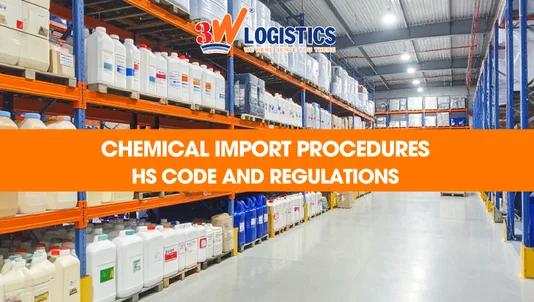
Chemical import is one of the most strictly regulated import sectors in Vietnam, featuring a dedicated classification system, prohibited lists, restricted lists, and separate licensing requirements for each chemical group.
Unlike most ordinary goods, chemical import procedures require businesses to complete multiple legal steps before cargo leaves the origin port – from chemical use registration and import license applications to preparing complete chemical safety documentation.
Many manufacturing, textile, electronics, and food processing companies only begin researching chemical import procedures after signing purchase contracts, only to discover that the chemical they intend to import falls under a restricted category requiring a permit, or that they lack a Safety Data Sheet (SDS) compliant with Vietnamese standards. The result is cargo held at port, mounting container storage costs, and in some cases forced re-export.
In this article, 3W Logistics presents the complete chemical import procedures process under current regulations – from chemical classification, licensing conditions, required documents, HS codes, and tax calculations to real-world risks, as seen from a freight forwarder with over 10 years of experience handling chemical import shipments.
1. Chemical Classification and Corresponding Legal Requirements
The first and most critical step in the chemical import procedures is determining which regulatory group the intended chemical falls under in Vietnam’s management system. Under Chemical Law 2007 and Decree 113/2017/ND-CP (as amended by Decree 82/2022/ND-CP), imported chemicals are divided into three groups with entirely different legal requirements.
| Chemical Group | Examples | Pre-Import Requirements |
|---|---|---|
| Prohibited chemicals | Certain narcotic precursor chemicals, chemical warfare agents, POPs chemicals banned under international conventions | Absolutely prohibited from import – violations are subject to criminal prosecution |
| Chemicals restricted in production and trading | Concentrated sulfuric acid, hydrochloric acid, acetone, toluene, certain industrial precursors… | Import license issued by the Ministry of Industry and Trade – mandatory before customs clearance |
| Ordinary chemicals | Industrial chemicals, water treatment chemicals, food additives, textile chemicals… | No separate import license required, but an SDS and chemical labeling compliant with regulations under Decree 113/2017 are mandatory |
In addition to the three groups above, businesses should also note two chemical categories subject to their own specific regulations:
- Narcotic precursor chemicals: Governed by Decree 60/2020/ND-CP – requires a precursor import license issued by the Ministry of Industry and Trade and must be declared to the relevant regulatory authority.
- Agricultural chemicals (pesticides): Under the jurisdiction of the Ministry of Agriculture and Rural Development, with a completely separate registration and licensing process from industrial chemicals.
Practical note: The boundary between “ordinary chemicals” and “restricted chemicals” can be very thin – the same chemical at different concentrations or for different purposes may fall under two different regulatory groups. Businesses should not make this determination on their own; instead, they should check the official list at the National Chemical Information Portal (chemicalvn.gov.vn) or contact the Department of Chemicals under the Ministry of Industry and Trade for confirmation before placing an order.
2. HS Codes and Import Duties for Chemicals
Imported chemicals span many chapters of the import-export tariff schedule – they are not concentrated in a single chapter. Identifying the correct HS code is a non-negotiable step in the chemical import procedures, since the HS code not only determines the duty rate but also identifies which import management policies apply to each chemical type.
Common HS code groups in chemical import procedures:
Chapter 28: Inorganic chemicals – acids, bases, inorganic salts, pure metals and non-metals
- HS Code H₂SO₄: 2807.00.00
- HS Code HCl: 2806.10.00
- HS Code NaOH: 2815.11.00
- HS Code H₂O₂: 2847.00.00
Chapter 29: Organic chemicals – solvents, organic acids, industrial alcohols, ketones, esters
- HS Code Acetone: 2914.11.00
- HS Code Methanol: 2905.11.00
- HS Code Toluene: 2902.30.00
- HS Code Ethyl acetate: 2915.31.00
Chapter 32: Dyes, pigments, paints, varnishes, printing inks (textile dyes, industrial pigments…)
- HS Code Industrial Offset/Flexo printing ink (black): 3215.11.00
- HS Code Architectural/construction alkyd-based paint: 3208.10.19
- HS Code Acrylic anti-rust paint (commonly used for steel structures, ship hulls): 3208.20.40
Chapter 34: Soaps, detergents, industrial lubricants (surfactants, lubricating oils, anti-rust agents…)
- HS Code Bar soap (molded bars, cakes, pieces): 3401.11.40
- HS Code Non-ionic organic surfactants: 3402.42.00
- HS Code Washing or cleaning preparations containing soap: 3402.90.12
- HS Code Industrial cleaning preparations: 3402.90.13
Chapter 38: Mixed industrial chemicals – water treatment chemicals, electroplating chemicals, flame retardants, industrial cleaning agents
- HS Code Metal surface rust/scale removal preparations: 3810.10.00
- HS Code Mixed-formula domestic/wastewater treatment chemicals: 3824.99.99
Additionally, each chemical product with a different classification, composition, or intended use will carry a different HS code – do not attempt to infer the HS code from the product name alone. Official lookup resources include:
- General Department of Vietnam Customs: customs.gov.vn – search by name or code number
- VNACCS/VCIS System: Look up directly when filing electronic declarations
- Commodity Classification Consultation: Businesses may submit a written request to the provincial/city Customs Department for HS code confirmation before shipment to avoid future disputes
- HS Code Lookup Tool: https://caselaw.vn/tra-cuu-ma-hs – search by name or code number
The HS codes above are for reference only. The accurate HS code depends on the specific composition and intended use of each chemical. Businesses should consult an experienced freight forwarder or request an advance HS code ruling from the Customs Department before filing to avoid misclassification risks.
Chemical Import Duty Rates by Country of Origin
| Country of Origin | Applicable C/O | Import Duty | Notes |
|---|---|---|---|
| China | C/O Form E (ACFTA) | 0–5% | Largest chemical import source; most Chapter 28 and 29 chemicals reduced to 0% with a valid C/O Form E |
| South Korea | C/O Form KV (VKFTA) | 0–3% | Major source of electronics and semiconductor chemicals; many HS codes already at 0% under the VKFTA roadmap |
| Japan | C/O Form JV (VJEPA) | 0–5% | Benefits from VJEPA preferences; high-tech chemicals from Japan are widely imported in the electronics and automotive sectors |
| EU (Germany, Netherlands…) | C/O Form EUR.1 (EVFTA) | 0–5% | Phased reduction under EVFTA; specialty chemicals and premium industrial chemicals sourced from the EU |
| USA and non-FTA countries | No FTA C/O | 3–10% (MFN) | Varies by HS code; plus VAT 10% calculated on CIF value plus import duty |
3. Required Documents for Chemical Import Procedures
The documentation set for chemical import procedures is more complex than for ordinary goods due to the additional layer of chemical safety documentation and mandatory specialized permits that vary by chemical group. Below is the complete documentation set for both scenarios: ordinary chemicals and chemicals on the restricted list.
| Document | When to Prepare | Important Notes |
|---|---|---|
| Import license for restricted chemicals | Before cargo departs origin (apply to Ministry of Industry and Trade) | Only required for chemicals on the restricted list – approval takes 10–20 working days; must be obtained before cargo arrives at port |
| Safety Data Sheet (SDS/MSDS) | Before cargo departs origin | Mandatory for all imported chemicals under Decree 113/2017; must be in Vietnamese and comply with the 16-section GHS standard; an English SDS from the manufacturer does not substitute for a Vietnamese SDS |
| GHS chemical label | Before cargo arrives or affixed at warehouse after clearance | Label must include all GHS elements: hazard pictograms, signal word, hazardous ingredients, and safety instructions in Vietnamese before the product is put into use |
| Sales Contract | Before deposit payment | Must clearly state the full chemical name (IUPAC name), CAS Number, concentration/content, Incoterms, and responsibilities for providing the SDS and C/O |
| Commercial Invoice & Packing List | Before cargo departs origin | Must fully state the chemical name, CAS Number, and concentration – listing only a generic trade name is likely to trigger a customs request for supplementary documents and physical inspection |
| Bill of Lading / AWB | After cargo is loaded | For hazardous chemicals, the B/L must correctly reflect the UN Number, IMO Class, and precise technical name – incorrect dangerous goods information is a serious violation of international transport regulations |
| C/O (Certificate of Origin) | Before cargo departs origin (supplier to apply) | Determines whether FTA or MFN duty rates apply – must be requested at the contract negotiation stage; cannot be supplemented after cargo leaves the origin port |
| Certificate of Analysis (CoA) | Before or at the same time cargo departs | Confirms the actual composition, concentration, and purity of the chemical – customs may request this to verify against declared information and confirm the correct HS code |
| Electronic customs declaration (VNACCS) | When full documentation is ready | Accurately declare the HS code, CAS Number, concentration, and import license number (if applicable); missing any of this information will result in the declaration being rejected immediately |
4. Step-by-Step Chemical Import Procedures
Step 1: Check the Chemical Registry and Determine Regulatory Group Before Ordering
Before signing a contract, businesses must look up the intended chemical on the National Chemical Information Portal (chemicalvn.gov.vn) to determine which group it falls under — prohibited, restricted, or ordinary. The lookup must be performed using both the trade name and the CAS Number, since the same substance may have multiple names. This step determines the entire roadmap for the chemical import procedures – skipping it is the most common cause of cargo being held at the border.
Step 2: Apply for an Import License (if the chemical is on the restricted list)
For chemicals on the restricted production and trading list, businesses must submit an import license application to the Department of Chemicals under the Ministry of Industry and Trade. The application includes the license application form, the sales contract, documentation demonstrating lawful intended use, and information about a storage facility meeting the required standards. Processing time is 10–20 working days. The import license is valid for a specific shipment and cannot be reused across multiple shipments.
Step 3: Prepare Vietnamese SDS and Execute the Contract
In parallel with applying for the permit, businesses must prepare a Vietnamese SDS compliant with the 16-section GHS standard under Decree 113/2017. This document is mandatory for all imported chemicals – regardless of whether the chemical is hazardous or ordinary. The C/O requirement should be written into the contract terms at this stage – before cargo is loaded.
Step 4: Transport Hazardous Chemicals in Compliance with IMDG/IATA Regulations
Hazardous chemicals shipped by sea must comply with the IMDG Code, which requires correct UN packaging, proper IMO Class hazard labeling, a Dangerous Goods Declaration, and correct container positioning on the vessel. For air freight, IATA Dangerous Goods Regulations apply. The freight forwarder must hold a Dangerous Goods Agent certification to handle these shipments – a requirement that many smaller forwarders cannot meet.
Step 5: Customs Declaration and Specialized Inspection
When cargo arrives at a Vietnamese port, the forwarder files an electronic customs declaration through VNACCS with full information – chemical name, CAS Number, concentration, and import license number (if applicable). Chemical imports are always assigned yellow or red channel – never green. Customs may take samples to test actual concentration and composition against declared values, particularly for chemicals on the restricted list.
Step 6: Customs Clearance, Tax Payment, and Delivery to Warehouse
After customs confirms the documentation is in order, the business pays the import duty and 10% VAT, collects the Delivery Order (D/O), and transports the chemicals to a compliant storage facility. Chemical storage facilities must meet requirements for ventilation, fire prevention, and separation by compatibility group – these are legal obligations under Decree 113/2017, not merely recommendations.
5. How to Calculate Chemical Import Taxes
A practical example: a shipment of Glacial Acetic Acid imported from China, CIF value USD 20,000, HS code 2915.21.00, MFN duty 5%, ACFTA duty 0%:
| Tax Item | Without C/O Form E (MFN 5%) | With C/O Form E (ACFTA 0%) |
|---|---|---|
| CIF Value | USD 20,000 | USD 20,000 |
| Import duty | 5% × 20,000 = USD 1,000 | 0% × 20,000 = USD 0 |
| VAT (10%) | 10% × (20,000 + 1,000) = USD 2,100 | 10% × (20,000 + 0) = USD 2,000 |
| Total tax payable | USD 3,100 (~VND 79 million) | USD 2,000 (~VND 51 million) |
| Savings with C/O Form E | USD 1,100 (~VND 28 million) – for businesses importing chemicals at high frequency (5–10 containers/month), this figure accumulates significantly over the course of a year. | |
From 3W Logistics’ practical experience: Chemicals are the commodity group where we most frequently encounter two errors occurring simultaneously in the same shipment: missing Vietnamese SDS and missing C/O Form E. These two issues are completely independent but both cause customs delays – missing the SDS causes customs to hold the cargo pending supplementary documentation, while missing the C/O means the business pays MFN duty instead of 0% ACFTA. For chemicals imported from China – which account for over 60% of the chemical shipments we handle – requiring the supplier to prepare both the C/O Form E and a complete 16-section English SDS (for translation into Vietnamese) at the time of contract negotiation is a habit that saves businesses both time and money. – Ms. Apple, CCO, 3W Logistics
6. Common Risks in Chemical Import Procedures
| Risk | How It Manifests | Prevention |
|---|---|---|
| Importing restricted chemicals without a license | Customs discovers the chemical is on the restricted list but no import license exists – the shipment is held indefinitely and may be subject to administrative investigation | Check the list at chemicalvn.gov.vn and confirm with the Department of Chemicals before signing a contract; do not place an order until the import license is in hand |
| Missing Vietnamese SDS or non-compliant SDS | Customs refuses clearance – cargo is held at port, incurring daily container storage fees; an English SDS does not substitute for a Vietnamese SDS | Prepare a Vietnamese SDS compliant with the 16-section GHS standard before cargo is loaded; carefully verify all 16 sections per Decree 113/2017 before submission to customs |
| Incorrect HS code declaration due to unclear trade name | Customs determines a different HS code than declared – back taxes, administrative fines; for restricted chemicals, an incorrect HS code may also raise suspicion of deliberate misrepresentation | Declare using the IUPAC chemical name and CAS Number rather than trade names; consult an experienced forwarder or request an advance ruling from the Customs Department before filing |
| Violation of dangerous goods transport regulations | Incorrect UN packaging, missing IMO Class label, or incorrect Dangerous Goods Declaration – the carrier refuses to accept the cargo, causing delays at the origin port | Use a forwarder with a Dangerous Goods Agent certification; confirm the UN Number and IMO Class with the supplier before booking the vessel |
| Actual concentration differs from declared concentration | Customs takes a sample and finds the actual concentration differs from the declared value – this may shift the regulatory group or HS code, resulting in back taxes and penalties | Require a CoA from the supplier confirming the actual concentration before filing; declare the correct concentration on the Invoice and customs declaration |
FAQ – Frequently Asked Questions About Chemical Import Procedures
Question 1: What documents are required for chemical import procedures?
The basic documentation set for chemical import procedures includes:
- Sales Contract (clearly stating IUPAC name and CAS Number);
- Commercial Invoice and Packing List;
- Bill of Lading or AWB;
- C/O under the applicable FTA;
- Safety Data Sheet (SDS) in Vietnamese, compliant with the 16-section GHS standard;
- Certificate of Analysis (CoA) from the manufacturer;
- Electronic customs declaration via VNACCS. For chemicals on the restricted list, an additional Import License from the Ministry of Industry and Trade is required.
Question 2: Which chemicals require an import license?
Chemicals on the List of Chemicals Restricted in Production and Trading under Decree 113/2017/ND-CP (as amended by Decree 82/2022/ND-CP) require an import license issued by the Ministry of Industry and Trade. This list includes certain concentrated inorganic acids, organic solvents, and industrial precursors. Businesses should check the full list at chemicalvn.gov.vn before placing an order.
Question 3: Can an English SDS substitute for a Vietnamese SDS?
No. Under Decree 113/2017/ND-CP, the Safety Data Sheet (SDS) must be in Vietnamese and comply with the 16-section GHS standard. An English SDS from the manufacturer is not accepted as a substitute. Businesses must prepare or commission a translation of the English SDS into Vietnamese in the required format before cargo arrives at port.
Question 4: What is the import duty on chemicals from China?
With a valid C/O Form E under the ACFTA agreement, most inorganic and organic chemicals in Chapters 28 and 29 benefit from a 0% import duty. Without C/O Form E, the MFN duty typically ranges from 3–10% depending on the specific HS code. In addition, 10% VAT applies, calculated on the CIF value plus import duty – manufacturing and trading businesses with invoices are eligible to reclaim input VAT.
Question 5: How long does the chemical import procedures take?
For ordinary chemicals with complete documentation, port clearance typically takes 3–7 working days depending on the assigned channel. For restricted chemicals, an additional 10–20 days are required to obtain the import license before cargo is loaded. If customs takes a sample for concentration testing, add another 5–10 days waiting for the analysis results.
How Does 3W Logistics Support Chemical Import Procedures?
As a freight forwarding company registered as an OTI-NVOCC with an FMC Bond (Federal Maritime Commission) in the United States and with over 10 years of experience handling chemical import shipments, 3W Logistics provides end-to-end services for businesses navigating chemical import procedures – from pre-order classification consulting and list verification through to delivery of chemicals to the production warehouse.
- Chemical classification consulting and pre-order list verification: Look up and confirm which regulatory group the intended chemical falls under; advise on the import license application process if required; identify the correct HS code based on IUPAC name and CAS Number; calculate actual tax costs by country of origin and applicable FTA.
- Support for restricted chemical import license applications: Advise on and assist with preparing the import license application file for the Department of Chemicals under the Ministry of Industry and Trade; track progress to ensure the license is obtained before cargo is loaded.
- Assistance preparing GHS-compliant Vietnamese SDS: Advise on SDS requirements under Decree 113/2017; review the Vietnamese SDS for completeness across all 16 GHS sections before customs submission to prevent cargo holds due to non-compliant SDS.
- Hazardous goods (DG Cargo) transportation handling: A team with Dangerous Goods Agent certification handles IMDG/IATA declarations, UN packaging, and vessel bookings that accept dangerous goods – ensuring cargo is loaded in compliance and not refused at the origin port.
- Assistance obtaining the correct FTA C/O from the supplier: Guide suppliers through the process of obtaining C/O Form E (China), Form KV (South Korea), Form JV (Japan), or EUR.1 (EU); verify the C/O before acceptance to ensure 100% consistency with the Invoice and B/L.
- Electronic customs declaration (VNACCS) and specialized inspection handling: Accurately declare IUPAC name, CAS Number, concentration, and license number; monitor channel assignment and coordinate rapid response when customs takes samples or requests supplementary documentation.
Why choose 3W Logistics for your chemical import shipments? Chemical import procedures require precision across multiple layers simultaneously – correct regulatory group classification, accurate CAS Number and concentration declaration, compliant SDS preparation, and proper handling of dangerous goods under IMDG. A single error at any layer results in held cargo. Our team specializes in chemical handling with DG Agent certification, deep knowledge of the Ministry of Industry and Trade’s regulatory lists, and proven experience with the licensing process – helping businesses avoid risks that ordinary forwarders may not even recognize. Contact 3W for specific consultation before signing your chemical purchase contract.
Address: 34 Bach Dang Street, Tan Son Hoa Ward, Ho Chi Minh City
Hotline: +84 28 3535 0087
____________________________
3W Logistics Hanoi Branch
Address: 81A Tran Quoc Toan Street, Cua Nam Ward, Hanoi
Hotline: +84 24 3202 0482
____________________________
3W Logistics Hai Phong Branch
Address: 8A Lot 28 Le Hong Phong Street, Gia Vien Ward, Hai Phong
Hotline: +84 225 355 5939
____________________________
3W LOGISTICS CO., LTD – We here serve you there!
Email: quote@3w-logistics.com
Website: www.3w-logistics.com

Ms. Apple is the CCO (Chief Commercial Officer) at 3W Logistics, with over 10 years of experience in sales and business operations management.
At 3W Logistics, Ms. Apple is responsible for commercial strategy, corporate customer development, managing a team of more than 50 sales professionals, and improving business performance in the logistics sector.
With practical experience in sales management and market development, Ms. Apple shares professional insights on business logistics solutions, international transportation, freight forwarding, customer management, trade lane development, and growth strategies in the logistics industry.


