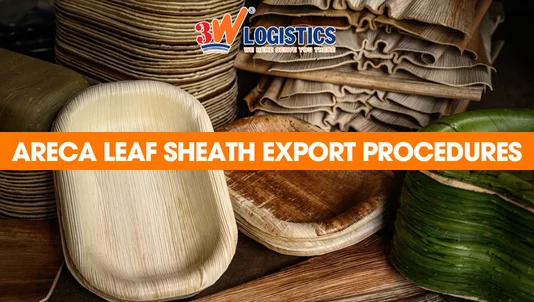
Areca leaf sheath export procedures are attracting significant interest from businesses producing eco-friendly consumer goods, as Vietnamese-made bowls, plates, trays, and spoons crafted from areca leaf sheaths have steadily won over demanding markets such as the U.S., Canada, the EU, and Japan.
From what once seemed like a discarded agricultural byproduct after the natural areca leaf falls, areca leaf sheath has become a raw material for the green consumer goods industry, meeting the growing global trend of replacing single-use plastic.
What makes areca leaf sheath export procedures distinctive is that the product is considered both a handicraft item made from natural material, and a utensil that comes into direct contact with food (bowls, plates, food trays), so businesses need to simultaneously meet both raw-material origin requirements and food safety regulations applicable to food packaging and containment materials.
The article below compiles the full legal basis, HS codes, procedures, costs, and common risks involved in areca leaf sheath export procedures, updated according to the latest applicable regulations.
1. Potential and development story of Vietnam’s areca leaf sheath products industry
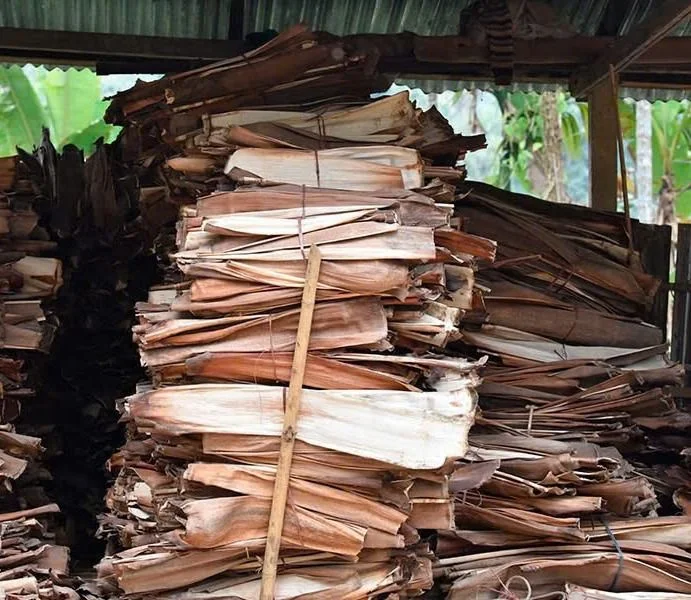
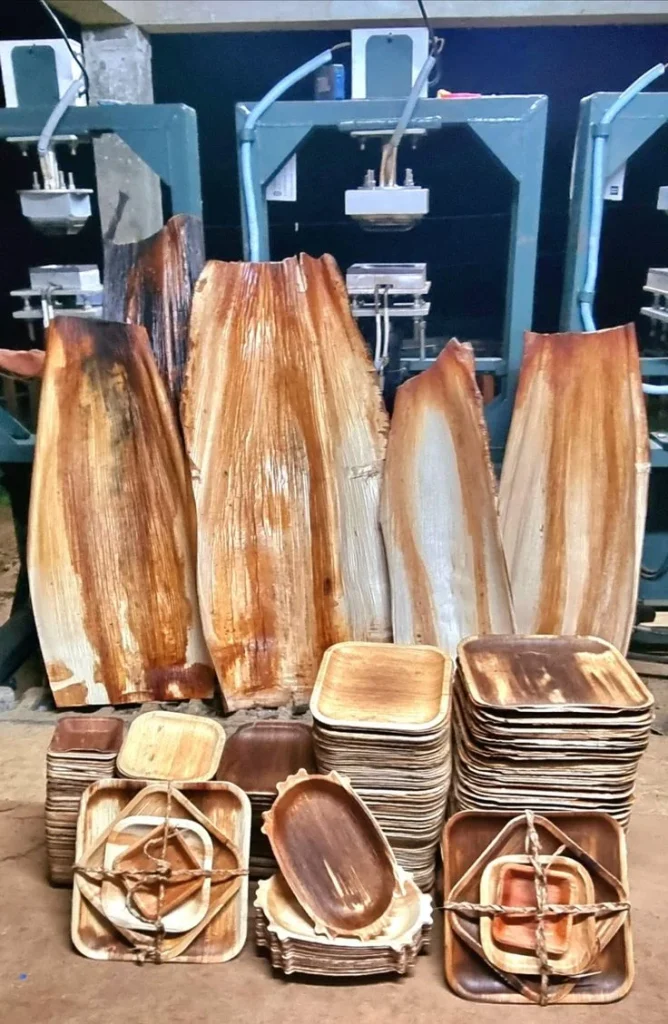
Areca leaf sheath (mo cau) is the natural leaf base that falls from the areca palm on its own, requiring no harvesting or tree-cutting, which keeps the raw material consistently available without harming the ecosystem. Quang Ngai — particularly Nghia Hanh district — is one of the major areca-growing regions, and also the birthplace of many production facilities making bowls, plates, and food trays from areca leaf sheath for areca leaf sheath export procedures to international markets.
From the first domestic orders (such as an order for areca-sheath bowls and plates to serve business-class passengers of a domestic airline), Vietnamese areca-sheath products have quickly expanded into major export markets thanks to their 100% natural composition, absence of harmful chemicals, good heat resistance (up to 220°C), and fast biodegradation within just 2-3 months — clear advantages over single-use plastic or pressed-paper alternatives.
2. Legal basis governing areca leaf sheath export procedures
| Legal document | Content regulated |
|---|---|
| Decree 69/2018/ND-CP | Areca leaf sheath products are not on the list of goods requiring an export license or prohibited from export |
| Decree 15/2018/ND-CP | Regulates product self-declaration, applicable to utensils and packaging/containment materials for food, such as areca-sheath bowls and plates |
| Circular 40/2016/TT-BYT | List of food utensils and packaging/containment materials by HS code, under the specialized management of the Ministry of Health |
| Food Safety Law 2010 | General regulations on food safety and hygiene conditions for facilities producing food-contact utensils |
| Circular 38/2015/TT-BTC, amended by Circular 39/2018/TT-BTC | Customs procedures and supervision for exported goods |
This is the fundamental legal framework that businesses need to understand clearly in order to correctly carry out areca leaf sheath export procedures, particularly the product self-declaration obligation given the product’s role as a food-contact utensil.
3. Conditions for production facilities and exported areca leaf sheath products
| Condition | Issuing/managing authority | Note |
|---|---|---|
| Product self-declaration (food-contact material) | Self-performed by the business under Decree 15/2018/ND-CP | Mandatory for bowls, plates, trays, and spoons made from areca sheath used to directly hold food |
| Food safety eligibility certificate | Sub-Department of Food Safety and Hygiene | Applicable to facilities that process areca sheath into finished products |
| Testing of the product’s hygiene and safety criteria | A designated testing laboratory | Confirms no chemical residue and compliance with food-contact standards before declaration |
| Facility registration with the FDA (U.S. market) | U.S. Food and Drug Administration | Necessary since the product is used to hold food when exported to the U.S. |
4. HS codes and export duties for areca leaf sheath products
Bowls, plates, trays, and spoons made from pressed and molded areca leaf sheath are typically classified under Chapter 46 — “Manufactures of straw, of esparto or of other plaiting materials; basketware and wickerwork” — heading 46.02, covering products plaited, woven, or pressed from plant material. Correctly determining the HS code is an important step in areca leaf sheath export procedures, as this is a fairly new product category, so businesses need to cross-check carefully with customs authorities.
| Product type | HS code (Vietnam) | Vietnam export duty | Note |
|---|---|---|---|
| Pressed and molded areca-sheath bowls, plates, and trays | 4602.19.90 | 0% | The common HS code applied by many businesses; further consultation with the local customs authority is advisable given this is a new product category |
| Raw areca leaf sheath, not yet pressed and molded | 1404.90.90 | 0% | Applicable when exporting in raw material form, not yet processed into a finished product |
| Disposable areca-sheath spoons, knives, and forks | 4602.19.90 | 0% | Same group as bowls and plates, given the same underlying plaited/pressed plant material |
Practical note: Export duty on areca leaf sheath and its products in Vietnam is currently 0%. Since this is a fairly new product category on the tariff schedule, businesses should proactively request an advance HS code ruling from the customs authority under Circular 38/2015/TT-BTC before exporting large volumes, to avoid classification disputes between different customs branches.
5. Documentation package for areca leaf sheath export procedures
| Document | When to prepare | Important note |
|---|---|---|
| Product self-declaration (food-contact material) | Before the first export shipment | Accompanied by test results confirming the product meets food safety standards |
| Sales Contract | Before manufacturing and packing | Must clearly state Incoterms, dimensions, design, and packing specifications |
| Commercial Invoice and Packing List | Before customs declaration | Value must match the contract and the bill of lading |
| Fumigation Certificate (if required) | After loading the goods into the container | Required by certain markets given the product’s natural plant origin |
| Certificate of Origin (C/O) | After the export declaration is issued | Required to enjoy preferential tariffs under the relevant FTA for the destination market |
| Export customs declaration (VNACCS) | Before customs clearance | Declare the correct HS code for the processed product or raw material |
6. Areca leaf sheath export procedure steps
Step 1: Harvest and pre-process the raw areca sheath material
The production facility collects naturally fallen areca leaf sheaths from growing regions, cleans off dirt and debris, and dries them to remove moisture — this is the foundational first step in areca leaf sheath export procedures, determining the durability and biodegradability of the finished product.
Step 2: Press, mold, and finish the product
After softening, the areca sheath is sorted by size and fed into a pressing machine to be molded per the template (bowl, plate, tray, spoon), then sanitized to complete the final product.
Step 3: Test and self-declare the product
The business sends product samples to a designated testing laboratory to check food-contact safety criteria, then completes the product self-declaration documentation under Decree 15/2018/ND-CP.
Step 4: Sign the contract and pack according to export specifications
Agree with the importer on design, size, and quantity per carton, then proceed with packing according to the agreed standards, ensuring the goods do not become damp or moldy during transport.
Step 5: Complete the documentation package and declare customs export
The enterprise or its forwarder prepares the invoice and packing list, and declares the electronic customs declaration on the VNACCS system, attaching the product self-declaration and a C/O matching the FTA of the destination market.
Step 6: International transport and import clearance in the destination country
Once the declaration is cleared, the goods are handed over to a sea or air carrier depending on shipment volume. For the U.S. market, the business needs to ensure FDA facility registration is complete before the goods arrive, to avoid being held for inspection.
7. Common risks in areca leaf sheath export procedures
| Risk | Manifestation | Prevention |
|---|---|---|
| Missing the food-contact product self-declaration | Goods rejected by the importer or held for inspection at the border | Complete the declaration documentation early, with full testing results attached |
| HS code dispute due to being a new product on the tariff schedule | Delayed customs clearance, need for explanation, need to amend the declaration | Request an advance HS code ruling from the customs authority before exporting large volumes |
| Moisture and mold developing during transport | Product quality declines, failing to meet visual/appearance standards upon arrival | Dry to the correct standard, use moisture-proof packing before releasing from the warehouse |
| FDA facility registration not yet completed when exporting to the U.S. | Shipment held for inspection or rejected for import | Complete FDA facility registration before signing a contract with a U.S. partner |
FAQ – Frequently asked questions about areca leaf sheath export procedures
Question 1: Does exporting areca leaf sheath products require a special license?
No. Areca leaf sheath products are not on the list of goods requiring an export license or prohibited from export; however, businesses must complete a product self-declaration for the product’s role as a food-contact utensil before carrying out areca leaf sheath export procedures.
Question 2: What is the current export duty on areca leaf sheath products in Vietnam?
Areca leaf sheath products (bowls, plates, trays, spoons) enjoy a 0% export duty rate in Vietnam.
Question 3: Why isn’t the HS code for areca leaf sheath products consistent across businesses?
Because this is a fairly new product category on the export-import tariff schedule, with no dedicated HS code specifically for products pressed from areca leaf sheath; businesses typically apply the code for plaited/pressed plant-material products and need to cross-check and confirm it in advance with the customs authority to ensure consistency.
Question 4: Does an exported areca leaf sheath product require any certification to prove it’s safe for health?
Yes. The business needs test results confirming the product contains no harmful chemicals and is safe for direct contact with hot or cold food, as the basis for the product self-declaration under Decree 15/2018/ND-CP.
How does 3W Logistics support areca leaf sheath export procedures?
As a freight forwarding company registered as an OTI-NVOCC with an FMC bond in the United States, holding an SCAC Code to self-file AMS/ISF declarations directly, 3W Logistics supports businesses through the entire areca leaf sheath export procedure — from HS code advisory and product self-declaration documentation through to customs clearance in the importing country.
Full-package logistics service at 3W Logistics:
- HS code advisory and advance ruling with customs authorities: Helping businesses work with customs to obtain a consistent HS code for a new product category like areca leaf sheath.
- Support completing the product self-declaration documentation: Guiding the process under Decree 15/2018/ND-CP, and connecting with reputable testing laboratories.
- Booking vessels and multimodal transport: Arranging sea or air transport to the U.S., EU, and Japanese markets.
- Electronic customs declaration (VNACCS): A professional team handles declarations; as an OTI-NVOCC with FMC and an SCAC Code, 3W Logistics directly issues its own HBL and self-files AMS/ISF for shipments bound for the U.S.
Why choose 3W Logistics: With offices in Ho Chi Minh City, Hanoi, and Hai Phong, and a team knowledgeable in food-contact material regulations and handicraft goods made from natural materials, 3W Logistics stands alongside green consumer goods businesses, ensuring areca leaf sheath shipments clear customs on time and to standard, right from the very first export. – Ms. Apple, CCO of 3W Logistics
Head Office – 3W Logistics Ho Chi Minh City Branch
Address: 34 Bach Dang, Tan Son Hoa Ward, Ho Chi Minh City
Hotline: +84 28 3535 0087
____________________________
3W Logistics Hanoi Branch
Address: 81A Tran Quoc Toan, Cua Nam Ward, Hanoi
Hotline: +84 24 3202 0482
____________________________
3W Logistics Hai Phong Branch
Address: 8A Lot 28 Le Hong Phong, Gia Vien Ward, Hai Phong
Hotline: +84 225 355 5939
____________________________
3W LOGISTICS CO., LTD – We here serve you there!
Email: info@3w-logistics.com
Website: www.3w-logistics.com

Ms. Apple is the CCO (Chief Commercial Officer) at 3W Logistics, with over 10 years of experience in sales and business operations management.
At 3W Logistics, Ms. Apple is responsible for commercial strategy, corporate customer development, managing a team of more than 50 sales professionals, and improving business performance in the logistics sector.
With practical experience in sales management and market development, Ms. Apple shares professional insights on business logistics solutions, international transportation, freight forwarding, customer management, trade lane development, and growth strategies in the logistics industry.


