
What is a dry containers? Structure, role, and practical applications.

Every day, millions of dry containers move through seaports, rail terminals, and container depots across the globe and among them, over 90% are dry cargo containers. From smartphones, clothing, and footwear to industrial machinery and raw materials, nearly everything you buy and use every day has at some point been transported inside a dry shipping container somewhere along the global supply chain.
So what exactly is a dry container? How is it constructed, what types of cargo is it suited for, and why has it become the backbone of modern international freight transport? This article provides everything you need to know – from the concept, structure, dimensions, advantages and disadvantages, to real-world applications and key considerations when using dry container shipping in import and export operations.
1. What Is Dry Container?
A dry container also known as a dry freight container, standard dry container, or General Purpose Container is a standardized transport unit designed to carry dry cargo: goods that require no temperature control, are not liquid or gaseous, and need to be protected from rain, wind, dust, and external impact throughout the entire shipping journey inside a rigid, sealed enclosure.
In appearance, a dry container is a rectangular steel box with a flat roof, fully sealed side walls, a hardwood floor, and double swing doors at one end (end door). This fundamental structure has remained unchanged since Malcolm McLean standardized the container in 1956 – clear proof of a design that has reached functional perfection.
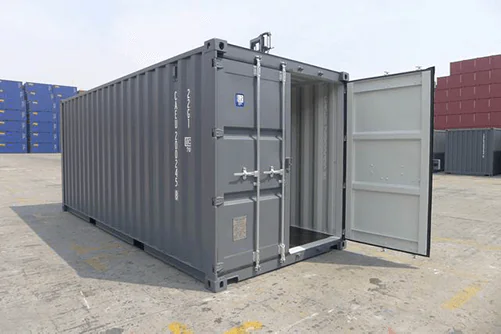
An important distinction among container types: a dry box container has no refrigeration system (unlike a reefer container), no special interior height (unlike a High Cube container), and no open-top or open-side structure (unlike open-top or flat-rack containers). It is the universal, multi-purpose container suited to the vast majority of general cargo in international trade.
ISO dry containers are manufactured and certified to international standards ISO 668 and ISO 1496, ensuring full compatibility with every handling, transport, and storage system worldwide – from port cranes and trucks to rail wagons and ship holds.
2. Structure and Dimensions of Standard Dry Containers
2.1 Detailed Structure of a Dry Cargo Container
Every dry cargo container – whether 20ft or 40ft – shares the same core components:
- Corner Posts and Corner Castings: The 8 cast steel corners are the most critical part of any intermodal dry container. These are the contact points for cranes, spreader bars, twist locks on trucks, and stacking pins. ISO standards require each corner to withstand a minimum vertical force of 2.5 million Newtons.
- Base Rail and Cross Members: Form the structural foundation that bears the full weight of the cargo inside. Steel cross members are evenly spaced to distribute the load uniformly.
- Flooring: Typically made from tropical hardwood (bamboo or Apitong) 28mm thick, treated for moisture and pest resistance. Steel runner rails run lengthwise along the floor to protect it during forklift access.
- Side Panels: Corrugated steel panels that increase structural rigidity without significantly adding weight. Panel thickness is typically 1.6-2.0mm.
- Roof Panels: Similar corrugated steel as the side panels, with a slight curve for rainwater runoff. The roof must withstand stacking loads from containers placed above.
- Front Wall / Bulkhead: A fully sealed steel panel at the end opposite the doors – typically the strongest part of the unit when pressure is applied from the rear during vessel loading.
- End Doors: Two steel doors that open 270° (and can be pinned flat to the side walls to avoid obstructing loading). The cam lock system and customs seal are fitted here. A rubber gasket around the door frame ensures a watertight and airtight seal.
- Lashing Rings / D-rings: Steel rings welded to the floor cross members and side wall rails, used to secure cargo with straps or lashing belts during transit.
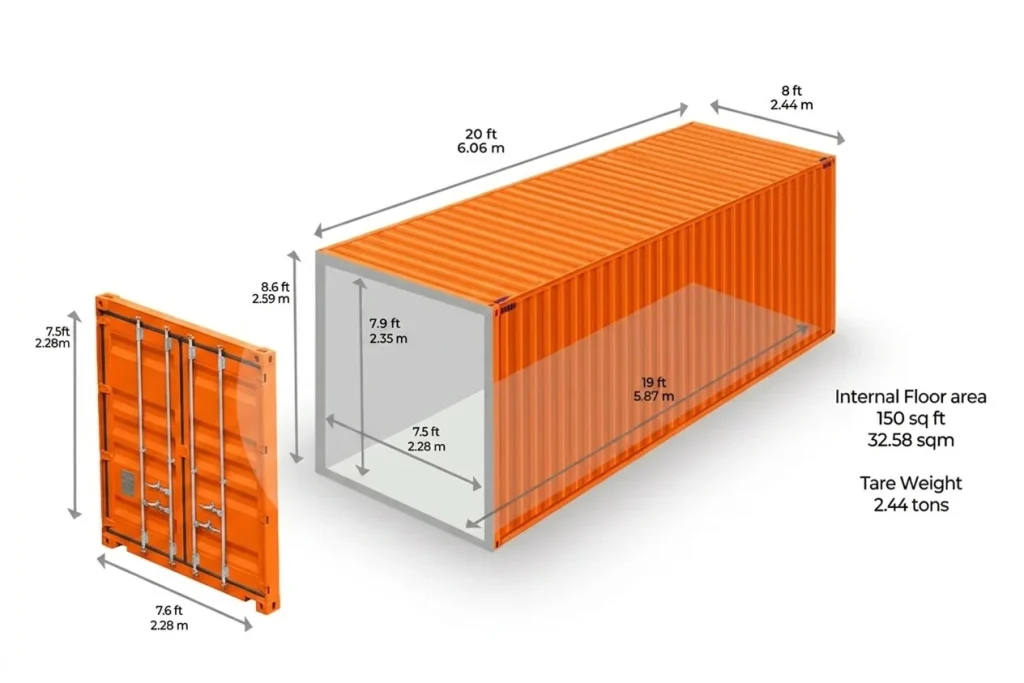
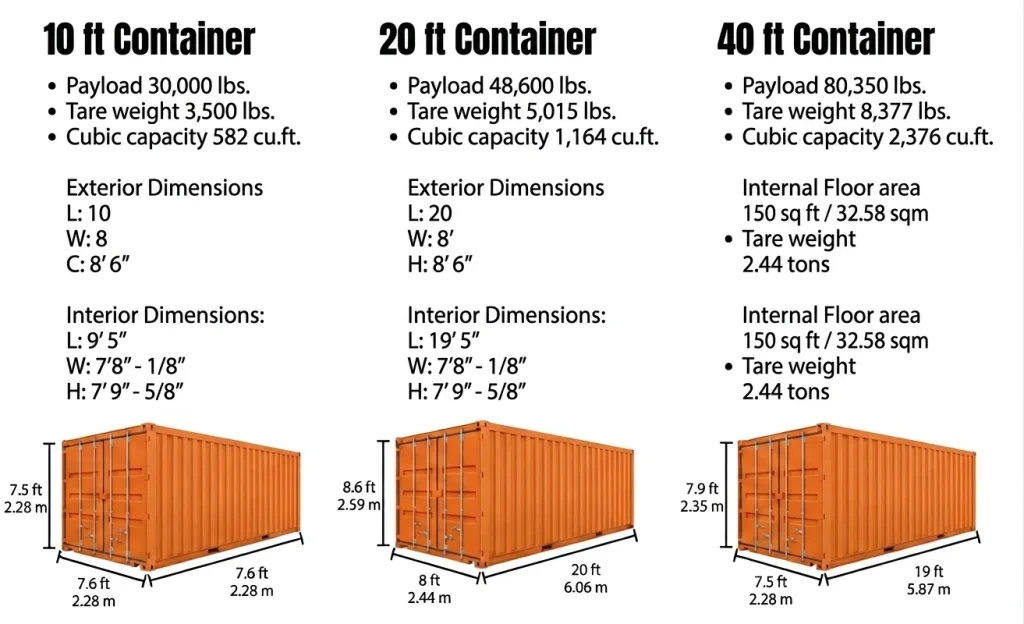
2.2 Dimensions and Payload of Standard Dry Containers
ISO Standard Dry Container Technical Specifications
| Specification | 20ft Dry Container (TEU) | 40ft Dry Container (FEU) | Practical Notes |
|---|---|---|---|
| External Length | 6,058 mm (20′) | 12,192 mm (40′) | 20ft = 1 TEU; 40ft = 2 TEU (freight billing unit) |
| External Width | 2,438 mm (8′) | 2,438 mm (8′) | Identical width for both sizes |
| External Height | 2,591 mm (8’6″) | 2,591 mm (8’6″) | Taller version is the High Cube container (9’6″) |
| Internal Length (usable) | ~5,895 mm | ~12,032 mm | After deducting front wall and door thickness |
| Internal Width (usable) | ~2,350 mm | ~2,350 mm | After deducting side wall thickness on both sides |
| Internal Height (usable) | ~2,393 mm | ~2,393 mm | ~30cm lower than High Cube (2,695mm) |
| Cargo Volume | ~33 CBM | ~67 CBM | Actual usable volume after deducting walls and floor |
| Maximum Payload | ~21,700 kg | ~26,700 kg | Maximum allowable cargo weight |
| Tare Weight | ~2,200 kg | ~3,800 kg | Weight of the empty container unit itself |
| Maximum Gross Weight (MGW) | 30,480 kg | 30,480 kg | Maximum Gross Weight — standard ISO limit |
Practical Note: When deciding between a 20ft and 40ft dry container, don’t only look at volume (CBM) – always factor in cargo weight. For heavy, dense cargo (steel, stone, ore), a 20ft dry freight container is often more efficient due to its higher payload-to-CBM ratio. For light but bulky goods (furniture, packaged consumer goods), a 40ft or 40ft High Cube dry container maximizes volume utilization without hitting weight limits, offering ~76 CBM of usable space.
3. The Role of Dry Containers Across Transport Modes
The dry cargo container is more than just a “box”, it is the standardized unit that enables the entire global logistics system to operate seamlessly and efficiently. Dry container transport spans all major modes of freight movement:
Ocean Freight
This is where the dry shipping container delivers its greatest value. Modern container vessels can carry between 10,000 and over 24,000 TEUs – tens of thousands of containers stacked in holds and on deck. Without standardized dry containers, modern ocean shipping simply would not exist. FCL (Full Container Load) and LCL (Less than Container Load) dry container shipping are the two most widely used booking methods in international import and export.
Rail Freight
A standard dry container can be transferred directly from a vessel to a rail wagon without unpacking or trans-loading, this is the essence of intermodal dry container transport. The China-Europe Railway Express (CRE) moves millions of intermodal dry containers annually from China and Vietnam to Europe, cutting transit time by 2–3 weeks compared to sea freight.
Road Freight
Once a container is discharged at the port, a truck hauls it directly to the customer’s warehouse – the most critical last-mile stage of dry container logistics. Both 20ft and 40ft dry van containers are fully compatible with standard container trucks, requiring no special equipment.
Warehousing and Temporary Storage
Dry storage containers are widely used as mobile storage units at construction sites, industrial zones, and container yards for temporary inventory. Their durable steel construction and weather-resistant properties make them a fast, cost-effective warehousing solution.
4. Advantages and Disadvantages of Dry Containers
Advantages
- Global standardization – compatible with every system: ISO dry containers are compatible with 100% of seaports, rail terminals, trucks, and ship holds worldwide. No special equipment or procedures are required. This is the single greatest advantage that no other container type or transport unit can match.
- Strong cargo protection against environmental factors: Four sealed steel walls, a rain-resistant roof, and watertight door gaskets protect cargo from rain, dust, wind, sunlight, and external impact throughout long-haul journeys.
- Lowest rental cost among all container types: Because they are mass-produced in the largest quantities, dry cargo containers carry significantly lower hire rates than reefer, open-top, or flat-rack containers – a key factor in optimizing logistics costs.
- High availability – easy to find at any major port worldwide: With over 40 million TEUs in global circulation, dry box containers are the easiest to source, fastest to book, and least likely to face shortages under normal market conditions.
- Flexible across a wide range of cargo types: From packaged consumer goods, textiles, and electronics to machinery and raw materials, the majority of standard commercial cargo can be transported in a dry freight container.
- Stackable up to 9 tiers: The cast steel corner casting design allows dry containers to be safely stacked up to 9 layers at depots and 6–8 layers on vessels, maximizing storage and transport space efficiency.
Disadvantages
- No temperature control: This is the most significant limitation. Internal temperatures inside a dry van container can reach 60–70°C in summer when sailing through tropical regions. Temperature-sensitive cargo (fresh food, pharmaceuticals, cosmetics, chemicals) requires a reefer container or specialized insulation solutions.
- Limited interior height for tall cargo: With an internal height of approximately 2.39m, cargo taller than 2.2m will be difficult to load. In such cases, a High Cube dry container (internal height 2.69m) is the better choice, offering an additional 30cm of clearance and increasing usable volume to ~76 CBM for 40ft units.
- Not suitable for bulk, liquid, or gaseous cargo: Grain in bulk, powder minerals, liquid oils, and liquefied gases all require specialized containers (bulk containers, tank containers) — not a standard dry container.
- Susceptible to container sweat (condensation): When a vessel travels through zones with significant temperature differentials between day and night, or between different climate regions, moisture inside the container can condense and drip onto the cargo. This is a common cause of damage to electronics, textiles, and dry food products.
- Cargo damage risk if not properly secured: Dry cargo containers have no automatic cargo securing system. If goods are not carefully lashed and padded, they can shift and collide during transit — especially in rough sea conditions.
5. Real-World Applications of Dry Containers in Import and Export
Garments and Footwear – Vietnam’s Top Export Sector
All apparel, footwear, and handbags exported from Vietnam to the US, EU, and Japan are loaded into 40ft dry shipping containers. This is the most common application in garment manufacturing zones in Binh Duong, Dong Nai, Hung Yen, and Hai Phong. A single 40ft dry container typically holds around 800–1,200 cartons of clothing depending on packaging size.
Electronics and Components
Smartphones, computers, and electronic components, strategic export products from Samsung, LG, Intel, and Foxconn operations in Vietnam – all use dry cargo containers with specific moisture control requirements (silica gel desiccants, VCI anti-corrosion bags) and careful lashing. For high-value electronics, 20ft dry box containers are often preferred for easier customs sealing control and reduced risk.
Timber and Export Furniture
Tables, chairs, cabinets, beds, and decorative furniture from workshops and factories in Binh Duong and Dong Nai shipped to importers in the US and Europe all use 40ft dry freight containers. This is an ideal cargo type for dry container shipping – lightweight (no payload concerns), bulky (needs maximum CBM), and requiring no temperature control. Note: timber goods must be fumigated before container stuffing to meet phytosanitary requirements of many importing countries.
Dry Agricultural Products and Processed Food
Packaged roasted coffee, cashews, black pepper, bagged rice, instant noodles, and bottled fish sauce Vietnam’s processed agricultural exports reaching over 150 countries, all rely on dry container transport. Key consideration: agricultural products are susceptible to container sweat (condensation moisture), requiring proper use of desiccant bags and adequate ventilation.
Industrial Machinery and Equipment
Production machinery, electrical equipment, and mechanical spare parts is goods with diverse shapes and dimensions typically use 20ft or 40ft dry cargo containers depending on size. Heavy equipment requires careful load distribution calculations to avoid exceeding the payload limit and to prevent concentrated point loads on the container floor.
Dangerous Goods (DG / IMDG)
Certain categories of dangerous goods (solid chemicals, batteries, paint, industrial cleaning agents) may be shipped in standard dry containers, but must strictly comply with IMDG (International Maritime Dangerous Goods Code) regulations: proper UN-certified packaging, correct hazard labeling, full declaration, and correct stowage position on the vessel in accordance with segregation requirements.
6. Documentation for Dry Container Shipments
In import and export operations, the dry container is the most widely used unit for transporting general cargo, consumer goods, machinery, raw materials, and palletized freight. To ensure a smooth shipping and customs clearance process for any dry container shipment, businesses must prepare a complete set of documents covering the shipper, freight forwarder, and carrier.
Documents Prepared by the Shipper
- Commercial Invoice: Reflects the value of the goods, buyer and seller information, and international payment terms.
- Packing List: Details the number of packages, weight, dimensions, and how cargo is loaded inside the dry cargo container.
- Sales Contract: The trade agreement between both parties covering price, delivery terms, and payment conditions.
- Shipping Instruction (SI): Information provided by the shipper to the forwarder or carrier to ensure accurate Bill of Lading issuance.
- Certificate of Origin (C/O): Proof of goods’ country of origin, used to claim preferential tariff rates.
- HS Code: The commodity classification code used for customs declaration and import/export duty calculation.
- Import/Export License (if applicable): Required for regulated goods such as food products, chemicals, or specialized equipment.
- VGM (Verified Gross Mass): Confirmation of the total weight of the packed dry container before vessel loading.
Documents Prepared by the Freight Forwarder
The freight forwarder acts as the intermediary managing transport, customs declaration, and international dry container logistics. Key documents handled by forwarders include:
- Booking Confirmation: Confirms successful container and vessel space reservation.
- Customs Declaration: Filed with customs authorities to clear the goods for export or import.
- Debit Note / Logistics Invoice: Document listing freight and logistics service charges.
- SI Submission: The forwarder submits the Shipping Instruction to the carrier on behalf of the shipper.
- C/O Application and VGM Support: In many cases, the forwarder assists with completing documentation and related procedures.
Documents Issued by the Carrier
The shipping line is the entity that physically executes dry container transport by sea and issues the key international transport documents:
- Bill of Lading (B/L): Confirms that the cargo has been loaded on board and serves as the document of title for collection at the destination port.
- Manifest: The cargo declaration submitted to customs at both the port of loading and the port of discharge.
- Delivery Order (D/O): The release order authorizing the consignee to collect the dry container at the port or depot.
- EIR (Equipment Interchange Receipt): A container handover receipt confirming the condition of the unit at pickup and return.
- Container Release Order: The authorization to release an empty dry box container for export stuffing.
- Arrival Notice: Notification to the consignee that the shipment has arrived at the destination port.
Having a complete and accurate documentation set for dry container shipping minimizes risk throughout the import and export process, ensures fast customs clearance, and avoids demurrage charges or delivery delays.
7. How 3W Logistics Supports Your Dry Container Shipments
Whether you’re exporting garments, furniture, agricultural products, or machinery — choosing the right container type, size, and dry container transport solution can make a significant difference in cost and risk for every shipment. 3W Logistics provides end-to-end support across every aspect of dry container logistics:
- Container type consultation: Based on actual shipment data (CBM, weight, cargo type, routing), the 3W team advises whether a 20ft, 40ft, High Cube, or specialized container is the right choice – avoiding wasted space or overloaded units.
- Container booking and vessel scheduling: 3W works directly with major carriers (Maersk, MSC, CMA CGM, Evergreen, and others) to secure dry container bookings on time, monitor vessel schedules, and provide timely alerts for any changes.
- Stuffing advisory and cargo securing support: Our technical team advises on proper cargo loading, weight distribution, lashing techniques, and padding to prevent cargo damage throughout long-haul dry container shipping.
- Full customs clearance and documentation handling: From electronic customs filing, Certificate of Origin application, and phytosanitary permit processing to preparing the full international payment document set (B/L, Invoice, Packing List), 3W manages everything end-to-end.
- Pre-carriage from warehouse to port: 3W coordinates container trucks directly to the customer’s facility – on time, with the right equipment, ensuring the dry cargo container arrives at the terminal before the vessel’s CY Closing Time.
- Real-time shipment tracking and updates: After cargo is loaded, 3W provides regular tracking updates — vessel position, transshipment ports, and estimated ETA — so customers can proactively plan cargo receipt and notify their partners.
A note from 3W Logistics’ field experience: Many first-time exporters choose a 40ft dry container for its larger volume without factoring in the actual cargo weight. The result: paying for 67 CBM but only utilizing 40 CBM because the weight limit is reached first. Conversely, some shippers use a 20ft dry freight container for light, bulky cargo – only to find they must leave part of the shipment behind because space runs out. To avoid these costly mistakes, contact 3W Logistics for the right dry container solution from the start and save both time and money.
Head Office – 3W Logistics Ho Chi Minh City Branch
Address: 34 Bach Dang Street, Tan Son Hoa Ward, Ho Chi Minh City
Hotline: +84 28 3535 0087
____________________________
3W Logistics Hanoi Branch
Address: 81A Tran Quoc Toan Street, Cua Nam Ward, Hanoi
Hotline: +84 24 3202 0482
____________________________
3W Logistics Hai Phong Branch
Address: 8A Lot 28 Le Hong Phong Street, Gia Vien Ward, Hai Phong
Hotline: +84 225 355 5939
____________________________
3W LOGISTICS CO., LTD – We here serve you there!
Email: quote@3w-logistics.com
Website: www.3w-logistics.com


