
Road freight — also known as road transport or land transportation — is the most widely used mode of cargo movement in Vietnam and across most countries worldwide, accounting for approximately 70–80% of total domestic freight volumes measured by shipment trips.
No seaport, no airport, no rail tracks required — with nothing more than a road and a truck, goods can be delivered directly to the consignee’s warehouse door. This unmatched flexibility and door-to-door accessibility is precisely what makes road cargo transport an indispensable link in every logistics chain, whether domestic or international.
This article provides everything you need to know about road transport: from core concepts, vehicle and cargo classifications, pros and cons, the step-by-step shipping process, and required documentation, to freight rate structures and practical tips to help businesses optimize costs and minimize risk in their road freight operations.
1. What is Road Transport?
Road transport — or road freight — is the movement of goods and passengers by motor vehicles (trucks, container vehicles, semi-trailers, box trucks, etc.) operating across road networks, including national highways, provincial roads, expressways, and rural roads.
It is the only mode of transport capable of providing direct, uninterrupted access from the exact point of origin to the exact point of destination — whether that is a manufacturing plant, a warehouse, a retail store, or a private residence.
Within modern logistics chains, road cargo transport serves two irreplaceable roles: as a standalone freight mode for short-to-medium haul routes, and as the connecting link (first-mile and last-mile) in more complex multimodal transport chains — bridging factories to seaports, airports to customer warehouses, or rail terminals to final delivery points.
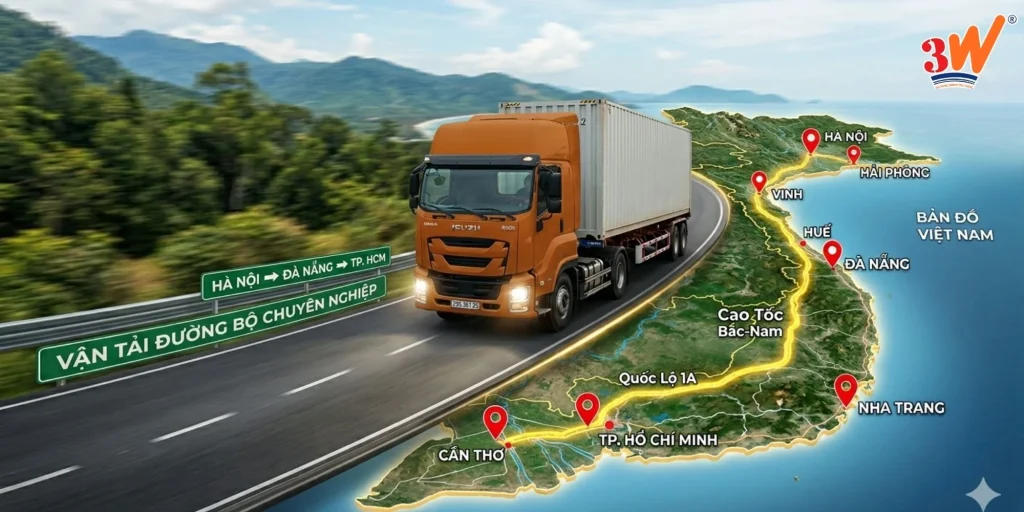
In Vietnam, land transportation services are administered primarily by the Ministry of Transport through a network of over 600,000 km of roads of all classifications.
Including more than 1,800 km of expressways in operation (as of 2026) and a national highway system connecting all 63 provinces.
Given Vietnam’s elongated North–South geography and the prevalence of industrial zones located deep inland, road freight is virtually the only viable option for cargo collection and last-mile distribution.
2. Advantages and Disadvantages of Road Freight
Advantages
- Unmatched flexibility — true door-to-door delivery: This is the defining advantage of road transport that no other mode can replicate. A truck can drive directly into a factory yard, collect cargo from the production floor, and deliver to the consignee’s storefront — with no intermediate transfer points. No seaport, airport, or rail terminal can offer that level of direct access.
- No limitations on service coverage area: Whether it is an industrial zone in Binh Duong, a farm in Dak Lak, or a warehouse along the Central Coast — if there is a road, road cargo transport can reach it. The coverage network of road freight is broader than any other transport mode.
- Faster transit for short-to-medium haul routes: For distances under 1,000 km, road freight is typically faster than the total door-to-door time of sea or rail freight when factoring in procedures, pre-carriage to the port or terminal, and cargo collection at the other end.
- Lower cost for small shipments and short distances: For a few-tonne shipment within the same province or neighboring region, trucking services are the most economical option — no THC surcharges, no port fees, no complex documentation requirements.
- Real-time shipment tracking: With modern GPS systems and fleet management software, the exact location of a shipment can be monitored minute by minute — a significant advantage over sea freight and many rail routes.
- Less demanding packaging requirements than sea freight: Cargo is not subjected to ocean swells or aircraft cabin pressure changes. Packaging standards are generally simpler, reducing overall packaging costs.
Disadvantages
- Higher cost than sea freight and rail for large-volume, long-haul cargo: A single vessel can carry hundreds of containers; a freight train can pull over 100 wagons. A standard semi-trailer carries just one 40ft container. For high-volume cargo over long distances, the cost per tonne-km of road freight is 3–5 times higher than sea freight.
- Dependent on traffic conditions and weather: Congestion on major arteries, flooding, and landslides on mountain passes are uncontrollable factors that can significantly delay cargo against schedule.
- Load weight and dimension restrictions: Each road has a maximum allowable vehicle weight (typically 30–44 tonnes GVW depending on the road classification). Oversized and overweight cargo requires special transport permits and must follow approved routing plans.
- Higher CO₂ emissions than rail and sea freight: Diesel-powered road freight emits approximately 4 times more CO₂ per tonne-km than rail transport and 6–8 times more than sea freight — an increasingly critical consideration as businesses face ESG commitments and supply chain decarbonization pressure.
- Higher exposure to accident and cargo theft risk: Compared to rail and sea freight, which operate within controlled dedicated corridors, goods transported by road face greater exposure to traffic accidents and in-transit theft.
3. Common Types of Road Freight Services
1. Full Truck Load (FTL)
FTL is the arrangement where an entire truck or semi-trailer is exclusively reserved for a single shipper’s cargo. Goods do not share space with other shipments and the vehicle makes no intermediate stops.
Best suited for: Shipments of 5 tonnes or more, urgent deliveries that cannot be consolidated, dangerous goods or special cargo requiring dedicated control.
Advantages of FTL:
- Fastest transit time — no intermediate pick-up or delivery stops
- Higher cargo safety — minimal shifting and impact during transport
- Lower cost per tonne when the shipment is large enough to fill the vehicle
Disadvantages of FTL:
- Not economical for small shipments — full vehicle rate applies regardless of actual cargo fill
- Difficult to arrange on short notice during peak season
2. Less Than Truck Load (LTL)
LTL consolidates cargo from multiple shippers into a single truck. Each shipper pays only for the space and weight their cargo occupies.
Best suited for: Shipments under 5 tonnes, trade samples, small and medium-sized businesses seeking to reduce road freight costs.
Advantages of LTL:
- Significantly lower cost compared to chartering a full truck
- Ideal for cargo that does not fill an entire vehicle
- Many freight providers operate fixed daily schedules on major trunk routes
Disadvantages of LTL:
- Longer transit times due to multiple pick-up and delivery stops along the route
- Higher risk of cargo damage from repeated loading and unloading
- Less precise real-time tracking compared to FTL
3. Specialized Cargo Transport (Oversized / Hazmat / Temperature-controlled)
This category covers cargo with specific transport requirements:
- Oversized and heavy-lift cargo: Industrial machinery, precast concrete components, electrical equipment — requiring specialized vehicles (multi-axle semi-trailers, low-bed flatbeds) and special transport permits from road management authorities.
- Dangerous goods (Hazmat): Chemicals, flammable substances, compressed gases — subject to strict compliance with ADR regulations (Agreement concerning the International Carriage of Dangerous Goods by Road) and applicable national regulations. Drivers must hold a certified hazardous materials transport qualification.
- Temperature-controlled cargo: Frozen food, pharmaceuticals, fresh produce — requiring refrigerated trucks (reefer trucks) to maintain stable temperature conditions throughout the entire journey.
4. Cross-border Road Freight
Cargo is transported by truck across land border crossings into neighboring countries: China, Laos, Cambodia, and vice versa. Vietnam’s most important road border crossings include: Mong Cai, Lang Son, Lao Cai (northbound to China), Lao Bao, Cau Treo (into Laos), and Moc Bai, Xa Mat (into Cambodia).
Cross-border road freight is particularly well-suited for agricultural products, consumer goods, and commodities with short regional distribution routes within ASEAN — where cost and transit time are often significantly lower than sea or air freight alternatives.
4. Road Transport in Multimodal Logistics
One of the most important yet frequently overlooked facts is this: road freight almost never operates in isolation within international logistics chains. Its true role is to serve as the connector between other transport modes.
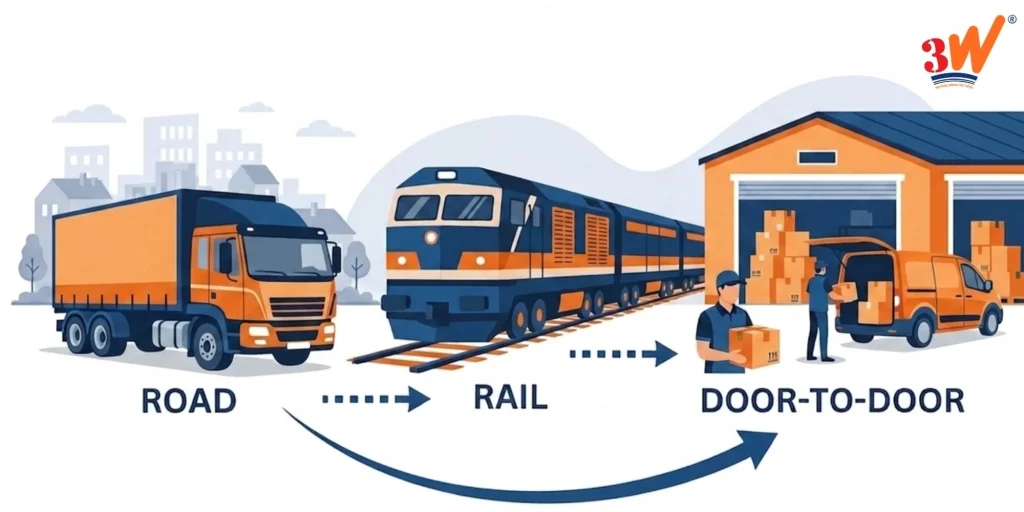
Practical examples in Vietnam:
- Factory → Seaport: Cargo from an industrial zone in Binh Duong is trucked to Cat Lai Port for sea freight export to the United States. This is the “first-mile” of the journey.
- Seaport → Distribution warehouse: Imports arriving at Hai Phong Port from China are trucked to distributor warehouses in Hanoi. This is the “last-mile.”
- Rail terminal → Delivery point: Cargo from the international railway freight network (China-Europe Railway Express) still requires trucking services to complete the last-mile delivery from the destination terminal to the consignee’s warehouse in Europe.
5. Road Freight Process — Domestic and Cross-border
Step 1: Intake and Transport Planning
The shipper provides full shipment details: cargo type, weight, dimensions, pick-up location, delivery destination, and required delivery timeframe. The trucking logistics provider determines the appropriate vehicle type, calculates the optimal route, checks road weight restrictions, and schedules the vehicle accordingly.
Step 2: Cargo Preparation and Documentation
The shipper packages and labels the cargo, then prepares the required documentation: warehouse release note, Packing List, VAT invoice (domestic) or Commercial Invoice (export), and the truck dispatch order. For dangerous goods, an MSDS and hazardous goods transport permit are required. For oversized cargo, a special transport license is mandatory.
Step 3: Vehicle Arrival, Cargo Collection, and Count Verification
The driver and logistics staff arrive at the pick-up location at the agreed time. A physical count is conducted, the cargo is checked against the Packing List, and the external condition of all items is recorded prior to loading. The driver signs the cargo handover record.
Step 4: Transit and Journey Monitoring
The vehicle departs on the pre-planned route. For GPS-equipped vehicles, both the cargo trucking services provider and the shipper can monitor the shipment’s position in real time. Drivers comply with mandatory driving hour regulations (no more than 4 consecutive hours) and compulsory rest period requirements under road traffic law.
Step 5: Delivery at Destination and Proof of Delivery
At the delivery point, the consignee inspects the quantity and condition of the cargo, then signs the delivery receipt. Any damage or shortage must be noted on the delivery record before signing — this documentation is the basis for any insurance claim or compensation request against the carrier.
Step 6 (Cross-border Shipments Only): Customs Clearance and Border Crossing Procedures
For international road transport services, an additional step is required: export customs declaration at the Vietnamese border crossing and import declaration at the destination country’s crossing. Depending on bilateral transport agreements, Vietnamese vehicles may be permitted to operate directly into the destination country’s territory, or cargo may need to be transloaded onto local vehicles at the border crossing — the latter being common practice on the Vietnam–China corridor.
6. Key Documents in Road Cargo Transport
Consignment Note / Waybill
The document confirming the contract of carriage between the shipper and the road freight services company. It specifies: cargo description, quantity, weight, pick-up address, delivery address, driver name, and vehicle registration number. For international road freight under the CMR Convention, the equivalent document is the CMR Consignment Note.
Packing List
Itemizes each package: sequential number, cargo description, quantity, net and gross weight, and dimensions. Must correspond exactly to the physical cargo loaded on the vehicle.
VAT Invoice / Commercial Invoice
For domestic shipments: VAT invoice compliant with Ministry of Finance regulations. For export shipments: Commercial Invoice stating full details of seller, buyer, cargo description, value, and applicable Incoterms.
Customs Declaration (For Import/Export Shipments)
Mandatory for all cross-border cargo. Filed on the VNACCS/VCIS system at the border crossing before the vehicle departs. Must accurately declare the HS code, commodity description, weight, and shipment value.
Special Transport Permit (For Oversized and Overweight Cargo)
Issued by the Vietnam Roads Administration or the provincial Department of Transport. Specifies the authorized route, permitted operating hours, and escort vehicle requirements. Without this permit, the vehicle is subject to fines and prohibited from operating.
Specialized Documents (If Applicable)
Phytosanitary Certificate (plant-based cargo, agricultural produce), Health Certificate (food products, animal products), MSDS plus Hazardous Goods Transport Permit (ADR/Hazmat compliance), Quarantine Certificate — required depending on cargo type and the requirements of the specialized inspection authority at the border crossing.
7. Road Freight Costs — Rate Structure and Key Influencing Factors
Unlike air freight or international rail transport, road freight rates are not published on a fixed tariff schedule. Pricing is determined by a combination of factors specific to each shipment:
Domestic Road Freight Rate Reference Table — Vietnam
| Vehicle Type / Capacity | Suitable Cargo Types | Short Haul (<300 km) | Long Haul (HCMC–Hanoi ~1,700 km) | Notes |
|---|---|---|---|---|
| Light Truck 0.5 – 2.5 tonnes | Small parcels, trade samples, e-commerce cargo | VND 500,000 – 1,500,000 / trip | VND 3,000,000 – 5,000,000 / trip | Common for urban delivery and short inter-provincial routes |
| Medium Truck 3 – 8 tonnes | Manufactured goods, agricultural produce, packaged consumer goods | VND 1,500,000 – 3,500,000 / trip | VND 6,000,000 – 10,000,000 / trip | Flexible for both FTL and LTL arrangements |
| Semi-trailer — 20ft Container Cargo payload ~18–20 tonnes | Import/export cargo, industrial goods | VND 2,000,000 – 4,000,000 / trip | VND 10,000,000 – 16,000,000 / trip | Standard for industrial zone to seaport routes |
| Semi-trailer — 40ft Container Cargo payload ~24–26 tonnes | High-volume import/export cargo, heavy industrial goods | VND 2,500,000 – 5,000,000 / trip | VND 13,000,000 – 20,000,000 / trip | North–South routes via Hai Van Pass may incur additional charges |
| Refrigerated Truck (Reefer) Capacities from 2 – 15 tonnes | Frozen food, pharmaceuticals, fresh produce, agricultural cargo | 20–35% premium over standard truck rate | 20–35% premium over standard truck rate | Refrigeration surcharge billed separately |
| Oversized / Heavy-lift Vehicle Custom specialized configurations | Industrial equipment, large structural components, heavy machinery | Individual quotation per shipment | Individual quotation per shipment | Special permit + escort vehicle required |
Important note on rates: The rates listed above are for reference purposes only as of the time of publication and are subject to change based on fuel prices, seasonal demand (agricultural peak periods, Lunar New Year), road conditions, and applicable tunnel and ferry surcharges. Always request a formal quotation from your road freight services company with full details of any applicable surcharges.
Key factors that directly influence road cargo transport rates:
- Distance and route characteristics: Expressway routes are typically faster and more competitively priced than mountain pass routes.
- Cargo type and special requirements: Refrigerated cargo, dangerous goods, and fragile items all attract dedicated surcharges.
- Toll fees: The HCMC–Hanoi corridor passes through multiple toll stations; road tolls can add VND 1–2 million per trip.
- Return load availability: If the vehicle must return empty (empty return), the rate will be higher than routes with a confirmed backhaul load.
- Market conditions: During agricultural peak seasons (lychee, mango, watermelon harvest periods) or in the weeks before Lunar New Year, truck availability tightens sharply and rates can increase 20–50% above normal levels.
8. Tips to Optimize Road Freight Costs and Minimize Risk
1. Plan Shipments Early – Avoid Last-minute Bookings During Peak Season
Peak agricultural harvests (April–June for lychee, longan, and mango in the North; July–September for coffee and pepper in the Central Highlands) and the weeks before Lunar New Year are the two most congested periods for truck availability in Vietnam. Businesses with recurring freight needs should consider signing long-term contracts with a trucking logistics provider to secure guaranteed vehicle availability and stable pricing.
2. Select the Right Vehicle – Avoid Over- or Under-sizing
Chartering a 15-tonne truck to move 3 tonnes of cargo wastes budget. Booking a 3-tonne truck for a 5-tonne shipment is simply not feasible. Always provide your cargo trucking services provider with accurate weight and dimension information so they can recommend the most appropriate — and most cost-efficient – vehicle for your needs.
3. Package Cargo Correctly and Secure It Properly Within the Vehicle
Cargo that is not firmly secured inside the truck will shift and sustain impact damage when the vehicle accelerates, brakes, or corners. Use lashing straps, pallets, and load bars to stabilize cargo. For fragile goods, mark cartons clearly with “FRAGILE” and indicate the correct upright orientation on the exterior of each package.
4. Purchase Cargo Insurance for All High-value Shipments
The liability of a road freight services company for cargo damage is typically capped by contractual terms or statutory limits – and is often well below the actual commercial value of the goods. Cargo insurance at a premium of just 0.05–0.2% of the shipment value is a small investment that covers the full risk exposure.
5. Document Cargo Condition Thoroughly Before and After Transport
Always record the condition of the cargo (photographs, written description) before loading and again upon delivery at the destination. Any damage or shortage discovered at delivery must be noted on the delivery receipt before signing – once a clean receipt is signed confirming full delivery, any subsequent claim becomes extremely difficult to pursue.
6. Combine Road Freight with Rail for Long-haul Domestic Shipments
For cargo moving between Hanoi and Ho Chi Minh City — particularly heavy industrial goods and manufacturing raw materials — combining road freight (factory to rail terminal) with railway freight (North terminal to South terminal) can deliver significant cost savings compared to full road transport, especially during periods of elevated fuel prices. Discuss both options with your logistics provider and compare based on your specific shipment requirements.
9. Frequently Asked Questions (FAQ) — Road Transport
Question 1: Is road freight or rail freight better for North–South shipments in Vietnam?
It depends on the cargo type, volume, and timeline requirements. Road freight offers greater flexibility — direct pick-up and delivery without the need to transport cargo to a rail terminal. Rail freight is more economical for heavy, high-volume cargo that is not time-critical. In practice, the most common and cost-effective approach is a combination: road freight for collection from multiple points → rail freight for the long-haul leg → road freight for last-mile distribution. This multimodal model optimizes both cost and transit time. For a detailed comparison, refer to our article on road freight vs rail freight.
Question 2: Are trucks permitted to operate in central urban areas of Ho Chi Minh City and Hanoi during daytime hours?
No. Both Ho Chi Minh City and Hanoi restrict truck access to central urban zones during peak daytime hours (typically 06:00–09:00 and 16:00–20:00). Vehicles over 2.5 tonnes are generally only permitted to enter the inner city between 22:00 and 06:00 the following morning, subject to area-specific and vehicle-class regulations. This must be factored into delivery planning to avoid fines and delays.
Question 3: Who is liable if cargo is damaged during road transport?
Under Vietnamese law, the road freight services company is responsible for compensating losses caused by its own negligence during the transportation process. However, the level of compensation is typically capped by contractual terms. To protect the full commercial value of your shipment, always purchase cargo insurance and thoroughly document the cargo’s condition prior to handover.
Question 4: What are the requirements for transporting dangerous goods by road?
The vehicle must hold a valid dangerous goods transport authorization. The driver must hold a certified dangerous goods transport qualification. The cargo must be packaged and labeled in full compliance with applicable regulations, accompanied by a Material Safety Data Sheet (MSDS). Prior to departure, the carrier must notify the road management authority and traffic police along the intended route — requirements that vary by dangerous goods classification.
Question 5: Does 3W Logistics provide road freight services?
Yes. 3W Logistics provides domestic and cross-border road freight services, including connections between industrial zones and seaports, airports, and rail terminals, as well as last-mile delivery to final consignees. We also provide advisory support on optimal transport mode selection – combining road freight with sea freight, air freight, or rail freight – tailored to each cargo type and budget. Contact us for a detailed quotation based on your actual shipment specifications.
End-to-End Road Freight Solutions at 3W Logistics
With extensive experience in integrated multimodal logistics, 3W Logistics delivers flexible and comprehensive land transportation services: from factory-floor cargo collection, seaport and airport connections, and cross-border road freight, to last-mile delivery at the consignee’s address — on time, within budget, and with complete cargo security.
Head Office – 3W Logistics Ho Chi Minh City Branch
Address: 34 Bach Dang Street, Tan Son Hoa Ward, Ho Chi Minh City
Hotline: +84 28 3535 0087
3W Logistics Hanoi Branch
Address: 81A Tran Quoc Toan Street, Cua Nam Ward, Hanoi
Hotline: +84 24 3202 0482
3W Logistics Hai Phong Branch
Address: 8A Lot 28 Le Hong Phong Street, Gia Vien Ward, Hai Phong
Hotline: +84 225 355 5939
3W LOGISTICS CO., LTD – We here serve you there!
Email: quote@3w-logistics.com
Website: www.3w-logistics.com


