
Rail freight (Rail Transport) accounts for approximately 8% of total global cargo volumes measured in tonne-kilometres — yet along certain strategic corridors such as the Asia-Europe rail route (China to Europe), it is growing faster than any other mode of transport.
With costs 60–70% lower than air freight, transit times 2–3 weeks shorter than sea freight, and the capacity to move large volumes independently of ocean weather conditions — railway transportation is rapidly becoming an increasingly critical choice in modern international supply chains.
This article provides everything you need to know about rail cargo transport: from concepts, classifications, and pros and cons, to the step-by-step shipping process, mandatory documentation, freight costs, and practical tips to help businesses choose the right mode and optimize logistics costs.
What is Rail Transport?
Rail transport — also known as railway transportation or rail freight — is the movement of goods by train across a network of rail tracks, connecting domestic and international freight terminals through interlinked rail systems.
It is one of the oldest forms of transportation, originating in early 19th-century Britain, and continues to serve as a backbone of logistics infrastructure in many countries, particularly across Asia, Europe, and North America.
Unlike sea freight, which depends on port access and ocean weather, or air freight, which is constrained by payload limits and high costs, rail cargo transport offers consistent average speeds, high load capacity, and schedules that can be planned with precision — a critical advantage for businesses that require tight supply chain management.
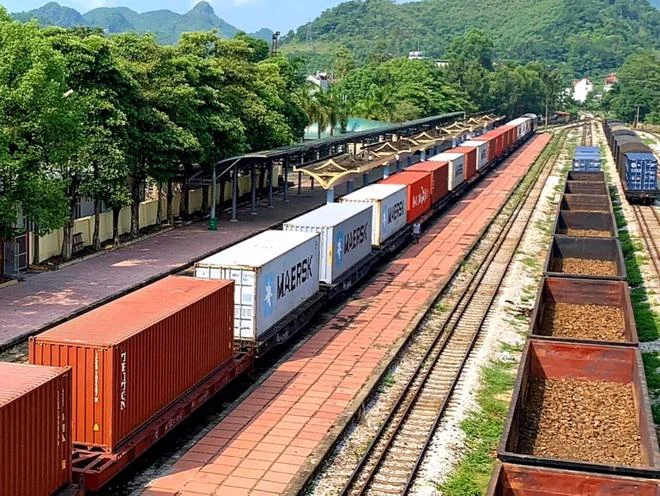
In Vietnam, railway transportation is operated by Vietnam Railways Corporation (VNR), with a total network length of approximately 3,143 km, connecting Hanoi Station to Saigon Station along the North–South corridor, with several branch lines extending to China via the Dong Dang (Lang Son) and Lao Cai border crossings.
Amid growing global integration and the rapid expansion of the China-Europe Railway Express (CRE), international rail freight services are attracting increasing attention from Vietnamese exporters.
Advantages and Disadvantages of Rail Freight
Advantages
- Significantly lower cost than air freight: Rail freight rates are 60–70% lower than air freight for the same shipment. This is the primary reason why exporters of electronics, textiles, and consumer goods to Europe are increasingly choosing railway transportation over air cargo.
- 2–3 weeks faster than sea freight on the Asia-Europe corridor: Sea freight from Vietnam to Europe takes 25–35 days. Via intermodal rail transport (transiting through China and Central Asia), transit time is reduced to just 18–22 days — at only one-third to one-quarter of the cost of air freight.
- Independent of ocean weather conditions: Rail cargo transport is unaffected by storms, rough seas, or peak-season port congestion at major terminals — factors that paralyzed global supply chains during 2021–2022.
- High load capacity, suitable for large-volume cargo: A single freight train can carry between 40 and over 100 containers, making freight rail services ideal for bulk cargo and heavy industrial shipments that road transport cannot handle efficiently.
- More environmentally friendly than road and air: CO₂ emissions from rail freight per tonne-km are approximately 75% lower than road transport and up to 90% lower than air freight — a key advantage for businesses pursuing ESG goals and reducing their supply chain carbon footprint.
- Reliable schedules, easier planning: No road congestion as with trucking. Fixed freight terminal schedules allow businesses to plan production and delivery timelines with greater accuracy.
Disadvantages
- Dependent on rail infrastructure and network coverage: Rail cargo transport is only viable when both origin and destination have connected freight terminals. In Vietnam, the rail freight network does not yet extend to most industrial zones — requiring first-mile and last-mile road connections to complete the journey.
- Less flexible scheduling than road transport: Trains operate on fixed timetables — if cargo misses the cut-off, it must wait for the next departure, potentially causing delays of several days to a week.
- Complex international transit procedures: Particularly on cross-border rail freight routes through multiple countries (Vietnam – China – Kazakhstan – Russia – Europe), cargo may require gauge changes at borders, wagon transfers at transshipment points, and compliance with customs regulations in each transit country.
- Not suitable for all oversized or overweight cargo: Certain goods with dimensions or weights exceeding the structural limits of rail wagons and bridges cannot be transported by standard railway freight services.
- Risk of cargo damage from vibration: Train movement generates higher vibration levels than calm sea voyages. Fragile goods and sensitive electronics require more robust packaging than standard sea freight specifications.
Common Types of Rail Freight Services
1. Container Rail Freight Service
This is the most widely used form of railway transportation in modern international logistics. Standard 20ft and 40ft containers are loaded onto specialized flatcars, ensuring full intermodal compatibility with seaports and road container depots.
- Best suited for: Electronics, textiles, consumer goods, industrial components, and standardized packaged cargo — particularly for the Vietnam/China to Europe corridor via the China-Europe Railway Express (CRE).
- Advantages: High compatibility with integrated logistics chains, easy tracking and cargo monitoring, minimal cargo handling and transfers.
- Disadvantages: Dependent on fixed train schedules; requires close coordination between origin and destination terminals.
2. Bulk Cargo Rail Transport
Dry bulk commodities such as coal, iron ore, grain, and fertilizers are carried in specialized open wagons without containers. This is the traditional form of bulk cargo rail transport, still accounting for a significant share of domestic freight in Vietnam and many developing countries.
- Best suited for: Minerals, raw materials, large-volume agricultural produce, coal, cement, fertilizers.
- Advantages: Very low cost, no complex packaging required, extremely high load capacity.
- Disadvantages: Limited to specific commodity types; requires dedicated terminals; longer loading and unloading times.
3. Oversized and Heavy-lift Rail Cargo
Large industrial equipment, power transformers, bridge components, and wind turbine parts — goods that exceed road transport limits but remain within rail infrastructure tolerances — are transported using specialized wagons such as low-bed flatcars and depressed center cars.
- Best suited for: Factory equipment, wind energy projects, large-scale infrastructure development.
- Advantages: Can transport equipment that cannot move by road due to bridge clearance and width restrictions.
- Disadvantages: Requires pre-route surveys, special transport permits, and higher planning costs.
4. International Rail Transit (Intermodal Rail Transport)
This form of intermodal rail transport connects the national railway systems of multiple countries through international transit agreements. The most prominent example is the China-Europe Railway Express (CRE) — linking over 180 cities in China with more than 60 cities in 21 European countries via the Northern Corridor (through Russia), the Middle Corridor (through Kazakhstan and Belarus), and the Southern Corridor (through Central Asia).
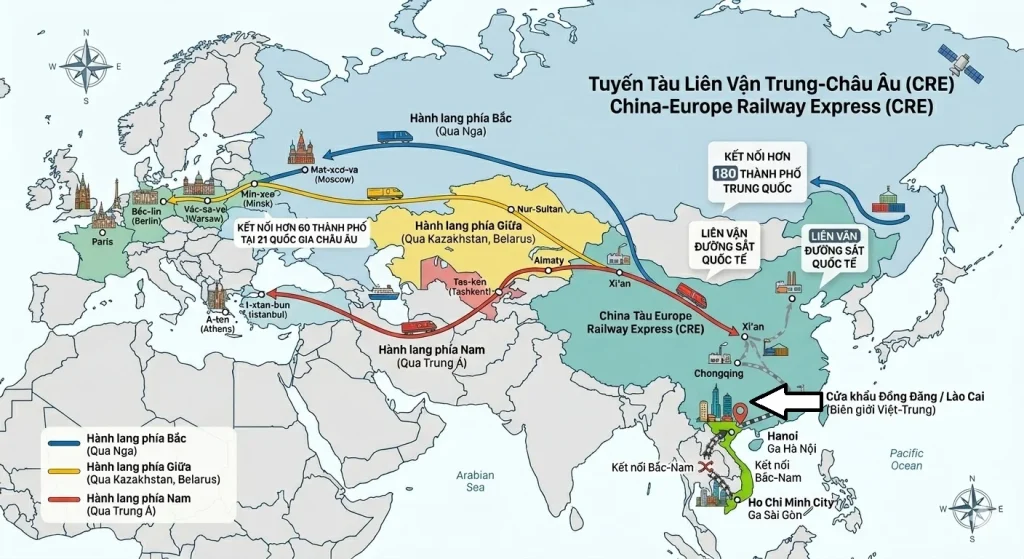
From Vietnam, shipments typically follow this routing: Hanoi / Saigon Station → Dong Dang or Lao Cai Border Crossing → Chinese Rail Terminal → CRE → Destination Station in Europe.
Rail Transport and Its Role in Modern Logistics
As global trade increasingly demands a balance between speed, cost, and sustainability, railway transportation — among the various modes of transport — is firmly establishing itself as the ideal “middle-ground” solution:
- Asia-Europe Corridor: The CRE has now completed over 90,000 train journeys since launch, with cargo volumes growing at an average of 30% per year between 2018 and 2024. This is the clearest evidence of rail freight’s expanding role in international logistics.
- Supply chain resilience: Following the lessons of the global port congestion crisis in 2021–2022, many multinational corporations diversified their transport strategies — incorporating rail logistics services as a parallel option alongside sea freight.
- Domestic connectivity: Within Vietnam, railway transportation plays a vital role in moving goods along the North–South corridor, particularly coal, cement, fertilizers, and agricultural produce from the Central and Central Highlands regions.
International Rail Freight Process from Vietnam
Step 1: Cargo Preparation and Booking
Contact a freight forwarder with proven experience in international rail freight services to receive routing advice, rate quotation, and slot booking on the train. Information required: cargo type, HS code, weight, dimensions, origin terminal, destination terminal, and cargo ready date.
Step 2: Export Customs Declaration in Vietnam
File the electronic customs declaration on Vietnam’s VNACCS/VCIS system. Prepare the complete commercial document set: Commercial Invoice, Packing List, Sales Contract, and any specialized certificates required (phytosanitary, CFS, etc.). Complete export customs clearance before delivering cargo to the freight terminal area.
Step 3: Transport to Border Terminal and Cross-border Rail Procedures
Cargo is transported by road or domestic rail to the border freight terminal (Dong Dang or Lao Cai). At this point, Vietnamese export exit procedures and Chinese import entry procedures are completed. For containerized shipments, containers are typically transferred to Chinese rail wagons due to track gauge differences (Vietnam: 1,000 mm; China: standard 1,435 mm). The China Railway Bill (CRB) is issued here.
Step 4: Transit Through Intermediate Countries
The train travels through Kazakhstan, Russia, or Belarus (depending on the corridor chosen) to Europe. At certain border points, bogie exchanges (wheel axle changes) are required due to track gauge differences between the standard gauge system (1,435 mm) and the Russian/CIS system (1,520 mm). The forwarder monitors the shipment and provides tracking updates to the shipper throughout the journey.
Step 5: Import Customs Clearance at the European Destination Terminal
At the destination terminal, the import customs broker handles customs clearance procedures, submits the required documentation, and pays applicable import duties in accordance with the destination country’s regulations. Once cleared, cargo is delivered to the consignee by road (last-mile delivery).
Step 6: Post-shipment Documentation and Payment
After safe cargo arrival, the forwarder provides the complete document set: CRB/Rail Waybill, Commercial Invoice, Packing List, C/O (if applicable), and Phytosanitary Certificate (if required) — for international payment processing and record-keeping purposes.
Key Documents in Rail Cargo Transport
CRB / Rail Waybill
The Rail Waybill (CIM Consignment Note for European routes; CRB for China routes) is the most important document in railway transportation. It serves simultaneously as the contract of carriage and the cargo receipt between the shipper and the rail operator.
Unlike a sea freight Bill of Lading, the Rail Waybill is non-negotiable — meaning ownership of the goods cannot be transferred through the document. The consignee does not need an original copy to collect the cargo; presentation of valid identification and agent confirmation is sufficient.
Commercial Invoice and Packing List
As with sea and air freight, these are the two fundamental commercial documents required for all shipments. The Invoice declares the shipment value (the basis for import duty calculation at the destination), while the Packing List itemizes each package and must match the physical cargo exactly.
Certificate of Origin (C/O)
Certifies the Vietnamese origin of the goods. Particularly critical for shipments to the EU (C/O Form EUR.1 or REX declaration under EVFTA) and other FTA partner markets. The C/O enables importers to access preferential tariff rates significantly below standard MFN duties. Download C/O
Customs Declaration
Export customs declaration filed in Vietnam (via VNACCS) and import declaration at the destination country. For cargo transiting through China and Central Asian countries, separate declarations may be required at each border crossing in accordance with each country’s regulations.
Specialized Documents (If Applicable)
Phytosanitary Certificate (plant-based cargo), Health Certificate (food products, animal products), MSDS (dangerous goods per RID — Regulations concerning the International Carriage of Dangerous Goods by Rail), Fumigation Certificate — required depending on cargo type and the importing country’s entry requirements.
Rail Freight Costs — Classification by Cargo Type and Wagon
Railway shipping costs are determined by multiple factors: cargo type, transit route, wagon type, distance, and time of year. The table below provides a reference classification of rail freight rates by cargo type and wagon characteristics:
Rail Freight Rate Reference Table
| Cargo Type | Suitable Wagon Type | Freight Unit | Reference Rate (Vietnam–EU via CRE) | Notes |
|---|---|---|---|---|
| Container Freight (FCL) Electronics, textiles, consumer goods | Container Flatcar — 40ft or 20ft | USD/container | USD 3,500 – 6,000 / 40ft | Subject to seasonal and corridor variation |
| LCL Rail (Groupage) Samples, small parcels | Consolidation Container | USD/CBM or USD/tonne | USD 80 – 150 / CBM | Varies by forwarder and consolidation frequency |
| Dry Bulk Cargo Coal, ore, cement, grain | Open Wagon (Gondola Car) | USD/tonne or VND/tonne-km (domestic) | USD 15 – 40/tonne (domestic Vietnam) Contract-based for international | Common on domestic Vietnam routes |
| Liquid Bulk / Chemicals Oil, acids, industrial chemicals | Specialized Tank Wagon | USD/tonne or USD/litre | Long-term contract basis | RID Dangerous Goods documentation required |
| Temperature-controlled Cargo Frozen food, pharmaceuticals, fresh produce | Refrigerated Wagon / Reefer Container | USD/reefer container | 20–35% premium over standard container rates | Route-dependent; advance confirmation required |
| Oversized / Heavy-lift Cargo Industrial equipment, transformers, large structures | Low-bed Flatcar / Depressed Center Car | Individual quotation per shipment | Subject to route survey | Special transport permit required |
| Vehicles / Rolling Stock Cars, trucks, construction equipment | Auto Carrier / RORO Rail Wagon | USD/vehicle or USD/unit | Route and vehicle type dependent | Common on domestic and Vietnam–China routes |
Important note on rates: The rates above are for reference purposes only at the time of publication. Railway shipping costs fluctuate based on wagon supply and demand, geopolitical developments (particularly on routes through Russia/Ukraine), fuel prices, and seasonal peaks. Always request a formal quotation from your forwarder with a stated validity period.
In addition to base freight rates, common surcharges in international rail logistics services include:
- Terminal Handling Charge (THC): Loading and unloading fees at origin and destination terminals
- Transshipment Fee: Transfer charges at gauge-change border crossing points
- Documentation Fee: Rail Waybill preparation and customs declaration charges
- Customs Clearance Fee: Clearance charges at each transit border crossing
- Insurance Premium: Cargo insurance covering the full multimodal journey
- Last-mile Delivery: Road delivery charges from the destination terminal to the consignee’s warehouse
Tips to Optimize Rail Freight Costs and Minimize Risk
1. Choose the Right Corridor Based on Speed and Cost Objectives
From Vietnam to Europe, three primary rail corridors are currently available: the Northern Corridor (via Russia and Belarus — fastest at ~18 days but geopolitically dependent), the Middle Corridor (via Kazakhstan and the Caspian Sea — more stable, ~22–25 days), and the Southern Corridor (via Central Asia and Iran — longest but avoids Russian dependency). Discuss your delivery requirements and current market conditions with your forwarder to select the most appropriate corridor.
2. Book Early During Peak Season
Unlike air or sea freight, international rail wagons have a more constrained supply. During peak season (Q4 each year), wagon availability becomes so tight that some forwarders cannot confirm space less than 2–3 weeks out. If you plan to ship during October–December, book at least 4 weeks in advance.
3. Pack More Robustly Than Sea Freight Standards
Train movement generates higher vibration than calm sea voyages. For electronics, fragile goods, or sensitive cargo — reinforce internal shock-absorbing padding within the container and secure cargo more firmly. Better packaging costs far less than cargo damage claims.
4. Purchase Cargo Insurance Covering the Full Multimodal Journey
International rail cargo transport across multiple countries represents the longest and most complex journey of any freight mode. Cargo may cross 5–7 borders and be transferred between wagons multiple times. Loss, damage, or incidents cannot be entirely ruled out. Cargo insurance under Institute Cargo Clauses (A) or All Risk terms is strongly recommended, typically at a premium of 0.1–0.25% of the shipment value.
5. Monitor Tracking Regularly and Prepare Contingency Plans
International rail journeys involve multiple checkpoint transitions. A reliable forwarder will provide real-time tracking or regular shipment position updates. In parallel, prepare contingency plans for potential delays at border crossings — especially for shipments with strict delivery deadlines.
6. Integrate Rail into a Multimodal Transport Strategy
Freight rail services are most effective when embedded in a multimodal chain: road/domestic sea → international rail → last-mile road delivery. A practical example: cargo from an industrial zone in Binh Duong travels by road to Song Than freight station, boards a train to the Dong Dang border crossing, and transfers to the CRE heading to Frankfurt — delivering significant savings compared to routing via Cat Lai Port by sea when ocean freight rates are elevated.
Frequently Asked Questions (FAQ) — Rail Transport
Question 1: How long does rail freight from Vietnam to Europe take?
From the time cargo departs Vietnam to arrival at the destination terminal in Europe, transit typically takes 18–25 days depending on the corridor and specific destination. The Northern Corridor (via Russia) is fastest at approximately 18 days. The Middle Corridor (via Kazakhstan) takes approximately 22–25 days. However, when accounting for domestic collection in Vietnam and last-mile delivery in Europe, the total door-to-door transit is typically 25–35 working days.
Question 2: Are rail freight rates cheaper than sea freight for Vietnam–Europe shipments?
Rail freight rates are typically 30–60% higher than sea freight but 60–70% lower than air freight. Railway transportation is the optimal choice when cargo cannot wait 30+ days by sea but the budget does not support air freight. During periods of extreme ocean freight rate spikes (such as 2021–2022), rail freight rates became directly competitive with — and in some cases lower than — all-in sea freight costs.
Question 3: What types of cargo cannot be transported by rail?
The vast majority of standard cargo can be handled by rail cargo transport. However, certain goods are restricted or prohibited: dangerous goods that do not comply with RID regulations (Regulations concerning the International Carriage of Dangerous Goods by Rail), cargo with dimensions exceeding rail infrastructure load gauge limits, and shipments requiring specific storage conditions that the chosen route cannot provide.
Question 4: Does rail cargo require a Phytosanitary Certificate?
Yes, if the shipment consists of plant-based products or agricultural commodities. The mode of transport — sea, air, rail, or road — has no bearing on phytosanitary requirements. These are mandated by the importing country and apply to all transport modes equally. Your forwarder will advise on the specific specialized documents required for each commodity type and destination.
Question 5: Does 3W Logistics provide rail freight services?
Yes. 3W Logistics supports the planning and execution of rail logistics services from Vietnam, including connections to international rail transit routes via the Dong Dang and Lao Cai border crossings, complete export and transit customs clearance handling, and coordination of full multimodal transport solutions (first-mile + rail + last-mile). Contact us for a detailed quotation based on your actual shipment specifications.
End-to-End Rail Freight Solutions at 3W Logistics
With extensive experience in international multimodal transport, 3W Logistics delivers comprehensive freight rail services — from corridor selection and wagon booking to multi-country customs clearance and last-mile delivery at the destination — ensuring your shipment arrives on time, within budget, and in full regulatory compliance.
Head Office – 3W Logistics Ho Chi Minh City Branch
Address: 34 Bach Dang Street, Tan Son Hoa Ward, Ho Chi Minh City
Hotline: +84 28 3535 0087
3W Logistics Hanoi Branch
Address: 81A Tran Quoc Toan Street, Cua Nam Ward, Hanoi
Hotline: +84 24 3202 0482
3W Logistics Hai Phong Branch
Address: 8A Lot 28 Le Hong Phong Street, Gia Vien Ward, Hai Phong
Hotline: +84 225 355 5939
3W LOGISTICS CO., LTD – We here serve you there!
Email: quote@3w-logistics.com
Website: www.3w-logistics.com


