
IQF (Individual Quick Freezing) is a technology for rapidly freezing individual pieces separately, in which each piece of product is frozen independently at a very low temperature over a short period, rather than being frozen into a block. This technology emerged in the 1960s and is now a mandatory technical standard for most of the world’s major seafood, fruit and vegetable, and poultry importing markets – from the EU, the US, and Japan to South Korea.
In international trade, the “IQF” requirement often appears directly in the sales contract, the L/C, and the buyer’s quality inspection slip. Products that do not meet the IQF criteria – clumping, excessive glaze, discoloration – can be rejected at the destination port or face significant price penalties.
In this article, 3W Logistics compiles the complete knowledge about IQF freezing systems: from the concept, principles, process, equipment classification, and technical parameters to common errors in exported goods – from the perspective of a forwarder with over 10 years of experience in international cold chain shipping.
1. What Is IQF? Concept and Characteristics
IQF stands for Individual Quick Freezing. By technical definition, IQF is a freezing method in which each unit of product (a shrimp, a piece of vegetable, a chicken wing, etc.) is frozen separately, without touching or sticking to each other throughout the freezing process.
The core technical characteristics of IQF:
- Freezing speed: The product’s core temperature reaches −18°C or lower within 30 minutes to a maximum of 4 hours, depending on product size.
- Freezing chamber temperature: Typically −30°C to −45°C; some cryogenic systems using liquid nitrogen can go down to −60°C to −80°C.
- Free-flow property: After leaving the IQF chamber, each individual piece of product can be poured, dispensed, and weighed separately without clumping.
- Low weight loss: The rapid freezing process forms small ice crystals inside the cells, limiting cell membrane damage and reducing drip loss upon thawing to 2-5%, compared to 8-12% for slow freezing.
- Preserved structure: The color, flavor, texture, and nutritional value of the product after thawing are closer to fresh product than with any other conventional freezing method.
Important note: In export trade, “IQF” is not just a technical requirement but also a contractual term. Goods stated as “IQF” on the bill of lading but actually shipped as block-frozen (semi-IQF or block freezer) can be considered goods that do not match the description and are subject to commercial disputes.
2. How Does IQF Differ From Conventional Freezing?
Conventional freezing (also known as slow freezing or block freezing) stacks products in layers or blocks, cooling them gradually through an ordinary cold room at −18°C to −22°C. This process takes several hours to several days, forming large ice crystals that break down cell walls and cause the product to lose fluid upon thawing.
| Comparison Criterion | IQF (Individual Quick Freezing) | Conventional Freezing (Block / Slow Freezing) |
|---|---|---|
| Freezing chamber temperature | −30°C to −45°C (or lower with cryogenic) | −18°C to −22°C |
| Freezing time | 30 minutes – 4 hours (depending on size) | 8 – 72 hours |
| Ice crystal size | Small, within the cell | Large, breaking the cell membrane |
| Drip loss upon thawing | 2 – 5% | 8 – 15% |
| Free-flow property | Yes – each piece separate, can be weighed/divided | No – product sticks together into a block |
| Sensory quality after thawing | Close to fresh product; color and texture well preserved | Product becomes mushy, loses water, easily discolors |
| Equipment investment cost | Higher (conveyor, fluidization, CAS systems) | Lower (ordinary freezer storage) |
| Suitable for which markets | EU, US, Japan, South Korea – markets requiring free-flow | Domestic market, large-volume industrial processing that doesn’t need separation |
| Typical application in import-export | Peeled shrimp, clams, vegetables, diced mango, chicken fillet | Block surimi, whole-shrimp block, bulk fish fillet, imported pork |
3. Comparing IQF With Other Freezing Methods
Besides IQF and block freezing, the import-export food industry also uses several other freezing technologies. Each method has its own characteristics suited to a particular product type and market requirement.
| Method | Freezing Temperature | Speed | Main Pros / Cons | Suitable For |
|---|---|---|---|---|
| IQF (Air Blast / Fluidization) | −30°C to −45°C | Fast (30 min – 4 h) | Good free-flow, low drip loss; high investment cost | Shrimp, vegetables, diced fruit |
| Plate Freezer | −35°C to −40°C | Medium (2 – 5 h) | Suited to flat products (fillets), forms blocks; no free-flow | Fish fillet, surimi, block shrimp |
| Cryogenic Freezer (liquid N₂ / CO₂) | −60°C to −196°C | Extremely fast (<10 minutes) | Highest quality; liquefied gas cost is expensive, suited to high-value products | Premium seafood, truffle mushrooms, medical products |
| Air Blast Freezer | −25°C to −35°C | Slow – medium (4 – 24 h) | Low cost; larger ice crystals than IQF, product prone to water loss | Whole carcasses, frozen confectionery, domestic goods |
| Immersion Freezer (brine / glycol) | −20°C to −30°C | Fast (30 min – 2 h) | Fast, suited to use onboard fishing vessels; the solution can affect flavor if not controlled | Ocean tuna, offshore-caught fish |
| CAS Freezer (Cells Alive System) | −20°C to −30°C | Fast (comparable to IQF) | Uses a magnetic field/oscillating wave to control ice crystals; very high thawed quality; very high equipment cost | Wagyu beef, premium seafood exported to Japan |
4. Principles of IQF Freezing
The core principle of IQF freezing relies on two factors: the speed of heat transfer and the mechanical separation between product pieces throughout the freezing process.
Heat Transfer Speed and Ice Crystals
When food is frozen quickly, the water inside the cells turns into small ice crystals (under 50 µm), distributed evenly within the cytoplasm without breaking the cell membrane. Upon thawing, the cell recovers almost completely, with minimal drip loss. Conversely, slow freezing forms large crystals (over 200 µm), breaking the cell membrane and causing fluid loss and a mushy texture.
The Fluidization Principle (Suspended in an Air Stream)
Most industrial IQF systems use the fluidization technique: a high-speed cold air stream (3–5 m/s) blows from below through a mesh conveyor belt, lifting small product pieces (peas, peeled shrimp, diced product) into suspension and separating them from each other. Each piece has its entire surface in contact with the cold air stream, ensuring even and fast freezing.
The Danger Zone and the “Maximum Ice Crystal Formation” Zone
In IQF freezing, the product must pass as quickly as possible through the −1°C to −7°C temperature zone (also known as the Maximum Ice Crystal Formation Zone). This is the zone where the most ice crystals form. IQF systems are designed so the time spent passing through this zone is under 30 minutes. If the equipment lacks sufficient cooling capacity or too much product is loaded, the product passes through this zone slowly, forming large crystals and failing to meet IQF quality.
Glazing After IQF
After leaving the IQF chamber, the product usually passes through a glazing chamber: sprayed with cold water or briefly dipped into a 0–2°C water bath to form a thin ice layer coating the outside (glaze). The glaze layer protects the product from freezer burn during storage and transport. The glaze content is typically 5–15%; some EU markets require the product weight after deducting the glaze (net drained weight) to be stated on the label.
5. The IQF Freezing Process
Step 1: Receiving and grading raw material
Raw material is received at below 4°C (or live/fresh for seafood). It is graded by size/count, removing crushed or discolored pieces. Size uniformity is a prerequisite for ensuring every piece freezes evenly within the same conveyor time.
Step 2: Preprocessing, washing, and draining
The product is preprocessed (peeled, de-headed, cut as required), washed with clean water at a controlled chlorine concentration, then drained or passed through a spin dryer. Excess surface moisture causes the product to stick together and uncontrollably increases the glaze ratio.
Step 3: Pre-cooling / Chilling
The product is passed through a pre-cooling chamber or chilling tunnel to lower the temperature to 0–4°C before entering the IQF conveyor. This step reduces the load on the IQF cooling system and shortens the heat removal time in the main freezing chamber.
Step 4: IQF freezing
The product is loaded onto the IQF conveyor at a controlled density (not overlapping). A high-speed −30°C to −45°C cold air stream acts on the entire product surface. The time on the conveyor (residence time) is adjusted according to product size and type. The product’s core temperature upon exit must reach ≤ −18°C.
Step 5: Glazing and inspection
The product exiting the IQF chamber passes through the glazing chamber. After glazing, random checks are made on core temperature, glaze ratio, looseness, and sensory quality. Products that fail are returned to the line or discarded.
Step 6: Packing and storage
The IQF product is packed into PE/PA bags or cartons, vacuum-sealed or MAP (Modified Atmosphere Packaging) if required, labeled per the market’s regulations (net weight, glaze %, lot number, best before). It is stored in a freezer at −18°C to −22°C pending shipment. Export reefer containers are set at −18°C; some Japanese markets require −25°C.
6. Classification of IQF Systems
In the current equipment market, IQF freezing systems are classified by mechanical principle and heat transfer method. Each type is suited to a different product group and production scale.
| IQF System Type | Common Name | Principle | Advantages | Typical Products |
|---|---|---|---|---|
| Fluidization IQF Tunnel | Fluidized bed tunnel | Cold air blows from below, suspending each small piece of product | Absolute free-flow; very even freezing; high throughput | Peeled shrimp, peas, sweet corn, diced onion, small strawberries |
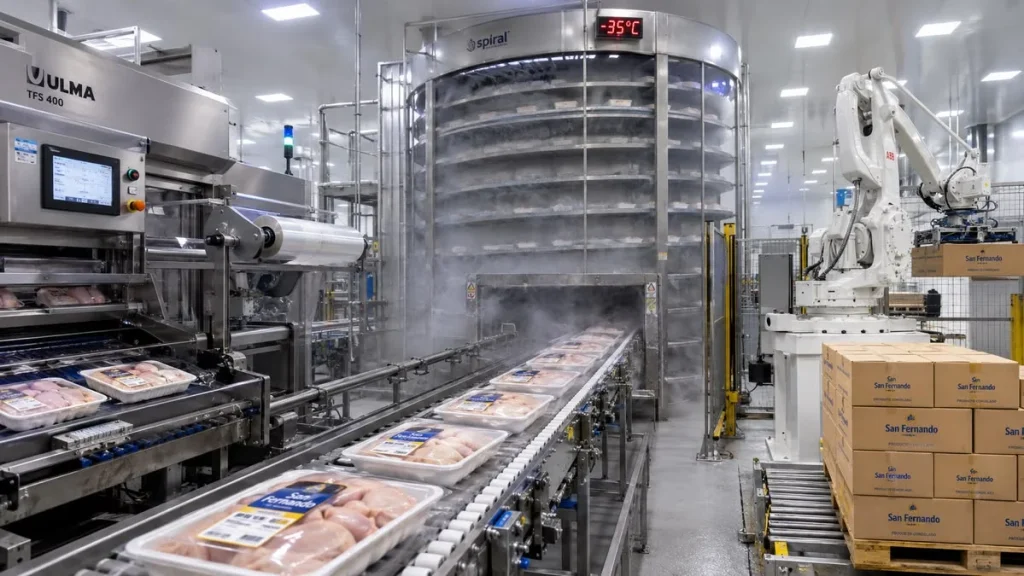
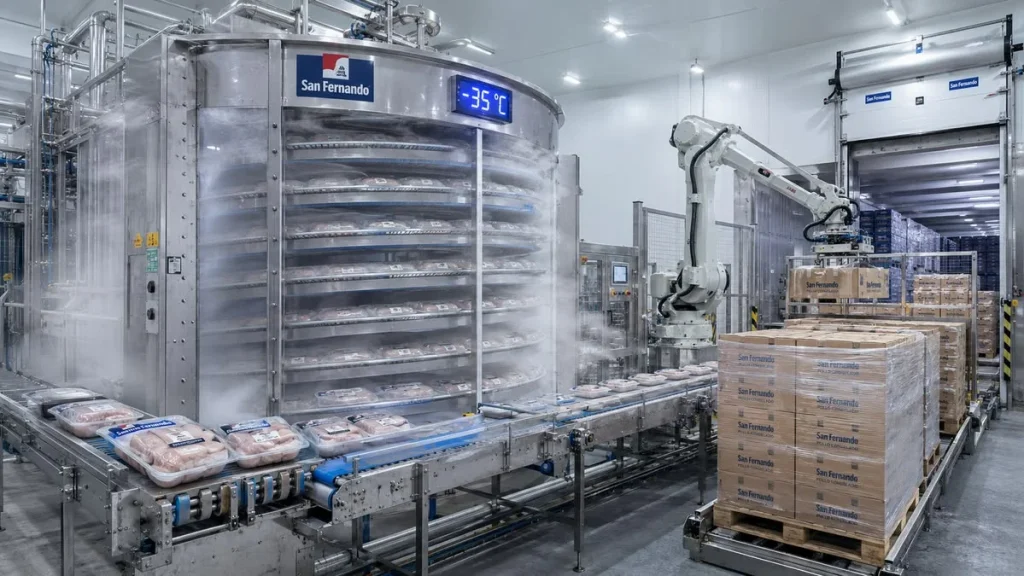
| Spiral IQF Freezer | Spiral freezing | A multi-tier spiral conveyor inside an enclosed cold chamber; cold air circulates | Space-saving; suited to larger, more delicate products; longer residence time | Chicken fillet, raw meat burger, seafood cake, fish fillet, squid |
| Straight Tunnel IQF | Linear tunnel | Straight conveyor; cold air blows across/along the product | Flexible for many product types; easy to clean; moderate cost | Whole shrimp, squid rings, asparagus, cauliflower |
| Cryogenic IQF (N₂ / CO₂) | Cryogenic freezing | Spraying liquid nitrogen (−196°C) or liquid CO₂ (−78°C) directly onto the product | Extremely fast freezing speed; highest quality; no large compressor needed | Premium seafood (sashimi-grade), mushrooms, sauced products/high-value ingredients |
| Plate IQF Freezer | Plate freezer | Product pressed between two cold metal plates; direct flat-surface contact | High throughput for flat products; low power use; suited to block export | Flat fish fillets, block surimi, block shrimp for domestic Chinese export |
| Impingement IQF Freezer | Impingement freezing | Extremely high-speed cold air (jet air) blown directly down onto the product surface | Breaks the static boundary layer, 2–3x faster freezing than an ordinary tunnel | Hamburger patties, pizza, thin processed products, exported frozen spring rolls |
From 3W Logistics’ practical experience: Most seafood export factories in Ca Mau, Soc Trang, and Bac Lieu use a Fluidization IQF Tunnel for peeled PD/PUD shrimp and a Spiral Freezer for whole shrimp/nobashi products. When inspecting goods before export, 3W Logistics’ documentation team typically requests confirmation of the IQF equipment type and the product’s core temperature from the factory to accurately state on the Certificate of Quality – this information is increasingly requested by EU and Japanese buyers to accompany the documentation set.
— Ms. Apple, CCO, 3W Logistics
7. IQF Applications by Import-Export Product Group
Frozen IQF Seafood
This is the largest application group for IQF technology in Vietnamese exports. Most shrimp, squid, and octopus export contracts to the EU, US, and Japan require IQF.
| Product | Common IQF Type | Market Requirements | Reference HS Code |
|---|---|---|---|
| Peeled white-leg/black tiger shrimp (PD, PUD, HLSO) | Fluidization IQF Tunnel | EU: HACCP, net drained weight; US: FDA FSVP, SIMP; Japan: JAS, glaze ≤ 20% | 0306.17; 0306.16 |
| Squid, cuttlefish rings | Straight Tunnel IQF / Spiral | EU: IUU Catch Certificate; SO₂ residue testing | 0307.43; 0307.49 |
| Octopus | Spiral IQF Freezer | Japan/Korea: uniform size, glaze not exceeding 15% | 0307.51; 0307.59 |
| Shelled clams, oysters, scallops | Fluidization or Straight Tunnel | EU: microbiology, Norovirus testing; A/B-certified harvest area | 0307.11; 0307.21; 0307.31 |
| Pangasius/basa fillet | Straight Tunnel IQF | US: USDC Grade A inspection; EU: phosphate testing, maximum glaze | 0304.62; 0304.89 |
Frozen IQF Fruits and Vegetables
IQF fruit and vegetable exports focus on the EU, US, and South Korean markets. Sweet corn kernels, peas, edamame, and diced mango are Vietnam’s largest IQF items in this category.
| Product | IQF Type | Specific Requirements | Reference HS Code |
|---|---|---|---|
| Sweet corn kernel | Fluidization IQF | BRC/FSSC 22000; moisture ≤ 76%; no dark yellow discoloration | 2005.80; 0710.40 |
| Peas, edamame | Fluidization IQF | Japan: pesticide testing, uniform size; EU: pesticide residue MRL | 0710.21; 0710.22; 2005.51 |
| Diced mango | Straight Tunnel or Spiral | Brix ≥ 14; no added water; growing area code check (Resolution 36/2026) | 0811.90 |
| Broccoli, chopped asparagus | Straight Tunnel or Fluidization | EU: blanched before IQF to deactivate enzymes; no sulfite | 0710.80; 0710.29 |
| Strawberries, blueberries (berries) | Fluidization IQF (gentle blowing) | US/EU: GlobalGAP or equivalent; total microbial count testing | 0811.10; 0811.20 |
IQF Meat and Poultry
Chicken fillet, chicken wings, chicken feet, and meat-processed products (burgers, nuggets, spring rolls) exported use IQF to ensure the product is separate, easy to count, and easy to further process at the destination.
| Product | Common IQF Type | Market Requirements | HS Code |
|---|---|---|---|
| Chicken breast fillet, boneless thigh | Spiral IQF Freezer | Japan: Halal + Salmonella testing; EU: Campylobacter testing | 0207.14; 0207.13 |
| Frozen chicken feet | Straight Tunnel or Spiral | China: SPS certification, GACC quarantine; no freezer burn | 0207.99 |
| Raw beef/chicken burger patties | Impingement IQF / Spiral | USDA/FSIS (US); EU: temperature log, full HACCP | 1602.50; 1602.32 |
8. Technical Parameters of IQF Systems
When evaluating or purchasing an IQF freezing system, the following technical parameters are most important for an export factory:
| Technical Parameter | Unit / Symbol | Typical Value | Practical Meaning |
|---|---|---|---|
| Freezing chamber temperature | °C | −30°C to −45°C | The lower, the smaller the ice crystals; power consumption increases |
| Product core temperature exiting the chamber | °C | ≤ −18°C (standard); ≤ −25°C (Japan) | Parameter checked upon shipment acceptance, recorded on the CoQ |
| Throughput | kg/h | 500 – 5,000 kg/h depending on equipment type | Determines the number of containers/week that can be produced |
| Air velocity | m/s | 3 – 5 m/s (fluidization); 1.5 – 3 m/s (ordinary tunnel) | Higher speed = better surface drying; too high = uneven glazing |
| Residence time (time on the conveyor) | minutes | 5 – 30 minutes (small products); 60 – 240 minutes (large products) | Adjusts conveyor speed; optimized per batch size |
| Glazing rate | % | 5 – 20% (EU market max 20%, Japan ≤ 15%) | Net drained weight must be stated; glaze must not be counted toward priced weight |
| Drip loss upon thawing | % | ≤ 5% (standard IQF); ≤ 3% (premium IQF) | A commercial criterion; EU/US buyers often require testing in the CoQ |
| Power consumption | kW / ton of product | 120 – 250 kW/ton (air blast IQF); < 80 kW/ton (cryogenic, but gas cost is higher) | Directly affects production cost; a factor when choosing equipment |
| Cleaning frequency (CIP/defrost) | hours/shift | Automatic defrost every 4 – 8 hours; deep CIP every 1 – 2 weeks | Accumulated frost reduces cold airflow, causing the IQF product to fail to reach temperature |
9. Common Mistakes About IQF in Exported Goods
Through years of handling documentation and booking reefer containers for exported IQF goods, the 3W Logistics team has observed several recurring errors at Vietnamese factories and export units:
| Common Mistake | Practical Consequence | Prevention |
|---|---|---|
| Overloading the IQF conveyor | Product overlaps, freezing unevenly; core temperature fails to reach −18°C; goods rejected at the destination port upon temperature check | Control loading density (kg/m² of conveyor); randomly monitor core temperature every 30 minutes |
| Product entering the IQF chamber with surface moisture still too high | Ice forms connecting the pieces together → product clumps; fails to meet the free-flow criterion; buyer complains | After washing, drain thoroughly with a centrifugal spinner or air-knife before loading the conveyor |
| Stating “IQF” on the C/O and Invoice but actually shipping semi-IQF or block | Commercial disputes; goods returned; loss of reputation; potential trade fraud litigation in some EU markets | Correctly state the product form throughout all documentation: IQF, Semi-IQF, Block Frozen – do not mix them up to avoid legal risk |
| Glaze ratio exceeding the market’s regulation | EU: violates labeling regulations (FIC Regulation (EU) 1169/2011); buyer demands compensation; goods held at customs | Check the glaze % for each batch using the weighing method; state net drained weight on the label |
| Reefer container not at temperature before stuffing | Product partially thaws → refreezes → forms large ice crystals → quality degrades; the temperature log shows an anomaly | Pre-cool the container to −18°C at least 4 hours before stuffing; check the temperature logger before closing the container doors |
| Not checking IQF equipment before the peak season | Frost builds up inside the chamber, reducing cold airflow; the IQF runs but the product fails to reach temperature; late detection causes many tons of spoiled goods | Perform periodic CIP maintenance and check the evaporator; defrost on the correct cycle; continuously log chamber temperature |
| Uneven product size when loading IQF | Small pieces over-freeze (freezer burn), large pieces don’t reach the required core temperature; inconsistent batch quality | Grade by size before IQF; adjust residence time for each size |
FAQ – Frequently Asked Questions About IQF in Import-Export
Question 1: How does IQF differ from semi-IQF?
True IQF ensures 100% of product pieces separate, fully free-flow. Semi-IQF (also called loose IQF) is the result of a not-yet-optimized IQF process: about 70–80% of the product separates, while some pieces still stick together in small clusters. EU and US buyers increasingly distinguish these two types clearly in the contract. If the contract states “IQF” but semi-IQF is delivered, the shipment may be rejected or subject to a price penalty.
Question 2: How do Chinese and European (Scanico, Grasso, GEA) IQF freezing machines differ?
IQF equipment from European brands such as Scanico (Denmark), GEA (Germany), and Frigoscandia typically has a more highly automated control system, more optimized energy consumption, and integrated CIP (Cleaning in Place). Chinese equipment costs 30–50% less to invest in, but usually requires more manual operation and maintenance.
For factories exporting to the EU, Japan, and the US, IQF equipment needs to meet audit requirements for automated temperature control and data traceability; this is where European equipment holds an advantage.
Question 3: Can IQF goods be exported using an ordinary reefer container?
Yes, but the cold chain process must be followed correctly. The reefer container is set to −18°C to −25°C depending on the market’s requirements, pre-cooled sufficiently before stuffing, fitted with an internal temperature logger, and connected to continuous power at the port yard and during vessel loading. A common mistake is the container not being cold enough when loading begins, causing the product’s core temperature to rise slightly and creating conditions for uncontrolled refreezing.
Question 4: What specific requirements does the EU market have for IQF products?
EU Regulation 1169/2011 (FIC) requires the net drained weight (weight after removing the glaze) to be clearly stated on the IQF product label. In addition, the maximum glaze ratio is typically stated in the EU buyer’s specification (usually ≤ 20% for seafood).
For IQF fruits and vegetables, the EU requires pesticide residue MRL (Maximum Residue Levels) testing under Regulation (EC) 396/2005. IQF seafood products need to meet a Health Certificate from the National Agro-Forestry-Fisheries Quality Assurance Department (NAFIQPM) and clearly state the lot number, production date, and expiry date to ensure traceability.
Question 5: Why do some batches of IQF shrimp clump together after reaching the buyer?
There are three main causes: (1) The cold chain was interrupted during transport, causing the product to partially thaw and then refreeze; (2) Insufficient glaze, causing the product surface to stick together when the temperature rises slightly in the container; (3) A factory error – the product entered the IQF chamber not sufficiently drained, or the chamber temperature failed to reach the requirement. To determine the cause, the container’s temperature logger needs to be read and cross-checked against the factory’s production temperature log.
How Does 3W Logistics Support Shipping IQF Import-Export Goods?
As an OTI-NVOCC with an FMC Bond in the United States and with over 10 years of experience shipping reefer containers, 3W Logistics accompanies factories and exporting businesses through the entire logistics chain for IQF frozen goods:
- Consulting on container type and temperature per market requirements: Determining the correct container temperature set-point (−18°C or −25°C), ventilation setting, and humidity control suited to each IQF goods type and each importing market.
- Booking dedicated reefer container routes: Routes to the US (Los Angeles, New York ports), the EU (Rotterdam, Hamburg, Antwerp), Japan (Tokyo, Osaka), South Korea, and intra-Asia routes.
- Documentation support for exporting frozen goods: Electronic customs declaration, Health Certificate, Certificate of Origin, Certificate of Quality, EUR.1/Form A (EU), APHIS Phytosanitary Certificate (US) depending on the product.
- Cold chain control from the factory to the port: Coordinating refrigerated trucks, monitoring temperature loggers, confirming container pre-cooling before stuffing, and power connection at the container yard.
- Handling quality complaints and cold cargo insurance: Supporting the filing of a claim with the shipping line when a temperature incident occurs during transport.
- Sea freight shipping: Combined with sea freight services for FCL and LCL reefer per the optimal sailing schedule.
Why choose 3W Logistics for exported IQF shipments?
IQF goods require an uninterrupted cold chain from the moment they leave the freezing chamber until they reach the buyer. Any temperature break, even just a few hours, can cause refreezing and completely destroy the product’s free-flow property. 3W Logistics understands this and designs a reefer logistics process with a temperature-checking checklist at every handover point in the shipping chain.
Head Office – 3W Logistics Ho Chi Minh City Branch
Address: 34 Bach Dang, Tan Son Hoa Ward, Ho Chi Minh City
Hotline: +84 28 3535 0087
____________________________
3W Logistics Hanoi Branch
Address: 81A Tran Quoc Toan, Cua Nam Ward, Hanoi
Hotline: +84 24 3202 0482
____________________________
3W Logistics Hai Phong Branch
Address: 8A Lot 28 Le Hong Phong, Gia Vien Ward, Hai Phong
Hotline: +84 225 355 5939
____________________________
3W LOGISTICS CO., LTD – We here serve you there!
Email: info@3w-logistics.com
Website: www.3w-logistics.com

Ms. Apple is the CCO (Chief Commercial Officer) at 3W Logistics, with over 10 years of experience in sales and business operations management.
At 3W Logistics, Ms. Apple is responsible for commercial strategy, corporate customer development, managing a team of more than 50 sales professionals, and improving business performance in the logistics sector.
With practical experience in sales management and market development, Ms. Apple shares professional insights on business logistics solutions, international transportation, freight forwarding, customer management, trade lane development, and growth strategies in the logistics industry.


