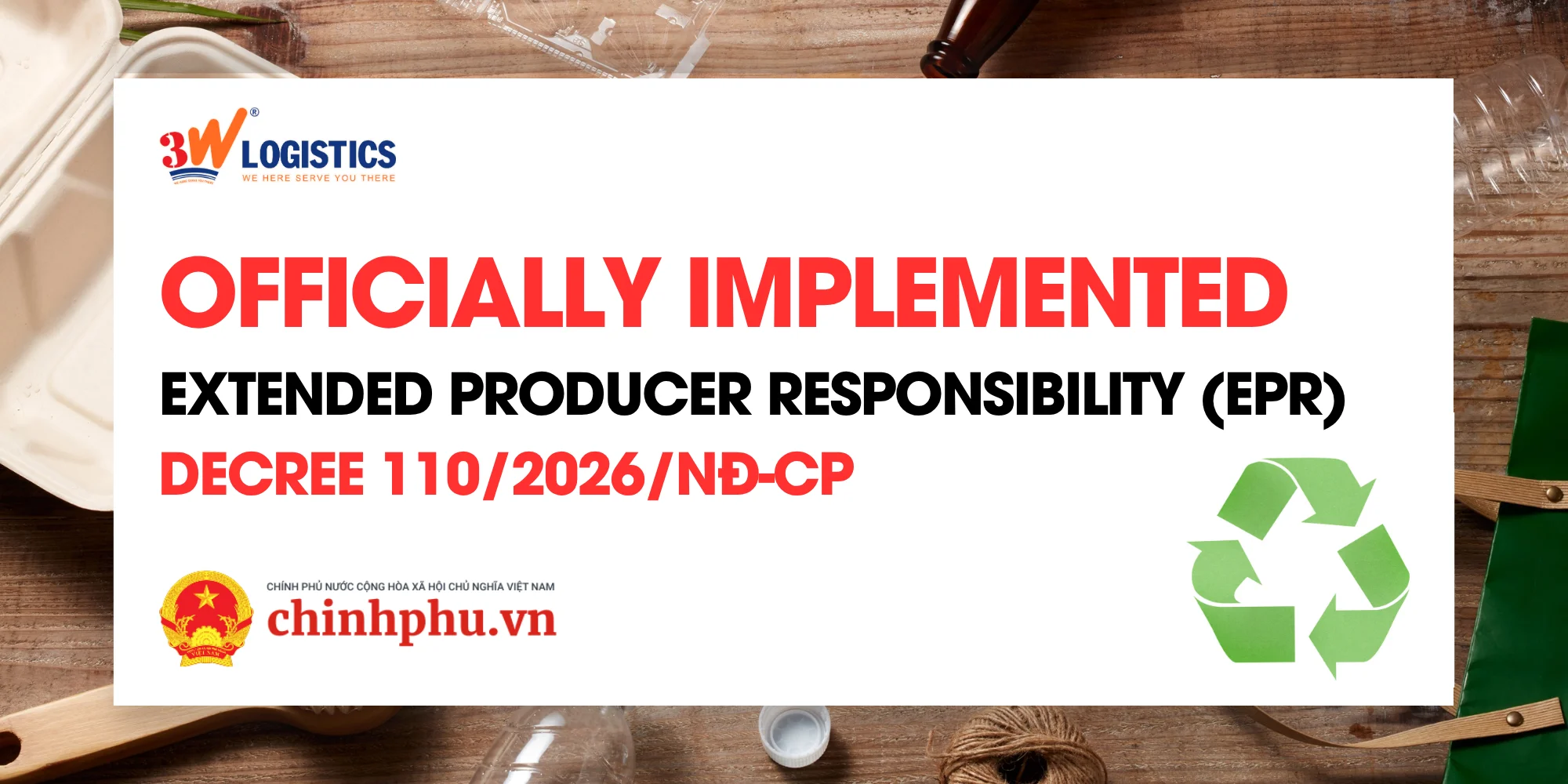
What Is EPR in Vietnam? Understanding Decree 110/2026/ND-CP
What is EPR? — Extended Producer Responsibility is the legal obligation requiring manufacturers and importers to take financial or operational responsibility for the post-consumer lifecycle of their products and packaging. Vietnam has been building its EPR framework since 2020, and on May 25, 2026, the most comprehensive regulation to date entered into force: Decree 110/2026/ND-CP.
This article breaks down every key provision of Decree 110/2026/ND-CP — who is subject to EPR, what the recycling and waste treatment obligations require, how financial contributions are calculated, and what importers and manufacturers operating in Vietnam must do to stay compliant from this point forward.
1. What Is EPR? Definition and Core Concept
EPR (Extended Producer Responsibility) is an environmental policy that holds producers and importers accountable for the environmental impact of their products throughout the entire product lifecycle — especially after the products are discarded by consumers. Under EPR, businesses cannot simply place goods on the market and walk away; they must ensure that end-of-life waste is properly collected, recycled, or treated.
EPR is not a tax or fee. It is a market-based mechanism designed to shift waste management costs from governments and local communities to the commercial entities that generate product waste in the first place. Revenue from EPR financial contributions flows into the Vietnam Environmental Protection Fund (VEPF), which then finances licensed waste collection, sorting, and recycling operations nationwide.
Key distinction: EPR has two separate tracks — (1) a recycling obligation for products and packaging, and (2) a waste treatment obligation for certain packaging types. Each track has different implementation pathways, mandatory rates, and deadlines. Businesses subject to both must manage them independently.
2. EPR Legal Framework in Vietnam: From 2020 to 2026
Vietnam is among the first countries in Southeast Asia to establish a structured EPR framework. The regulatory evolution has moved in three distinct phases.
| Legal Instrument | Key Content | Status |
|---|---|---|
| Law on Environmental Protection 2020 | First legally binding EPR mandate in Vietnam; Articles 54 and 55 define recycling and waste treatment responsibilities | In force from January 1, 2022 |
| Decree 08/2022/ND-CP | First implementing decree; defined product categories, mandatory recycling rates, formula for financial contributions (F = R × V × Fs) | In force from January 10, 2022; partially superseded |
| Decree 05/2025/ND-CP | Amended Decree 08; raised SME exemption threshold to VND 30 billion revenue; clarified responsible entities for labeling obligations | In force from January 6, 2025 |
| Decree 110/2026/ND-CP | Standalone EPR decree; replaces Chapter IV of Decree 08; provides full implementation clarity on subjects, obligations, rates, contribution deadlines, and recycling standards | In force from May 25, 2026 |
The progression reflects a deliberate legislative approach: establish the obligation first, then refine the implementation mechanics as industry experience accumulates. Decree 110 represents the completion of that process — a standalone, self-contained regulation dedicated entirely to EPR.
Why Decree 110 matters now: Previous decrees left critical gaps in how the VEPF managed collected funds and how waste collection infrastructure would be supported. Decree 110 closes those gaps, making EPR immediately enforceable with clear compliance pathways for every category of regulated business.
3. Who Must Comply With EPR Under Decree 110?
Decree 110 applies to manufacturers and importers of products and packaging listed in its annexes. The responsible party is whoever controls the quality and labeling of goods placed on the Vietnamese market — not necessarily the entity that physically produces or imports the goods.
Three specific clarifications under Decree 110 are critical for supply chain operators:
- Contract manufacturing (OEM/ODM): When a product is manufactured under contract, the ordering party — not the contract manufacturer — bears the EPR obligation. This directly affects foreign brands that source from Vietnamese factories.
- Entrusted import: When goods are imported on behalf of another party, the entity responsible for labeling is liable for EPR — not the logistics or customs agent executing the import.
- Corporate groups: Subsidiaries or independent branches may authorize their parent company to fulfill EPR obligations on their behalf, simplifying group-level compliance management.
3.1 SME Exemption Threshold
Manufacturers and importers whose annual revenue from products with regulated packaging falls below VND 30 billion (approximately USD 1.15 million at current exchange rates) are exempt from the recycling obligation under Decree 110. This threshold was raised from VND 20 billion under the previous Decree 05/2025/ND-CP to reduce compliance burden on smaller operators.
Note for importers: The exemption applies to revenue from regulated product categories specifically — not total company revenue. Businesses with overall turnover above VND 30 billion but revenue from regulated products below the threshold should verify their status category-by-category before claiming exemption.
4. EPR Obligations: Recycling vs. Waste Treatment
Decree 110 imposes two distinct obligations. Whether a business is subject to one or both depends on the specific products and packaging it places on the market.
4.1 Recycling Obligation
The recycling obligation requires regulated businesses to ensure a minimum percentage of their products or packaging is recycled each year. Businesses have three implementation pathways:
- Self-organise recycling: Directly collect and contract with licensed recyclers to process the required volume. The business retains full operational control but must meet output standards — under Decree 110, plastic packaging recycling can no longer treat plastic flakes as a final acceptable output. Higher-quality end-products are now required.
- Work through a Producer Responsibility Organization (PRO): Join a licensed PRO that manages collective recycling infrastructure on behalf of member companies. This is the preferred route for businesses without direct access to recycling supply chains.
- Financial contribution to the VEPF: Pay into the Vietnam Environmental Protection Fund based on the regulated formula. The Fund then finances licensed recycling operators. This is the simplest compliance pathway but does not allow businesses to claim recycling credits above the mandatory rate.
4.2 Waste Treatment Obligation
The waste treatment obligation applies to direct packaging of certain materials (primarily plastic, paper, glass, and metal packaging in direct contact with products). Compliance is fulfilled exclusively through financial contribution to the VEPF — self-organisation is not an option for waste treatment. The applicable rate and contribution amount are calculated per unit of packaging placed on the market.
4.3 Mandatory Recycling Rates
Mandatory recycling rates under Decree 110 are largely carried over from Decree 08/2022/ND-CP, with targeted adjustments in three categories: road vehicles, furniture, and construction materials. Businesses in those sectors should verify their specific rates against the updated annexes of Decree 110 before submitting annual declarations.
Carry-forward credit (new under Decree 110): When a business recycles above the mandatory rate in a given year, the excess volume (not the excess percentage as previously regulated) may be carried forward and credited against the following year’s recycling obligation. This incentivises over-performance and provides planning flexibility for businesses with variable annual output.
5. Financial Contribution Formula and Deadlines
For businesses choosing the financial contribution pathway (the most common approach for importers), Decree 110 maintains the contribution formula established under Decree 08: F = R × V × Fs, where F is the total contribution, R is the mandatory recycling or waste treatment rate, V is the volume of products or packaging placed on the market, and Fs is the reasonable cost per unit as set by the Ministry of Agriculture and Environment.
Decree 110 introduces a key change to the compliance calendar that reduces pressure on businesses:
| Action | Deadline | Platform |
|---|---|---|
| Annual EPR declaration (volume placed on market in prior year) | Before April 1 of the following year | National EPR declaration system |
| Financial contribution payment to VEPF | Before April 20 of the following year | Vietnam Environmental Protection Fund |
| Recycling volume verification (for self-organisers) | Before March 31 of the following year | Licensed recycler certification documents |
Under the previous framework, businesses were required to fulfill obligations within the same calendar year the products were sold. Decree 110 shifts this to the following year, giving businesses additional time to calculate volumes, arrange recycling contracts, and process payments. This is a material operational improvement, particularly for importers managing large SKU portfolios.
Practical note: The national EPR declaration system is the government’s online portal for annual volume reporting. Businesses not already registered should do so immediately — declarations are mandatory regardless of whether the business is contributing financially or self-organising recycling.
6. What Products and Packaging Are Regulated?
EPR obligations apply to products and packaging explicitly listed in the annexes of Decree 110. The two obligations — recycling and waste treatment — cover different product and packaging categories.
| EPR Obligation | Regulated Categories (Representative) | Implementation Method |
|---|---|---|
| Recycling | Lubricants and oils; batteries and accumulators; tires; electrical and electronic equipment; road vehicles; packaging (plastic, paper, glass, metal, composite); furniture; construction materials | Self-organise, PRO, or financial contribution to VEPF |
| Waste Treatment | Direct packaging: plastic, paper, glass, and metal packaging in direct contact with the product | Financial contribution to VEPF only |
For importers, nearly all consumer goods categories involve regulated packaging of some kind. Even businesses not importing “regulated products” directly may still carry waste treatment obligations if their goods arrive in plastic or metal direct packaging. A thorough review of product SKUs against Decree 110’s annexes is the essential first compliance step.
7. Key Changes Under Decree 110 vs. Previous Rules
Decree 110 does not start from scratch — it builds on Decree 08 (as amended by Decree 05). But it introduces several provisions that meaningfully change day-to-day compliance practice.
| Area | Previous Rules (Decree 08 / Decree 05) | Decree 110 (Effective May 25, 2026) |
|---|---|---|
| Responsible entity in contract manufacturing | Not explicitly clarified — ambiguity between ordering party and manufacturer | Ordering party is clearly responsible; contract manufacturer is not |
| SME exemption threshold | VND 20 billion total revenue (Decree 08); VND 30 billion product revenue (Decree 05) | VND 30 billion annual revenue from regulated products (maintained and clarified) |
| Compliance deadline | Obligations fulfilled within the same calendar year | Declaration by April 1; payment by April 20 of the following year |
| Recycling carry-forward | Excess recycling percentage carried forward | Excess recycling volume carried forward (more business-friendly) |
| Plastic packaging recycling standard | Plastic flakes accepted as final recyclate | Plastic flakes no longer accepted — higher output standard required |
| Group-level compliance | Not explicitly addressed | Subsidiaries may authorise parent company to fulfill obligations |
8. EPR Compliance Checklist for Importers in Vietnam
For foreign manufacturers, brand owners, and trading companies importing goods into Vietnam, the following actions are required to establish EPR compliance under Decree 110.
- Determine responsibility: Identify whether your entity is the party responsible for product labeling in Vietnam. If you use contract manufacturers or entrusted importers, confirm in writing which party carries the EPR obligation for each product category.
- Review product and packaging lists: Check all SKUs against the annexes of Decree 110 to identify which products are subject to recycling obligations, which packaging triggers waste treatment obligations, and the applicable mandatory rates.
- Verify SME exemption status: Calculate annual revenue from regulated product categories. If below VND 30 billion (~USD 1.15 million), file for exemption; if above, proceed with compliance registration.
- Register on the national EPR declaration system: Set up your company account and input baseline product volume data for the prior year.
- Select implementation pathway: Decide between self-organising recycling, joining a PRO, or making financial contributions to the VEPF for each obligation type. Most importers without local recycling infrastructure will opt for the financial contribution route.
- Submit annual declaration by April 1 and complete payment to the VEPF by April 20 of each year for the prior year’s volumes.
- Document and retain records: Maintain documentation of volumes placed on the market, recycling contracts (if self-organising), and contribution receipts for a minimum of 5 years to support any post-clearance audit.
9. Frequently Asked Questions About EPR in Vietnam
What is EPR in Vietnam?
EPR (Extended Producer Responsibility) in Vietnam is a legal mechanism under the 2020 Law on Environmental Protection that requires manufacturers and importers to take responsibility for the recycling or waste treatment of their products and packaging after consumer use. Compliance is fulfilled either by self-organising recycling, joining a Producer Responsibility Organization (PRO), or making financial contributions to the Vietnam Environmental Protection Fund (VEPF).
When did Decree 110/2026/ND-CP take effect?
Decree 110/2026/ND-CP was issued on April 1, 2026 and officially took effect on May 25, 2026. It replaces Chapter IV and Annex XXII of Decree 08/2022/ND-CP, becoming the standalone legal instrument governing all EPR obligations for manufacturers and importers in Vietnam.
Who is exempt from EPR obligations under Decree 110?
Manufacturers and importers whose annual revenue from regulated product categories falls below VND 30 billion (approximately USD 1.15 million) are exempt from the recycling obligation. Exemptions must be verified per product category — not based on total company revenue. The waste treatment obligation may still apply to exempt businesses if their direct packaging materials are regulated under Decree 110.
Is EPR a tax in Vietnam?
No. EPR is not a tax or fee. It is a financial contribution mechanism that businesses make to the Vietnam Environmental Protection Fund to fund licensed waste collection, sorting, and recycling operations. The contribution amount is calculated based on the formula F = R × V × Fs — linked directly to the volume of products or packaging placed on the market, not to profit or turnover.
What is the deadline to declare and pay EPR contributions?
Under Decree 110, businesses must submit their annual EPR declaration on the national EPR system before April 1 of the year following the reporting period, and complete payment to the VEPF before April 20 of the same year. This replaces the previous same-year deadline and gives businesses significantly more time to compile volume data and arrange payments.
Does EPR apply to foreign companies importing into Vietnam?
Yes. Any foreign manufacturer, brand owner, or importer whose products or packaging enter the Vietnamese market and appear on the regulated lists in Decree 110 is subject to EPR. In entrusted import arrangements, the party responsible for product labeling — not the logistics or customs agent — carries the EPR obligation. Foreign brand owners using contract manufacturers in Vietnam are treated as the ordering party and are therefore the responsible entity.
Conclusion: What Decree 110/2026/ND-CP Means for Your Business
Decree 110/2026/ND-CP is not a new concept — EPR has been in Vietnam’s legal framework since 2022. What the decree changes is clarity and enforceability. Businesses that have delayed compliance due to regulatory ambiguity no longer have that justification. Key action items:
- Audit your product portfolio against Decree 110’s annexes — determine which SKUs carry recycling obligations, which carry waste treatment obligations, and which rates apply.
- Clarify responsibility in your supply chain — especially for OEM/ODM arrangements and entrusted import relationships where the EPR-liable entity may not be the entity executing the customs clearance.
- Register on the national EPR declaration system and establish an annual compliance calendar anchored to the April 1 declaration deadline and April 20 payment deadline.
- Review plastic packaging recycling standards — if you self-organise recycling for plastic packaging, ensure your contracted recyclers can meet the higher output standard introduced by Decree 110 (plastic flakes no longer accepted as final recyclate).
This article is based on Decree 110/2026/ND-CP (effective May 25, 2026), the 2020 Law on Environmental Protection, Decree 08/2022/ND-CP, and Decree 05/2025/ND-CP. Content reflects the regulatory framework as of the date of publication and should not be construed as legal advice.
Related reading: Vietnam Import Customs Services — 3W Logistics
3W Logistics — Supporting Importers Through Regulatory Change
Navigating EPR compliance alongside day-to-day import operations adds a real administrative burden — product categorization, volume tracking, declaration filing, and payment coordination all require accurate data from the customs and logistics process. Errors at the import stage flow directly into EPR miscalculations and potential non-compliance liability. 3W Logistics is a leading Vietnam-based logistics and customs clearance provider with the expertise and infrastructure to support importers in aligning their trade operations with the requirements of Decree 110/2026/ND-CP.
- Customs and compliance specialists: Our customs team has hands-on experience processing import declarations across all regulated product categories under Vietnam’s EPR framework — electronics, batteries, lubricants, consumer goods, and packaged products. We help clients accurately capture HS codes, product volumes, and packaging data at the point of customs clearance, providing the clean input data that EPR declarations require.
- Full-coverage logistics network as a licensed NVOCC: As a licensed Non-Vessel Operating Common Carrier (NVOCC), 3W Logistics operates consolidated and full-container-load services into major Vietnamese ports — Ho Chi Minh City, Hai Phong, Da Nang — from key trade origins including China, South Korea, Japan, Europe, and the United States. Consistent shipping schedules mean predictable volume data for annual EPR reporting.
- Fast clearance to reduce DEM/DET exposure: Our coordinated approach between the import customs team and port operations minimises dwell time at Vietnamese ports, reducing the risk of demurrage and detention charges that compound when shipments are held for document review. Faster clearance means goods reach clients’ warehouses on schedule — and volume data is captured accurately at each stage.
Businesses with questions about how Vietnam’s EPR requirements interact with their import operations, or those looking for an experienced customs and logistics partner to support Decree 110 compliance, are welcome to contact 3W Logistics for a no-obligation consultation.
CONTACT INFORMATION:
Head Office – 3W Logistics Ho Chi Minh City
Address: 34 Bach Dang Street, Tan Son Hoa Ward, Ho Chi Minh City
Hotline: +84 28 3535 0087
3W Logistics Hanoi Branch
Address: 81A Tran Quoc Toan Street, Cua Nam Ward, Hanoi
Hotline: +84 24 3202 0482
3W Logistics Hai Phong Branch
Address: 8A Lot 28 Le Hong Phong Street, Gia Vien Ward, Hai Phong
Hotline: +84 225 355 5939
3W LOGISTICS CO., LTD – We here serve you there!
Email: quote@3w-logistics.com
Website: www.3w-logistics.com

Hello, I’m Nguyen Phuong Nhan (Ms. Nina)
I currently serve as Trade Lanes Supervisor at 3W Logistics, with more than 10 years of experience in international logistics and freight forwarding.
My primary responsibility is developing and managing global logistics partnerships, building strategic trade lanes, and working closely with overseas agents to provide reliable and competitive transportation solutions for customers.
I regularly collaborate with agents and logistics partners worldwide to explore new business opportunities, negotiate freight rates, develop trade routes, and support import-export shipments. I also work closely with our sales team to design logistics solutions tailored to specific markets and customer requirements.
My expertise includes Ocean Freight, Air Freight, Trade Lane Development, Global Agent Network Management, International Logistics Solutions, and Import-Export Support.
Through the articles I share on the 3W Logistics website, I aim to provide practical insights into the international logistics industry, global transportation trends, overseas agent cooperation, and effective logistics strategies that help businesses optimize their supply chain operations.
I believe that strong global partnerships and well-developed trade lanes are essential to delivering sustainable logistics solutions and long-term value to customers worldwide.


