


What is an On Board Bill of Lading? Important things to note
In L/C payment transactions, banks do not only check whether a B/L is “clean” – they also verify an equally important question: has the cargo actually been loaded on board the vessel, or has it only arrived at the port terminal? This is precisely the dividing line between an On Board Bill of Lading and a Received for Shipment Bill of Lading – two types of B/L within the ocean bill of lading classification system that shippers must understand clearly to avoid L/C discrepancies related to the shipment date.
What Is an On Board Bill of Lading?
On Board Bill of Lading (also known as a Shipped on Board B/L) is a B/L that confirms the cargo has actually been loaded onto the vessel at the port of loading. This type of B/L states the vessel name and the on board date – the two core pieces of information a bank will check first when reviewing an L/C document set.
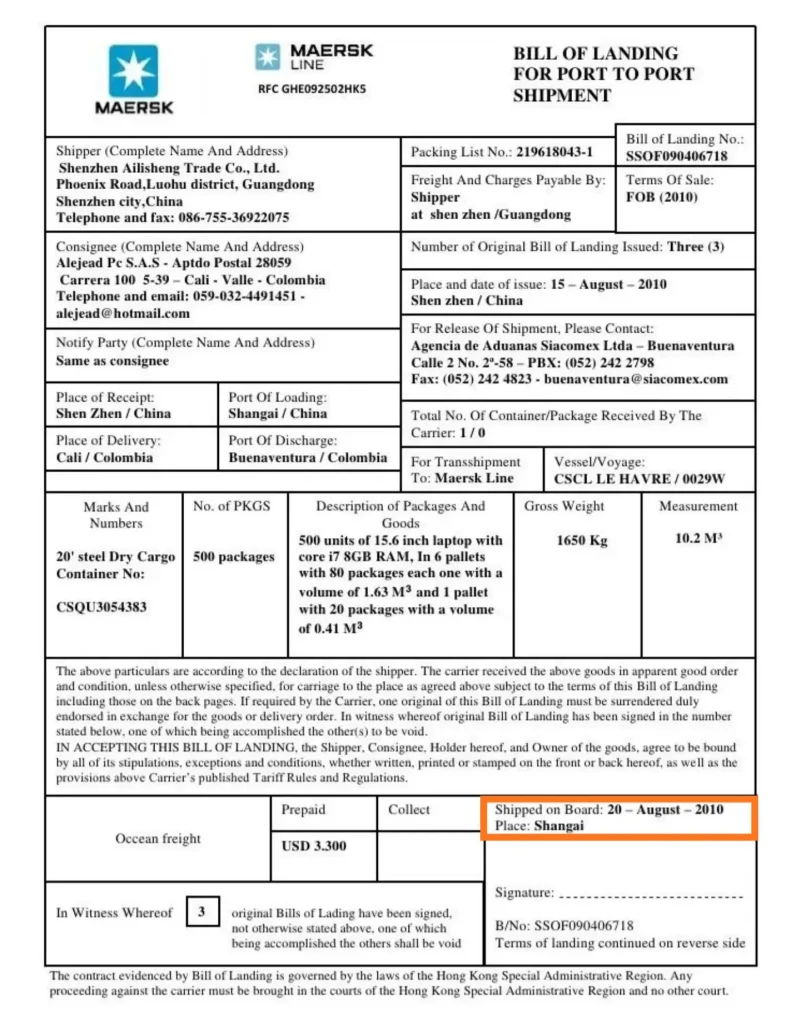
An On Board B/L can be issued in two ways:
Method 1: Issued directly as an On Board B/L
The carrier waits until after the cargo has been loaded onto the vessel before issuing the B/L. In this case, the B/L is an On Board B/L from the outset – no additional notation is needed. The date of issue is also the on board date.
Method 2: Converted from a Received for Shipment B/L
The carrier issues a Received for Shipment B/L before the cargo is loaded, then adds an On Board Notation once the cargo has actually been loaded onto the vessel. The On Board Notation takes the following form:
Shipped on Board
Vessel: EVER GIVEN
On: 15 January 2025
[Signature and stamp of the carrier or authorised agent]
Once a complete On Board Notation has been added, the B/L carries the same legal standing as an On Board B/L and is accepted by banks under an L/C.
Note per UCP 600 Article 20: Banks require the B/L to show that the cargo has been loaded on board a named vessel. If the B/L contains no on board notation, or if the on board notation is missing the vessel name or the on board date – this constitutes a discrepancy and the bank will reject the entire document set.
What Is a Received for Shipment Bill of Lading?
Received for Shipment Bill of Lading (abbreviated: RFS B/L) is a B/L issued by the carrier immediately after the cargo has been received into the port warehouse or yard — that is, before the cargo has been loaded onto the vessel. At the time of issuance, the vessel may not yet have called at the port, or the loading schedule for that particular cargo may not yet have been reached.
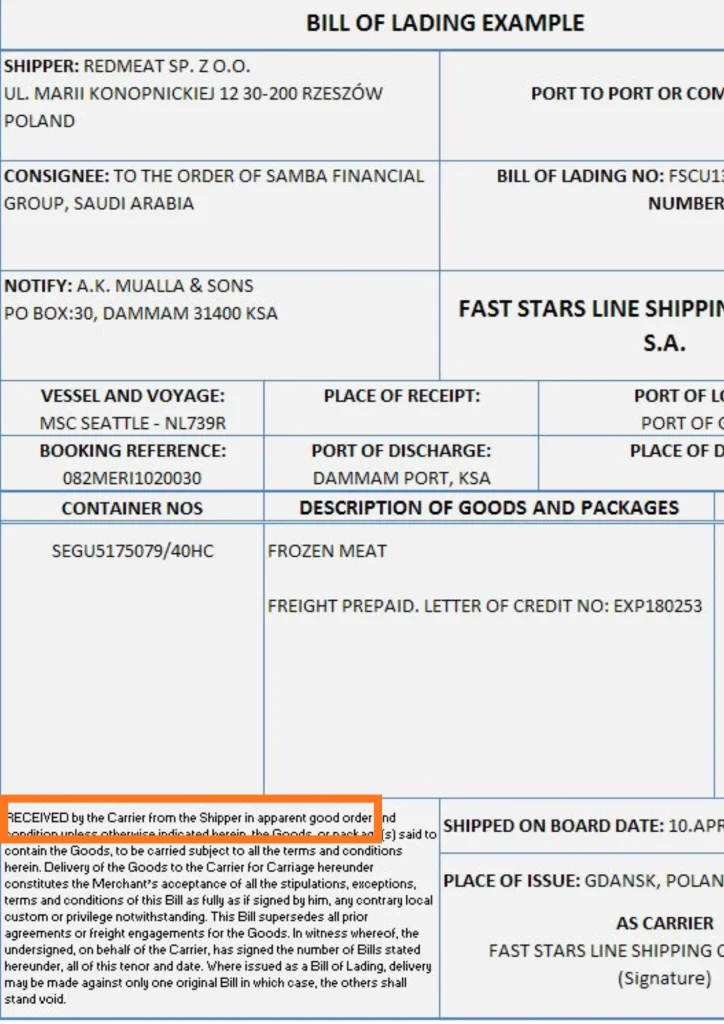
A Received for Shipment B/L confirms a more limited event: the carrier has taken receipt of the goods and assumes responsibility for their safekeeping in preparation for transport. Because the cargo has not yet been loaded, this type of B/L does not state the vessel name and carries no on board date — a legal gap in the eyes of an L/C bank.
A Received for Shipment B/L still carries certain legal standing — it confirms the carrier has accepted the goods and is responsible for them from the point of receipt. However, in practical import and export operations, particularly in transactions involving a bank, an RFS B/L is an incomplete document that must be upgraded to an On Board B/L before it can be submitted to the bank.
Comparison On Board B/L vs. Received for Shipment B/L
| Criteria | On Board B/L | Received for Shipment B/L |
|---|---|---|
| Common name | Shipped on Board B/L | Pre-Shipment B/L |
| Time of issuance | After the cargo has actually been loaded onto the vessel | After cargo enters the port warehouse/yard – before loading onto the vessel |
| Vessel name stated? | Yes – specific vessel name | No – or only an intended vessel name |
| On board date stated? | Yes – specific date of loading | No |
| Legal standing | Highest – fully confirms the shipment event | Lower – only confirms the carrier has received the goods |
| Accepted under L/C? | Yes – mandatory per UCP 600 Article 20 | No – unless the L/C contains a specific provision |
| Needs to be converted? | No – already complete | Yes – On Board Notation must be added before submitting to the bank |
| Suitable payment methods | L/C (mandatory), D/P, T/T | T/T advance payment – when no B/L-based control is required |
| Date used to calculate L/C deadline | On board date = shipment date under the L/C | No on board date – cannot be calculated |
Specific Requirements of UCP 600 Article 20 for On Board B/Ls
UCP 600 Article 20 is the international legal basis setting out what banks require of a B/L in an L/C transaction. Regarding the on board requirement, Article 20 states: Download UCP 600 here
The B/L must indicate that the goods have been loaded on board a named vessel at the port of loading specified in the L/C. Specifically, banks verify three conditions:
1. The vessel name must be specific: “Intended vessel” or “vessel TBN (To Be Named)” are not accepted – the actual vessel that loaded the cargo must be named.
2. The on board date must be clearly stated: The bank uses this date to determine whether the goods were shipped within the timeframe stipulated in the L/C (Latest Shipment Date). If the on board date falls after the Latest Shipment Date – it is an immediate discrepancy.
3. The on board notation must be authenticated: The on board notation must bear the signature or confirmation of the carrier or its authorised agent – it cannot be self-inserted by the shipper.
A situation commonly encountered at 3W Logistics: A shipper receives a Draft B/L from the carrier and sees only the B/L issue date – no separate on board date. This is the case with an On Board B/L issued directly after loading – the issue date is the on board date. However, if the B/L is a Received for Shipment type, the shipper must check whether an On Board Notation has been added and what the on board date is. This must be confirmed before the Draft B/L is approved. – Ms. Apple, CCO, 3W Logistics
Why Is the On Board Date the Most Important Date in an L/C?
Of all the dates that appear on a B/L – the issue date, the ETD, the ETA – the on board date is the only one the bank uses as the legal basis for evaluating the L/C document set. Specifically:
Checking the Latest Shipment Date: An L/C typically stipulates a latest date by which goods must be shipped (Latest Shipment Date). If the on board date on the B/L falls after this date – the document set is rejected unconditionally, even if every other document is flawless.
Calculating the Presentation Period: UCP 600 requires the shipper to present documents to the bank within 21 days of the on board date (unless the L/C specifies otherwise), and no later than the L/C expiry date. A miscalculation of this deadline results in a late presentation discrepancy that cannot be corrected.
Impact on marine insurance: Marine insurance contracts typically specify that coverage begins when the cargo is on board. The on board date on the B/L serves as the reference point for resolving insurance claims in the event of a loss or damage.
Practical example: An L/C specifies a Latest Shipment Date of 20 January 2025. Cargo enters the port terminal on 18 January (RFS B/L issued on 18 January), but due to port congestion, the cargo is actually loaded on 22 January. The On Board Notation records 22 January – two days after the Latest Shipment Date – and the entire document set is rejected by the bank despite everything else being correct.
How to Convert a Received for Shipment B/L into an On Board B/L
The conversion process is relatively straightforward but must be carried out correctly for the B/L to be accepted by the bank:
Step 1: Confirm the cargo has actually been loaded
Contact the carrier or forwarder to confirm the actual on board date and the exact vessel name. Do not fill in this information yourself.
Step 2: Request the carrier to add the On Board Notation
Bring the original Received for Shipment B/L to the carrier or its agent and request the On Board Notation to be added. The carrier will stamp or hand-write the notation on the original B/L, clearly stating the vessel name, the on board date, and signing to authenticate.
Step 3: Verify the On Board Notation before accepting
Ensure the On Board Notation states the correct vessel name (matching the Booking Confirmation), the correct actual loading date, and bears a valid signature and stamp from the carrier. The on board date must be on or before the Latest Shipment Date in the L/C.
Step 4: Submit the B/L with the On Board Notation to the bank
The B/L now satisfies UCP 600 Article 20 and is accepted by the bank as an On Board B/L. The Presentation Period is calculated from the on board date stated in the notation – not from the original B/L issue date.
The 3 Most Common On Board Notation Errors in Practice
Error 1: On Board Notation missing the date
The carrier stamps “Shipped on Board” but omits the specific date. This is a discrepancy because the bank cannot determine the shipment date to compare against the Latest Shipment Date. Resolution: ask the carrier to re-issue the notation with a clear date.
Error 2: On board date falls after the Latest Shipment Date
Cargo enters the port before the deadline but due to congestion or a schedule change, it is loaded later than expected. This is a discrepancy that cannot be corrected by amendment – the only options are to request a waiver from the buyer or seek an L/C amendment if there is still time. Prevention: book cargo space early and build in sufficient buffer time.
Error 3: Vessel name in the On Board Notation differs from the vessel name in the L/C
This occurs when cargo involves transhipment and the L/C does not permit transhipment, or when the carrier substitutes a vessel at the last moment without the shipper updating the L/C. Always check whether the L/C permits transhipment before booking a routing that involves a connecting vessel.
Advisory from 3W Logistics: When reviewing a Draft B/L, shippers must check not only the content of each field but also confirm: (1) whether the B/L is an On Board type or a Received for Shipment type, (2) if it is a Received for Shipment B/L, whether the On Board Notation has already been added, and (3) whether the on board date falls before the Latest Shipment Date in the L/C. These three points are overlooked more often than errors in the name or port fields. – Ms. Apple, CCO, 3W Logistics
FAQ – Frequently Asked Questions
Question 1: What is an On Board Bill of Lading?
An On Board Bill of Lading is a B/L that confirms the cargo has actually been loaded onto the vessel, stating the vessel name and the on board date. It is the type of B/L with the highest legal standing and is a mandatory requirement under L/C transactions per UCP 600 Article 20.
Question 2: What is a Received for Shipment Bill of Lading?
A Received for Shipment Bill of Lading is a B/L issued by the carrier after receiving the cargo into the port warehouse or yard, but before the cargo has been loaded onto the vessel. This type of B/L does not state the vessel name or on board date, does not satisfy UCP 600 Article 20, and is not accepted by banks under an L/C unless an On Board Notation has been added.
Question 3: What is an On Board Notation?
An On Board Notation is a stamp or handwritten addition made by the carrier on the B/L to confirm the cargo has been loaded onto the vessel, typically in the form: “Shipped on Board [Vessel Name] on [Loading Date]”. The notation must bear the carrier’s signature and clearly state the on board date – this date is used to calculate the document presentation deadline under the L/C.
Question 4: Can a Received for Shipment B/L be converted into an On Board B/L?
Yes. Once the cargo has actually been loaded, the carrier adds an On Board Notation to the original Received for Shipment B/L, stating the vessel name, the loading date, and signing to authenticate. A B/L with a complete On Board Notation carries the same legal standing as an On Board B/L and is accepted by banks under an L/C.
Question 5: Which date on the B/L is counted as the shipment date under an L/C?
The on board date – the date the cargo was actually loaded onto the vessel – is the shipment date under the L/C, not the B/L issue date. This date must be on or before the Latest Shipment Date in the L/C. Shippers also count from the on board date to determine the Presentation Period (typically 21 days under UCP 600) to ensure documents are submitted on time.
How Does 3W Logistics Support B/L Documentation?
3W Logistics is an OTI-NVOCC with FMC bond, able to self-issue HBLs and self-file AMS/ISF (for US shipments) and E-Manifest (for Canadian shipments) using 3W’s own SCAC code. This makes the shipping process to the US and Canada significantly smoother with 3W Logistics.
With over 10 years of experience in logistics and freight forwarding, the 3W Logistics team provides comprehensive B/L documentation support for import and export businesses:
- Draft B/L and On Board Notation review: Checking whether the B/L is an On Board or Received for Shipment type, verifying the On Board Notation is correct and complete before the shipper confirms – preventing discrepancies related to the on board date under an L/C.
- Vessel schedule monitoring and early alerts: Notifying the shipper immediately upon identifying a risk that cargo may be loaded after the Latest Shipment Date in the L/C, and supporting timely resolution.
- L/C documentation support: Advising on and preparing document sets for bank presentation in compliance with UCP 600 to reduce discrepancy rates – including verification of the On Board Notation before submission to the bank.
- Handling on board issues when they arise: Supporting shippers through situations involving late loading, vessel schedule changes, or transhipment that affects L/C compliance.
Head Office – 3W Logistics Ho Chi Minh City Branch
Address: 34 Bach Dang Street, Tan Son Hoa Ward, Ho Chi Minh City
Hotline: +84 28 3535 0087
____________________________
3W Logistics Hanoi Branch
Address: 81A Tran Quoc Toan Street, Cua Nam Ward, Hanoi
Hotline: +84 24 3202 0482
____________________________
3W Logistics Hai Phong Branch
Address: 8A, Lot 28, Le Hong Phong Street, Gia Vien Ward, Hai Phong
Hotline: +84 225 355 5939
____________________________
3W LOGISTICS CO., LTD – We here serve you there!
Email: quote@3w-logistics.com
Website: www.3w-logistics.com

Ms. Apple is the CCO (Chief Commercial Officer) at 3W Logistics, with over 10 years of experience in sales and business operations management.
At 3W Logistics, Ms. Apple is responsible for commercial strategy, corporate customer development, managing a team of more than 50 sales professionals, and improving business performance in the logistics sector.
With practical experience in sales management and market development, Ms. Apple shares professional insights on business logistics solutions, international transportation, freight forwarding, customer management, trade lane development, and growth strategies in the logistics industry.


