What is a duty free shop? Regulations regarding duty free goods
Duty free shops are a concept familiar to frequent international travellers, yet not everyone fully understands who is eligible to buy, how much can be purchased, which goods are tax-exempt, and how the buying process actually works. For those working in import-export and logistics, duty free shops are also closely tied to tax policy, customs regulations, and a distinctive business model that is worth understanding in depth.
The article below from 3W Logistics provides a comprehensive explanation of what a duty free-shop is, the different types of duty free shops, purchasing conditions, tax-free allowances, the legal framework in Vietnam, and practical tips when shopping at duty free shops both domestically and abroad.
1. What Is a Duty Free Shop?
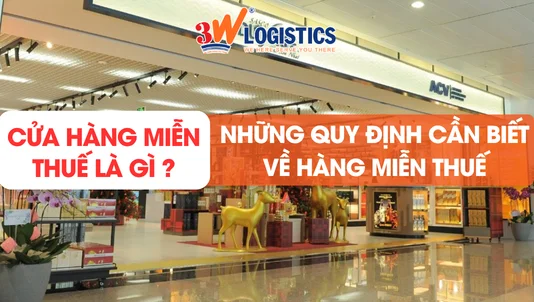
What is a duty free shop? A duty free shop (also written as duty-free store) is a retail outlet that sells goods exempt from some or all of the taxes and charges that would normally apply – including import duty, excise tax, and value added tax (VAT) – allowing goods to be sold at prices lower than on the general market.
A duty free shop does not operate under a standard commercial model; it is located within special customs zones: international border crossings, international airports (in the area beyond passport control), international seaports, free trade economic zones, or on ocean-going vessels. This is why only people who are in the process of international departure or arrival – that is, leaving or entering a country’s territory – are entitled to purchase goods at a duty free shop.
Why are duty free goods exempt from tax? Legally, goods held in a duty free shop are treated as not yet imported into the country’s consumption territory. A person who purchases goods at an airport upon departure is effectively buying goods “outside the customs territory” – the goods will leave the country with the buyer and will not be consumed domestically, so no domestic tax obligation arises.
2. Types of Duty Free Shops
Duty free shops are not found only at airports; they exist in various forms depending on their location and the customers they serve:
| Type of Duty Free Shop | Characteristics | Who Can Buy |
|---|---|---|
| Airport departure duty free | The most common type; located in the area beyond security and passport control; accessible to passengers who have checked in and cleared immigration | International departing passengers; boarding pass and passport required; goods are sealed and may only be opened at the destination |
| Airport arrival duty free | Located in the area before the customs exit; common at many Asian airports; the range and quantity of goods available is generally more limited than at departure shops | Passengers arriving from abroad; purchases count against the traveller’s duty-free allowance for goods brought into the country |
| Land border crossing duty free | Located at international land border crossing points; common at crossing pairs between Vietnam and China, Laos, and Cambodia | Persons crossing the border by land; allowances and eligible goods vary by crossing point |
| International seaport duty free | Located within international port areas; serves passengers on cruise ships and crew members; generally smaller in scale than airport duty free shops | International cruise passengers; officers and crew on ocean-going vessels |
| In-flight / On-board duty free | Goods sold directly during an international flight or sea voyage; product range is limited by available storage space on board | Passengers on international flights or voyages; payment accepted in foreign currency or by international card |
| Special economic zone / tax-free island duty free | Designated areas operating under special tax policies; examples include Phu Quoc (Vietnam), Hainan Island (China), and the Canary Islands (Spain) | Both tourists and local residents within the prescribed allowances; international departure is not required |
Important note: Many people mistakenly assume that “duty free” means all taxes are completely waived and there is no purchase limit. In practice, every country sets specific duty-free allowances – purchases exceeding those limits must be declared to customs and the applicable tax paid on the excess. Goods purchased at a duty free shop abroad and brought into Vietnam are still subject to Vietnam’s inbound baggage duty-free allowances.
3. Conditions and Allowances for Purchasing at Duty Free Shops
3.1. Conditions for purchasing at a duty free shop
- Must be in the process of international departure or arrival: The buyer must present a passport (or equivalent travel document) and a boarding pass, or proof of arriving from abroad.
- Goods must leave the country with the buyer: Duty free goods may not be consumed domestically; when purchased on departure, goods are sealed and may only be opened at the destination; when purchased on arrival, they count against the inbound baggage allowance.
- Comply with duty-free allowances: Each country and each category of goods has its own allowance; quantities or values exceeding the limit must be declared and tax paid on the excess.
- Personal use only – not for resale: Duty free shops are intended for personal shopping only; purchasing large quantities for commercial purposes will result in customs investigation and confiscation.
3.2. Duty-free allowances when entering Vietnam
Under Decree 134/2016/NĐ-CP (as amended by Decree 18/2021/NĐ-CP) and the guidance circulars of the General Department of Vietnam Customs, the duty-free baggage allowances for persons entering Vietnam are as follows:
| Goods Category / Condition | Duty-Free Allowance | Notes |
|---|---|---|
| General goods (excluding tobacco and alcohol) | Total value ≤ VND 10,000,000 | Amounts exceeding the limit must be declared and tax paid on the excess |
| Cigarettes | 200 cigarettes (1 carton) or 250g of pipe tobacco | Excess must be declared and tax paid |
| Cigars | 20 cigars | Excess must be declared and tax paid |
| Spirits 22% ABV and above | 1.5 litres | Excess must be declared and tax paid |
| Alcohol below 22% ABV / beer | 2 litres | Excess must be declared and tax paid |
| Children under 15 years of age entering Vietnam | May not bring tobacco or alcohol; other goods are subject to the adult allowance | Allowances cannot be pooled across family members |
Note: The duty-free allowances above apply to all goods brought in – including items purchased at duty free shops abroad, gifts, and new personal effects. These allowances are subject to change; always check the General Department of Vietnam Customs portal (customs.gov.vn) before travelling.
4. Regulations Governing Duty Free Shops in Vietnam
In Vietnam, the operation of duty free shops is governed by a comprehensive legal framework:
| Legal Instrument | Subject Matter |
|---|---|
| Customs Law 2014 (Law No. 54/2014/QH13) | Establishes the legal status of duty free shops as special locations within a non-tariff zone; goods held in duty free shops are subject to continuous customs supervision |
| Decree 167/2016/NĐ-CP on duty free retail | The most specific instrument governing duty free shops in Vietnam: sets out business licensing conditions, eligible buyers, duty-free allowances, customs procedures, accounting requirements, and inspection and supervision arrangements |
| Decree 134/2016/NĐ-CP (as amended by Decree 18/2021/NĐ-CP) | Sets the duty-free baggage allowances for persons entering Vietnam; the standard baggage allowances apply to goods purchased at overseas duty free shops and brought into Vietnam |
| Circular 72/2015/TT-BTC (as amended) | Provides guidance on customs procedures for goods imported and exported through duty free shops; covers warehouse opening, closing, and liquidation processes, and inventory record-keeping requirements |
| Decision 1012/QĐ-BTC on Phu Quoc | Governs the special duty-free policy within the Phu Quoc Economic Zone; buyers there do not need to make an international departure, but allowance limits still apply |
Conditions for obtaining a duty free shop operating licence in Vietnam
Under Decree 167/2016/NĐ-CP, businesses wishing to operate a duty free shop in Vietnam must satisfy the following requirements:
- Be a legally incorporated enterprise under the Enterprise Law with a minimum charter capital of VND 100 billion.
- Have business premises located within an approved customs zone (the international terminal sterile area of an international airport, an international land border crossing, an international seaport, or a free trade economic zone).
- Have a warehouse, CCTV surveillance system, and inventory management software connected to customs authorities to track all goods received, dispatched, and held in stock in real time.
- Hold a Duty Free Retail Operating Licence issued by the Ministry of Finance; for Phu Quoc specifically, the licence is issued by the Kien Giang Provincial People’s Committee.
“When clients ask whether specific goods can be supplied to a duty free shop, 3W Logistics typically advises checking two things carefully: first, whether the goods fall within the categories permitted for sale in a duty free shop under Decree 167; and second, whether the goods have valid origin documentation and supporting paperwork for customs declaration under the applicable special procedures. Overlooking this can create serious legal risk.” – Ms. Apple, CCO, 3W Logistics
5. Popular Product Categories at Duty Free Shops
Duty free shops typically carry product categories that attract high import duties or excise taxes, creating a meaningful price gap compared to the general retail market:
| Product Category | Why Prices Are Attractive | Purchasing Tips |
|---|---|---|
| Spirits, beer, and alcoholic beverages | Exempt from import duty (up to 45–65%) and excise tax (35–65%); retail price typically 30–50% lower than supermarkets | Check the alcohol allowance for bringing into Vietnam (1.5 litres for spirits ≥ 22% ABV) |
| Cigarettes and cigars | Exempt from import duty and the very high excise taxes applied in many countries; the largest price differential of any duty free category | Allowance is 200 cigarettes per person when entering Vietnam; excess will be confiscated |
| Perfume and luxury cosmetics | Exempt from VAT and import duty; typically 15–25% less expensive than buying at a domestic shopping mall | Liquids over 100ml must be checked in if purchased before passing security |
| Luxury watches and jewellery | Exempt from import duty and VAT; particularly attractive for Swiss and Japanese brands at their country-of-origin airports | The total value of goods brought into Vietnam counts toward the VND 10 million allowance |
| Consumer electronics | Exempt from VAT; savings are less dramatic than for alcohol or tobacco but still attractive for premium electronics | Check the warranty terms carefully: duty free goods typically carry an international warranty that may not be honoured for after-sales service in Vietnam |
| Local specialty foods | Although the price differential is smaller, this is the fastest-growing category at Asian airport duty free shops in recent years | Check Vietnam’s quarantine regulations for food items imported from each country of origin |
6. Duty Free Shops in Vietnam Today
Vietnam’s duty free shop network is operated by a number of licensed businesses, concentrated mainly at major international airports and principal border crossings:
- Noi Bai Airport (Hanoi): Duty free shops at Terminal T2 (international), in both the departure and arrival areas; operated mainly by Vietnam Airlines, Aeonmall Vietnam, and their partners.
- Tan Son Nhat Airport (Ho Chi Minh City): Duty free shops at the international terminal, covering both departure and arrival zones; the largest duty free operation in the country, with a wide range of international brands.
- Da Nang Airport: Duty free shops at the international terminal; medium scale, serving primarily Korean, Japanese, and Chinese tourists.
- Phu Quoc: A dedicated duty free retail system under the Phu Quoc Economic Zone framework; tourists do not need to make an international departure and can purchase within the prescribed allowances.
- Land border crossings: Mong Cai (Quang Ninh), Lao Cai, Lang Son, Moc Bai (Tay Ninh), and Ha Tien (Kien Giang) all have smaller-scale duty free shops.
FAQ – Frequently Asked Questions About Duty Free Shops
Question 1: What is a duty free shop and how does it differ from a regular shop?
A duty free shop is a retail outlet located within a special customs zone (an international airport, border crossing, etc.) where goods are sold exempt from import duty, excise tax, and VAT. The key distinction is that duty free goods may not be consumed within that country’s territory – they must leave with the buyer – so no domestic consumption tax obligation arises.
Question 2: Can Vietnamese nationals returning from abroad purchase duty free goods?
Yes. When entering Vietnam after a trip abroad, Vietnamese nationals may bring in goods (including items purchased at overseas duty free shops) within the duty-free allowance: total value of general goods (excluding alcohol and tobacco) ≤ VND 10 million, spirits ≥ 22% ABV ≤ 1.5 litres, cigarettes ≤ 200. Amounts exceeding these limits must be declared to customs and tax paid on the excess.
Question 3: Is it necessary to keep receipts from overseas duty free shops?
Yes, receipts should be kept. When entering Vietnam with goods that exceed the duty-free allowance, a duty free receipt serves as the supporting document for customs to determine the correct taxable value. Without a receipt, customs will estimate the value based on their own database, which may be higher than the price actually paid.
Question 4: Why are airport duty free shops sometimes not cheaper than the regular market?
This occurs with goods that carry low or no special taxes in a given country (for example, branded bags and clothing in some countries). In addition, duty free shops typically face very high airport rental costs, specific operating expenses, and higher margins to compensate. The price advantage of duty free shopping is most pronounced for alcohol, tobacco, perfume, and goods subject to high excise taxes.
Question 5: Can goods purchased at Phu Quoc duty free shops be taken to the Vietnamese mainland?
Yes, but within limits. Under the regulations governing the Phu Quoc Economic Zone, when tourists leave Phu Quoc Island for the mainland, goods purchased at Phu Quoc duty free shops will be assessed against the standard duty-free baggage allowance under current regulations. Any amount in excess of that allowance must be declared and tax paid upon returning to the mainland.
Question 6: Can businesses importing goods for sale to duty free shops benefit from any tax relief?
Yes. Goods imported to supply a duty free shop are exempt from import duty at the time of importation into the duty free operator’s warehouse, as this is a customs-supervised non-tariff zone. Tax liability only arises if goods are not sold through the duty free channel and instead enter the general market. This mechanism is provided for under Decree 167/2016/NĐ-CP and the Law on Import and Export Duties.
Address: 34 Bach Dang Street, Tan Son Hoa Ward, Ho Chi Minh City
Hotline: +84 28 3535 0087
____________________________
3W Logistics Hanoi Branch
Address: 81A Tran Quoc Toan Street, Cua Nam Ward, Hanoi
Hotline: +84 24 3202 0482
____________________________
3W Logistics Hai Phong Branch
Address: 8A Lot 28 Le Hong Phong Street, Gia Vien Ward, Hai Phong
Hotline: +84 225 355 5939
____________________________
3W LOGISTICS CO., LTD – We here serve you there!
Email: info@3w-logistics.com
Website: www.3w-logistics.com

Ms. Apple is the CCO (Chief Commercial Officer) at 3W Logistics, with over 10 years of experience in sales and business operations management.
At 3W Logistics, Ms. Apple is responsible for commercial strategy, corporate customer development, managing a team of more than 50 sales professionals, and improving business performance in the logistics sector.
With practical experience in sales management and market development, Ms. Apple shares professional insights on business logistics solutions, international transportation, freight forwarding, customer management, trade lane development, and growth strategies in the logistics industry.