
What is a D/O? Understanding the Delivery Order in logistics
D/O (Delivery Order) is one of the most critical documents in the import process in Vietnam. Without a D/O, importers cannot collect their cargo from the port even after completing all customs procedures. In practice, many businesses still confuse D/O with the Bill of Lading (B/L), are unclear about when they need to obtain a D/O, or incur Demurrage and Detention charges due to delays in processing.
In this article, 3W Logistics provides a comprehensive explanation of what a D/O is, when it is required, the types of D/Os, the procedure for obtaining a Delivery Order, associated surcharges, and real-world risks to avoid – from the perspective of a freight forwarder with over 10 years of experience handling import shipments.
1. What Is a D/O? Information Found on a Delivery Order
What is a D/O? D/O stands for Delivery Order. It is a document issued by the shipping line, shipping agent, or freight forwarder at the port of destination, confirming the importer’s right to take delivery of their goods. The port and cargo warehouse will only release cargo upon presentation of a valid D/O.
In essence, a D/O in import/export is the “pass” for releasing cargo from the port – similar to a warehouse release note in domestic logistics. A D/O does not replace the Bill of Lading (B/L) but is issued on the basis that the importer has fulfilled their obligations to the carrier: surrendering the original B/L or signing a Letter of Indemnity, and settling all freight charges in full.
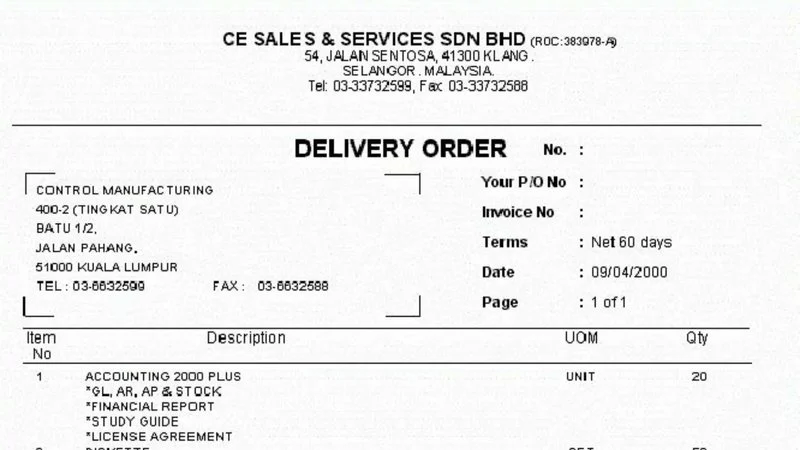
Information Found on a D/O
| Field | Details |
|---|---|
| D/O Number | The Delivery Order reference code issued by the carrier or forwarder, used to look up and cross-reference with the port system |
| Consignee Name & Address | The company or individual entitled to collect the cargo; must exactly match the information on the B/L |
| Vessel & Voyage Number | The name of the carrying vessel and voyage number, used to cross-reference port records |
| Bill of Lading Number (B/L No.) | The original B/L number corresponding to the shipment; serves as the link between the D/O and the transport document |
| Container Number & Seal Number | Used by the port and warehouse to identify the exact container to be released; must be verified carefully before presenting at the port gate |
| Cargo Description | Commodity name, number of packages, and gross weight as stated on the B/L |
| Port of Discharge | The destination port where cargo will be handed over to the consignee |
| Free Time Expiry Date | The deadline for free container storage at the port; Demurrage begins accruing immediately after this date |
| Signature & Stamp | From the issuing carrier or agent; serves as authentication of the D/O’s validity |
Practical note: A D/O is typically valid for 3–5 working days from the date of issuance. If it expires, the importer must apply for a new D/O and may incur additional document handling fees. During peak import periods (before Lunar New Year, summer season), carriers may take longer than usual to process D/Os – contact the carrier in advance to schedule issuance.
2. When Is a Delivery Order Required?
A Delivery Order (D/O) is required for all sea freight import shipments into Vietnam and in many cases for air freight as well. Specifically:
- FCL sea freight (full container load): Every FCL container arriving at a Vietnamese seaport (Cat Lai, Hai Phong, Tien Sa, etc.) requires a D/O to release the container from the yard.
- LCL sea freight (less than container load): After the container is unstuffed at a CFS warehouse, the importer needs a House D/O issued by the forwarder to collect their individual cargo lot.
- Air freight imports: The equivalent document is an AWB Release or a D/O issued by the air freight agent once the cargo arrives at the airport warehouse.
- Transshipment cargo: When goods transit through an intermediate port before arriving in Vietnam, the importer still needs a D/O at the final port of destination.
- Cargo imported under FOB / CFR / CIF terms: Under these Incoterms, risk and costs transfer at the port of destination – a D/O is a mandatory requirement to take delivery.
- Cargo imported through a forwarder / NVOCC: The D/O may be issued by the forwarder (House D/O) rather than directly by the carrier; the document exchange process involves one additional step compared to importing directly through a carrier.
When to process the D/O: After the vessel berths and cargo is discharged, the importer should immediately contact the carrier or agent to exchange the original B/L for a D/O. In the case of Telex Release or Sea Waybill, no original paper B/L is required, but confirmation with the carrier must still be completed. The D/O must be obtained before lodging the import customs declaration to ensure accurate entry of the container number, port of discharge, and vessel arrival date.
3. Types of D/O in Import/Export
Depending on the issuing party and mode of transport, types of D/O in import/export are classified as follows:
| Type of D/O | Issuing Party | Key Features |
|---|---|---|
| Master D/O (Original D/O) | Shipping Line (Carrier) | Issued against the Master B/L; the consignee must present the original B/L or confirm Surrendered / Telex Release status; common when importing directly through the carrier |
| House D/O | Forwarder / NVOCC | Issued against the House B/L; common when importing through an agent; the importer must first exchange the House B/L for a House D/O, after which the forwarder exchanges the Master B/L for a Master D/O with the carrier |
| Air Freight D/O | Airline / Air Freight Agent | Equivalent to an AWB Release; no original B/L required as the AWB is a non-negotiable document; issued once cargo arrives at the airport warehouse |
| LCL D/O (Less than Container Load) | CFS Agent / Forwarder | Issued for each individual LCL cargo lot after the container is unstuffed at the CFS warehouse; the consignee presents this at the CFS warehouse – not at the container yard as with FCL |
| Telex Release / Sea Waybill | Shipping Line (Carrier) | Electronic confirmation; no original paper B/L required; the carrier notifies its agent at the port of destination to release the D/O; common in transactions between established partners with a high level of trust |
Master D/O vs. House D/O – key difference: If importing directly through the carrier, only one step is needed to obtain the Master D/O. If importing through a forwarder/NVOCC, the House B/L must first be exchanged for a House D/O – after which the forwarder processes the Master D/O with the carrier. These two steps may generate two separate sets of fees and add 1–2 working days, which must be factored into the customs clearance plan to avoid Demurrage charges.
4. Procedure for Obtaining a Delivery Order (D/O) in Import/Export
The standard procedure for obtaining a Delivery Order (D/O) at Vietnamese seaports (Cat Lai, Hai Phong, Tien Sa, etc.) consists of seven steps:
Step 1: Receive the Arrival Notice from the Carrier
When the vessel is about to berth (typically 2–3 days in advance), the carrier or agent sends an Arrival Notice (AN) notifying the importer of the shipment’s arrival. Carefully review the following: B/L number, vessel name, ETA, container number, port of discharge, and Demurrage free time deadline. This is when the free time countdown begins – customs clearance planning should start immediately at this step.
Step 2: Pay Freight and Port Charges to the Carrier
If the shipment is on Freight Collect terms (freight payable at destination), the importer must settle the ocean freight, THC, D/O fee, and any applicable surcharges before the carrier will issue the D/O. For Freight Prepaid shipments (freight paid at origin), only the destination port surcharges need to be settled.
Step 3: Submit the Original B/L in Exchange for the D/O
Bring the original B/L (hard copy) to the carrier’s office or agent to exchange for the D/O. In the case of a Telex Release / Surrendered B/L, only a copy of the B/L with the carrier’s endorsement is required – no original is needed. For B/Ls made out “To Order,” an endorsement of assignment must be applied before the D/O can be issued.
Step 4: Receive the D/O and Verify the Information
Once the carrier confirms, the D/O is issued (in paper or electronic form). Check the following details carefully upon receipt: consignee name, container number, seal number, D/O validity date, and the name of the port/warehouse for cargo collection. Any discrepancies must be flagged to the carrier for an Amendment immediately, as the port will reject a D/O where the information does not match.
Step 5: File the Electronic Customs Declaration (VNACCS)
Use the information on the D/O to file the import customs declaration on the VNACCS system: container number, vessel arrival date, and port of discharge. Accurate filing from the outset helps avoid unnecessary red-channel inspection, valuation queries, and retroactive duty assessments.
Step 6: Register the D/O at the Port or Cargo Warehouse
Bring the D/O to the port or CFS warehouse for registration. Port staff will verify the D/O against their system, confirm the right to collect the cargo, and issue an Equipment Interchange Receipt (EIR). This step must be completed before the truck is allowed into the yard.
Step 7: Collect Cargo and Return the Empty Container
After the customs declaration is cleared (green, yellow, or red channel), the importer presents the EIR and brings a truck into the yard to collect the cargo. The empty container must be returned to the designated depot within the Detention free time to avoid Detention charges. This is the final step in the D/O collection process.
“In practice, many businesses overlook the free time deadline when they receive the D/O, resulting in significant Demurrage and Detention charges. At 3W Logistics, we always monitor D/O deadlines and proactively notify our clients to arrange trucks and complete customs clearance on time, preventing unnecessary costs.” – Ms. Apple, CCO, 3W Logistics
5. Fees and Surcharges Associated with a D/O
When collecting a D/O and taking delivery of cargo at the port, importers typically face a range of D/O fees and import/export surcharges. The most common charges are summarized below:
| Fee Name | Abbreviation | Description | Reference Rate |
|---|---|---|---|
| Delivery Order Fee | D/O Fee | Fee charged by the carrier or agent upon issuance of the D/O; mandatory for all import shipments | VND 500,000 – 1,500,000 / B/L |
| Documentation Fee | Documentation Fee | Fee for document processing, printing, and confirmation at the carrier or agent’s office | VND 300,000 – 800,000 / B/L |
| Terminal Handling Charge | THC | Port terminal handling fee for loading/unloading containers; charged by container type (20′ / 40′ / 40’HC) | VND 1,700,000 – 3,500,000 / container |
| Container Storage at Port | Demurrage | Accrues when the container remains in the port yard beyond the free time (typically 3–7 free days); charged per day on a tiered escalating scale | From VND 600,000 – 2,000,000 / container / day |
| Container Storage Outside Port | Detention | Accrues when the container has left the port but has not been returned to the designated depot within the free time (typically 3–5 free days) | From VND 500,000 – 1,500,000 / container / day |
| Container Cleaning Fee | Cleaning Fee | Charged when returning an empty container to the depot if the container interior is dirty or contains residual material | VND 500,000 – 1,500,000 / container |
| CFS Cargo Handling Fee | CFS Handling Fee | Applicable to LCL shipments: fee for unstuffing cargo at the CFS warehouse, charged per CBM or as agreed with the agent | Per CBM, as negotiated |
| Port Congestion Surcharge | PCS | Levied during peak seasons or when port congestion occurs; charged by the carrier on top of the base freight rate | Varies by carrier and trade lane |
Important note on D/O fees: Demurrage and Detention are the fastest-accruing and most costly charges, especially for shipments arriving during peak seasons or for cargo subject to physical examination (red channel). Always request a complete Arrival Notice from your carrier or forwarder that clearly states the free time expiry date, and arrange trucks and customs clearance in advance to minimize these costs.
6. Key Risks and Considerations When Using a D/O
Although a D/O is a standard document in import/export operations, businesses that are unfamiliar with the process may encounter serious risks:
| Risk | How It Manifests | How to Prevent It |
|---|---|---|
| Cargo Released Without Original B/L | Carrier releases a D/O without requiring the original B/L under a special arrangement; if the buyer has not made full payment, the risk of cargo loss or commercial disputes is very high | Ensure all payment obligations to the seller are fulfilled before cargo is released; do not allow the carrier to release goods before all conditions are met |
| Fraudulent D/O | Counterfeit D/Os have occurred at some Vietnamese ports; businesses received a D/O via email from an unknown source and attempted to present it at the port, only to have it rejected | Verify the D/O directly with the carrier through their official website or hotline; only accept D/Os from confirmed carrier email addresses or offices |
| Failure to Obtain D/O in Time | Cargo sits at the port accumulating large fees; beyond a certain period, the port may transfer goods to a customs warehouse or even put them up for public auction under regulations on abandoned cargo | Prioritize D/O processing immediately after the vessel berths; for high-value shipments, prepare all documents and arrange trucks before the vessel arrives |
| Incorrect Information on D/O | Errors in the consignee name, container number, or seal number cause the port to refuse cargo release; the importer must return to the carrier for an Amendment, losing 1–2 working days while Demurrage continues to accrue | Check all D/O details carefully upon receipt; request an Amendment from the carrier immediately if any error is found – never present an incorrect D/O at the port |
| Accumulating Demurrage and Detention | The most common financial risk; delays in obtaining the D/O due to a missing original B/L, customs holds, or trucks unable to access the port on schedule can generate tens of millions of VND in charges | Plan customs clearance before the vessel arrives; confirm the exact free time deadline and pre-arrange trucks; for red-channel shipments, build in an additional 2–3 day buffer |
| Lost Original B/L | Cannot exchange the D/O through the standard process; must apply for a Letter of Indemnity (LOI) usually backed by a bank guarantee, adding several days and additional costs | Store the original B/L securely; consider using Telex Release or Sea Waybill with regular trading partners to reduce the risk of losing paper documents |
“For shipments with a short free time (3 days) or seasonal imports (electronics, garments before Lunar New Year), 3W Logistics typically prepares the customs clearance dossier and pre-books trucks 2–3 days before the vessel arrives. The goal is to collect the cargo on the very first day of free time — eliminating Demurrage charges entirely, even for a single day.” – Ms. Apple, CCO, 3W Logistics
FAQ – Frequently Asked Questions About D/O in Import/Export
Question 1: What is a D/O and how does it differ from a B/L?
A D/O (Delivery Order) is a cargo release document issued by the shipping line or freight forwarder at the port of destination, confirming the importer’s right to collect their goods. A B/L (Bill of Lading) is the bill of lading – a document of title issued by the carrier when the cargo is received for shipment. These are entirely different documents: the B/L is issued at the port of origin and has value in international trade finance; the D/O is issued at the port of destination and is the practical requirement for collecting cargo from the port.
Question 2: What is the difference between a Telex Release and a D/O?
Telex Release is the carrier’s electronic confirmation waiving the requirement for the original paper B/L, allowing the consignee to collect goods with only a copy. In this case, the carrier still issues a D/O at the port of destination, but the consignee does not need to surrender an original paper B/L. Telex Release is common in transactions between regular trading partners and saves time by eliminating the wait for the original document to be couriered from overseas.
Question 3: How much is the D/O Fee and who collects it?
The D/O Fee (Delivery Order fee) typically ranges from VND 500,000 – 1,500,000 per B/L and is collected by the shipping line or its agent at the time the D/O is issued. If the shipment is handled through a forwarder/NVOCC, an additional House D/O Fee may apply. The exact amount varies by carrier and trade lane – confirm the fee in advance from the Arrival Notice to avoid unexpected charges.
Question 4: Can a D/O still be obtained if the original B/L is lost?
If the original B/L is lost, the importer must contact the carrier immediately to follow a special procedure: signing a Letter of Indemnity (LOI), usually backed by a bank guarantee, committing to indemnify the carrier for any losses arising. This process takes additional days and incurs extra costs, while Demurrage continues to accrue during the waiting period, the situation must be resolved as quickly as possible.
Question 5: Does LCL cargo require a separate D/O?
Yes. For LCL (less than container load) shipments, the forwarder or CFS agent issues a House D/O for each individual cargo lot after the container is unstuffed at the CFS warehouse. The importer presents the House D/O at the CFS warehouse to collect their goods – not at the container yard as with FCL cargo. Note that CFS storage fees also apply if goods are not collected promptly.
Question 6: Can a D/O be transferred to a third party?
In general, a D/O is not a freely negotiable document like a “To Order” B/L. A D/O is only valid for the consignee named on the document. In certain cases, an amendment to the consignee name can be requested from the carrier with a valid reason, but this must be done early as the Amendment process takes additional time and incurs handling fees.
Address: 34 Bach Dang, Tan Son Hoa Ward, Ho Chi Minh City
Hotline: +84 28 3535 0087
____________________________
3W Logistics Hanoi Branch
Address: 81A Tran Quoc Toan, Cua Nam Ward, Hanoi
Hotline: +84 24 3202 0482
____________________________
3W Logistics Hai Phong Branch
Address: 8A Lot 28 Le Hong Phong, Gia Vien Ward, Hai Phong
Hotline: +84 225 355 5939
____________________________
3W LOGISTICS CO., LTD – We here serve you there!
Email: info@3w-logistics.com
Website: www.3w-logistics.com

Ms. Apple is the CCO (Chief Commercial Officer) at 3W Logistics, with over 10 years of experience in sales and business operations management.
At 3W Logistics, Ms. Apple is responsible for commercial strategy, corporate customer development, managing a team of more than 50 sales professionals, and improving business performance in the logistics sector.
With practical experience in sales management and market development, Ms. Apple shares professional insights on business logistics solutions, international transportation, freight forwarding, customer management, trade lane development, and growth strategies in the logistics industry.


