

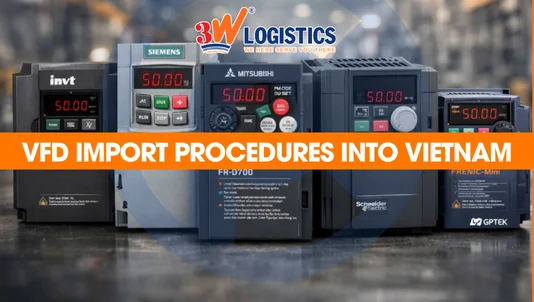
Importing Variable Frequency Drives (VFD) is an industrial electrical equipment group that enjoys a relatively smooth customs clearance process compared to many other household electrical appliance categories. This is because most VFDs are not subject to mandatory energy labeling under Decision No. 04/2017/QD-TTg—unlike electric motors or generators, which require Minimum Energy Performance Standards (MEPS) testing prior to market circulation.
However, not all businesses clearly understand the VFD import procedure, particularly when it comes to distinguishing standard industrial VFDs from those integrated with communication or remote control modules.
The latter group may fall under specialized management regulations if its technical nature is not properly declared and described. A single mistake in HS code classification or omitting product labeling requirements can cause the entire shipment to be detained at port.
In this article, 3W Logistics presents the complete VFD import procedure according to the latest legal regulations and tax schedules – covering legal conditions, HS codes, tax calculations, required documentation, a step-by-step guide, and real-world risks from the perspective of an experienced forwarder handling imported industrial electrical equipment.
1. Legal Conditions for Importing VFDs into Vietnam
VFDs are not on the list of prohibited imports and are not subject to conditional business operations. This makes VFD import procedures significantly simpler compared to many consumer electrical appliance categories.
| Condition | Detailed Content |
|---|---|
| State Quality Inspection | Most standard industrial VFDs are not required to undergo state quality inspection or specialized inspection upon import. |
| Energy Labeling | VFDs generally do not fall into the list of equipment requiring mandatory energy labeling under Decision No. 04/2017/QD-TTg—unlike electric motors or generators which must undergo energy efficiency testing (MEPS) before market distribution. |
| Exceptions Requiring Inspection | VFDs integrated with wireless communication modules or network connectivity for remote monitoring/control may be classified as telecommunications equipment, requiring separate conformity inspection under Ministry of Information and Communications regulations. |
| Product Labeling | Vietnamese supplementary label compliant with Decree No. 43/2017/ND-CP and Decree No. 111/2021/ND-CP: product name, model, technical specifications (power rating, voltage range), origin, and importing entity details. |
Practical Note: Because most VFDs are exempt from specialized inspection and energy labeling, many enterprises assuming that VFD import procedures carry zero legal risks become complacent. In practice, businesses must carefully audit product configurations prior to importing—if a VFD incorporates Ethernet cards, Wi-Fi modules, or remote monitoring capabilities via the Internet (IoT-enabled VFD), it may be reclassified under telecommunications equipment, which is governed by entirely different requirements than basic industrial VFDs that only control internal motor speed.
2. HS Code and Import Duty for VFDs
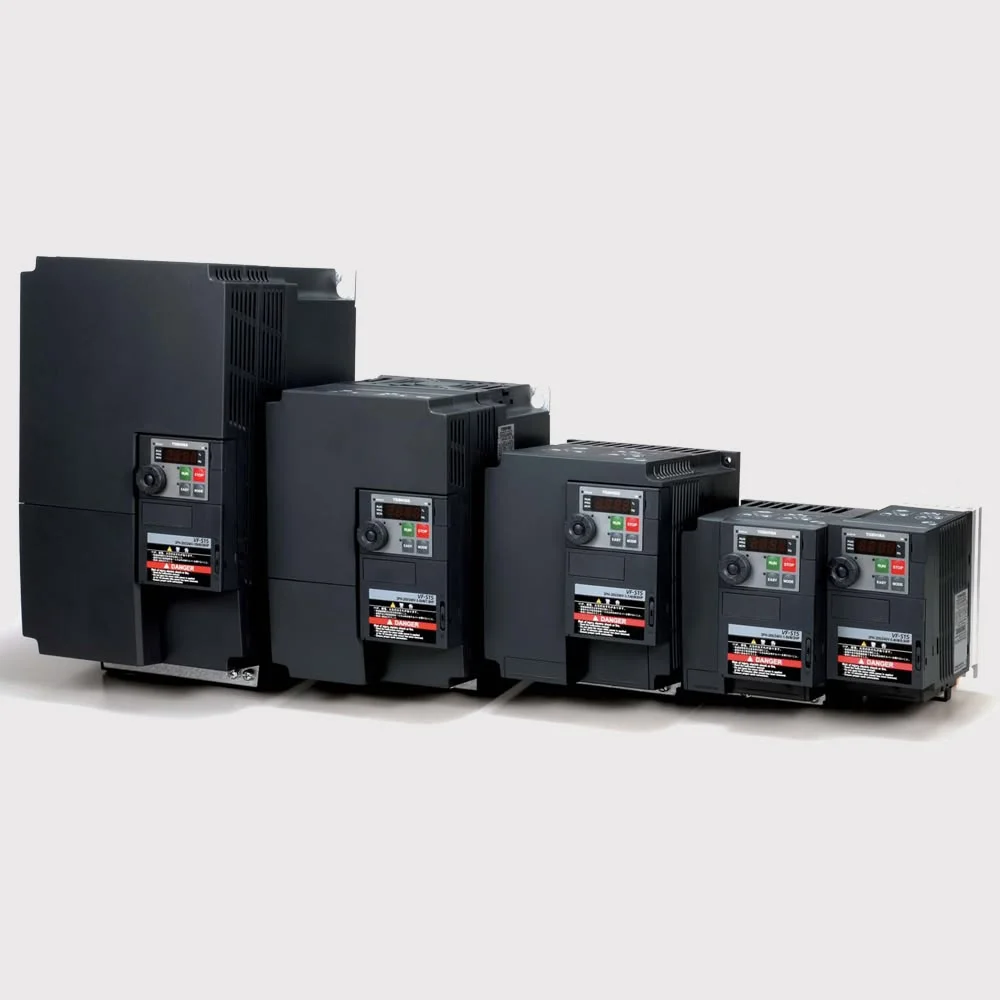
VFDs fall under heading 8504.40 (Static converters) in the Export and Import Tariff schedule—the same classification category as Uninterruptible Power Supplies (UPS) and other industrial rectifiers, as the technical nature of a VFD is a static frequency/voltage converter used to control motor speed.
| Heading / HS Code | Detailed Description | Import Duty (MFN) |
|---|---|---|
| 85.04 — Electrical transformers, static converters (for example, rectifiers) and inductors | ||
| 8504.40.11 | Low-power rectifiers for consumer motor control equipment | 0% |
| 8504.40.19 | Static converters specialized for industrial automation and telecommunications – VFDs with integrated monitoring/connectivity functions should pay attention to this sub-heading | 0% |
| 8504.40.90 | General-purpose industrial VFDs, motor speed controllers (VFD/Inverter Drive) – the most common HS code when importing VFDs | 0–5% |
| 8504.90.90 | Parts and components of VFDs (IGBT modules, control circuit boards) imported separately | 0–10% |
Important Note on HS Codes and Duties: Similar to UPS units, most sub-headings under 8504.40 used for VFDs enjoy Most Favored Nation (MFN) import duty rates of 0% because Vietnam is a signatory to the WTO Information Technology Agreement (ITA). For goods imported from countries without MFN status or lacking valid Certificates of Origin (C/O), higher standard import duties may apply. Regarding VAT, the 8% rate currently applies through December 31, 2026 under Decree No. 174/2025/ND-CP; businesses should review policy updates after this date as it may revert to the standard 10%. In VFD import procedures, accurately identifying the proper 8-digit sub-heading based on actual power ratings and configurations—supported by technical catalogues—is key to preventing misclassification into other regulatory categories.
3. Required Documentation for VFD Import Procedures
The document set for VFD import procedures is relatively streamlined compared to conditional goods, adhering to Circular No. 38/2015/TT-BTC (amended by Circular No. 39/2018/TT-BTC).
| Document | When to Prepare | Important Notes |
|---|---|---|
| Sales Contract | Before paying deposit | Clearly state power capacity, model numbers, origin, and terms for C/O provision. |
| Commercial Invoice & Packing List | Before cargo shipment | Include full product descriptions, power ratings (kW/HP), and itemized quantities per model. |
| Bill of Lading | After vessel departure | VFDs are typically shipped in dry containers; require shockproof and moisture-proof packaging to safeguard electronic circuit boards. |
| Technical Catalogue / Specification Sheet | Before HS code declaration | Serves as the technical basis for power capacity, configuration, correct HS code assignment, and verifying specialized inspection criteria. |
| Certificate of Origin (C/O) | Before cargo shipment | Necessary if the goods do not automatically qualify for 0% MFN or when seeking preferential FTA tariff treatment. |
| Electronic Customs Declaration (VNACCS/VCIS) | Upon complete dossier | Declare the exact HS code under heading 8504.40; include C/O reference numbers on the declaration if applicable. |
4. Step-by-Step VFD Import Clearance Procedure
Step 1: Check technical specifications and determine HS Code
Review technical specs (power output, voltage range, presence/absence of communication modules) and obtain detailed catalogues from the supplier to identify the exact 8-digit HS code under 8504.40.11, .19, or .90.
Step 2: Negotiate contract terms and request C/O
Finalize the purchase agreement, ensuring power capacity, model numbers, and C/O obligations are explicitly detailed, particularly if the item does not qualify for 0–3% MFN rates automatically.
Step 3: Determine specialized inspection applicability
Cross-check product features (e.g., integrated wireless modules or IoT network connectivity) to establish whether specialized regulatory filings are required before port arrival.
Step 4: Transport cargo to Vietnam port
VFDs are generally shipped in standard dry containers. Ensure adequate shock-absorption and moisture-proof packaging to safeguard sensitive internal electronic components during long-distance transit.
Step 5: File customs declaration and obtain clearance
Submit the declaration via the VNACCS/VCIS system with complete HS code details and C/O information (if available). Standard VFDs exempt from specialized inspections move through clearance rapidly once duties and VAT are paid.
Step 6: Take delivery, apply product labels, and distribute
Upon clearance, affix mandatory Vietnamese supplementary labels compliant with national regulations, transport the shipment to warehouse facilities, and archive all customs records for post-clearance audits.
5. How to Calculate VFD Import Taxes
VFDs are exempt from Special Consumption Tax, incurring only import duty and Value Added Tax (VAT). For instance, considering an industrial VFD shipment imported from Germany (HS Code 8504.40.90) with a CIF value of VND 600,000,000, here is a comparison between importing with vs. without a C/O:
| Tax / Fee Breakdown | Without C/O (Standard 3%) | With EVFTA C/O / MFN (0%) |
|---|---|---|
| CIF Value | VND 600,000,000 | VND 600,000,000 |
| Import Duty | 3% × 600m = VND 18,000,000 | 0% × 600m = VND 0 |
| VAT (8%, applicable through 2026) | 8% × (600+18)m = VND 49,440,000 | 8% × (600+0)m = VND 48,000,000 |
| Total Payable Tax | VND 67,440,000 (~67.4 million) | VND 48,000,000 (~48 million) |
| Savings with C/O or MFN status | ~VND 19,440,000 – Note that the 8% preferential VAT rate is a temporary incentive valid through December 31, 2026; businesses should monitor updates for future shipments. | |
Real-World Insights from 3W Logistics: When importing VFDs, rather than permit or testing delays that affect other product groups, the most frequent pitfall we observe in VFD import procedures is failing to audit technical configurations prior to ordering. Certain high-end VFDs feature integrated Ethernet cards or IoT modules for remote monitoring; during customs declaration, officials may request specialized telecom inspection documents because the unit gets flagged as telecommunications equipment—even if the importer originally viewed it as a basic motor drive. Consulting thoroughly with suppliers and having detailed technical catalogues ready before contract signing prevents this setback. – Ms. Apple, CCO, 3W Logistics
6. Common Risks in VFD Import Procedures
| Risk Factor | Manifestation | Prevention Strategy |
|---|---|---|
| Confusing standard VFDs with telecom equipment | VFDs with built-in networking/IoT capabilities get reclassified under specialized inspection controls, causing unexpected paperwork demands during clearance. | Audit detailed specifications with the vendor prior to signing, confirming whether telecom components are integrated. |
| Misapplying HS codes within heading 8504.40 | Confusing sub-headings based on capacity or usage leads to customs reclassification and tax adjustment penalties under Decree No. 128/2020/ND-CP. | Obtain technical catalogues from the manufacturer before filing; consult an experienced forwarder handling industrial electrical cargo. |
| Transit damage to internal circuit boards | Internal components suffer short circuits or mechanical failure due to impacts, vibration, or humidity during long-haul freight. | Require international-standard shockproof and moisture-barrier packaging from suppliers, along with comprehensive cargo insurance. |
| Outdated VAT policy assumptions | Calculating costs based on the temporary 8% VAT rate for shipments imported after its expiration date (December 31, 2026) leads to budget deficits. | Track official VAT regulation announcements closely before finalizing long-term import financial planning. |
| Incomplete mandatory product labeling | Missing technical parameters or country of origin details on Vietnamese sub-labels results in port holds for label rectification. | Prepare compliant label templates under Decree No. 43/2017/ND-CP and Decree No. 111/2021/ND-CP prior to shipment arrival. |
FAQ – Frequently Asked Questions About VFD Import Procedures
Question 1: What documents are required for VFD import procedures?
A complete dossier for VFD import procedures includes: Sales Contract; Commercial Invoice & Packing List; Bill of Lading; Certificate of Origin (if applicable); Technical Catalogue/Specification Sheet; Electronic Customs Declaration (VNACCS/VCIS). For specialized units (VFDs with telecommunications modules), specialized inspection filings may also be required.
Question 2: Are VFDs subject to mandatory energy labeling?
No, in most cases. Unlike electric motors or generators, VFDs generally do not fall within the scope of mandatory energy labeling under Decision No. 04/2017/QD-TTg. This keeps VFD import procedures straightforward—importers only need to exercise caution if the product incorporates telecom/wireless capabilities.
Question 3: How many types of tax apply when importing VFDs?
VFDs are subject to two tax layers: (1) Import Duty calculated on CIF value, with most items enjoying 0% MFN rates under the WTO ITA agreement (standard non-C/O rates sit around 5%); (2) VAT currently set at 8% through December 31, 2026 under Decree No. 174/2025/ND-CP. VFDs are not subject to Special Consumption Tax.
Question 4: How long does the VFD import process take?
Total turnaround time from contract signing to warehouse arrival generally spans 15 to 30 days—faster than conditional product categories due to the absence of prior import licenses or quality testing waits. Transit takes 7–15 days from Asia and 20–30 days from Europe, while customs declaration and clearance require 2–3 days for standard non-inspected goods.
How 3W Logistics Supports Your VFD Import Procedures
With extensive expertise in handling imported industrial electrical goods and holding an OTI-NVOCC registration with an FMC bond (Federal Maritime Commission) in the United States, 3W Logistics delivers end-to-end solutions for VFD import procedures—from accurate HS code classification to final warehouse delivery.
End-to-End Logistics Services at 3W Logistics:
- Precise HS code advisory based on power and configuration: Accurate classification across sub-headings 8504.40.11, .19, and .90 to eliminate reclassification risks and back-tax penalties.
- Pre-order specialized inspection risk assessment: Determining if a VFD model contains IoT/telecom functions subject to distinct regulatory oversight.
- Tax optimization and duty calculation support: Guidance on leveraging 0% MFN rates under ITA commitments or securing valid C/O forms, backed by updated VAT policy monitoring.
- Specialized handling for industrial electronics cargo: Enforcing standard shockproof and humidity-controlled packing to safeguard sensitive internal components.
- Customs Brokerage via VNACCS/VCIS and port-side resolution: Proper HS code filing and prompt handling of supplementary documentation requests at border gates.
Why choose 3W Logistics for imported VFD shipments? While VFD import procedures are simpler than regulated goods categories, businesses must still execute HS code classification accurately based on specs and recognize specialized inspection exceptions. We partner with you from initial HS code verification through to destination delivery—helping lower clearance times and prevent unnecessary operational costs. Contact 3W Logistics for tailored consultation prior to concluding your import agreements.
Address: 34 Bach Dang, Tan Son Hoa Ward, Ho Chi Minh City
Hotline: +84 28 3535 0087
____________________________
3W Logistics Hanoi Branch
Address: 81A Tran Quoc Toan, Cua Nam Ward, Hanoi
Hotline: +84 24 3202 0482
____________________________
3W Logistics Hai Phong Branch
Address: 8A Lot 28 Le Hong Phong, Gia Vien Ward, Hai Phong
Hotline: +84 225 355 5939
____________________________
3W LOGISTICS CO., LTD – We here serve you there!
Email: info@3w-logistics.com
Website: www.3w-logistics.com

Ms. Apple is the CCO (Chief Commercial Officer) at 3W Logistics, with over 10 years of experience in sales and business operations management.
At 3W Logistics, Ms. Apple is responsible for commercial strategy, corporate customer development, managing a team of more than 50 sales professionals, and improving business performance in the logistics sector.
With practical experience in sales management and market development, Ms. Apple shares professional insights on business logistics solutions, international transportation, freight forwarding, customer management, trade lane development, and growth strategies in the logistics industry.


