
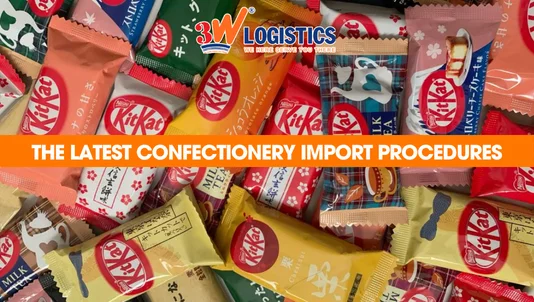
Importing confectionery is one of the processed food categories that draws strong interest from businesses thanks to steady year-round consumer demand that spikes sharply during Lunar New Year, Mid-Autumn Festival, and Christmas. Unlike beer and spirits, confectionery is not on the prohibited goods list or subject to special conditional business licensing, but it remains a food category under strict food safety oversight, requiring businesses to complete product self-declaration before customs clearance.
This article by 3W Logistics presents the complete up-to-date confectionery import procedures – covering legal conditions, 8-digit HS codes, tax calculation, required documentation, step-by-step process, and real-world risks, from the perspective of a forwarder experienced in handling imported food products.
1. Legal Conditions for Importing Confectionery into Vietnam
Confectionery is not on the list of prohibited imports, however as a processed food category it falls under the specialized food safety management of the Ministry of Health under Decree 15/2018/ND-CP and Point d, Clause 2, Article 41 of Decree 85/2019/ND-CP.
| Condition | Detailed Content |
|---|---|
| Business qualification | Must hold a Business Registration Certificate with an appropriate business line (food import, distribution) – no separate sub-license required as with liquor |
| Product self-declaration (food safety) | Mandatory for all confectionery imported for commercial purposes, carried out per Form No. 01, Appendix I of Decree 15/2018/ND-CP, submitted before the product is released to the market |
| State inspection of food safety | Register inspection via the National Single Window Portal (vnsw.gov.vn); two inspection modes: strict inspection (sample testing) and normal inspection (document review) |
| Food additives | Additives, food coloring, and preservatives in confectionery must comply with Vietnam’s approved additive list issued by the Ministry of Health |
| Product labeling | Vietnamese sub-labels must be complete under Decree 43/2017/ND-CP and 111/2021/ND-CP: ingredients, nutritional information, production date, expiry date, origin, and name/address of the responsible entity |
Practical note: The most important distinction in confectionery import procedures compared to other food categories is that businesses should import sample goods first to complete product self-declaration and QCVN standard testing, rather than waiting for the full shipment to arrive at port. With confectionery shipments containing multiple product types (hard candy, gummies, chocolate…), each type requires its own separate self-declaration – a step many new importers overlook, causing their documentation to be rejected and returned for supplementation.
2. HS Codes and Import Tax on Confectionery
Confectionery is classified into three main groups in Vietnam’s Import-Export Tariff Schedule: Group 17.04 (sugar confectionery not containing cocoa), Group 18.06 (chocolate and other cocoa-containing preparations), and Group 19.05 (bread, biscuits, wafers). Determining the correct 8-digit HS code depends on the product’s actual composition.
| Confectionery Type | 8-Digit HS Code | Detailed Description | Import Tax (MFN) |
|---|---|---|---|
| Chewing gum | 1704.10.00 | Chewing gum, whether or not sugar-coated, not containing cocoa | 20% |
| Hard candy | 1704.90.10 | Hard candy of all kinds not containing cocoa (lollipops, mint candy…) | 20% |
| Gummy candy, soft candy | 1704.90.90 | Gummies, marshmallows, fruit gum candy, and other sugar confectionery not elsewhere specified | 20% |
| Filled chocolate bar/block | 1806.31.00 | Chocolate and other cocoa-containing preparations, in block/bar/stick form, filled (nut filling, cream filling…) | 30% |
| Unfilled chocolate bar/block | 1806.32.00 | Solid chocolate block, unfilled (dark, milk, white chocolate bars) | 30% |
| Chocolate pieces, gift boxes | 1806.90.00 | Other cocoa-containing preparations not elsewhere specified (pralines, mixed chocolate assortment boxes) | 35% |
| Sweet biscuits | 1905.31.00 | Sweet biscuits of all kinds, whether or not containing cocoa | 20% |
| Wafers | 1905.32.00 | Waffles and wafers, filled or unfilled (cream wafers, chocolate wafers) | 20% |
Important note on confectionery HS codes: HS code classification must be based on the actual composition of the product – particularly the cocoa content, since biscuits coated in chocolate may shift from Group 19.05 to Group 18.06 with a higher tax rate. For complex products, it is advisable to rely on catalogues, technical documentation, or request an assessment from the Customs Inspection Department before official declaration. Confectionery from countries with an FTA with Vietnam (China under ACFTA, South Korea under VKFTA/AKFTA, the EU under EVFTA…) with valid C/O may qualify for special preferential import tax rates as low as 0-5%.
3. Documentation for Confectionery Import Procedures
Unlike beer and spirits, confectionery is not subject to special consumption tax, so the documentation set focuses mainly on commercial documents and food safety self-declaration.
| Document | When to Prepare | Important Notes |
|---|---|---|
| Sales Contract | Before deposit payment | Clearly state product name, ingredients, packaging specifications, origin, and terms for providing C/O and CFS |
| Commercial Invoice & Packing List | Before goods are shipped | Fully list product name, quantity, weight, and number of cartons/packages for each confectionery type |
| Bill of Lading | After loading onto vessel/aircraft | Confectionery is usually shipped in standard 20’/40′ dry containers; chocolate products require temperature control to avoid melting in hot climates |
| Product self-declaration form | Before goods arrive at port (do early) | Under Decree 15/2018/ND-CP, accompanied by CFS/Health Certificate and test results; each product type requires its own separate declaration |
| Certificate of Free Sale (CFS) | Before product self-declaration | Provided by the exporter, proving the product is legally sold in the country of origin |
| C/O (Certificate of Origin) | Before goods are shipped | Not mandatory but recommended to obtain special preferential tax rates under the relevant FTA |
| State food safety inspection registration | When goods arrive at port | Register via the National Single Window Portal; if qualified, a confirmation certificate of food meeting import requirements will be issued |
| Electronic Customs Declaration (VNACCS/VCIS) | Once documentation is complete | Declare the correct HS code under group 17.04/18.06/19.05, and enter the self-declaration receipt number and C/O number (if any) |
4. Step-by-Step Confectionery Import Procedures
Step 1: Import sample goods and complete product self-declaration
Import a sample of the confectionery to Vietnam first, have it tested against QCVN standards, and translate the product labeling. Once test results pass, submit the product self-declaration – one separate declaration per product type.
Step 2: Negotiate the contract and determine the HS code
Sign the confectionery purchase contract, clearly specifying ingredients, packaging specifications, and origin. Determine the correct HS code based on actual composition (cocoa-containing or not) to pre-calculate tax costs and request C/O in the contract terms if seeking FTA preferential treatment.
Step 3: Ship the confectionery to a Vietnamese port
Confectionery is usually shipped in standard dry containers; for chocolate and other heat-sensitive products, consider temperature-controlled containers or scheduling shipment to avoid the hot season.
Step 4: Register state food safety inspection
Once goods arrive at port, register for quality inspection via the National Single Window Portal. Under strict inspection, authorities take samples for testing; under normal inspection, only the documentation (including prior self-declaration) is reviewed.
Step 5: Customs declaration, tax payment, and clearance
Open the VNACCS/VCIS declaration with the complete HS code, self-declaration receipt number, and C/O number (if any). The system automatically assigns a green/yellow/red channel; red channel triggers physical inspection. Once food safety inspection results pass, the business pays import tax and VAT.
Step 6: Receive goods and transport to the distribution warehouse
After clearance, complete the Vietnamese sub-label application (if not already done), receive the goods, and transport them to the warehouse. For confectionery with short shelf life or seasonal timing (Mid-Autumn Festival, Lunar New Year), plan for fast distribution to optimize the product’s shelf life.
5. How to Calculate Confectionery Import Tax
Unlike beer and spirits, confectionery is subject to only two tax layers – import tax and VAT, with no special consumption tax. For example, with a chocolate shipment imported from South Korea (HS code 1806.32.00), CIF value of 200 million VND, comparing scenarios with and without C/O Form VK/AK:
| Tax / Cost Item | No C/O (MFN 30%) | With C/O Form VK/AK (0%) |
|---|---|---|
| CIF value | 200,000,000 VND | 200,000,000 VND |
| Import tax | 30% × 200M = 60,000,000 VND | 0% × 200M = 0 VND |
| VAT (10%) | 10% × (200+60)M = 26,000,000 VND | 10% × (200+0)M = 20,000,000 VND |
| Total tax payable | 86,000,000 VND (~86 million) | 20,000,000 VND (~20 million) |
| Savings with C/O | ~66,000,000 VND – a very significant difference, since many VKFTA/AKFTA tariff lines for chocolate have already dropped to 0%. This is why C/O is the most valuable document in confectionery import procedures. | |
From 3W Logistics’ practical experience: The most common mistake when importing confectionery isn’t related to tax, but to businesses waiting until goods reach port before starting the product self-declaration process – a procedure (including sample testing, label translation, and filing) that typically takes 10-20 business days. For seasonal shipments like Mid-Autumn Festival cakes or Lunar New Year confectionery, even a few days’ delay can cause a product to miss its optimal selling window. We always recommend clients import samples and complete self-declaration in parallel with negotiating the main shipment contract. – Ms. Apple, CCO, 3W Logistics
6. Common Risks in Confectionery Import Procedures
| Risk | Manifestation | Prevention |
|---|---|---|
| Product self-declaration not completed | Goods arrive at port but lack a completed declaration for each product type – customs declaration cannot be opened, resulting in container/storage fees | Import samples and complete self-declaration before importing the main shipment, especially for products being imported for the first time |
| Incorrect HS code between groups 17.04/18.06/19.05 | Confusing chocolate-coated biscuits (group 18.06) with plain biscuits (group 19.05) – customs reclassifies and retroactively collects the tax difference | Determine the HS code based on actual product composition, cross-check with technical catalogues; consult a forwarder experienced in food product categories |
| Additives not on the approved list | Product contains coloring or preservatives not on Vietnam’s approved additive list – self-declaration rejected or inspection fails | Check product ingredients against the Ministry of Health’s approved additive list before signing the import contract |
| Heat damage during transport | Chocolate melts or deforms due to high temperatures in an uncontrolled container – triggers insurance claims and reduces the quantity actually received | Use refrigerated or temperature-controlled containers for heat-sensitive products; avoid shipping during peak hot seasons |
| Sub-label missing nutritional information | Missing nutrition facts table or nutritional values as required by the Ministry of Health – customs holds the goods and requires re-labeling at port | Prepare complete sub-label samples under Decree 43/2017/ND-CP and 111/2021/ND-CP before goods arrive at port |
FAQ – Frequently Asked Questions about Confectionery Import Procedures
Question 1: What documents are needed for confectionery import procedures?
A complete documentation set for confectionery import procedures includes: Sales Contract; Commercial Invoice and Packing List; Bill of Lading; C/O (if seeking FTA preferential treatment); Product self-declaration form under Decree 15/2018/ND-CP; Certificate of Free Sale (CFS); state food safety inspection registration; Vietnamese sub-label; and electronic customs declaration (VNACCS/VCIS).
Question 2: Does confectionery import require a license from the Ministry of Industry and Trade?
No sub-license is required as with liquor. Confectionery only requires the business to have appropriate business registration and complete product self-declaration per the Ministry of Health’s regulations under Decree 15/2018/ND-CP – this is a key factor that makes confectionery import procedures significantly simpler than alcoholic beverages.
Question 3: How many types of tax must be paid when importing confectionery?
Confectionery is subject to only two tax layers: (1) Import tax, calculated on CIF value, ranging from 5% to 40% depending on the HS code and origin, which can drop to 0% with a valid FTA C/O; (2) VAT, typically 10% (some food categories qualify for a 2% VAT reduction under support policies effective through 2026), calculated on total CIF value plus import tax. Confectionery is not subject to special consumption tax.
Question 4: How long does confectionery import take?
The total time from starting the product self-declaration to goods arriving at the warehouse typically ranges from 20-40 days. This includes: sample import and self-declaration, 10-20 business days (should be done in advance, in parallel with negotiating the main shipment); transport from Asia, 7-15 days, from Europe, 20-30 days; food safety inspection and customs clearance, 3-7 days. Shipments that already have a self-declaration on file from a previous import will clear significantly faster.
How 3W Logistics Supports Confectionery Import Procedures
With experience handling a wide range of imported food products and registration as an OTI-NVOCC with FMC bond (Federal Maritime Commission) in the United States, 3W Logistics offers a full-service package for businesses covering confectionery import procedures – from product self-declaration consulting to delivery at the distribution warehouse.
- Consulting on accurate HS code determination based on product composition: Correctly classify between groups 17.04, 18.06, and 19.05 based on actual cocoa content and composition, avoiding the risk of reclassification and retroactive tax collection.
- Support with sample import and product self-declaration procedures: Coordinate QCVN testing, label translation, and filing of self-declaration paperwork in parallel with negotiating the main shipment, reducing wait time at port.
- Support obtaining the correct FTA C/O form from suppliers: Guide South Korean suppliers in obtaining Form VK/AK, Chinese suppliers Form E, and EU suppliers Form EUR.1 to optimize import tax costs.
- Registration of state food safety inspection via the National Single Window Portal: Prepare complete registration documentation, monitor and quickly respond to requests for supplementary information from authorities.
- Electronic customs declaration (VNACCS/VCIS) and resolving issues at the border checkpoint: Declare the correct HS code, coordinate proper sub-label application before clearance.
Why choose 3W Logistics for your confectionery shipment? While confectionery import procedures are less complex than alcoholic beverages, they still require precise handling of product self-declaration, HS code classification across dozens of different subcategories, and optimizing FTA C/O to reduce tax costs. We accompany you from the sample declaration stage through to warehouse delivery – helping businesses shorten clearance time, which is especially critical for seasonal goods. Contact 3W for specific consultation before signing your import contract.
Address: 34 Bach Dang, Tan Son Hoa Ward, Ho Chi Minh City
Hotline: +84 28 3535 0087
____________________________
3W Logistics Hanoi Branch
Address: 81A Tran Quoc Toan, Cua Nam Ward, Hanoi
Hotline: +84 24 3202 0482
____________________________
3W Logistics Hai Phong Branch
Address: 8A Lot 28 Le Hong Phong, Gia Vien Ward, Hai Phong
Hotline: +84 225 355 5939
____________________________
3W LOGISTICS CO., LTD – We here serve you there!
Email: quote@3w-logistics.com
Website: www.3w-logistics.com

Ms. Apple is the CCO (Chief Commercial Officer) at 3W Logistics, with over 10 years of experience in sales and business operations management.
At 3W Logistics, Ms. Apple is responsible for commercial strategy, corporate customer development, managing a team of more than 50 sales professionals, and improving business performance in the logistics sector.
With practical experience in sales management and market development, Ms. Apple shares professional insights on business logistics solutions, international transportation, freight forwarding, customer management, trade lane development, and growth strategies in the logistics industry.


