
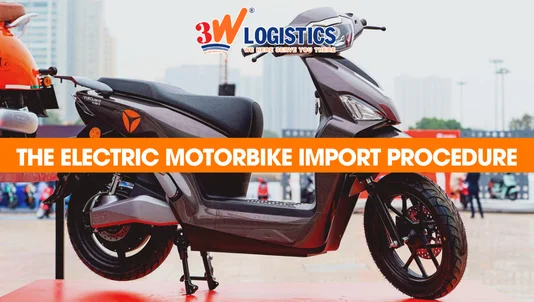
The electric motorbike import procedure is a category of transportation vehicles with the tightest management process among industrial-consumer goods categories, requiring businesses to pass a technical safety and environmental quality inspection (vehicle registration/type approval) before circulation is permitted — quite different from most ordinary industrial machinery and equipment, which only requires a straightforward customs declaration.
Not every business fully understands the electric motorbike import procedure, especially the difference in tax obligations compared to gasoline motorbikes — since electric motorbikes have no cylinder displacement, they are not subject to special consumption tax like gasoline motorbikes above 125cc. An error in HS code determination, or overlooking quality inspection registration, can result in the entire shipment being held at port or unable to be sold on the market.
In this article, 3W Logistics presents the complete electric motorbike import procedure under the latest legal regulations and tariff schedule — from legal conditions, HS codes, tax calculation, and required documentation, through the step-by-step process and practical risks, from the perspective of a forwarder experienced in handling imported transportation vehicles.
1. Legal conditions for importing electric motorbikes
Electric motorbikes may only be imported 100% new; used electric motorbikes are on the prohibited import list under Decree 69/2018/ND-CP, similar to used gasoline motorcycles and mopeds. This is a fundamental difference from industrial machinery, which only limits equipment age rather than fully prohibiting used goods.
| Condition | Detailed Content |
|---|---|
| Technical safety quality inspection | Mandatory vehicle registration inspection under Circular 55/2024/TT-BGTVT, governing technical safety and environmental quality inspection for imported motorcycles and mopeds (replacing Circular 25/2019/TT-BGTVT), carried out through the Vietnam Register |
| Specific battery and fire safety regulations | Electric motorbikes are subject to an additional specific inspection requirement for the energy-storage battery under Circular 82/2024/TT-BCA of the Ministry of Public Security, focused on fire and explosion safety — a distinction from gasoline motorbikes |
| Quality inspection registration | Businesses must register documentation on the National Single Window Portal and receive confirmation from the Vietnam Register before the goods arrive at port |
| Product labeling | A Vietnamese supplementary label under Decree 43/2017/ND-CP and 111/2021/ND-CP: product name, model, technical specifications (motor power, voltage, battery capacity), origin, and importer |
Practical note: Many businesses apply the gasoline motorbike import process wholesale to electric motorbikes, resulting in overlooking the specific battery safety requirements under Circular 82/2024/TT-BCA. In the electric motorbike import procedure, businesses need to prepare complete technical documentation on motor power, voltage, battery capacity, and continuous range right from the quality inspection registration stage, to avoid being asked for additional documentation once the goods have already arrived at port.
2. HS code and import tax for electric motorbikes
Electric motorbikes fall under heading 87.11 (Motorcycles, including mopeds and cycles fitted with an auxiliary motor) in the Import-Export Tariff Schedule, specifically the subheading dedicated to electric-motor-propelled types.
| Heading/HS Code | Detailed Description | Import Tax (MFN) |
|---|---|---|
| 87.11 — Motorcycles (including mopeds) and cycles fitted with an auxiliary motor, with electric motor for propulsion | ||
| 8711.60.11 | Electric motorcycles, motor power not exceeding 4 kW — the most common code used when importing standard electric motorbikes | 25–45% |
| 8711.60.19 | Electric motorcycles, motor power exceeding 4 kW | 25–45% |
| 8711.60.20 | Electric bicycles (bicycle-frame form with an integrated electric motor and pedal-assist) | 20–35% |
| 8711.60.90 | Other electric-motor-propelled vehicles not classified above | 25–45% |
| 85.07 — Electric storage batteries, including lithium-ion batteries, imported separately | ||
| 8507.60.00 | Lithium-ion batteries for electric motorbikes, imported independently without the vehicle | 0–10% |
Important note on HS codes and tax: The ordinary import tax rate (without C/O) for electric motorbikes ranges roughly 25-45% depending on the subheading. For goods with a valid Certificate of Origin (C/O), for example Form E from China under ACFTA, import tax can drop sharply to 0-5%. Regarding VAT, since electric motorbikes have no cylinder displacement, they are not subject to special consumption tax (unlike gasoline motorbikes above 125cc), so electric motorbikes are not on the exclusion list under Decree 174/2025/ND-CP and enjoy the preferential 8% VAT rate applicable through December 31, 2026, instead of the standard 10%. This is an important distinction businesses need to note when budgeting costs for the electric motorbike import procedure.
3. Documentation for the electric motorbike import procedure
The documentation set for the electric motorbike import procedure is considerably more extensive than for ordinary industrial machinery, since it involves 2 stages: customs clearance and quality registration inspection, per Circular 38/2015/TT-BTC (as amended by Circular 39/2018/TT-BTC).
| Document | When to Prepare | Important Note |
|---|---|---|
| Sales Contract | Before deposit | Clearly state motor power, voltage, battery capacity, and terms for providing the C/O |
| Commercial Invoice & Packing List | Before goods are shipped | Fully state the product name, model, and quantity for each electric motorbike type |
| Bill of Lading | After goods are loaded onto the vessel | Electric motorbikes containing lithium batteries are dangerous goods (Class 9); must be declared correctly under maritime dangerous goods shipping regulations |
| Technical specification document | Before declaring the HS code | Includes dimensions, weight, permitted passenger count, maximum speed, motor power, voltage, battery capacity, and continuous range — serves as the basis for vehicle inspection |
| Quality inspection registration | Before goods arrive at port | Registered via the National Single Window Portal and confirmed by the Vietnam Register under Circular 55/2024/TT-BGTVT |
| C/O (Certificate of Origin) | Before goods are shipped | Needed to reduce import tax from the standard 25-45% rate down to 0-5% for goods with an FTA |
| Electronic customs declaration (VNACCS/VCIS) | Once documentation is complete | Declare the correct HS code under heading 8711.60, together with the quality inspection registration number |
4. Step-by-step electric motorbike import procedure
Step 1: Check technical specifications and determine the HS code
Determine the electric motorbike’s motor power, voltage, and battery capacity, and work with the supplier to obtain complete technical documentation, from which the correct HS code — subheading 8711.60.11, .19, .20, or .90 — can be determined.
Step 2: Negotiate the contract and require a C/O
Sign the electric motorbike purchase contract, clearly stating power, voltage, and model, and include a C/O requirement in the contract terms to secure preferential FTA import tax instead of the standard rate of 25-45%.
Step 3: Register for quality inspection before goods arrive
Submit the quality inspection registration via the National Single Window Portal for confirmation by the Vietnam Register before the goods arrive at port, to avoid delaying the clearance timeline.
Step 4: Transport goods to a Vietnamese port
Electric motorbikes containing lithium-ion batteries are classified as dangerous goods for maritime transport; they must be packaged and declared correctly under dangerous goods (DG cargo) regulations to avoid being refused loading by the shipping line.
Step 5: Customs declaration and clearance
File the VNACCS/VCIS declaration with the full HS code, quality inspection registration number, and C/O number (if applicable). Once import tax and VAT have been paid in full, the goods are cleared.
Step 6: Vehicle registration, labeling, and release for circulation
After clearance, complete the import vehicle registration inspection procedure at the Vietnam Register, apply the Vietnamese supplementary label as required, receive the goods, and transport them to the warehouse. Only once a passing inspection result is obtained may the electric motorbike be sold on the market.
5. How to calculate import tax on electric motorbikes
Electric motorbikes are not subject to special consumption tax since they have no cylinder displacement. As an example, for a shipment of 3kW electric motorbikes imported from China (HS code 8711.60.11) with a CIF price of VND 600 million, comparing the case with and without a Form E C/O:
| Tax / Cost Item | Without C/O (ordinary rate 45%) | With C/O Form E/ACFTA (5%) |
|---|---|---|
| CIF price | VND 600,000,000 | VND 600,000,000 |
| Import tax | 45% × 600M = VND 270,000,000 | 5% × 600M = VND 30,000,000 |
| VAT (8%, applicable through end of 2026) | 8% × (600+270)M = VND 69,600,000 | 8% × (600+30)M = VND 50,400,000 |
| Total tax payable | VND 339,600,000 (~339.6 million) | VND 80,400,000 (~80.4 million) |
| Savings with C/O Form E | ~VND 259,200,000 — a very large difference since the ordinary import tax rate for electric motorbikes is quite high; businesses should place particular emphasis on securing a complete C/O right from the contract negotiation stage. | |
From 3W Logistics’ practical experience: With electric motorbikes, the most common mistake we see in the electric motorbike import procedure is businesses registering for quality inspection too late, or lacking battery technical documentation — a specific documentation requirement that gasoline motorbikes do not have. Because the import tax gap between having and not having a C/O is so large, negotiating for the supplier to commit to providing a Form E C/O (or the appropriate form) right in the original contract, while also preparing complete battery specifications before registering for quality inspection, can help businesses save significant cost and clearance time. — Ms. Apple, CCO, 3W Logistics
6. Common risks in the electric motorbike import procedure
| Risk | Manifestation | Prevention |
|---|---|---|
| Confusing used vehicles with new ones | Mistakenly importing a used electric motorbike (demo, display unit) — on the prohibited import list, forced into re-export or destruction | Require the supplier to clearly confirm 100% new, unused condition, and check carefully before signing the contract |
| Missing battery technical documentation | Missing battery specifications required under Circular 82/2024/TT-BCA when registering for quality inspection, delaying the vehicle inspection timeline | Require the manufacturer to provide complete technical documentation on voltage, capacity, and battery technology from the outset |
| Improper dangerous goods transport | Lithium-ion batteries in the electric motorbike are not declared or packaged to dangerous goods standards, resulting in the shipping line refusing transport or imposing a penalty | Work with a forwarder experienced in shipping goods containing lithium batteries, with complete DG cargo declaration |
| Misapplying the HS code among the 8711.60 subheadings | Confusion between electric motorcycles and electric bicycles (different tax rates) — customs reclassifies the goods and retroactively collects the tax difference under Decree 128/2020/ND-CP | Request detailed technical documentation from the manufacturer before declaration; consult a forwarder experienced with the transportation vehicles goods category |
| Product label missing mandatory information | Missing power, voltage, or battery capacity specifications on the Vietnamese supplementary label — customs or the vehicle inspection authority requests supplementary labeling | Prepare a complete supplementary label sample under Decree 43/2017/ND-CP and 111/2021/ND-CP before the goods arrive at port |
FAQ – Frequently asked questions about the electric motorbike import procedure
Question 1: What documents are required for the electric motorbike import procedure?
The complete documentation set for the electric motorbike import procedure includes: Sales Contract; Commercial Invoice and Packing List; Bill of Lading; Technical specification document; quality inspection registration via the National Single Window Portal; C/O (if needed); electronic customs declaration (VNACCS/VCIS). After clearance, businesses must complete the vehicle registration inspection procedure before the vehicle can be sold on the market.
Question 2: Can used electric motorbikes be imported?
No. Used electric motorbikes are on the prohibited import list under Decree 69/2018/ND-CP, similar to used gasoline motorbikes. This is a major difference from industrial machinery, which only limits equipment age (no more than 10 years) rather than fully prohibiting used goods. In the electric motorbike import procedure, businesses may only import 100% new vehicles.
Question 3: How many types of tax must be paid when importing electric motorbikes?
Electric motorbikes are subject to only two layers of tax: (1) Import tax calculated on the CIF price, with a standard rate of 25-45% under heading 8711.60, potentially reduced to 0-5% with a valid C/O; (2) VAT at the preferential 8% rate applicable through December 31, 2026 under Decree 174/2025/ND-CP. Electric motorbikes are not subject to special consumption tax since they have no cylinder displacement.
Question 4: How long does the electric motorbike import procedure take?
The total time from signing the contract to the vehicle being permitted for sale on the market is typically 30-45 days, longer than for many industrial goods categories since it involves both customs clearance and vehicle registration inspection. Of this: shipping takes 10-20 days depending on the route; quality inspection registration and waiting for results takes 10-15 working days.
How does 3W Logistics support the electric motorbike import procedure?
With experience handling a wide range of imported transportation vehicles, and registration as an OTI-NVOCC with an FMC Bond (Federal Maritime Commission) in the United States, 3W Logistics provides end-to-end service for businesses on the electric motorbike import procedure — from HS code determination consulting through to vehicle registration completion and arrival at the distribution warehouse.
Full-package logistics services at 3W Logistics:
- Consulting on accurate HS code determination based on power and vehicle type: Correctly classifying between subheadings 8711.60.11, .19, .20, and .90, avoiding the risk of reclassification and retroactive tax collection.
- Support with quality inspection registration and connecting with the Vietnam Register: Preparing complete technical documentation and registering early to shorten the vehicle inspection waiting time.
- Expertise in transporting goods containing lithium-ion batteries: Ensuring correct declaration and packaging under dangerous goods regulations for maritime transport.
- Support in calculating actual tax and optimizing preferences: Advising on obtaining the appropriate C/O to sharply reduce import tax, and keeping up to date on the latest VAT policy.
- Electronic customs declaration via VNACCS/VCIS and resolving issues at the border gate: Declaring the correct HS code and quickly handling any requests for additional documentation.
Why choose 3W Logistics for your imported electric motorbike shipment? Because this category of goods must go through both customs procedures and specialized vehicle registration inspection with specific battery safety requirements, businesses need a partner who thoroughly understands both processes to avoid unplanned yard storage costs or delays. We stand alongside you from HS code determination through to vehicle registration completion — helping businesses shorten the time to market and avoid unnecessary added costs. Contact 3W for specific advice before signing your import contract.
Address: 34 Bach Dang, Tan Son Hoa Ward, Ho Chi Minh City
Hotline: +84 28 3535 0087
____________________________
3W Logistics Hanoi Branch
Address: 81A Tran Quoc Toan, Cua Nam Ward, Hanoi
Hotline: +84 24 3202 0482
____________________________
3W Logistics Hai Phong Branch
Address: 8A Lo 28 Le Hong Phong, Gia Vien Ward, Hai Phong
Hotline: +84 225 355 5939
____________________________
3W LOGISTICS CO., LTD – We here serve you there!
Email: info@3w-logistics.com
Website: www.3w-logistics.com

Ms. Apple is the CCO (Chief Commercial Officer) at 3W Logistics, with over 10 years of experience in sales and business operations management.
At 3W Logistics, Ms. Apple is responsible for commercial strategy, corporate customer development, managing a team of more than 50 sales professionals, and improving business performance in the logistics sector.
With practical experience in sales management and market development, Ms. Apple shares professional insights on business logistics solutions, international transportation, freight forwarding, customer management, trade lane development, and growth strategies in the logistics industry.


