

Importing refractory bricks into Vietnam involves a specialized construction-material category used mainly by heavy industry – cement kilns, steel-smelting furnaces, ceramic kilns, thermal power plants – where materials must withstand extremely high temperatures that ordinary construction bricks cannot handle.
However, not every business fully understands the refractory brick import procedure, particularly how to correctly determine the HS code based on the product’s chemical composition – the factor that directly determines the applicable import duty.
In this article, 3W Logistics presents the full refractory brick import procedure under the current legal regulations and latest tariff schedule – covering legal conditions, the 8-digit HS code, tax calculation, documentation, the step-by-step process, and practical risks, from the perspective of a forwarder experienced in handling imported refractory materials and industrial construction materials.
1. Legal conditions for importing refractory bricks into Vietnam
Refractory bricks are not on the list of prohibited imports, but as a specialized construction material they must comply with regulations on standard-of-application declaration and specialized construction-quality inspection.
| Condition | Detailed Content |
|---|---|
| Standard-of-application declaration | Mandatory for all imported construction materials under Decree 209/2026/ND-CP (effective July 1, 2026), to be completed before the goods are placed on the market |
| Quality inspection and conformity declaration | Refractory bricks, as a construction material, must undergo quality inspection under the current QCVN 16 national technical regulation and Circular 10/2024/TT-BXD, registered with the Department of Construction where the business is headquartered or where the goods are imported |
| Test sampling | Carried out at an inspection body designated by the Ministry of Construction, such as Vinacontrol, Quatest 1/3, Bureau Veritas, SGS, or Intertek; the results serve as the basis for completing the conformity declaration |
| Pay-duty-first, store-in-warehouse mechanism | Businesses may apply to pay duty upfront and move the goods to a storage warehouse while awaiting quality-inspection results, avoiding prolonged container/yard demurrage charges at port |
| Product labeling | A supplementary Vietnamese-language label is required under Decrees 43/2017/ND-CP and 111/2021/ND-CP, showing the product name, heat-resistance specifications, origin, and the responsible entity |
Practical note: In the refractory brick import procedure, businesses need to clearly distinguish between two steps: the standard-of-application declaration (mandatory for all construction materials) and the conformity declaration (mandatory only when the product falls into a risk group under QCVN 16). Refractory bricks used for industrial facilities (smelting furnaces, kilns) usually fall into the mandatory quality-inspection group because they relate to the safe operation of high-temperature equipment, unlike certain ordinary decorative bricks, which may only require a standard-of-application declaration without conformity certification.
2. 8-digit HS codes and import duty for refractory bricks
Refractory bricks fall under heading 69.02 (Chapter 69 – Ceramic products) in the Import-Export Tariff Schedule, classified according to the product’s main chemical composition – this is the factor that directly determines the 8-digit HS code and applicable duty rate.
| Refractory Brick Type | 8-Digit HS Code | Detailed Description | Import Duty (MFN) |
|---|---|---|---|
| Mg/Ca/Cr-based refractory bricks | 6902.10.00 | Containing over 50% by weight of Mg, Ca, or Cr elements (individually or combined), calculated as MgO, CaO, Cr2O3 – used for metallurgical furnaces and cement kilns | 10% |
| Alumina-Silica (Al-Si) based refractory bricks | 6902.20.00 | Containing over 50% by weight of Al, Si elements (individually or combined), calculated as Al2O3, SiO2 – the most common type, widely used for cement kilns and ceramic kilns | 10% |
| Other refractory bricks | 6902.90.00 | Refractory bricks and blocks not falling under the two chemical-composition groups above, including carbon bricks and zircon bricks | 10–15% |
| Refractory ceramic accessories (crucibles, pipes, pouring funnels) | 6903.90.90 | Other refractory ceramic products (metal-melting crucibles, pipes, pouring funnels, furnace lining panels) accompanying the refractory brick system | 10% |
Important note on HS codes: The 10% import duty rate for code 6902.20.00 (alumina-silica-based refractory bricks) has been officially confirmed by the General Department of Customs in a written response to a business inquiry, and this serves as an important reference when declaring goods in the refractory brick import procedure. Correctly classifying goods under heading 6902.10 or 6902.20 depends entirely on the chemical composition ratio (MgO/CaO/Cr2O3 versus Al2O3/SiO2); this information must be confirmed through a certificate of analysis (COA) from the manufacturer and cannot be inferred from the commercial product name. For goods with a valid C/O from China (ACFTA/RCEP) or ASEAN (ATIGA), the import duty can be significantly reduced, even down to 0% depending on the specific tariff line under the special preferential tariff schedule.
3. Documentation for the refractory brick import procedure
The documentation set for the refractory brick import procedure includes an additional layer of quality-inspection and conformity-declaration paperwork compared with ordinary goods.
| Document | When to Prepare | Important Notes |
|---|---|---|
| Sales Contract | Before placing a deposit | Clearly state the brick type, chemical composition, origin, and terms for providing C/O and CQ |
| Commercial Invoice & Packing List | Before the goods are shipped | Fully state the product name, number of units/pallets, and weight for each brick specification |
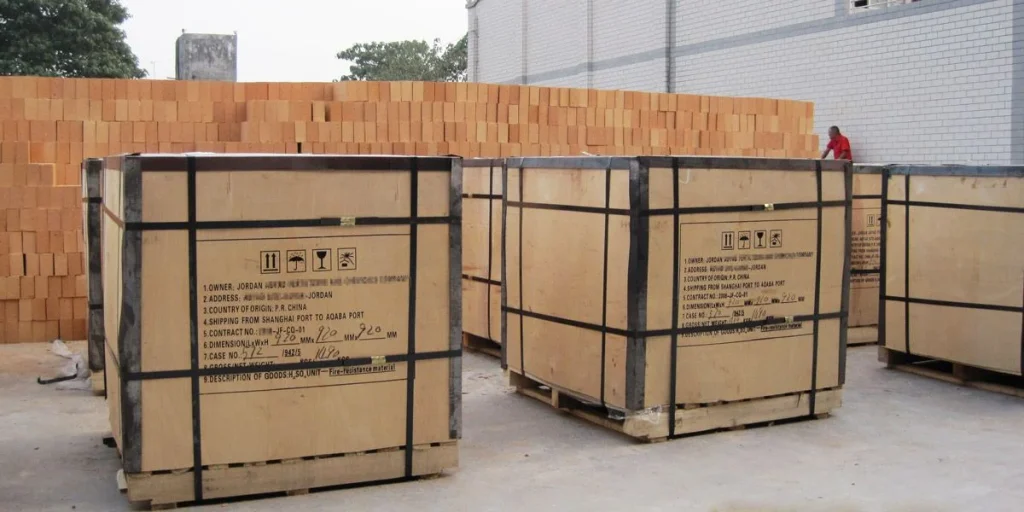
| Bill of Lading | After the goods are loaded on the vessel | Refractory bricks are typically shipped in 20’/40′ dry containers, carefully palletized to avoid breakage given the heavy weight and brittleness of the material |
| Certificate of Quality (CQ) & Catalogue | Before declaring the HS code | Provided by the manufacturer, showing the chemical composition and heat-resistance specifications – the basis for determining the correct HS code |
| Quality-inspection registration | When the goods arrive at port | Submitted to the Department of Construction, together with the contract, invoice, packing list, and technical catalogue |
| C/O (Certificate of Origin) | Before the goods are shipped | Needed to enjoy the special preferential import duty under the relevant FTA, if the agreement’s conditions are met |
| Conformity certificate | After the test results are available | Submitted as a supplement to the Department of Construction to complete the conformity declaration, allowing the product to be officially placed on the market |
| Electronic customs declaration (VNACCS/VCIS) | Once the documentation is complete | Declare the correct HS code under heading 69.02, recording the C/O number and the quality-inspection registration number on the declaration |
4. Step-by-step refractory brick import procedure
Step 1: Negotiate the contract and determine the HS code
Sign the purchase contract for refractory bricks, requesting the supplier to provide a certificate of analysis (COA) of the chemical composition and a technical catalogue in order to correctly determine whether the HS code falls under heading 6902.10, 6902.20, or 6902.90.
Step 2: Register for quality inspection
Submit the quality-inspection registration application to the Department of Construction before or immediately upon the goods’ arrival at port, together with the product’s complete technical documentation.
Step 3: Ship the goods to Vietnamese port
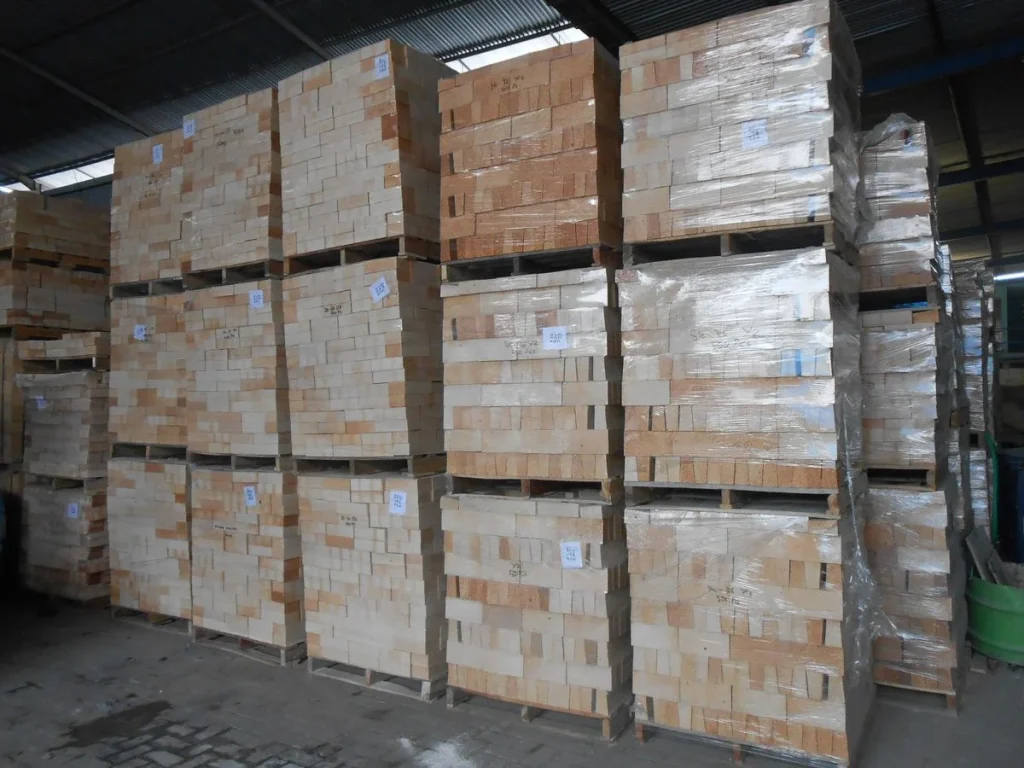
Refractory bricks are typically shipped in standard dry containers, stacked on sturdy wooden pallets; careful packaging is essential, as this is a heavy but brittle material prone to breakage and chipping during handling.
Step 4: Customs declaration and clearance
Open the VNACCS/VCIS declaration with the complete HS code, C/O number, and quality-inspection registration number. Thanks to the pay-duty-first mechanism, businesses may obtain clearance and move the goods to a storage warehouse while awaiting the test results.
Step 5: Test sampling and conformity certification
The inspection body designated by the Ministry of Construction visits the warehouse to collect samples and test the technical parameters under QCVN 16. If the results meet requirements, the business submits the conformity certificate to the Department of Construction as a supplement to complete the declaration.
Step 6: Pay duty and release the goods for circulation
Pay the full import duty and VAT according to the cleared declaration. Once the conformity certificate is obtained, the refractory bricks may be officially sold on the market or installed at the project site.
5. How to calculate import duty for refractory bricks
Refractory bricks are not subject to special consumption tax, only import duty and VAT. Take, for example, a shipment of alumina-silica-based refractory bricks under HS code 6902.20.00 imported from China, with a CIF value of VND 500 million, comparing the scenario with and without a C/O Form E:
| Duty / Cost Item | No C/O (MFN 10%) | With C/O Form E (0%) |
|---|---|---|
| CIF value | VND 500,000,000 | VND 500,000,000 |
| Import duty | 10% × 500M = VND 50,000,000 | 0% × 500M = VND 0 |
| VAT (10%) | 10% × (500+50)M = VND 55,000,000 | 10% × (500+0)M = VND 50,000,000 |
| Total tax payable | VND 105,000,000 (~105 million) | VND 50,000,000 (~50 million) |
| Savings with C/O | ~VND 55,000,000 — a significant difference from a single valid C/O, particularly meaningful for businesses importing large volumes for industrial-furnace projects. | |
From 3W Logistics’ practical experience: For refractory bricks, the most common mistake we see is not related to tax rates but to businesses declaring the HS code based on the commercial name printed on the packaging rather than on the actual chemical-composition analysis certificate — leading to confusion between heading 6902.10 (Mg/Ca/Cr-based) and 6902.20 (alumina-silica-based), which then triggers a customs request for explanation or reclassification. For industrial-furnace installation projects with tight schedules, even a few days’ delay caused by an HS-code classification issue can affect the entire construction timeline. We always advise clients to request a complete COA right from the contract-negotiation stage, so the HS code can be proactively determined before the goods are loaded on the vessel. – Ms. Apple, CCO, 3W Logistics
6. Common risks in the refractory brick import procedure
| Risk | Symptom | Prevention |
|---|---|---|
| Incorrect HS-code classification by chemical composition | Confusing the Mg/Ca/Cr ratio with Al/Si content leads to an incorrect HS-code declaration – customs reclassifies the goods and collects the tax difference under Decree 128/2020/ND-CP | Request an accurate COA from the manufacturer before declaration; consult a forwarder experienced with refractory materials |
| Quality-inspection registration not yet completed | The goods arrive at port but quality-inspection registration with the Department of Construction has not been completed – the declaration cannot be opened on schedule, incurring yard-storage fees | Prepare the quality-inspection registration documentation in parallel with the shipment’s transit time |
| Test results fail to meet QCVN standards | The product fails to meet the heat-resistance or mechanical-strength criteria under the technical regulation – forcing re-export or preventing conformity declaration, resulting in significant losses | Request test samples from the supplier before placing a large order to ensure compliance with Vietnamese standards |
| Breakage or chipping during transport | Refractory bricks are broken or chipped at the corners due to substandard packaging or careless handling – leading to insurance claims and a reduced received quantity | Require the supplier to package the goods on sturdy pallets with cushioning that meets international shipping standards, and purchase adequate cargo insurance |
| Product label missing technical specifications | The supplementary Vietnamese-language label lacks information on maximum operating temperature or composition – customs holds the goods and requests the label be supplemented at port | Prepare a complete supplementary-label sample under Decrees 43/2017/ND-CP and 111/2021/ND-CP before the goods arrive at port |
FAQ – Frequently Asked Questions about the refractory brick import procedure
Question 1: What documents are required for the refractory brick import procedure?
A complete file for the refractory brick import procedure includes: Sales Contract; Commercial Invoice and Packing List; Bill of Lading; C/O (if seeking FTA preferential treatment); Certificate of Quality (CQ) and technical Catalogue; Quality-inspection registration with the Department of Construction; Conformity certificate once test results are available; Electronic customs declaration VNACCS/VCIS.
Question 2: Are imported refractory bricks required to have conformity certification?
Yes. As a construction material, refractory bricks must undergo quality inspection and conformity declaration under the current QCVN 16 national technical regulation and Circular 10/2024/TT-BXD before being placed on the market. This is an indispensable step in the refractory brick import procedure, and can be carried out in parallel with moving the goods to a storage warehouse thanks to the pay-duty-first mechanism.
Question 3: How many types of tax must be paid when importing refractory bricks?
Refractory bricks are subject to only two layers of tax: (1) Import duty, calculated on the CIF value, with a common MFN rate of 10% as officially confirmed by the General Department of Customs for code 6902.20.00, which can be reduced to 0% with a valid FTA C/O; and (2) VAT of 10%, calculated on the CIF value plus import duty. Refractory bricks are not subject to special consumption tax.
Question 4: How long does the refractory brick import procedure take?
The total time from contract signing to the goods arriving at the warehouse is typically 25–45 days. This includes: 5–10 days shipping from China, 25–35 days from Europe; 3–5 days for quality-inspection registration and opening the declaration; and 10–15 days for testing and conformity certification, which can run in parallel after the goods are moved to a storage warehouse thanks to the pay-duty-first mechanism. Shipments with a prior track record of passing testing from an earlier import will complete the procedure significantly faster.
How does 3W Logistics support the refractory brick import procedure?
With experience handling a wide range of imported construction materials and refractory materials, and an OTI-NVOCC registration with FMC bond (Federal Maritime Commission) in the United States, 3W Logistics provides an end-to-end service for businesses on the refractory brick import procedure — from HS-code classification consulting through to the goods reaching the project site.
- Consulting on accurate HS-code determination by chemical composition: Correctly classifying goods between headings 6902.10, 6902.20, and 6902.90 based on the COA, avoiding the risk of reclassification and back-tax collection.
- Support for quality-inspection registration and conformity declaration: Coordinating with the Department of Construction and reputable inspection bodies, leveraging the pay-duty-first mechanism to shorten time at port.
- Support in obtaining the correct FTA C/O form from the supplier: Guiding Chinese suppliers on obtaining Form E and ASEAN suppliers on obtaining Form D to optimize import-duty costs.
- Specialized transport for refractory materials: Ensuring proper packaging and pallet stacking to minimize breakage and chipping during long-distance transport.
- Electronic customs declaration via VNACCS/VCIS and resolving issues at the border gate: Declaring the correct HS code and coordinating timely submission of the conformity certificate.
Why choose 3W Logistics for your refractory brick import shipment? The refractory brick import procedure requires handling quality-inspection requirements, conformity declaration under QCVN 16, and accurate HS-code classification by chemical composition simultaneously – a technical factor that demands deep expertise. We accompany you from HS-code determination through to the goods reaching your project site – helping your business shorten clearance time and avoid unnecessary costs. Contact 3W for specific consultation before signing an import contract.
Address: 34 Bach Dang, Tan Son Hoa Ward, Ho Chi Minh City
Hotline: +84 28 3535 0087
____________________________
3W Logistics Hanoi Branch
Address: 81A Tran Quoc Toan, Cua Nam Ward, Hanoi
Hotline: +84 24 3202 0482
____________________________
3W Logistics Hai Phong Branch
Address: 8A Lot 28 Le Hong Phong, Gia Vien Ward, Hai Phong
Hotline: +84 225 355 5939
____________________________
3W LOGISTICS CO., LTD – We here serve you there!
Email: quote@3w-logistics.com
Website: www.3w-logistics.com

Ms. Apple is the CCO (Chief Commercial Officer) at 3W Logistics, with over 10 years of experience in sales and business operations management.
At 3W Logistics, Ms. Apple is responsible for commercial strategy, corporate customer development, managing a team of more than 50 sales professionals, and improving business performance in the logistics sector.
With practical experience in sales management and market development, Ms. Apple shares professional insights on business logistics solutions, international transportation, freight forwarding, customer management, trade lane development, and growth strategies in the logistics industry.


