

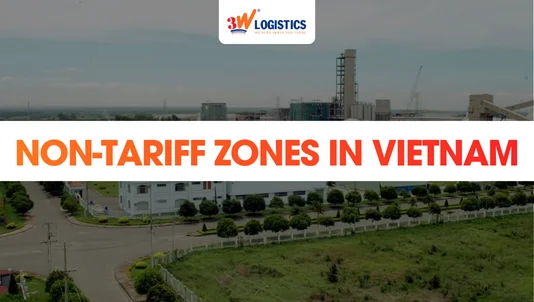
Non-Tariff Zones in Vietnam: Definition, Rules & Tax Policy
Non-Tariff Zones are economic zones with clearly defined geographical boundaries located within Vietnamese territory, separated from the outside area by a hard fence, and subject to inspection and supervision by customs authorities. Buying and selling transactions between a non-tariff zone and the outside are considered export and import relations.
Many businesses often confuse non-tariff zones with export processing zones or bonded warehouses, and are unclear about who is permitted to operate there or which tax policies apply. The article below presents the full definition, characteristics, eligible entities, tax policies, and current legal basis for non-tariff zones in Vietnam.
1. What Is a Non-Tariff Zone?
According to Clause 1, Article 4 of the Law on Export and Import Duties No. 107/2016/QH13, a non-tariff zone is an economic zone located within Vietnamese territory, established in accordance with the law, with clearly defined geographical boundaries, separated from the outside area by a hard fence, ensuring conditions for the inspection, supervision, and control by customs authorities and relevant agencies over exported and imported goods as well as vehicles and passengers entering or exiting the country. Buying and selling transactions between a non-tariff zone and the outside are considered export and import relations.
Practical example: A domestic business sells raw materials to an export processing enterprise located within a non-tariff zone. Legally speaking, this transaction is treated as an export (from the domestic seller’s perspective), even though the goods remain within Vietnamese territory, and the selling business may be eligible for a 0% VAT rate, just like a standard export, if it meets the required conditions.
2. Characteristics of Non-Tariff Zones
Non-tariff zones are notably characterized by a clear physical separation from the domestic area via a hard fence, strict customs supervision, and the treatment of transactions with the outside area as import-export activities.
- Clearly defined geographical boundaries: equipped with a hard fence, gates, and entry/exit points, ensuring conditions for customs control.
- Subject to customs supervision: customs authorities monitor and inspect goods and vehicles entering and leaving the zone.
- Trade with the outside is treated as import-export: even though the goods remain within Vietnamese territory, transactions with a non-tariff zone are subject to the same tax policies as international transactions.
- Includes various types of zones: a non-tariff zone may include export processing zones, export processing enterprises, bonded warehouses, tax-suspension zones, special economic-trade zones, and other economic areas established by decision of the Prime Minister.
3. Entities Permitted to Operate in Non-Tariff Zones
According to Article 5 of the Regulation on the Operation of Non-Tariff Zones within Economic Zones and Border-Gate Economic Zones, issued together with Decision No. 100/2009/QD-TTg, the following entities are permitted to operate in non-tariff zones:
- Vietnamese traders: domestic enterprises engaged in manufacturing, processing, exporting, or providing services.
- Branches and representative offices of Vietnamese traders: supporting trade transactions or market research.
- Branches of foreign traders: permitted to be established in non-tariff zones in accordance with investment law.
- Legitimate investors: domestic and foreign organizations and individuals that meet the investment conditions prescribed by law.
4. Activities Permitted in Non-Tariff Zones
According to Article 30 of Decree No. 35/2022/ND-CP, the following commercial, investment, manufacturing, business, and service activities are permitted within the non-tariff zones of an economic zone:
- Temporary import for re-export or temporary export for re-import, transit, transshipment, and cross-border transfer of goods.
- Manufacturing, processing, recycling, assembling, sorting, and packaging of exported and imported goods.
- Logistics services and other services related to import-export activities.
- Trading of other goods and services in accordance with the law, complying with regulations on prohibited, restricted, and conditional goods and services.
Note: Entities operating in a non-tariff zone are permitted to export and import goods, except for goods on the List of Goods Banned from Export, Banned from Import, or Subject to Temporary Suspension of Export or Import under Vietnamese law. Goods requiring an export/import license, goods subject to conditional import/export, and goods with restricted trading status must still comply fully with applicable regulations.
5. Tax Policy for Goods Entering and Leaving Non-Tariff Zones
Import and export duties on goods related to non-tariff zones are determined based on two scenarios: dutiable and non-dutiable.
| Scenario | Applies to |
|---|---|
| Subject to export/import duty | Goods exported from the domestic market into a non-tariff zone; goods imported from a non-tariff zone into the domestic market |
| Not subject to export/import duty | Goods imported from abroad into a non-tariff zone and used only within that zone; goods transferred from one non-tariff zone to another |
6. List of Some Non-Tariff Zones in Vietnam
Non-tariff zones in Vietnam are typically associated with economic zones and border-gate economic zones established by decision of the Prime Minister, located in various provinces with favorable positions for international trade.
- Chu Lai Open Economic Zone (Quang Nam)
- Dung Quat Economic Zone (Quang Ngai)
- Nghi Son Economic Zone (Thanh Hoa)
- Border-gate economic zones in several border provinces (e.g., Lao Bao and Moc Bai border-gate economic zones)
- Export processing enterprises and export processing zones established within industrial parks under separate regulations
Note: The list and specific boundaries of each non-tariff zone may change according to the establishment, expansion, or adjustment decisions of the Prime Minister over time. Businesses should check the specific establishment decision for each economic zone to confirm exact details.
7. How Do Non-Tariff Zones Differ from Export Processing Zones?
A non-tariff zone is a broad concept — an economic zone or special geographical area established by decision of the Prime Minister — whereas an export processing zone is a specific type of zone located within an industrial park, dedicated to enterprises manufacturing goods for export, and which is also governed under non-tariff zone regulations.
| Criteria | Non-Tariff Zone | Export Processing Zone |
|---|---|---|
| Nature | A broad concept of a special economic area subject to import-export tax policy | A specific type of specialized industrial zone for manufacturing export goods |
| Relationship | Encompasses various types of zones, including export processing zones | A specific form governed under non-tariff zone regulations |
| Eligible entities | Diverse: trade, services, manufacturing, logistics | Mainly manufacturing and processing enterprises producing export goods |
| Location of establishment | Economic zones, border-gate economic zones, or separate designated areas | Usually located within an industrial park |
8. How Do Non-Tariff Zones Differ from Bonded Warehouses?
A non-tariff zone is an economic area with diverse commercial, manufacturing, and service activities, whereas a bonded warehouse is simply a type of warehouse or storage yard used to hold goods pending export, import, or re-export — two fundamentally different concepts, even though both relate to special tax policies.
| Criteria | Non-Tariff Zone | Bonded Warehouse |
|---|---|---|
| Nature | A special economic area that may include manufacturing, trading, and services | A pure storage facility for goods, with no manufacturing |
| Scope of activity | Manufacturing, processing, trade, logistics, services | Storage of goods, along with some simple services (packaging, labeling) |
| Duration | No time limit on operation (a long-term, stable economic zone) | Limited storage period (up to 12 months, extendable by up to another 12 months) |
| Legal basis | Law on Export-Import Duties No. 107/2016/QH13, Decision No. 100/2009/QD-TTg, Decree No. 35/2022/ND-CP | Articles 61-63 of the 2014 Customs Law, Articles 82-91 of Decree No. 08/2015/ND-CP |
Note: A bonded warehouse may be located entirely within a non-tariff zone, but the non-tariff zone itself has a much broader scope and range of activities than a single bonded warehouse.
9. Practical Example of a Non-Tariff Zone
An export processing enterprise located in a non-tariff zone within the Chu Lai Economic Zone imports machinery and equipment from abroad for use in production without paying import duty, because the goods are used only within the non-tariff zone. When this enterprise sells finished products to a domestic distribution company in Vietnam, the transaction is treated as an import, and the distribution company must pay the corresponding import duty as prescribed.
10. Advantages and Challenges of Operating in a Non-Tariff Zone
Non-tariff zones offer businesses significant tax and procedural advantages, but also require strict compliance with boundary and customs supervision regulations.
Advantages:
- Exemption from import duty on goods brought in from abroad for use within the non-tariff zone.
- Businesses selling goods into a non-tariff zone may be eligible for a 0% VAT rate, similar to exported goods, if conditions are met.
- Favorable for manufacturing and processing of export goods, thanks to preferential tax policies.
Challenges:
- Must strictly comply with geographical boundary requirements, hard fencing, and continuous customs supervision.
- Customs procedures are more complex than ordinary domestic transactions, since the export/import nature of each transaction must be correctly determined.
- Easily confused with related concepts (export processing zones, bonded warehouses) if the business is not clear on the regulations.
11. Common Mistakes Businesses Make When Trading with Non-Tariff Zones
The most common mistake when trading with non-tariff zones is misidentifying the nature of the transaction (not treating it as an export/import), lacking documentation proving the goods’ use within the zone, or applying the wrong tax policy.
| Common Mistake | Consequence | How to Fix It |
|---|---|---|
| Not treating a transaction with a non-tariff zone as an export/import | Incorrect declaration of transaction type, possibly resulting in back taxes | Correctly determine the export/import nature of the transaction from the outset |
| Lack of documentation proving goods are used within the zone | Ineligibility for the tax exemption, resulting in import duty being assessed | Maintain complete records and documentation proving the intended use of the goods |
| Confusing a non-tariff zone with an export processing zone/bonded warehouse | Incorrect application of regulations, procedures not matching the actual zone type | Clearly identify the specific type of zone involved before declaring |
| Trading in prohibited/restricted goods without proper authorization | Administrative penalties for customs violations | Check the list of prohibited and restricted goods before trading |
Practical example: A domestic business sold raw materials to an export processing enterprise in a non-tariff zone but declared the transaction as an ordinary domestic sale. As a result, the tax authority required the company to make corrections and pay back the resulting VAT difference.
12. Legal Regulations on Non-Tariff Zones
Non-tariff zones in Vietnam are currently governed directly by the Law on Export and Import Duties No. 107/2016/QH13, Decision No. 100/2009/QD-TTg, Decree No. 35/2022/ND-CP, and related guiding documents.
- Law on Export and Import Duties No. 107/2016/QH13 — Clause 1, Article 4 defines non-tariff zones.
- Decision No. 100/2009/QD-TTg — Article 2 provides definitions; Article 5 sets out the entities permitted to operate in non-tariff zones.
- Decree No. 35/2022/ND-CP — Article 30 sets out permitted commercial, investment, manufacturing, business, and service activities in the non-tariff zones of economic zones.
- Decree No. 08/2015/ND-CP, Circular No. 38/2015/TT-BTC (as amended by Circular No. 39/2018/TT-BTC) — guidance on customs procedures for goods entering and leaving non-tariff zones.
13. Frequently Asked Questions About Non-Tariff Zones (FAQ)
Is a non-tariff zone a separate country?
No. A non-tariff zone remains within Vietnamese territory; it is simply subject to a special tax policy treating goods entering and leaving the zone as if they were part of an international transaction.
Can an individual business operate in a non-tariff zone?
Yes, if it is a Vietnamese trader, a branch, a representative office, or a legitimate investor that meets the conditions set out in Article 5 of Decision No. 100/2009/QD-TTg.
Is selling goods into a non-tariff zone eligible for a 0% VAT rate?
It may be, if the transaction meets the conditions to be treated as an export under VAT regulations, similar to goods exported abroad.
Is an export processing zone the same as a non-tariff zone?
An export processing zone is a specific type of zone governed under non-tariff zone regulations, but a non-tariff zone is a broader concept that includes various other types of zones besides export processing zones.
What goods cannot be brought into a non-tariff zone?
Goods on the list of items banned from export, banned from import, or subject to temporary suspension of export or import under Vietnamese law cannot be brought into a non-tariff zone.
Can a bonded warehouse be located within a non-tariff zone?
Yes. A bonded warehouse can be located entirely within a non-tariff zone, but the two are different in nature and scope of operation.
Is duty payable on goods transferred between two non-tariff zones?
No. Under current regulations, goods transferred from one non-tariff zone to another are not subject to export or import duty.
What should businesses keep in mind when trading with a non-tariff zone?
Businesses should correctly determine whether a transaction is an export or import, maintain complete documentation proving the intended use of the goods, and clearly distinguish non-tariff zones from related concepts such as export processing zones and bonded warehouses.
3W Logistics – Supporting Businesses in Trading with Non-Tariff Zones
Trading goods with a non-tariff zone requires businesses to correctly understand the legal nature and applicable tax policy involved. 3W Logistics accompanies businesses in handling customs procedures and documentation related to non-tariff zones accurately and in full compliance with regulations.
- In-depth knowledge of non-tariff zone regulations: a clear understanding of the tax policies and customs procedures applicable to each type of transaction with a non-tariff zone.
- Advice on identifying the appropriate zone type: helping businesses determine whether a non-tariff zone, export processing zone, or bonded warehouse best fits their needs.
- Accurate documentation handling and declaration: minimizing the risk of back-tax assessments due to misdeclaring the nature of a transaction.
Businesses seeking advice on non-tariff zones and related import-export procedures are welcome to contact 3W Logistics for support.
CONTACT INFORMATION:
Head Office – 3W Logistics Ho Chi Minh City Branch
Address: 34 Bach Dang, Tan Son Hoa Ward, Ho Chi Minh City
Hotline: +84 28 3535 0087
3W Logistics Hanoi Branch
Address: 81A Tran Quoc Toan, Cua Nam Ward, Hanoi
Hotline: +84 24 3202 0482
3W Logistics Hai Phong Branch
Address: 8A Lot 28 Le Hong Phong, Gia Vien Ward, Hai Phong
Hotline: +84 225 355 5939
3W LOGISTICS CO., LTD – We here serve you there!
Email: info@3w-logistics.com
Website: www.3w-logistics.com

Hello, I’m Nguyen Phuong Nhan (Ms. Nina)
I currently serve as Trade Lanes Supervisor at 3W Logistics, with more than 10 years of experience in international logistics and freight forwarding.
My primary responsibility is developing and managing global logistics partnerships, building strategic trade lanes, and working closely with overseas agents to provide reliable and competitive transportation solutions for customers.
I regularly collaborate with agents and logistics partners worldwide to explore new business opportunities, negotiate freight rates, develop trade routes, and support import-export shipments. I also work closely with our sales team to design logistics solutions tailored to specific markets and customer requirements.
My expertise includes Ocean Freight, Air Freight, Trade Lane Development, Global Agent Network Management, International Logistics Solutions, and Import-Export Support.
Through the articles I share on the 3W Logistics website, I aim to provide practical insights into the international logistics industry, global transportation trends, overseas agent cooperation, and effective logistics strategies that help businesses optimize their supply chain operations.
I believe that strong global partnerships and well-developed trade lanes are essential to delivering sustainable logistics solutions and long-term value to customers worldwide.


