
Importing motorcycle parts is a recurring need for import businesses, parts distributors, warranty centers, and repair shops in Vietnam – especially as consumers increasingly favor genuine parts from Japan, Taiwan, China, and European countries.
However, motorcycle parts import procedures are considerably more complex than most businesses initially expect, because a significant portion of motorcycle parts are subject to mandatory quality inspection at the port of entry, while also carrying relatively high MFN import duties without a valid FTA C/O.
Many businesses only begin researching motorcycle parts import procedures after cargo has already arrived at port – only to discover that the product falls under specialized inspection by the Vietnam Register, that quality certification is missing, or that the HS code was incorrectly declared, resulting in cargo being held and extended container storage costs.
In this article, 3W Logistics presents the complete motorcycle parts import procedure process under current regulations – from parts classification, quality inspection requirements, required documents, HS codes, and tax calculations to the most common real-world risks, as seen from a freight forwarder with over 10 years of experience handling automotive and motorcycle parts imports.
1. Are Imported Motorcycle Parts Subject to Quality Inspection?
This is the central question when carrying out motorcycle parts import procedures. The answer depends on the specific part – certain part groups directly related to vehicle safety are subject to mandatory quality inspection under regulations of the Ministry of Transport and the Vietnam Register.
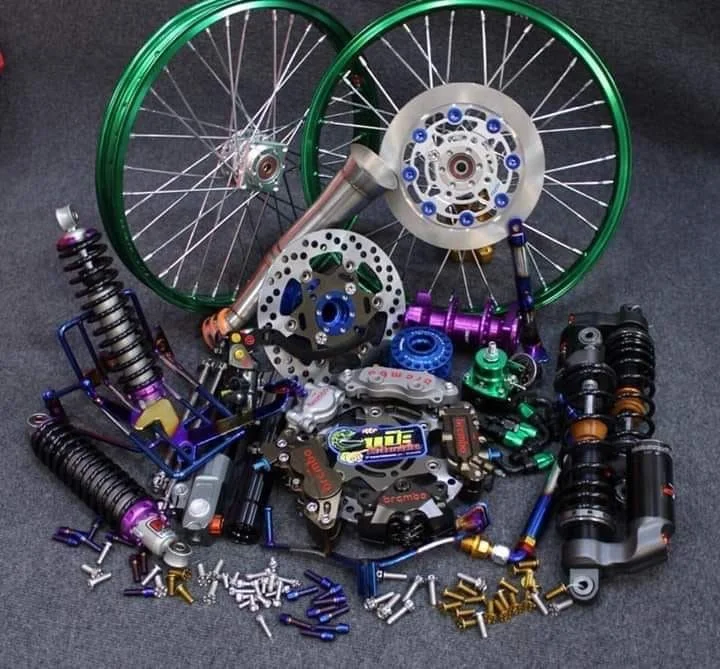
Under Circular 31/2011/TT-BGTVT (and its amendments), motorcycle part groups related to safety must undergo state quality inspection at the port of entry before customs clearance. Specifically:
| Parts Group | Product Examples | Inspection Requirements |
|---|---|---|
| Brake system parts | Brake pads, brake discs, brake linings, brake cylinders, brake cables, ABS brakes… | Mandatory quality inspection at the port of entry conducted by the Vietnam Register – parts directly related to braking safety |
| Motorcycle tires and inner tubes | Tubeless tires, tube-type tires, standard motorcycle tires, scooter tires, off-road tires… | Mandatory quality inspection – tires are the most critical safety component; certification per QCVN 34 or an equivalent standard is required |
| Motorcycle helmets | Full-face helmets, 3/4 helmets, half helmets, children’s helmets… | Mandatory conformity certification per QCVN 2:2008/BKHCN – the CR mark must be present before market distribution; inspection conducted by the Vietnam Register or a designated body |
| Lighting system parts | Headlights, taillights, turn signal lights, replacement bulbs… | Quality inspection – vehicle lighting equipment must meet ECE standards or an equivalent TCVN |
| Standard mechanical parts | Chains, sprockets, gear sets, handlebars, seats, mirrors, screws, decals… | Not subject to mandatory specialized inspection – processed as standard commercial goods under motorcycle parts import procedures |
| Engine and drivetrain parts | Pistons, cylinders, crankshafts, transmissions, clutches, oil filters, spark plugs… | Varies by specific part – confirmation with the Vietnam Register or an experienced forwarder is needed before importing |
Practical note: The boundary between “safety parts requiring specialized inspection” and “standard parts” can sometimes be unclear for newer products on the market. In motorcycle parts import procedures, businesses should confirm directly with the Vietnam Register or consult an experienced forwarder before ordering – avoiding the situation where cargo arrives at port only to discover it requires specialized inspection with no documentation prepared.
2. HS Codes and Import Duties for Motorcycle Parts
Correctly identifying the HS code is the most important step and also the one most prone to error – in the motorcycle parts import procedure. Motorcycle parts are scattered across many chapters of the import-export tariff schedule, primarily Chapter 87 (motor vehicle parts), but many mechanical, electrical, and rubber components fall under Chapters 40, 73, 84, and 85.
| Motorcycle Part | Reference HS Code | Reference MFN Duty |
|---|---|---|
| Motorcycle parts and components (general group) | 8714.10 / 8714.91 / 8714.99 | 15–30% |
| Motorcycle tires (new) | 4011.40.00 | 25–30% |
| Brake pad / brake lining | 6813.81.00 / 6813.89.00 | 20–25% |
| Motorcycle drive chain | 7315.11.00 / 7315.12.00 | 15–25% |
| Motorcycle sprocket | 8714.91.90 | 20–30% |
| Motorcycle battery | 8507.10.10 / 8507.20.10 | 20–30% |
| Spark plug | 8511.10.00 | 15–20% |
| Oil filter | 8421.23.00 | 15–20% |
| Motorcycle helmet | 6506.10.10 | 20–30% |
| Headlight, taillight | 8512.20.10 / 8512.20.90 | 20–30% |
Additionally, each part within the motorcycle parts category with a different classification and intended use will carry a different HS code – do not attempt to infer the HS code from the product name alone. Official lookup resources include:
- General Department of Vietnam Customs: customs.gov.vn – search by name or code number
- VNACCS/VCIS System: Look up directly when filing electronic declarations
- Commodity Classification Consultation: Businesses may submit a written request to the provincial/city Customs Department for HS code confirmation before shipment to avoid future disputes
- HS Code Lookup Tool: https://caselaw.vn/tra-cuu-ma-hs – search by name or code number
Important note on MFN duties for motorcycle parts: Motorcycle parts carry relatively high MFN duties of 15–30% – considerably higher than electronic components or raw materials. Since China and Taiwan are the largest suppliers of motorcycle parts to Vietnam, a C/O Form E under the ACFTA agreement can reduce import duty to 0–15%, creating a very significant cost difference. This is the single most important cost-saving document in motorcycle parts import procedures, yet many businesses overlook it.
Motorcycle Parts Import Duty Rates by Country of Origin
| Country of Origin | Applicable C/O | Import Duty | Notes |
|---|---|---|---|
| China | C/O Form E (ACFTA) | 0–15% | Largest source of aftermarket motorcycle parts; C/O Form E yields major savings compared to MFN rates of 20–30% |
| Japan | C/O Form JV (VJEPA) | 0–10% | Genuine OEM parts from Honda, Yamaha, and Suzuki sourced from Japan; phased reduction to 0% under VJEPA |
| Thailand, Indonesia (ASEAN) | C/O Form D (ATIGA) | 0–5% | Honda/Yamaha OEM parts manufacturing plants are located in Thailand and Indonesia; significant preferential rates under ATIGA |
| Taiwan | No bilateral FTA | 15–30% (MFN) | A major source of parts from Taiwan, but no FTA exists with Vietnam – full MFN duty applies; plus 10% VAT |
3. Required Documents for Motorcycle Parts Import Procedures
The documentation set for motorcycle parts import procedures consists of commercial documents prepared before cargo is loaded and specialized inspection documents (for safety parts). Absolute consistency across documents is a non-negotiable requirement – a small discrepancy between the part name on the Invoice and the quality certificate is enough for customs to hold the cargo for verification.
| Document | When to Prepare | Important Notes |
|---|---|---|
| Quality Certificate / Conformity Certificate (for safety parts) | Before cargo arrives at port | Mandatory for tires, brake pads, helmets, and other safety parts on the Ministry of Transport’s list – testing and certification typically takes 15–30 working days |
| Sales Contract | Before deposit payment | Must clearly state the part name, part number, compatible vehicle brand, applicable technical standard (OEM/aftermarket), Incoterms, and the C/O provision clause |
| Commercial Invoice | Before cargo departs origin | Must clearly state: part name, part number, brand, technical standard, and unit of measure – a generic description such as “motorcycle parts” provides insufficient information for HS code determination and specialized inspection |
| Packing List | Before cargo departs origin | Clearly state the quantity and weight of each part type for shipments with multiple different part types, a detailed Packing List by SKU helps customs classify more quickly |
| Bill of Lading / AWB | After cargo is loaded | The goods description on the B/L should specify the main part types – do not use generic terms like “goods” or “merchandise”; the consignee must exactly match the customs declaration |
| C/O (Certificate of Origin) | Before cargo departs origin (supplier to apply) | Especially important for parts from China due to high MFN duties; C/O Form E can save 15–20% on import duty – must be requested at the contract negotiation stage |
| Catalogue / Technical documentation | Before or at the same time cargo departs | Customs may request this to determine the correct HS code and for specialized inspection; genuine OEM parts require an authorization letter or original invoice from the manufacturer |
| Electronic customs declaration (VNACCS) | When full documentation is ready | Declare the correct HS code for each part group, including the quality certificate number (if applicable) – shipments with multiple part types may require multiple line items on the same declaration |
4. Step-by-Step Motorcycle Parts Import Procedure
Step 1: Classify Parts and Check Quality Control Requirements Before Ordering
Before signing a contract, the business must classify each part type in the shipment into two groups: safety parts subject to mandatory specialized inspection, and standard parts. At the same time, identify the correct HS code for each group based on material composition and function – not based on trade names or common nomenclature. This step determines the entire roadmap of the motorcycle parts import procedure.
Step 2: Send a Sample for Testing and Obtain Quality Certification (for Safety Parts)
For tires, brake pads, helmets, and other safety parts, the business sends a sample to Vietnam for testing at a body designated by the Vietnam Register or the Ministry of Science and Technology. Only after the sample passes and certification is issued should the business place the main order. Testing and certification typically takes 15–30 working days depending on the part type.
Step 3: Sign the Contract and Request the C/O from the Supplier
After obtaining quality certification (or confirming that the part is not subject to mandatory requirements), the business signs the formal contract and includes the C/O requirement under the applicable FTA directly in the contract terms. For parts from China, C/O Form E is the top priority given the significant duty savings. The part name, part number, and technical standard must be clearly stated in the contract to prevent the supplier from delivering goods with specifications different from the certified sample.
Step 4: Shipping and Appropriate Packaging
Motorcycle parts are typically shipped by sea as FCL or LCL depending on volume. For mixed shipments with multiple part types, require the supplier to package each SKU clearly and label part numbers on the outside of carton boxes for easy counting during customs physical inspection. Tires and rubber parts must be packed to avoid contact with oils, grease, and corrosive chemicals.
Step 5: Customs Declaration and Specialized Inspection at the Port of Entry
When cargo arrives at port, the forwarder files the VNACCS declaration with the correct HS code for each part group. Shipments containing safety parts are always assigned yellow or red channel – the quality inspection authority (the Vietnam Register or a delegated body) takes samples for comparison against issued certifications. Shipments containing only standard mechanical parts may be assigned green channel if documentation is complete and the business has a good compliance history.
Step 6: Customs Clearance, Tax Payment, and Warehousing
After specialized inspection passes, customs confirms the tax obligations. The business pays import duty and 10% VAT, collects the D/O, and transports parts to the warehouse. An important note: motorcycle parts bearing trademark brands (Honda, Yamaha, Suzuki, etc.) require documentation proving legitimate origin to avoid being treated as counterfeit goods after entering circulation.
5. How to Calculate Motorcycle Parts Import Taxes
A practical example: a shipment of motorcycle tires imported from China, CIF value USD 20,000, HS code 4011.40.00, MFN duty 30%, ACFTA duty 15%:
| Tax Item | Without C/O Form E (MFN 30%) | With C/O Form E (ACFTA 15%) |
|---|---|---|
| CIF Value | USD 20,000 | USD 20,000 |
| Import duty | 30% × 20,000 = USD 6,000 | 15% × 20,000 = USD 3,000 |
| VAT (10%) | 10% × (20,000 + 6,000) = USD 2,600 | 10% × (20,000 + 3,000) = USD 2,300 |
| Total tax payable | USD 8,600 (~VND 219 million) | USD 5,300 (~VND 135 million) |
| Savings with C/O Form E | USD 3,300 (~VND 84 million) – more than 38% of total taxes payable, from a single C/O obtained free of charge from the Chinese supplier. | |
From 3W Logistics’ practical experience: Motorcycle parts are the commodity group where we most frequently see two problems occurring together: importers place large orders covering both tires and brake pads without preparing quality certification in advance – cargo arrives at port and is held for 3–4 weeks awaiting testing, racking up significant container storage fees. At the same time, there is no C/O Form E from the Chinese supplier because it was never requested from the outset. With a 30% MFN duty on tires versus 15% under ACFTA, the duty difference on a USD 20,000 shipment exceeds USD 3,000 – an entirely avoidable figure if the process is set up correctly from the start. These two mistakes are independent but arise together in the same shipment more often than anything else we see among first-time motorcycle parts importers. – Ms. Apple, CCO, 3W Logistics
6. Common Risks in Motorcycle Parts Import Procedures
| Risk | How It Manifests | Prevention |
|---|---|---|
| Missing quality certification when cargo arrives at port | Tires and brake pads held at port – samples must be tested from the actual shipment; the 15–30 day wait results in very significant container storage fees | Send samples for testing and obtain certification before placing the main order; do not sign high-volume contracts without quality certification in hand |
| Incorrect HS code due to multiple part types | A shipment with multiple part types is declared under a single HS code – customs reclassifies, back-taxes the difference, and clearance time is extended | Declare separate HS codes for each part group; consult a forwarder or request an advance ruling for parts with unclear HS codes before filing |
| Counterfeit OEM-branded parts | Customs detects parts bearing Honda, Yamaha, etc. brands without authorization documentation – shipment is detained for counterfeit investigation, a serious intellectual property violation | Only import OEM parts from officially authorized distributors with complete authorization documentation; or import aftermarket parts without original brand marks |
| No C/O — paying high MFN duty | Must pay MFN duty of 25–30% instead of 0–15% under FTA – for parts from China and Taiwan (no FTA), the difference is especially large | Include the C/O Form E requirement directly in the contract terms; for goods from Taiwan, factor the MFN cost correctly into the import price during negotiations |
| Actual shipment differs from the certified sample | Supplier changes materials or specifications compared to the tested sample – quality certification no longer applies to the actual shipment | Specify technical specifications and materials in the contract; require the supplier to confirm in writing that specifications are unchanged from the certified sample before each shipment |
FAQ – Frequently Asked Questions About Motorcycle Parts Import Procedures
Question 1: What documents are required for motorcycle parts import procedures?
The complete documentation set for motorcycle parts import procedures includes: Quality Certificate (for safety parts such as tires, brake pads, helmets); Sales Contract, Commercial Invoice (clearly stating part numbers and technical specifications), Packing List; Bill of Lading or AWB; C/O under the applicable FTA; technical catalogue; trademark authorization documents (for genuine OEM parts); and an electronic customs declaration via VNACCS.
Question 2: Do imported motorcycle tires and brake pads require quality inspection?
Yes – mandatory. Motorcycle tires and brake pads are direct safety parts under the Ministry of Transport’s list and must undergo state quality inspection at the port of entry. Businesses must prepare quality certification before cargo arrives at port – it cannot be obtained after cargo has already arrived in the motorcycle parts import procedure.
Question 3: What is the import duty on motorcycle parts from China?
With a valid C/O Form E under the ACFTA agreement, the import duty on motorcycle parts from China is typically 0–15% depending on the HS code, compared to the MFN rate of 20–30%. In addition, 10% VAT applies, calculated on the CIF value plus import duty. This represents a significant difference for high-value parts shipments.
Question 4: Can genuine OEM motorcycle parts from Honda or Yamaha be imported?
Yes, but complete documentation proving legitimate origin is required – an invoice from a distributor authorized by Honda/Yamaha, an authorization letter, or an official distribution agreement. Importing OEM-branded parts without valid authorization documentation is treated as an intellectual property violation, and customs may detain the entire shipment for investigation.
Question 5: How long does the motorcycle parts import procedure take in total?
For standard parts with complete documentation, port clearance typically takes 3–7 working days. For safety parts requiring specialized inspection, add 7–15 days for sampling and results. If the business has already prepared quality certification in advance, the inspection time is significantly shortened. Total time from sending samples for testing to cargo arriving at the warehouse is typically 35–60 days.
How Does 3W Logistics Support Motorcycle Parts Import Procedures?
As a freight forwarding company registered as an OTI-NVOCC with an FMC Bond (Federal Maritime Commission) in the United States and with over 10 years of experience handling automotive and motorcycle parts imports, 3W Logistics provides end-to-end services for businesses navigating motorcycle parts import procedures – from pre-order classification and specialized inspection consulting through to parts arriving at the distribution warehouse.
- Parts classification consulting and specialized inspection check before ordering: Determine whether each part type is subject to mandatory inspection; identify the correct HS code; calculate actual tax costs by country of origin and applicable FTA – giving businesses complete figures before price negotiations with suppliers.
- Sample testing coordination and quality certification tracking: Connect with testing bodies designated by the Vietnam Register or the Ministry of Science and Technology; track progress to ensure certification is in place before the main shipment arrives at port.
- Assistance obtaining the correct FTA C/O from the supplier: Guide Chinese suppliers through the correct C/O Form E process, Japanese suppliers through Form JV, and ASEAN suppliers through Form D; verify the C/O before acceptance to ensure 100% consistency with the Invoice and B/L.
- Vessel booking and shipping from major motorcycle parts markets: Arrange FCL or LCL from China, Japan, Taiwan, Thailand, Indonesia, and other markets to the ports of Hai Phong, Da Nang, and Cat Lai Ho Chi Minh City.
- Electronic customs declaration (VNACCS) by HS code: Declare the correct separate HS code for each part group; monitor channel assignment and coordinate rapid response when the quality inspection authority takes samples or requests supplementary documentation at the port of entry.
- Assistance resolving intellectual property issues with genuine OEM parts: Advise on preparing complete trademark authorization documentation; assist in resolving cases where customs requests origin verification for parts bearing well-known brands.
Why choose 3W Logistics for your motorcycle parts import shipments? Motorcycle parts import procedures require handling multiple layers of issues simultaneously — specialized inspection for safety parts, multiple HS code declarations within a single shipment, and duty optimization through FTA C/Os. A mixed shipment with many part types can easily overwhelm an inexperienced forwarder across all of these layers at once. We work alongside businesses from the parts classification stage before ordering through to cargo clearing customs and arriving at the warehouse – helping businesses avoid the most costly mistakes. Contact 3W for specific consultation before signing your parts purchase contract.
Address: 34 Bach Dang Street, Tan Son Hoa Ward, Ho Chi Minh City
Hotline: +84 28 3535 0087
____________________________
3W Logistics Hanoi Branch
Address: 81A Tran Quoc Toan Street, Cua Nam Ward, Hanoi
Hotline: +84 24 3202 0482
____________________________
3W Logistics Hai Phong Branch
Address: 8A Lot 28 Le Hong Phong Street, Gia Vien Ward, Hai Phong
Hotline: +84 225 355 5939
____________________________
3W LOGISTICS CO., LTD – We here serve you there!
Email: quote@3w-logistics.com
Website: www.3w-logistics.com

Ms. Apple is the CCO (Chief Commercial Officer) at 3W Logistics, with over 10 years of experience in sales and business operations management.
At 3W Logistics, Ms. Apple is responsible for commercial strategy, corporate customer development, managing a team of more than 50 sales professionals, and improving business performance in the logistics sector.
With practical experience in sales management and market development, Ms. Apple shares professional insights on business logistics solutions, international transportation, freight forwarding, customer management, trade lane development, and growth strategies in the logistics industry.


