
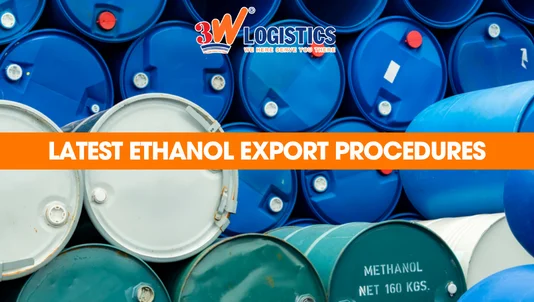
Ethanol export procedures in Vietnam are highly specialized, since ethanol (chemical formula C2H5OH) is both a flammable, explosive chemical subject to management under the Chemicals Law and a raw material widely used in healthcare, cosmetics, food, and industry.
This diversity of use is precisely why businesses need to clearly identify which type of ethanol they are exporting — industrial ethanol, medical-grade ethanol, or food-grade ethanol — in order to apply the correct documentation package and management regulations.
Unlike many other products, ethanol export procedures require businesses to complete chemical declaration obligations with the Chemicals Agency (Ministry of Industry and Trade) and comply with dangerous goods transport regulations due to ethanol’s flammable and explosive nature. The article below compiles the full legal basis, conditions, HS codes, procedures, costs, and common risks involved in ethanol export procedures, updated according to the latest applicable regulations.
1. Characteristics and common types of ethanol exported by Vietnam
Ethanol is produced in Vietnam from various raw materials such as cassava, sugarcane, and grains, serving diverse purposes: industrial ethanol used as a solvent and chemical raw material; medical-grade ethanol used for disinfection and sterilization; and food-grade ethanol used in producing alcoholic beverages, flavorings, and cosmetics. Each product group has its own management requirements, directly affecting the ethanol export procedure a business needs to follow.
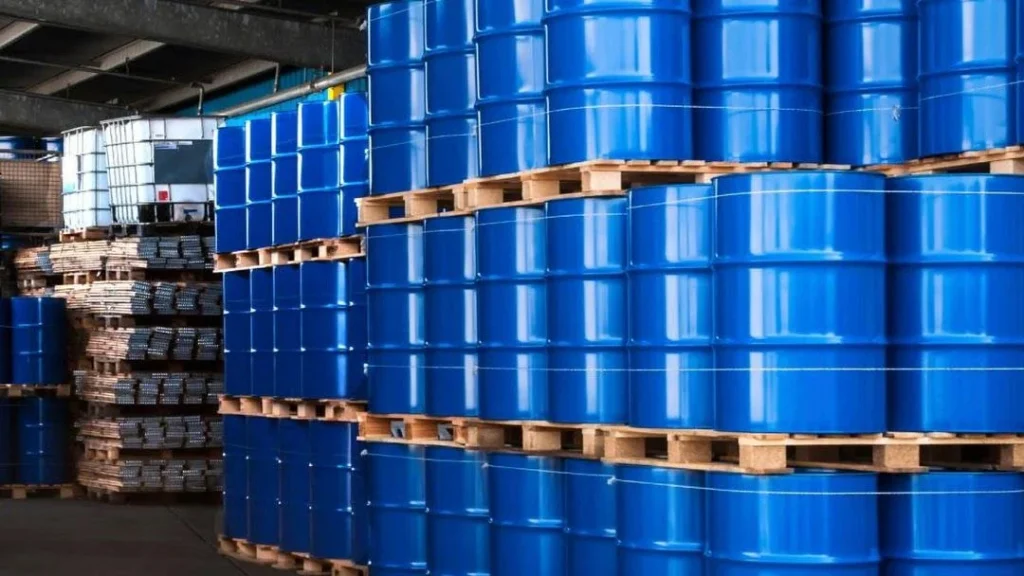
As a flammable and explosive chemical, ethanol is not only subject to chemical declaration management but must also strictly comply with packing, labeling, and dangerous goods transport regulations throughout the export process, particularly when shipped by international sea or air freight.
2. Legal basis governing ethanol export procedures
| Legal document | Content regulated |
|---|---|
| Chemicals Law 2007 | General regulations on chemical management, under which high-concentration industrial/medical ethanol is a regulated substance |
| Decree 113/2017/ND-CP | Provides guidance for implementing the Chemicals Law, regulating chemical declaration and the Material Safety Data Sheet (MSDS) |
| Decree 42/2020/ND-CP | Regulates dangerous goods transport, applicable to ethanol under the flammable liquids category (Class 3) |
| Decree 105/2017/ND-CP, amended by Decree 17/2020/ND-CP | Regulates the liquor trading business, applicable when food-grade ethanol is used as a raw material for blending alcoholic beverages |
| Circular 38/2015/TT-BTC, amended by Circular 39/2018/TT-BTC | Customs procedures and supervision for exported goods |
This is the fundamental legal framework that businesses need to understand clearly in order to correctly carry out ethanol export procedures, avoiding complications with chemical declaration obligations and dangerous goods transport regulations.
3. Conditions for businesses exporting ethanol
| Condition | Issuing/managing authority | Note |
|---|---|---|
| Chemical declaration | Chemicals Agency, Ministry of Industry and Trade | Carried out via the National Single Window Portal before the first export shipment |
| Material Safety Data Sheet (MSDS/SDS) | Self-prepared by the business according to the prescribed template | Mandatory to accompany the shipment; many importing countries require a bilingual version |
| Dangerous goods transport permit | Relevant specialized authority depending on the mode of transport | Applicable to high-concentration ethanol under the flammable liquids category (Class 3) when transported domestically to the port/airport |
| Product self-declaration (for food-grade ethanol) | Sub-Department of Food Safety and Hygiene | Applicable when ethanol is used as a food ingredient or in alcoholic beverages, under Decree 15/2018/ND-CP |
4. HS codes and export duties for ethanol
Ethanol falls under Chapter 22 — “Beverages, spirits and vinegar” — heading 22.07, “Undenatured ethyl alcohol of an alcoholic strength by volume of 80% vol. or higher; ethyl alcohol and other spirits, denatured, of any strength.” Correctly determining the HS code based on whether the ethanol is denatured or undenatured is an important step in ethanol export procedures.
| Product type | HS code (Vietnam) | Vietnam export duty | Note |
|---|---|---|---|
| Undenatured ethyl alcohol, 80% strength or higher | 2207.10 | 0% | Applies to medical-grade ethanol, food-grade ethanol, and ethanol used in cosmetics production |
| Denatured ethyl alcohol, any strength | 2207.20 | 0% | Common for industrial ethanol, solvents, and biofuel |
| Ethyl alcohol and other spirits, under 80% strength | 2208.90 | 0% | Additional alcoholic beverage regulations may apply if used directly as liquor |
Practical note: Export duty on ethanol in Vietnam is currently 0% for HS codes under heading 2207. Businesses need to pay particular attention to distinguishing between undenatured and denatured ethanol, as these are two product groups with entirely different intended uses, import duty rates in the destination country, and control requirements — high-concentration undenatured ethanol in particular tends to be more strictly controlled by importing countries, since it can be used to produce alcoholic beverages.
5. Documentation package for ethanol export procedures
| Document | When to prepare | Important note |
|---|---|---|
| Chemical declaration form | Before the first export shipment | Carried out via the National Single Window Portal, linked to the Chemicals Agency |
| Material Safety Data Sheet (MSDS) | Before packing the shipment | Must accompany the shipment; recommended to prepare a Vietnamese-English bilingual version |
| Sales Contract | Before manufacturing and packing | Must clearly state Incoterms, alcohol concentration, and packing specifications (drums, ISO tanks) |
| Commercial Invoice and Packing List | Before customs declaration | Value must match the contract and the bill of lading |
| Certificate of Origin (C/O) | After the export declaration is issued | Required to enjoy preferential tariffs under the relevant FTA for the destination market |
| Export customs declaration (VNACCS) | Before customs clearance | Declare the correct HS code for denatured/undenatured ethanol, attaching the MSDS |
6. Ethanol export procedure steps
Step 1: Determine the ethanol type and the appropriate HS code
The business clearly determines whether the product is industrial, medical-grade, or food-grade ethanol, cross-checking concentration and denaturation status to select the correct HS code — this is the foundational first step in ethanol export procedures.
Step 2: Carry out chemical declaration
The business declares the chemical via the National Single Window Portal, linked directly to the Chemicals Agency (Ministry of Industry and Trade), before proceeding with subsequent steps.
Step 3: Prepare the Material Safety Data Sheet (MSDS)
The business prepares an MSDS containing complete information on the properties, fire/explosion hazards, and incident response measures for ethanol, prepared bilingually to meet international requirements.
Step 4: Sign the contract and manufacture/pack according to the order
Agree with the importer on ethanol concentration and packing specifications (drums, ISO tanks, dedicated plastic jerrycans), then proceed with manufacturing and packing according to the agreed standards.
Step 5: Register for domestic dangerous goods transport
The business contacts a transport provider licensed for dangerous goods transport to move the ethanol shipment from the factory to the seaport or airport, ensuring compliance with Class 3 (flammable liquids) regulations.
Step 6: Complete the documentation package and declare customs export
The enterprise or its forwarder prepares the invoice and packing list, and declares the electronic customs declaration on the VNACCS system, attaching the MSDS, the chemical declaration form, and a C/O matching the FTA of the destination market.
Step 7: International transport and import clearance in the destination country
Once the declaration is cleared, the goods are handed over to a carrier with dangerous goods transport capability, by sea or air. The importer coordinates with the local customs authority to complete import procedures.
7. Common risks in ethanol export procedures
| Risk | Manifestation | Prevention |
|---|---|---|
| Missing chemical declaration before export | Goods held at customs, unable to clear on schedule | Complete the chemical declaration early, starting from the very first export shipment |
| No dangerous goods transport permit | Transport vehicle fined, delays in getting goods to the port/airport | Only work with transport providers holding a valid dangerous goods transport license |
| Incorrect HS code between denatured and undenatured ethanol | Retroactive tax collection, delayed customs clearance, need to amend the declaration | Carefully cross-check the HS code with a customs unit experienced in chemical cargo |
| Leakage or fire/explosion during transport | Cargo damage, safety impact, possible rejection of the shipment | Use specialized UN-certified packaging and comply with dangerous goods packing regulations |
8. FAQ – Frequently asked questions about ethanol export procedures
Question 1: Does exporting ethanol require a special license?
Ethanol is not on the list of goods prohibited from export; however, businesses must complete chemical declaration with the Chemicals Agency and comply with dangerous goods transport regulations before carrying out ethanol export procedures.
Question 2: What is the current export duty on ethanol in Vietnam?
All types of ethanol (HS codes under heading 2207) enjoy a 0% export duty rate in Vietnam.
Question 3: Why is it necessary to distinguish between denatured and undenatured ethanol when exporting?
Because these are two product groups with different intended uses and levels of control in the importing country — high-concentration undenatured ethanol tends to be more strictly controlled due to its potential use in alcoholic beverages, while denatured ethanol is mainly used as an industrial solvent.
Question 4: What is the MSDS used for in ethanol export procedures?
The MSDS (Material Safety Data Sheet) provides information on the hazardous properties, preventive measures, and incident response for ethanol; it is a mandatory document accompanying the shipment to ensure safety throughout transport and to help customs and transport providers understand the cargo’s characteristics.
How does 3W Logistics support ethanol export procedures?
As a freight forwarding company registered as an OTI-NVOCC with an FMC bond in the United States, holding an SCAC Code to self-file AMS/ISF declarations directly, 3W Logistics supports businesses through the entire ethanol export procedure — from chemical declaration advisory and MSDS preparation through to customs clearance in the importing country.
Full-package logistics service at 3W Logistics:
- Accurate HS code advisory and ethanol classification: Helping businesses distinguish between industrial, medical, and food-grade ethanol to prepare the correct documentation from the start.
- Support with chemical declaration and MSDS preparation: Guiding the declaration process via the National Single Window Portal, and preparing a standard-compliant bilingual MSDS.
- Connecting with dangerous goods transport providers: Ensuring the ethanol shipment is transported safely, in compliance with Class 3 regulations, from the factory to the port or airport.
- Booking vessels and dangerous goods transport: Arranging internationally compliant sea or air transport for flammable cargo.
- Electronic customs declaration (VNACCS): A professional team handles declarations; as an OTI-NVOCC with FMC and an SCAC Code, 3W Logistics directly issues its own HBL and self-files AMS/ISF for shipments bound for the U.S.
Why choose 3W Logistics: With offices in Ho Chi Minh City, Hanoi, and Hai Phong, and a team knowledgeable in chemical and dangerous goods regulations, 3W Logistics ensures ethanol shipments clear customs on time and to standard, with safe transport right from the very first export. – Ms. Apple, CCO of 3W Logistics
Head Office – 3W Logistics Ho Chi Minh City Branch
Address: 34 Bach Dang, Tan Son Hoa Ward, Ho Chi Minh City
Hotline: +84 28 3535 0087
____________________________
3W Logistics Hanoi Branch
Address: 81A Tran Quoc Toan, Cua Nam Ward, Hanoi
Hotline: +84 24 3202 0482
____________________________
3W Logistics Hai Phong Branch
Address: 8A Lot 28 Le Hong Phong, Gia Vien Ward, Hai Phong
Hotline: +84 225 355 5939
____________________________
3W LOGISTICS CO., LTD – We here serve you there!
Email: info@3w-logistics.com
Website: www.3w-logistics.com

Ms. Apple is the CCO (Chief Commercial Officer) at 3W Logistics, with over 10 years of experience in sales and business operations management.
At 3W Logistics, Ms. Apple is responsible for commercial strategy, corporate customer development, managing a team of more than 50 sales professionals, and improving business performance in the logistics sector.
With practical experience in sales management and market development, Ms. Apple shares professional insights on business logistics solutions, international transportation, freight forwarding, customer management, trade lane development, and growth strategies in the logistics industry.


