

Complete Built-Up (CBU) car imports represent one of the most complex conditional business sectors in Vietnam’s import-export operations. Businesses must not only prepare a full set of commercial documents but also meet a series of specific legal conditions – from a car import business license and technical safety quality certification to authorization documents from the foreign manufacturer.
In this article, 3W Logistics presents the complete CBU car import procedure under current regulations – from legal conditions, 8-digit HS codes, the calculation of three tax layers, documentation, step-by-step process, to real-world risks, from the perspective of a forwarder with over 10 years of experience handling imported automobile shipments.
1. Legal Conditions for Importing CBU Cars into Vietnam
This is the first and most important barrier in CBU car import procedures. Not every business is permitted to import CBU cars for commercial purposes; they must simultaneously meet the conditions under Decree 116/2017/ND-CP and the latest amending document, Decree 117/2026/ND-CP, effective from April 3, 2026.
| Condition | Details |
|---|---|
| Car Import Business License | The business must hold a Car Import Business License issued by the Ministry of Industry and Trade – this is a prerequisite condition; without this license, a business cannot open a commercial car import customs declaration |
| Warranty and Maintenance Facility | Must have, or have a contract with, a qualified car warranty and maintenance facility per Ministry of Transport regulations – proving the ability to provide after-sales service to consumers |
| Manufacturer’s Authorization Document | Must have an official authorization document from the foreign manufacturer (consularly legalized), including confirmation of recall rights and a commitment to supply replacement parts |
| Vehicle Quality Certificate | Vehicles must have a Technical Safety and Environmental Protection Quality Certificate issued by the Vietnam Register per Circular 03/2018/TT-BGTVT – inspection is conducted by shipment batch or by vehicle type |
| Vehicle Technical Standards | Imported vehicles must not have right-hand drive, except in special cases per regulation. Electric and hybrid vehicles have additional requirements for battery system and electrical safety inspection |
Practical note: The car import business license and the manufacturer’s authorization document are the two documents that many businesses new to the market overlook or prepare incorrectly. In CBU car import procedures, missing either of these two documents means the entire shipment cannot clear customs, even if all other paperwork is complete. Amended Decree 117/2026 provides that the business conditions of Decree 116 do not apply to organizations or individuals manufacturing/assembling cars for export – commercial imports must still fully meet all conditions.
2. HS Code and Import Tax for CBU Cars
Correctly determining the 8-digit HS code is the step with the greatest impact on tax cost in CBU car import procedures. CBU cars mainly fall under heading 8703 (vehicles for transporting fewer than 10 people) or heading 8702 (vehicles for transporting 10 or more people, including the driver). Within heading 8703, the 8-digit subheadings are further divided by engine type and cylinder capacity – two parameters that determine both the special consumption tax and import tax rates.
| Vehicle Type / Cylinder Capacity | Reference 8-Digit HS Code | Special Consumption Tax |
|---|---|---|
| Passenger car – gasoline engine, ≤ 1,000 cc | 8703.21.18 / 8703.21.28 | 35% |
| Passenger car – gasoline engine, > 1,000 cc to ≤ 1,500 cc | 8703.22.18 / 8703.22.28 | 40% |
| Passenger car – gasoline engine, > 1,500 cc to ≤ 2,000 cc | 8703.23.57 / 8703.23.63 | 40% |
| Passenger car – gasoline engine, > 2,000 cc to ≤ 3,000 cc | 8703.24.51 / 8703.24.59 | 50% |
| Passenger car – gasoline engine, > 3,000 cc | 8703.24.51 / 8703.24.59 | 60% |
| Battery electric vehicle (BEV) | 8703.80.11 / 8703.80.19 | 3% (preferential) |
| Hybrid vehicle (gasoline + electric) | 8703.40.11 / 8703.40.19 | 70% of the standard special consumption tax rate |
| Vehicles for 10 or more passengers (buses/coaches) | 8702.10.11 / 8702.90.11 | Not subject to special consumption tax (over 10 seats) |
Important note on CBU car HS codes: When declaring customs in CBU car import procedures, all technical specifications must be fully declared: model year, brand, engine capacity, number of doors, engine type (gasoline/diesel/electric/hybrid), and seating capacity. Under Decree 73/2025/ND-CP issued on March 31, 2025, HS codes 8703.23.63 and 8703.23.57 (1.5L-2.0L vehicles) had their MFN tax rate reduced from 64% to 50%; HS code 8703.24.51 (2.0L-2.5L vehicles) was reduced from 45% to 32% – an important change to account for when calculating import costs.
Import Tax Rates for CBU Cars by Origin
| Origin | Applicable C/O | Import Tax | Notes |
|---|---|---|---|
| Thailand, Indonesia (ASEAN) | C/O Form D (ATIGA) | 0% | Applicable since January 1, 2018; vehicles must meet a minimum 40% ASEAN local content ratio; Toyota Fortuner and Mitsubishi Xpander from Thailand are the largest import sources into Vietnam |
| Japan | C/O Form JV (VJEPA) / CPTPP Form | 32-50% | Per the CPTPP and VJEPA roadmap; rates continued to be reduced in 2025 – higher than ASEAN but significantly lower than MFN |
| South Korea | C/O Form KV (VKFTA) | 30-50% | Hyundai and KIA vehicles from South Korea; the rate follows the VKFTA reduction roadmap, depending on engine capacity |
| EU (Germany, France, Italy…) | C/O Form EUR.1 (EVFTA) | 32-50% | BMW, Mercedes, Volkswagen, and Audi vehicles from the EU; reduced under the EVFTA roadmap through 2030; further cuts continued in 2025 per commitments |
| United States | No FTA with Vietnam yet | 70%+ (MFN) | The highest MFN rate – Vietnam does not yet have an FTA with the United States; imported US vehicles bear a very heavy overall tax burden once special consumption tax and VAT are added |
3. Documentation for CBU Car Import Procedures
The documentation set for CBU car import procedures is significantly larger than for ordinary commercial goods due to the additional mandatory quality inspection layer. Absolute consistency of technical specifications across all documents – VIN number, chassis number, engine number, cylinder capacity, and color – is a non-negotiable requirement when working with the Vietnam Register and Customs.
| Document | When to Prepare | Important Notes |
|---|---|---|
| Car Import Business License | Before signing the contract | Issued by the Ministry of Industry and Trade – an indispensable prerequisite; the licensing process typically takes 15-30 working days, so it must be prepared before ordering vehicles |
| Manufacturer’s authorization document (consularly legalized) | Before placing the order | Includes confirmation of import authorization, a recall commitment, and a parts supply commitment; must be consularly legalized in the country of origin for use in Vietnam – the process typically takes 2-4 weeks |
| Sales Contract | Before placing the deposit | Clearly states: model, year of manufacture, VIN of each unit (if available), cylinder capacity, color, Incoterms, and clauses on providing C/O and technical documentation |
| Commercial Invoice | Before goods are exported | Fully states: brand, model, year of manufacture, VIN, cylinder capacity, vehicle color, unit price per vehicle – serves as the basis for the Vehicle Register and Customs to cross-check against the actual vehicle |
| Bill of Lading (Ro-Ro or container) | After the vehicles are loaded | Cars are typically shipped by Ro-Ro (roll-on/roll-off) vessel or 40′ container; the B/L clearly states the quantity, model, and VIN of each vehicle – the consignee must match the import license |
| C/O (Certificate of Origin) | Before the vehicles are exported (obtained by the supplier) | Critically important for vehicles from ASEAN (C/O Form D – 0% tax) and the EU/Japan/South Korea (reduced tax under the relevant FTA); the tax difference between having and not having a C/O can reach several hundred million VND per vehicle |
| Quality inspection registration / Inspection slip | Before goods arrive at port | Registration for technical safety and environmental protection inspection with the Vietnam Register – mandatory for all imported vehicles; the actual inspection at port takes 3-7 working days |
| Electronic customs declaration (VNACCS) | Once the documentation is complete | Declare the correct 8-digit HS code based on cylinder capacity and engine type; declare the VIN and chassis number of each vehicle; state the import license number and C/O number on the declaration |
4. Step-by-Step CBU Car Import Procedure
Step 1: Apply for a Car Import Business License and Prepare Legal Conditions
This is the mandatory starting point and the most time-consuming step in CBU car import procedures. The business submits an application for the Car Import Business License to the Ministry of Industry and Trade, while simultaneously preparing a qualified warranty and maintenance facility and contacting the foreign manufacturer for the authorization document. The entire process of preparing legal conditions takes 30-60 days, so it must begin in parallel with negotiating and selecting vehicles.
Step 2: Negotiate the Contract, Determine the HS Code, and Require a C/O
Once the license is obtained, the business signs a purchase contract with the supplier, clearly stating full technical specifications for each model and requiring a C/O under the relevant FTA directly in the contract terms. For vehicles from Thailand or Indonesia, C/O Form D is a condition for the 0% tax rate – it cannot be requested retroactively once the vehicles are already loaded. At the same time, confirm the exact 8-digit HS code by cylinder capacity to pre-calculate actual tax costs.
Step 3: Register Quality Inspection with the Vehicle Register
Before vehicles arrive at port, the business registers for technical safety and environmental protection quality inspection with the Vietnam Register under Circular 03/2018/TT-BGTVT. Inspection is conducted by batch or by vehicle type – for models that already hold a prior type-approval certificate, the procedure is significantly faster. Full technical documentation, the manufacturer’s quality certification, and the sales contract must be submitted.
Step 4: Ship the Vehicles by Ro-Ro Vessel or Container
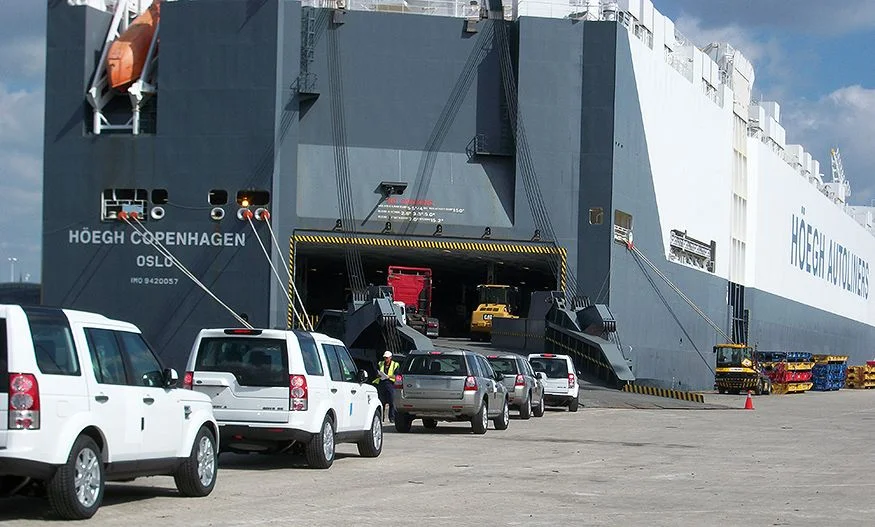
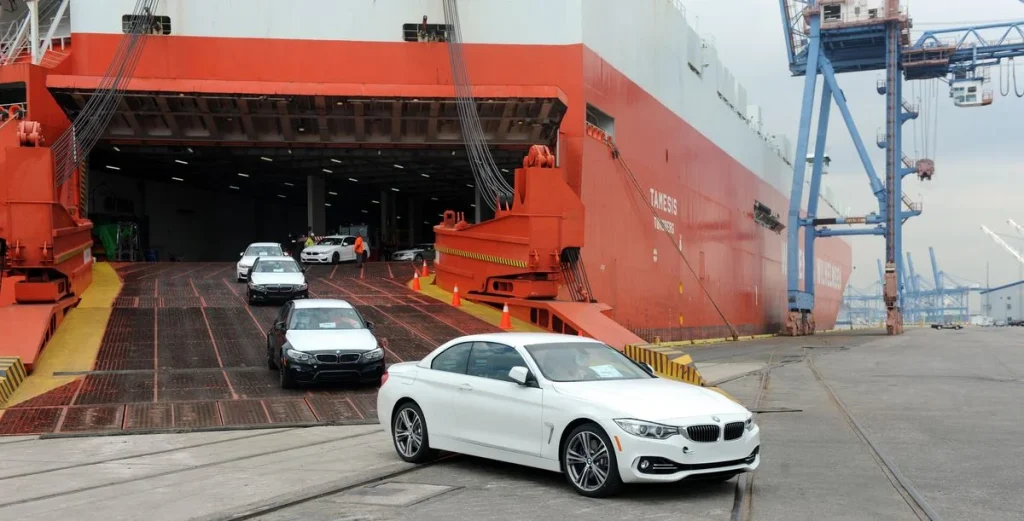
CBU cars are typically shipped by Ro-Ro vessel – vehicles are driven directly into the ship’s hold, which is lower cost and more convenient for shipments involving multiple vehicles. For small quantities (1-2 vehicles), a 40′ HC container may be used. The forwarder needs to book Ro-Ro vessel space early, as sailing schedules from Japan, South Korea, and the EU to Vietnam are not frequent. The bill of lading must fully record the VIN of each vehicle in the shipment.
Step 5: Customs Declaration, Tax Payment, and Physical Inspection at Port
When the vessel arrives at port (Hai Phong, Da Nang, or Cat Lai), the forwarder opens a VNACCS declaration with the full 8-digit HS code, import license number, C/O number, and registered inspection information. Every CBU car shipment is subject to mandatory physical inspection – the Vehicle Register physically inspects each vehicle, cross-checking the VIN, chassis number, engine number, and technical specifications against the registered documentation. After inspection is passed, customs confirms the tax amount, and the business pays import tax, special consumption tax, and VAT.
Step 6: Customs Clearance, Vehicle Collection, and Registration
Once all taxes are paid and inspection is complete, the Vehicle Register issues a Technical Safety and Environmental Protection Quality Certificate for each vehicle. The business receives the delivery order, moves the vehicles out of port, and transports them to the warehouse/showroom. The next step is license plate registration with the local Police Department and payment of the registration fee (2% of vehicle value in Ho Chi Minh City and Hanoi, with different rates in other provinces/cities) before handing the vehicle over to the customer.
5. How to Calculate Import Tax for CBU Cars
CBU cars are subject to three cumulative tax layers – import tax, special consumption tax (SCT), and VAT – resulting in a very heavy overall tax burden. A concrete example with a Toyota Fortuner imported from Thailand, CIF price of 800 million VND, 2.7L displacement, with C/O Form D (0% import tax) versus without C/O Form D (70% MFN tax):
| Tax / Cost Item | Without C/O Form D (MFN 70%) | With C/O Form D ATIGA (0%) |
|---|---|---|
| CIF Value | VND 800,000,000 | VND 800,000,000 |
| Import tax | 70% x 800M = VND 560,000,000 | 0% x 800M = VND 0 |
| Special consumption tax (50%) | 50% x (800 + 560)M = VND 680,000,000 | 50% x (800 + 0)M = VND 400,000,000 |
| VAT (10%) | 10% x (800+560+680)M = VND 204,000,000 | 10% x (800+0+400)M = VND 120,000,000 |
| Total tax payable | VND 1,444,000,000 (~1.44 billion) | VND 520,000,000 (~520 million) |
| Savings with C/O Form D | VND 924,000,000 (~924 million) – a difference of nearly VND 1 billion from a single C/O Form D obtained from the manufacturer in Thailand. This is why the C/O is the single most important document in CBU car import procedures. | |
From 3W Logistics’ practical experience: CBU cars are the product category where we see the two most frequent – and most costly – mistakes. The first is not having a C/O Form D from the Thai manufacturer because the importer failed to request it from the start – on a single vehicle with a CIF value of 800 million VND, the additional tax burden is nearly 1 billion VND. The second is a manufacturer’s authorization document that was not properly consularly legalized – the shipment arrives at port and cannot clear customs, requiring the process to be redone from scratch, taking 3-6 weeks, while the vehicles sit at port accruing very high storage fees. Both mistakes occur most commonly among businesses importing CBU cars for the first time, and both are entirely avoidable with proper preparation before signing the contract. – Ms. Apple, CCO, 3W Logistics
6. Common Risks in CBU Car Import Procedures
| Risk | Symptom | Prevention |
|---|---|---|
| Manufacturer’s authorization document improperly prepared | Vehicles arrive at port but the document lacks consular legalization or required content – the declaration cannot be opened, requiring the process to be redone from scratch (3-6 weeks), incurring very high port storage fees | Require the manufacturer to provide an authorization document template that complies with Ministry of Industry and Trade regulations; verify the content and complete consular legalization before the vehicles are exported |
| No C/O or an invalid C/O | Must pay 70% MFN tax instead of 0% (ASEAN) or 32-50% (EU/Japan/South Korea) – the difference per vehicle can reach several hundred million to nearly 1 billion VND | Require the C/O directly in the vehicle purchase contract terms; obtain the C/O from the supplier before the vehicles are loaded; verify the C/O matches 100% with the Invoice and B/L |
| Mismatched technical specifications across documents | VIN, cylinder capacity, or color on the Invoice differs from the actual vehicle – the Vehicle Register refuses to issue the certificate, requiring a correction process that adds 1-3 weeks | Require the supplier to provide the exact VIN of each vehicle before issuing the Invoice; cross-check technical specifications across all documents before registering for inspection |
| Incorrect 8-digit HS code – miscalculated special consumption tax | Misclassifying cylinder capacity or engine type subheading – customs reclassifies the goods, retroactively collects the special consumption tax difference, and imposes penalties for customs declaration violations | Confirm the exact 8-digit HS code against precise technical specifications before opening the declaration; consult an experienced automotive forwarder or request an advance ruling from Customs |
| Not meeting commercial import conditions | The business does not yet hold a Car Import Business License, or does not yet meet warranty/maintenance facility conditions – the entire shipment cannot clear commercial customs | Fully complete all conditions under Decree 116/2017 and Decree 117/2026 before signing a vehicle purchase contract; do not place an order until the license is in hand |
FAQ – Frequently Asked Questions About CBU Car Import Procedures
Question 1: What documents are needed for CBU car import procedures?
A complete documentation set for CBU car import procedures includes:
- Car Import Business License (issued by the Ministry of Industry and Trade);
- Manufacturer’s authorization document (consularly legalized);
- Sales contract with full technical specifications for each vehicle;
- Commercial Invoice with complete VIN and cylinder capacity information;
- Packing List;
- Bill of Lading;
- C/O under the relevant FTA;
- Quality inspection registration with the Vehicle Register and an electronic customs declaration (VNACCS).
Question 2: Do CBU cars imported from Thailand into Vietnam enjoy 0% tax?
Yes – but with conditions. CBU cars from Thailand and Indonesia enjoy a 0% import tax rate under the ATIGA Agreement when accompanied by a valid C/O Form D and the vehicle meets a minimum 40% ASEAN local content ratio. Without a valid C/O Form D, the vehicle is still subject to MFN tax, which can reach up to 70%, creating an enormous cost difference. This is why the C/O is the top priority in CBU car import procedures from ASEAN.
Question 3: How many types of tax must be paid when importing CBU cars?
CBU cars are subject to three cumulative tax layers:
- Import tax: calculated on the CIF value, ranging from 0% (ASEAN) to 70%+ (MFN);
- Special consumption tax (SCT): calculated on CIF plus import tax, ranging from 35% to 60% depending on cylinder capacity (electric vehicles receive a preferential 3% rate);
- VAT of 10%: calculated on total CIF plus import tax plus SCT. After customs clearance, a registration fee also applies upon vehicle registration.
Question 4: How long do CBU car import procedures take?
The total time to complete CBU car import procedures, from applying for the license to the vehicles arriving at the warehouse, typically ranges from 60-90 days. This includes: applying for the import business license, 15-30 days; consular legalization of the authorization document, 2-4 weeks; transport time of 10-14 days from Thailand, 15-20 days from Japan/South Korea, and 25-35 days from the EU; and physical inspection at port plus completion of customs clearance, 7-15 days. Shipments with complete documentation and a valid C/O clear customs significantly faster.
How Does 3W Logistics Support CBU Car Import Procedures?
As a freight forwarding company registered as an OTI-NVOCC with FMC bond (Federal Maritime Commission) in the United States, with over 10 years of experience handling imported automobiles and motorcycles, 3W Logistics provides an end-to-end service for businesses handling CBU car import procedures – from support preparing legal conditions and HS code/tax consultation through to the vehicles arriving at the showroom.
- Legal condition consultation and support preparing the car import license: Full review of conditions under Decree 116/2017 and Decree 117/2026; guidance on the application for a Car Import Business License at the Ministry of Industry and Trade; consultation on preparing the manufacturer’s authorization document with proper consular legalization.
- Determining the 8-digit HS code and calculating actual tax before ordering vehicles: Determining the exact 8-digit HS code based on cylinder capacity and engine type; calculating all three tax layers (import tax, SCT, VAT) for each origin and applicable FTA – giving the business accurate cost figures before contract negotiation.
- Support obtaining the correct FTA C/O form from suppliers: Guiding Thai/Indonesian suppliers on obtaining C/O Form D, Japanese suppliers on Form JV/CPTPP, and EU suppliers on Form EUR.1; verifying the C/O received before the vehicles are loaded to ensure validity.
- Booking Ro-Ro vessels and ocean transport from major automotive markets: Arranging Ro-Ro or container shipping schedules from Thailand, Japan, South Korea, Germany, the United States, and other markets to Hai Phong, Da Nang, and Cat Lai (Ho Chi Minh City) ports; real-time shipment tracking.
- Coordinating quality inspection registration with the Vehicle Register: Preparing complete technical safety inspection registration documentation; coordinating with the Vehicle Register at port for swift physical inspection, avoiding extended storage time.
- Electronic customs declaration (VNACCS) and resolving issues at the border gate: Declaring the correct 8-digit HS code for each vehicle model, fully stating the import license number and C/O number; tracking customs channel classification and resolving requests for supplementary documentation or technical specification explanations quickly.
Why choose 3W Logistics for your CBU car import shipment? CBU car import procedures require handling multiple complex layers simultaneously – business conditions under Decree 116 and Decree 117, Vehicle Register inspection documentation, calculating three tax layers according to the correct 8-digit HS code, and optimizing the FTA C/O. A single mistake regarding the license or C/O in CBU car import procedures can cost a business hundreds of millions to over a billion VND on a single vehicle. We accompany you from the legal condition preparation stage through to the vehicles arriving at the showroom – helping your business avoid the costliest mistakes. Contact 3W for specific consultation before signing your vehicle purchase contract.
Address: 34 Bach Dang, Tan Son Hoa Ward, Ho Chi Minh City
Hotline: +84 28 3535 0087
____________________________
3W Logistics Hanoi Branch
Address: 81A Tran Quoc Toan, Cua Nam Ward, Hanoi
Hotline: +84 24 3202 0482
____________________________
3W Logistics Hai Phong Branch
Address: 8A Lot 28 Le Hong Phong, Gia Vien Ward, Hai Phong
Hotline: +84 225 355 5939
____________________________
3W LOGISTICS CO., LTD – We here serve you there!
Email: quote@3w-logistics.com
Website: www.3w-logistics.com

Ms. Apple is the CCO (Chief Commercial Officer) at 3W Logistics, with over 10 years of experience in sales and business operations management.
At 3W Logistics, Ms. Apple is responsible for commercial strategy, corporate customer development, managing a team of more than 50 sales professionals, and improving business performance in the logistics sector.
With practical experience in sales management and market development, Ms. Apple shares professional insights on business logistics solutions, international transportation, freight forwarding, customer management, trade lane development, and growth strategies in the logistics industry.


