
Beef import procedures are among the most strictly controlled food import processes. Beef is not prohibited from import and does not require an import permit, but every shipment must be registered for veterinary quarantine inspection before arrival at port, and may only be imported from countries and processing facilities that have been approved by Vietnam’s competent authorities. One missed step in the quarantine chain and a refrigerated container can be left sitting at port, accruing daily electricity and storage charges.
In addition, beef import procedures in 2026 have seen significant changes: quarantine inspection of terrestrial animals and animal products is now carried out under Circular 01/2026/TT-BNNMT (effective 01/01/2026, replacing Circular 25/2016/TT-BNNPTNT and its amending circulars), the responsible authority is the Department of Livestock Production and Veterinary Medicine under the Ministry of Agriculture and Environment, and fresh and frozen unprocessed beef is not subject to VAT at the import stage under VAT Law 48/2024/QH15.
This article presents the complete beef import procedure under current regulations – covering legal requirements, HS codes, taxes, required documents, step-by-step process, and real-world risks, from the perspective of a freight forwarder with over 10 years of experience handling imported frozen and chilled food products.
1. Legal Requirements for Beef Import Procedures
The primary legal bases for the beef import procedure are the Law on Veterinary Medicine 2015 (as amended by Law No. 146/2025/QH15), the Law on Food Safety 2010, and Circular 01/2026/TT-BNNMT (as amended by Circular 22/2026/TT-BNNMT dated 19/5/2026). Meat and meat products of terrestrial animal origin are listed in Appendix I – the list of animal products subject to mandatory quarantine inspection.
| Requirement | Details |
|---|---|
| Importer qualifications | Business with a valid business registration, tax code, digital signature, and active VNACCS and National Single Window electronic customs accounts. Beef is not on the prohibited import list and does not require a separate import permit. |
| Mandatory quarantine inspection | Every beef shipment must be registered for quarantine inspection with the Department of Livestock Production and Veterinary Medicine before import, declared for quarantine before the goods arrive at the border gate, and cleared with a Veterinary Quarantine Certificate for Imported Animal Products. |
| Exporting country and processing facility | Beef may only be imported from countries, territories, and production facilities that Vietnam’s competent authorities have approved with regard to veterinary hygiene requirements, food safety, and health certificate templates. New cases listed in Appendix IV must undergo a risk analysis before importation is permitted. |
| Veterinary quarantine certificate from the exporting country | A Health Certificate issued by the exporting country’s competent authority is required (original or a certified copy, with the original to be submitted at the time of inspection). Where both parties agree on electronic certification, the electronic version is acceptable. |
| Cold storage facilities | The consignee must arrange cold storage that meets the preservation requirements for the goods during the quarantine waiting period, and is responsible for the accuracy of the quarantine registration and declaration dossier. |
| Sample shipments under 50 kg | Imported animal product shipments brought in as commercial samples weighing less than 50 kg are exempt from the exporting country’s veterinary quarantine certificate and from sample testing. |
| Goods labeling | Imported goods must carry the original manufacturer’s label and a supplementary label in Vietnamese containing all required information under the goods labeling regulations (Decree 43/2017/NĐ-CP and its amendments), including the date of manufacture, expiry date, and storage conditions. |
Practical note: The most significant change to the beef import procedure from 01/01/2026 concerns the legal basis and the responsible authority: dossiers are now submitted to the Department of Livestock Production and Veterinary Medicine under Circular 01/2026/TT-BNNMT, no longer under Circular 25/2016/TT-BNNPTNT. Dossiers submitted before the new Circular came into force continue to be processed under the regulations in effect at the time of submission. Businesses still using the old forms and process are likely to have their dossiers returned.
2. HS Code and Import Duty for Beef
Beef falls under Chapter 02 of the tariff schedule: heading 0201 (fresh or chilled beef), heading 0202 (frozen beef), and heading 0206 (edible offal such as tongue, liver, tail, and stomach). In the beef import procedure, the preferential import duty (MFN) ranges from 8% to 20% depending on the cut, but can be reduced to 0% with a valid C/O under trade agreements such as AANZFTA.
| Meat Type | Reference 8-Digit HS Code | Reference Preferential Import Duty (MFN) | Standard Import Duty |
|---|---|---|---|
| Frozen beef carcasses and half-carcasses | 0202.10.00 | 20% | Check tariff schedule |
| Other frozen bone-in beef cuts | 0202.20.00 | 20% | Check tariff schedule |
| Frozen boneless beef | 0202.30.00 | 14% | 21% |
| Fresh or chilled beef | Heading 0201 | Check tariff schedule | Check tariff schedule |
| Edible beef offal, frozen (tongue, liver, tail, etc.) | 0206.21 / 0206.22 / 0206.29 | 8% | Check tariff schedule |
Important note on beef HS codes: When declaring in the beef import procedure, the declaration must correctly describe the form of meat (whole carcass, bone-in, boneless, offal), preservation state (fresh, chilled, frozen), and the name and registration code of the production facility. Processed beef products such as sausages, canned meat, and ham fall under different headings and are subject to different duty rates and VAT treatment. The duty rates in the table are for reference only and must be verified against the current tariff schedule at the time of customs declaration.
Beef Import Duty by Country of Origin
Country of origin determines the majority of the cost in the beef import procedure. Frozen beef from Australia and New Zealand – the two largest import sources – may qualify for a 0% duty rate under AANZFTA with a valid C/O:
| Country of Origin | Applicable C/O | Import Duty | Notes |
|---|---|---|---|
| Australia, New Zealand | C/O Form AANZ (AANZFTA) | 0% | Frozen beef qualifies for special preferential duty when origin rules are met; C/O should be required in the purchase contract from the outset. |
| India | C/O Form AI (AIFTA) | 0% | Primarily frozen buffalo meat sharing the same HS codes; verify the exact HS code when importing beef specifically. |
| Canada, Mexico, Japan, etc. | C/O Form CPTPP | Phased reduction | Rate depends on the implementation year and HS code; check the CPTPP tariff schedule for the actual import period. |
| USA, Brazil, Argentina, and non-FTA countries | Not applicable | 8% – 20% (MFN) | MFN preferential duty applies per HS code; the USA does not have an FTA with Vietnam. |
VAT on Imported Beef
Under Clause 1, Article 5 of VAT Law No. 48/2024/QH15 (effective 01/7/2025, as amended by Law No. 149/2025/QH15), livestock products that are unprocessed or have only undergone ordinary preliminary processing are not subject to VAT at the import stage. In the beef import procedure, fresh, chilled, and frozen beef therefore generally does not attract VAT at the border.
At the commercial resale stage, a rate of 5% or no declaration requirement applies depending on the type of buyer, under Law 149/2025/QH15 and Decree 181/2025/NĐ-CP. Beef that has been processed into other products is subject to VAT at the standard rate (8% through 31/12/2026 under Resolution 204/2025/QH15).
| Tax Type | Rate | Taxable Base | Notes |
|---|---|---|---|
| Preferential import duty (MFN) | 8% – 20% | CIF value | Depends on the form of meat and HS code. |
| Special preferential import duty (FTA) | 0% | CIF value | Requires a C/O in the correct form (e.g. AANZ, AI). |
| VAT at import stage | Not applicable | – | For unprocessed beef or beef that has only undergone ordinary preliminary processing. |
| VAT at commercial resale stage | 5% or no declaration required | Selling price | Depends on the type of buyer; check Law 149/2025/QH15 and Decree 181/2025/NĐ-CP. |
3. Documents Required for Beef Import Procedures
The full dossier for the beef import procedure consists of two layers: a quarantine dossier for the veterinary authority and a standard customs dossier. Information on the Health Certificate, invoice, packing list, and bill of lading – in particular the facility name, lot number, date of manufacture, and quantity – must be completely consistent across all documents.
| Document | When to Prepare | Key Notes |
|---|---|---|
| Sales Contract | Before placing deposit | Must clearly state the form of meat, production facility, temperature conditions, and the supplier’s obligation to provide a Health Certificate in the agreed template and a C/O. |
| Commercial Invoice | Before shipment | Full description of the meat type, quantity, unit price, and the name and code of the production facility; must match the Health Certificate. |
| Packing List | Before shipment | Number of cartons, weight per product type, lot number, date of manufacture, and expiry date; serves as the reference for the quarantine authority’s physical inspection of the goods. |
| Bill of Lading | After goods are loaded onto the vessel | Must clearly state the refrigerated container details and the set temperature; some quarantine authorities require a bill of lading confirmed by the shipping line. |
| Veterinary quarantine certificate from the exporting country (Health Certificate) | Before shipment | Issued by the exporting country’s competent authority using the template agreed with Vietnam; submit the original or a certified copy, with the original to be provided at the time of inspection. |
| Quarantine registration application (Form 19) | Before import | Submitted to the Department of Livestock Production and Veterinary Medicine via the National Single Window portal; the Department responds in writing with approval and quarantine guidance within 04 working days of receiving a complete dossier. |
| Quarantine declaration (Form 3) | After receiving written approval, before goods arrive at the border gate | Submitted to the border quarantine authority; the authority confirms and notifies the inspection location and time within 01 working day. |
| Certificate of Origin (C/O) | Before shipment | Required to claim special preferential duty (Form AANZ, Form AI, Form CPTPP, etc.); the duty difference can amount to 14%–20% of the shipment value. |
| Veterinary Quarantine Certificate for Imported Animal Products | After passing quarantine inspection | Issued by the border quarantine authority, valid for 60 days; required for customs clearance and market distribution. |
| Electronic customs declaration (VNACCS) | Once dossier is complete | Declare the correct 8-digit HS code, facility name, and C/O reference number; attach the complete quarantine documentation. |
4. Step-by-Step Beef Import Procedure
Below are the six standard steps of the beef import procedure that 3W Logistics follows for customers importing frozen and chilled beef into Vietnam:
Step 1: Verify the exporting country and facility, and determine the HS code
Before placing an order, the business confirms that the exporting country and production facility have been approved by Vietnam’s competent authorities, and determines the form of meat, HS code, and applicable duty rate by origin. This is the prerequisite step in the beef import procedure: goods from a facility that has not been approved cannot be cleared through quarantine.
Step 2: Sign the contract and request the Health Certificate and C/O from the supplier
At this stage of the beef import procedure, the contract must clearly state the supplier’s obligation to provide a Health Certificate in the agreed template, a C/O for preferential duty, and the required transport temperature conditions. Both the exporting country’s veterinary quarantine certificate and the C/O must be issued before the goods are shipped – they cannot be obtained retroactively.
Step 3: Register for quarantine inspection with the Department of Livestock Production and Veterinary Medicine
Before import, the business submits Form 19 (Quarantine Registration Application) via the National Single Window portal. Within 04 working days of receiving a complete and valid dossier, the Department of Livestock Production and Veterinary Medicine issues a written approval and quarantine guidance, and forwards the case to the border quarantine authority. For shipments subject to risk analysis, the processing time for the beef import procedure will be longer.
Step 4: Transport by refrigerated container and submit the quarantine declaration
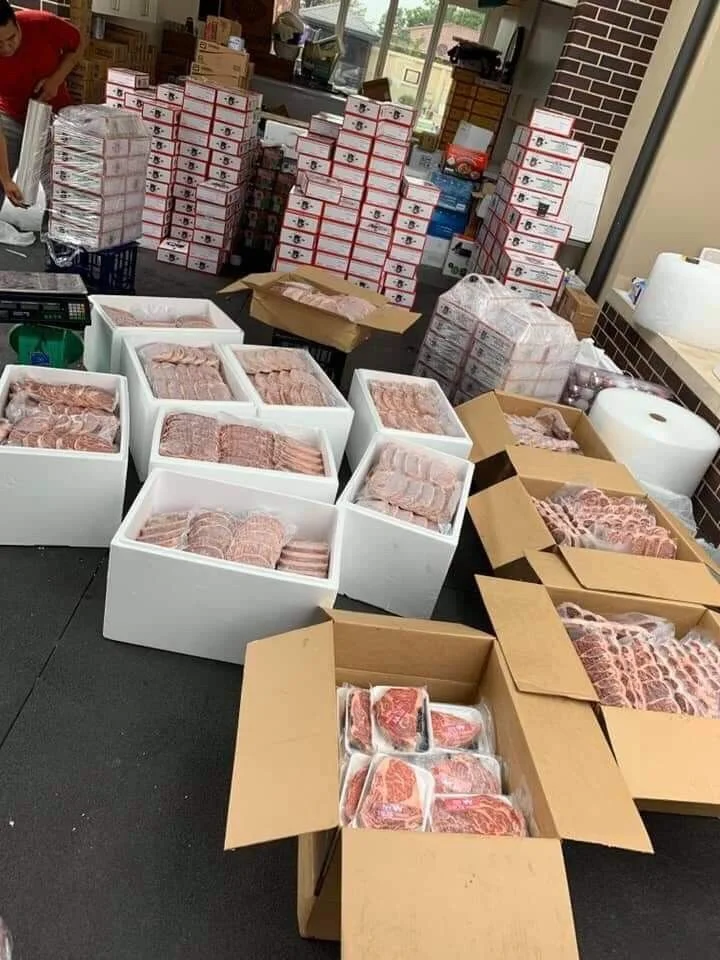
In the beef import procedure, beef is transported in refrigerated (reefer) containers maintaining a stable temperature throughout the journey; frozen beef is typically carried at -18°C or below. The forwarder advises on the appropriate sea freight arrangement, container power supply, and temperature monitoring. After receiving the written approval and before the goods arrive at the border gate, the business submits Form 3 (Quarantine Declaration) and the Health Certificate; the quarantine authority confirms within 01 working day.
Step 5: Customs declaration and quarantine inspection at the border gate
When the goods arrive at port, the forwarder files a VNACCS declaration with the correct HS code, facility name, C/O reference number, and full quarantine documentation. The border quarantine authority carries out a physical inspection of the goods, cross-checks the shipment information against the dossier, and collects samples for testing against the indicators specified in Appendix XII of Circular 01/2026/TT-BNNMT. Within 05 working days from the date of inspection, if all requirements are met, the authority issues the Veterinary Quarantine Certificate for Imported Animal Products.
Step 6: Pay taxes, clear customs, and take delivery
Once the Veterinary Quarantine Certificate has been obtained and the applicable import duty (if any) has been paid, the business receives the delivery order and brings the container to a cold storage warehouse. When transporting frozen or chilled beef intended for human consumption out of the province after import, the business must continue to comply with the controls specified in Appendix XIII of the Circular. This is the final step of the beef import procedure.
5. How to Calculate Import Tax on Beef
In the beef import procedure, import duty is the primary tax because VAT does not arise at the import stage. For example, consider a shipment of frozen boneless beef (HS 0202.30.00) imported from Australia by De Nhat Food, with a CIF value of VND 1 billion: the table below compares the scenario without a C/O Form AANZ (MFN duty of 14%) and the scenario with a C/O Form AANZ (0% duty):
| Tax / Cost Item | Without C/O Form AANZ (MFN 14%) | With C/O Form AANZ (0%) |
|---|---|---|
| CIF value | VND 1,000,000,000 | VND 1,000,000,000 |
| Import duty | 14% × VND 1,000M = VND 140,000,000 | 0% × VND 1,000M = VND 0 |
| VAT at import stage | Not applicable = VND 0 | Not applicable = VND 0 |
| Total tax payable | VND 140,000,000 | VND 0 |
| Saving with C/O Form AANZ | VND 140,000,000 on a VND 1-billion shipment — from a single C/O requested from the exporter. This is why the C/O is always the first thing checked when advising on the beef import procedure. | |
In the beef import procedure, the costs that typically exceed the tax amount arise from quarantine waiting time: a refrigerated container sitting at port must be kept connected to power continuously, on top of daily container and storage charges. If the test results are unsatisfactory, the consignee must bear the costs of treatment or destruction of the shipment in accordance with the applicable regulations.
From 3W Logistics’ practical experience: For beef imports, we see two mistakes repeat most often. The first is importing from a facility that is not on the approved list, or presenting a Health Certificate that does not match the agreed template – causing the shipment to be unable to pass quarantine and leaving the refrigerated container at port for days. The second is failing to require the exporter to issue a C/O Form AANZ from the outset, forfeiting a 14% duty benefit on the entire shipment. Both are entirely avoidable if the beef import procedure is reviewed from the very beginning of the supplier selection stage. — Ms. Apple, CCO, 3W Logistics
6. Common Risks in Beef Import Procedures
Based on our experience handling chilled and frozen cargo, the following risks appear most frequently in the beef import procedure and all can be mitigated with early preparation:
| Risk | How It Manifests | How to Prevent It |
|---|---|---|
| Unapproved facility or country of origin | The Department of Livestock Production and Veterinary Medicine refuses quarantine registration or requires a risk analysis; the goods cannot be imported. | Confirm the facility name and production facility code are authorized to export to Vietnam before signing the contract. |
| Health Certificate in the wrong template or with missing information | The exporting country’s quarantine certificate is invalid or shipment details do not match; the Veterinary Quarantine Certificate for Imported Animal Products is refused. | Require the supplier to use exactly the agreed template; cross-check the lot number, facility name, and quantity against the invoice and packing list before shipment. |
| Failed test results | Veterinary hygiene indicators fail; the shipment is subject to treatment or destruction at the consignee’s expense; the veterinary authority notifies the exporting country. | Select facilities with a consistent quality record; maintain the correct temperature throughout; request production lot documentation. |
| Cold chain break | Container temperature fluctuates, power supply fails at port or warehouse; meat deteriorates and is rejected. | Choose a shipping line, port, and cold storage facility with a reliable power supply system; monitor temperature continuously and document any incidents. |
| No C/O or incorrect HS code declaration | Preferential duty is lost and 14%–20% of the shipment value must be paid; customs reclassifies the goods, back-charges tax, and imposes penalties for incorrect declaration. | Require the C/O in the purchase contract; confirm the correct 8-digit HS code for the specific form of meat before filing the declaration. |
| Quarantine delays generating detention charges | Late quarantine registration or a mismatch between the vessel’s arrival and the scheduled inspection; the refrigerated container sits at port accruing storage and power charges. | Register for quarantine early; plan the quarantine declaration before the goods arrive at the border gate; ensure a pre-registered cold storage facility is ready. |
FAQ – Frequently Asked Questions about Beef Import Procedures
Question 1: Is an import permit required for beef?
Beef does not require an import permit, but mandatory quarantine inspection applies. Businesses register for quarantine with the Department of Livestock Production and Veterinary Medicine under Circular 01/2026/TT-BNNMT before importing. This is an obligatory component of the beef import procedure: goods may only be cleared through customs once a Veterinary Quarantine Certificate for Imported Animal Products has been issued.
Question 2: What is the import duty on beef?
In the beef import procedure, frozen beef under heading 0202 carries a reference preferential import duty (MFN) of 14% for boneless cuts and 20% for carcasses and bone-in cuts; edible offal is approximately 8%. Shipments with a valid C/O under AANZFTA (Australia, New Zealand) or AIFTA (India) may qualify for a 0% duty rate.
Question 3: Is VAT payable on imported beef?
Fresh, chilled, and frozen beef that is unprocessed or has only undergone ordinary preliminary processing is not subject to VAT at the import stage under Clause 1, Article 5 of VAT Law 48/2024/QH15. Beef processed into other products is subject to standard VAT rates. Businesses should also consult Decree 181/2025/NĐ-CP when selling to the market as part of the beef import procedure.
Question 4: How long does the quarantine inspection process take for imported beef?
Under Circular 01/2026/TT-BNNMT, the timeline for the beef import procedure is as follows: the Department of Livestock Production and Veterinary Medicine responds to the quarantine registration within 04 working days; the border quarantine authority confirms the declaration within 01 working day; and the Veterinary Quarantine Certificate is issued within 05 working days from the date of inspection, provided all requirements are met. The Veterinary Quarantine Certificate for Imported Animal Products is valid for 60 days.
Question 5: Can individuals bring beef into Vietnam from abroad?
Fresh or minimally processed animal products may not be carried on the person across the border. Circular 01/2026/TT-BNNMT exempts only processed, pre-packaged animal products intended for personal consumption, not exceeding 05 kg, from quarantine requirements. All commercial beef shipments must go through the complete beef import procedure.
How 3W Logistics Supports Beef Import Procedures
As a freight forwarding company registered as an OTI-NVOCC with FMC Bond (Federal Maritime Commission) in the United States and with over 10 years of experience handling imported frozen and chilled food products, 3W Logistics provides end-to-end services for businesses navigating the beef import procedure – from HS code and tax advice through to delivery at your cold storage warehouse.
- HS code, tax advisory, and C/O optimization: Determining the correct 8-digit HS code by form of meat, calculating import duty by origin, and guiding suppliers on obtaining the correct C/O Form AANZ, AI, or CPTPP.
- Facility eligibility review and quarantine dossier preparation: Supporting the beef import procedure from the stage of checking the exporting facility, the Health Certificate template, and preparing Form 19 (Quarantine Registration Application) and Form 3 (Quarantine Declaration) via the National Single Window portal.
- Coordination with the Department of Livestock Production and Veterinary Medicine and the border quarantine authority: Tracking the written approval, inspection schedule, and test results to keep the shipment moving without interruption at port.
- Sea freight by refrigerated container: Booking reefer containers, advising on temperature settings, monitoring power supply, and tracking the shipment in real time.
- Electronic customs declaration (VNACCS): Filing with the correct HS code, facility name, and C/O reference number; rapid response when customs or the quarantine authority requests supplementary documents.
- Cold storage and cargo insurance advisory: Recommending suitable cold storage facilities, assisting clients in obtaining appropriate insurance for chilled food products, and coordinating inspection in the event of loss or damage.
Why choose 3W Logistics for your beef shipment? The beef import procedure requires managing multiple layers simultaneously: facility eligibility, a quarantine dossier compliant with Circular 01/2026/TT-BNNMT, C/O optimization, and an unbroken cold chain. A single documentation error or timing misstep can leave a refrigerated container at port for days and generate costs that far exceed the tax amount. We accompany you from the supplier selection stage through to delivery at your cold storage warehouse. Contact 3W for specific advice before signing the purchase contract.
Address: 34 Bach Dang, Tan Son Hoa Ward, Ho Chi Minh City
Hotline: +84 28 3535 0087
____________________________
3W Logistics Hanoi Branch
Address: 81A Tran Quoc Toan, Cua Nam Ward, Hanoi
Hotline: +84 24 3202 0482
____________________________
3W Logistics Hai Phong Branch
Address: 8A Lot 28 Le Hong Phong, Gia Vien Ward, Hai Phong
Hotline: +84 225 355 5939
____________________________
3W LOGISTICS CO., LTD – We here serve you there!
Email: info@3w-logistics.com
Website: www.3w-logistics.com

Ms. Apple is the CCO (Chief Commercial Officer) at 3W Logistics, with over 10 years of experience in sales and business operations management.
At 3W Logistics, Ms. Apple is responsible for commercial strategy, corporate customer development, managing a team of more than 50 sales professionals, and improving business performance in the logistics sector.
With practical experience in sales management and market development, Ms. Apple shares professional insights on business logistics solutions, international transportation, freight forwarding, customer management, trade lane development, and growth strategies in the logistics industry.


