Pure honey export procedures in Vietnam are entering a stage with many positive signals, as the U.S. Department of Commerce (DOC) has just announced a significant reduction in the anti-dumping duty on Vietnamese honey, down to 14.14% after years of facing record-high tariffs. This is an important turning point for the honey industry, which had previously faced serious difficulties in the U.S. market — the destination that absorbs the majority of Vietnam’s honey export volume.
However, honey export procedures still require businesses to strictly comply with quarantine requirements, particularly control of Chloramphenicol antibiotic residue — an almost mandatory criterion for every demanding market such as the U.S., the EU, and Japan. The article below compiles the full legal basis, HS codes, tax policy, procedures, costs, and common risks involved in honey export procedures, updated according to the latest applicable regulations.
1. Status and potential of Vietnam’s honey exports
Vietnam is one of the major honey-exporting countries in Asia, with beekeeping regions concentrated in the Central Highlands, the Southeast, and several northern mountainous provinces — areas with abundant natural floral sources from rubber trees, coffee, acacia, and various wild forest flowers. The U.S., the EU, and Japan have been the three main export markets in Vietnam’s honey export procedures for many years.
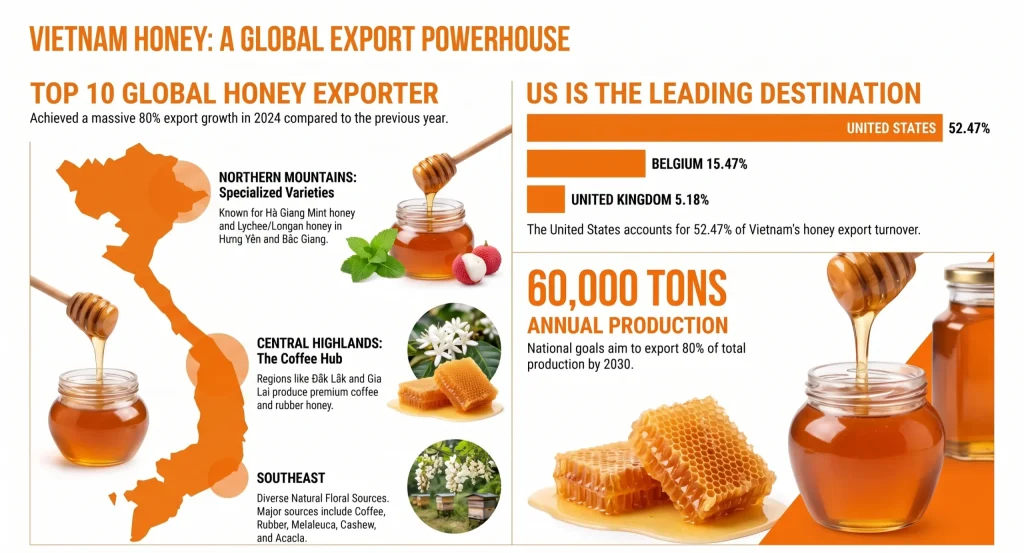
According to the U.S. Department of Agriculture, domestic U.S. honey production has fallen by about 14% while honey prices have risen by about 27%, indicating this market still needs external supply. Combined with the reduced anti-dumping duty, this presents an opportunity for Vietnamese businesses to ramp up honey exports to the U.S. again in the period ahead.
2. Legal basis governing honey export procedures
| Legal document | Content regulated |
|---|---|
| Food Safety Law 2010, Veterinary Law 2015 | General regulations on food safety control and quarantine of exported animal products |
| Consolidated Document 02/VBHN-BNNPTNT (consolidating Circular 48/2013 and Circular 32/2022) | Inspection and food safety certification for exported agricultural and aquatic products; authority to issue the Health Certificate |
| Circular 38/2015/TT-BTC, amended by Circular 39/2018/TT-BTC | Customs procedures and supervision for exported goods, and the paper customs declaration form HQ/2015/XK |
| U.S. Department of Commerce (DOC) anti-dumping duty order, updated with 2026 review results | The anti-dumping duty rate on Vietnamese honey exported to the U.S. has just been reduced to 14.14% |
Important update: After the 2021 preliminary determination set an anti-dumping duty of over 400%, the DOC has significantly reduced the rate through subsequent administrative reviews, and the current duty on Vietnamese honey exported to the U.S. now stands at just 14.14%. In addition, businesses should note the general 20% reciprocal tariff the U.S. applies to Vietnamese goods from August 7, 2025 (already reduced from the initial proposed rate of 46%), which may compound and affect the total cost when exporting honey to this market.
3. Conditions for businesses and exported honey products
| Condition | Issuing/managing authority | Note |
|---|---|---|
| Food safety eligibility of the facility | Sub-Department of Food Safety and Hygiene / NAFIQAD | Mandatory for facilities that purchase, process, and pack honey for export |
| Control of Chloramphenicol and banned antibiotic residues | NAFIQAD / a designated testing laboratory | A mandatory testing criterion for most shipments exported to the U.S. and the EU |
| Export honey quality standards | Cross-checked against TCVN or Codex standards | Controls moisture content (typically under 20%), sugar content, and impurities |
| Registration as a business eligible for a separate rate (U.S. market) | U.S. Department of Commerce (DOC) | Only businesses that fully participate in the review process are eligible for a lower, separate duty rate |
4. HS codes and export duties for honey
Natural honey falls under Chapter 04 — “Dairy produce; birds’ eggs; natural honey; edible products of animal origin” — heading 04.09. Correctly determining the HS code is a mandatory step in honey export procedures, especially important when cross-checking against the detailed product codes the U.S. applies in its anti-dumping duty order.
| Product type | HS code (Vietnam) | Vietnam export duty | Note |
|---|---|---|---|
| Natural honey (pure, unblended) | 0409.00.00 | 0% | The most common code group, corresponding to the detailed codes the U.S. applies: 0409.00.0005/0035/0045/0056/0065 |
| Artificial honey (blended or unblended with natural honey) | 1702.90.20 | 0% | Not within the scope of the anti-dumping duty order applicable to natural honey |
Practical note: Export duty on honey in Vietnam is currently 0%. However, when exporting to the EU, natural honey (HS code 0409.00.00) is subject to a most-favored-nation import tariff of around 17.30%, while artificial honey (HS code 1702.90.20) is subject to around 10.28% — unless a C/O Form EUR.1 is used to claim preferential treatment under the EVFTA. For the U.S. market specifically, in addition to the 14.14% anti-dumping duty, businesses need to factor in the general 20% reciprocal tariff applied from August 7, 2025, when planning their selling price.
5. Documentation package for honey export procedures
| Document | When to prepare | Important note |
|---|---|---|
| Sales Contract | Before packing and export | Must clearly state Incoterms, packing specifications, and honey quality criteria |
| Commercial Invoice and Packing List | Before customs declaration | Value must match the contract and the bill of lading |
| Quarantine confirmation certificate (including Chloramphenicol level) | Before goods reach the port | Mandatory for shipments exported to the U.S. and the EU under honey quarantine regulations |
| Facility confirmation certificate meeting honey export standards | Before the first export shipment | Issued by the competent authority; must remain valid at the time of export |
| Certificate of Origin (C/O) | After the export declaration is issued | A C/O Form EUR.1 helps secure preferential import tariffs under the EVFTA when entering the EU |
| Export customs declaration (VNACCS) | Before customs clearance | Declare the correct HS code for natural or artificial honey |
6. Honey export procedure steps
Step 1: Standardize the purchasing, processing, and packing facility
The business ensures the facility meets food safety conditions and holds a confirmation certificate meeting honey export standards — this is the foundational first step in honey export procedures.
Step 2: Sample testing for antibiotic residue and quality
The business sends honey samples to a designated testing laboratory to check Chloramphenicol levels, moisture content, sugar content, and other quality criteria required by the destination market.
Step 3: Sign the contract and pack according to the agreed specifications
Agree with the importer on packing specifications (drums, plastic jerrycans, glass jars, etc.), volume, and the quality criteria to be met before proceeding with packing.
Step 4: Apply for a quarantine confirmation certificate for the shipment
The business registers with the competent authority to obtain a quarantine confirmation certificate, including the Chloramphenicol test result, for each shipment — particularly mandatory when exporting to the U.S. and the EU.
Step 5: Complete the documentation package and declare customs export
The enterprise or its forwarder prepares the invoice and packing list, and declares the electronic customs declaration on the VNACCS system, attaching the quarantine confirmation certificate, the facility eligibility certificate, and a C/O matching the destination market.
Step 6: International transport and import clearance in the destination country
Once the declaration is cleared, the goods are handed over to a sea or air carrier depending on volume. For the U.S. market, businesses need to prepare complete documentation proving selling price, raw materials, and costs to support anti-dumping duty administrative reviews.
7. Timeline, costs, and common risks
| Risk | Manifestation | Prevention |
|---|---|---|
| Chloramphenicol residue exceeding the permitted threshold | Quarantine confirmation certificate denied, or an alert issued in the importing country | Strictly control the feed and veterinary drugs used for bee colonies |
| Not meeting the conditions for a separate duty rate in the U.S. | Subject to an anti-dumping duty rate higher than 14.14% | Fully and promptly participate in the DOC’s review process, and build a transparent, verifiable data system |
| Honey moisture content exceeding the standard | Product prone to fermentation, reducing quality upon arrival | Control the harvest timing and reduce moisture content before packing |
| Incorrect HS code between natural and artificial honey | Retroactive tax collection, delayed customs clearance, need to amend the declaration | Carefully cross-check the HS code with a customs unit experienced in honey export shipments |
8. FAQ – Frequently asked questions about honey export procedures
Question 1: What is the current anti-dumping duty on Vietnamese honey exported to the U.S.?
According to the latest review results announced by the DOC, the anti-dumping duty on Vietnamese honey exported to the U.S. has been reduced to 14.14%, significantly lower than the preliminary rate of over 400% announced in 2021.
Question 2: What is the most important quarantine criterion when exporting honey?
Chloramphenicol level — an antibiotic banned in beekeeping — is the most important criterion and is almost always required to be confirmed in the quarantine certificate when exporting to the U.S. and the EU.
Question 3: What is the current import duty on honey in the EU?
Natural honey (HS code 0409.00.00) is subject to a most-favored-nation import tariff of around 17.30% in the EU, while artificial honey (HS code 1702.90.20) is subject to around 10.28%, unless a C/O Form EUR.1 is used to claim preferential treatment under the EVFTA.
Question 4: What does a business need to do to qualify for a lower separate duty rate in the U.S.?
The business needs to submit complete documentation to the DOC, on time and consistently, while building a verifiable data system for both raw materials and production costs to support the administrative review process.
How does 3W Logistics support honey export procedures?
As a freight forwarding company registered as an OTI-NVOCC with an FMC bond in the United States, holding an SCAC Code to self-file AMS/ISF declarations directly, 3W Logistics supports businesses through the entire honey export procedure — from HS code advisory and quarantine coordination through to customs clearance in the importing country.
- Advisory on updates to anti-dumping and reciprocal tariff policies in the U.S.: Closely tracking DOC review cycles, helping businesses proactively plan their export strategy.
- Support connecting to obtain the quarantine confirmation certificate: Coordinating with the competent authority so shipments are tested and certified on time.
- Booking vessels and multimodal transport: Arranging sea or air transport depending on the destination market.
- Electronic customs declaration (VNACCS): A professional team handles declarations and cross-checks HS codes; as an OTI-NVOCC with FMC and an SCAC Code, 3W Logistics directly issues its own HBL and self-files AMS/ISF for shipments bound for the U.S.
Why choose 3W Logistics: With offices in Ho Chi Minh City, Hanoi, and Hai Phong, and a team that stays closely updated on U.S. and EU tariff policy, 3W Logistics ensures honey shipments clear customs on time and to standard, right from the very first export. – Ms. Apple, CCO of 3W Logistics
Head Office – 3W Logistics Ho Chi Minh City Branch
Address: 34 Bach Dang, Tan Son Hoa Ward, Ho Chi Minh City
Hotline: +84 28 3535 0087
____________________________
3W Logistics Hanoi Branch
Address: 81A Tran Quoc Toan, Cua Nam Ward, Hanoi
Hotline: +84 24 3202 0482
____________________________
3W Logistics Hai Phong Branch
Address: 8A Lot 28 Le Hong Phong, Gia Vien Ward, Hai Phong
Hotline: +84 225 355 5939
____________________________
3W LOGISTICS CO., LTD – We here serve you there!
Email: info@3w-logistics.com
Website: www.3w-logistics.com

Ms. Apple is the CCO (Chief Commercial Officer) at 3W Logistics, with over 10 years of experience in sales and business operations management.
At 3W Logistics, Ms. Apple is responsible for commercial strategy, corporate customer development, managing a team of more than 50 sales professionals, and improving business performance in the logistics sector.
With practical experience in sales management and market development, Ms. Apple shares professional insights on business logistics solutions, international transportation, freight forwarding, customer management, trade lane development, and growth strategies in the logistics industry.


