

The hand-held drill import procedure is a category of hand-held power tools with a clearly differentiated clearance process by product line — not every type of drill is subject to the same set of regulations, as many businesses assume.
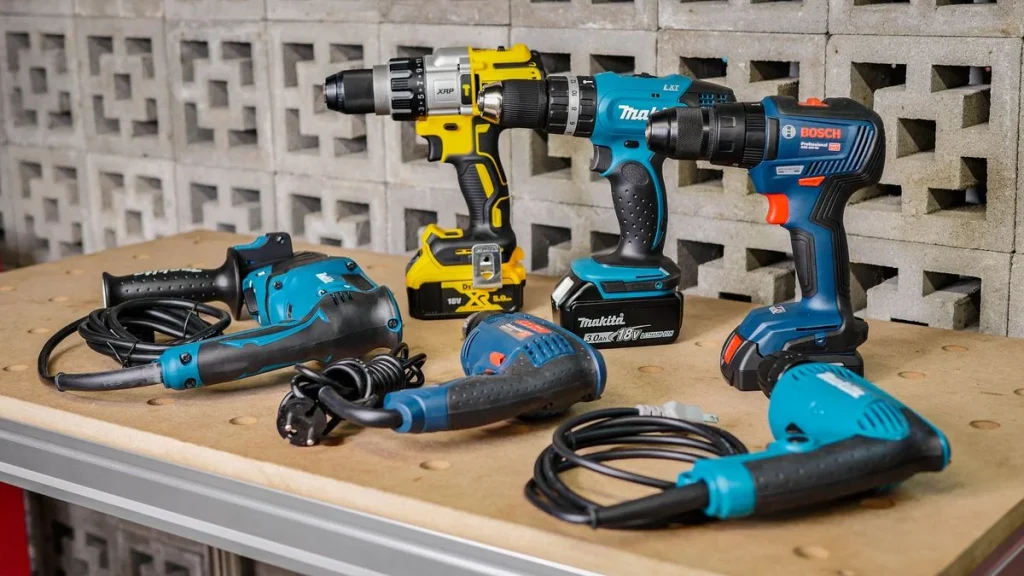
Battery-powered drills, fixed bench drills, and high-power drills are exempt from quality inspection, while hand-held AC-powered drills under 1000W — the most common product line on the market — are subject to mandatory state quality inspection before clearance.
Not every business fully understands the hand-held drill import procedure, especially the distinction between drill types by power source and wattage, which determines the quality inspection obligation. An error in HS code determination, or overlooking quality inspection registration when the goods are subject to it, can result in the entire shipment being held at port.
In this article, 3W Logistics presents the complete hand-held drill import procedure under the latest legal regulations and tariff schedule — from legal conditions, HS codes, tax calculation, and required documentation, through the step-by-step process and practical risks, from the perspective of a forwarder experienced in handling imported hand tools.
1. Legal conditions for importing hand-held drills
Hand-held drills are not on the list of prohibited import goods and are not a conditional-business item, but whether state quality inspection is required depends entirely on the power source and wattage — this is the key point in the hand-held drill import procedure that businesses need to clearly determine from the outset.
| Condition | Detailed Content |
|---|---|
| Exempt from quality inspection | Battery/rechargeable battery-powered drills (DC power), bench drills, fixed drills, and hand-held drills above 1000W are not subject to state quality inspection upon import |
| Subject to mandatory quality inspection | Hand-held drills using AC power, under 1000W, fall under the Group 2 goods list per Circular 01/2021/TT-BLDTBXH (replacing Circular 22/2018/TT-BLDTBXH), requiring mandatory state quality inspection before clearance |
| Applicable technical regulation | Assessed against QCVN 9:2012/BKHCN — the National Technical Regulation on electromagnetic compatibility for household and similar-purpose electrical and electronic equipment, together with the electrical safety standards applicable to hand-held power tools |
| Product labeling | A Vietnamese supplementary label under Decree 43/2017/ND-CP and 111/2021/ND-CP: product name, model, technical specifications (wattage, voltage), origin, and importer |
Practical note: Many businesses import several drill product lines together in one shipment (both battery drills and AC drills) and apply the same process to all of them, resulting in the AC drill portion under 1000W being missed for quality inspection registration. In the hand-held drill import procedure, clearly categorizing each product line on the packing list right from the ordering stage helps businesses proactively prepare quality inspection documentation at the right time, avoiding being caught off guard once the goods have already arrived at port.
2. HS code and import tax for hand-held drills
Hand-held drills powered by an electric motor fall under heading 8467.21 (Hand tools with self-contained electric motor) in the Import-Export Tariff Schedule, with no distinction made by power source when declaring the HS code — the AC/DC distinction only affects the quality inspection obligation, not the HS code.
| Heading/HS Code | Detailed Description | Import Tax (MFN) |
|---|---|---|
| 84.67 — Tools for working in the hand, pneumatic, hydraulic or with self-contained electric or non-electric motor | ||
| 8467.21.00 | Drills of all types (including rotary drills, hammer drills), powered by a self-contained electric motor — the most common code used when importing hand-held drills | 0–10% |
| 8467.22.00 | Saws of all types powered by a self-contained electric motor — applies when imported together with a multi-tool kit | 0–5% |
| 8467.29.90 | Other hand tools powered by a self-contained electric motor (screwdrivers, hand-held multi-purpose grinders) | 0–10% |
| 8467.91.00 – 8467.99.90 | Parts and accessories of hand tools under heading 84.67 (drill bits, batteries, chargers) imported separately | 0–5% |
Important note on HS codes and tax: For goods with a valid Certificate of Origin (C/O) from countries with an FTA with Vietnam (ASEAN, China, South Korea, EU, Japan…), the import tax on hand-held drills under heading 8467.21 is typically reduced to 0%, instead of the standard MFN rate of 5-10%. Regarding VAT, the current rate of 8% applies through December 31, 2026 under Decree 174/2025/ND-CP; after that date, businesses should check for updated policy, as the rate may revert to the standard 10%. In the hand-held drill import procedure, correctly declaring the 8-digit subheading based on the actual function of each product line is important to avoid misclassification and retroactive tax collection after clearance.
3. Documentation for the hand-held drill import procedure
The documentation set for the hand-held drill import procedure varies depending on whether the product line is subject to quality inspection, per Circular 38/2015/TT-BTC (as amended by Circular 39/2018/TT-BTC).
| Document | When to Prepare | Important Note |
|---|---|---|
| Sales Contract | Before deposit | Clearly state model, wattage, power source (AC/DC), and terms for providing the C/O |
| Commercial Invoice & Packing List | Before goods are shipped | List each product line separately by wattage and power source to easily determine which are subject to quality inspection |
| Bill of Lading | After goods are loaded onto the vessel | Hand-held drills are typically shipped in dry containers, packed in individual cartons and stacked on pallets |
| Catalogue/technical documentation | Before declaring the HS code | Serves as the basis for determining wattage and power source to apply the correct HS code and determine whether quality inspection is required |
| State quality inspection registration | Before or at the time the declaration is filed | Applies only to hand-held AC drills under 1000W, submitted via the National Single Window Portal |
| C/O (Certificate of Origin) | Before goods are shipped | Needed when goods do not qualify for 0% MFN, or to secure preferential FTA import tax |
| Electronic customs declaration (VNACCS/VCIS) | Once documentation is complete | Declare the correct HS code under heading 8467.21, and note the C/O number on the declaration if applicable |
4. Step-by-step hand-held drill import procedure
Step 1: Check technical specifications and determine the HS code
Check the hand-held drill’s technical specifications (wattage, AC/DC power source) and work with the supplier to obtain a detailed catalogue, from which the correct HS code under heading 8467.21 can be determined, along with the quality inspection status.
Step 2: Negotiate the contract and require a C/O
Sign the hand-held drill purchase contract, clearly stating wattage, power source, and model, and include a C/O requirement in the contract terms if the goods do not automatically qualify for the preferential MFN rate.
Step 3: Determine whether quality inspection applies
Cross-check the wattage and power source of each drill line in the shipment to determine which portion requires quality inspection registration under Circular 01/2021/TT-BLDTBXH, and which portion is exempt.
Step 4: Transport goods to a Vietnamese port
Hand-held drills are typically shipped in standard dry containers; sturdy carton packaging and pallet stacking are required to prevent impact from damaging the plastic housing and internal electronic components.
Step 5: Customs declaration and clearance
File the VNACCS/VCIS declaration with the full HS code and C/O number (if applicable). For drill lines subject to quality inspection, submit the inspection registration and wait for results before clearance; for exempt lines, clearance proceeds quickly once import tax and VAT have been paid in full.
Step 6: Receive goods, apply labeling, and release for circulation
After clearance, complete the required Vietnamese supplementary labeling, receive the goods, and transport them to the warehouse. Keep complete documentation on file to support post-clearance inspection if requested by customs.
5. How to calculate import tax on hand-held drills
Hand-held drills are not subject to special consumption tax — only import tax and VAT apply. As an example, for a shipment of 750W AC hand-held drills imported from China (HS code 8467.21.00) with a CIF price of VND 300 million, comparing the case with and without a C/O:
| Tax / Cost Item | Without C/O (ordinary rate 10%) | With C/O ACFTA / MFN (0%) |
|---|---|---|
| CIF price | VND 300,000,000 | VND 300,000,000 |
| Import tax | 10% × 300M = VND 30,000,000 | 0% × 300M = VND 0 |
| VAT (8%, applicable through end of 2026) | 8% × (300+30)M = VND 26,400,000 | 8% × (300+0)M = VND 24,000,000 |
| Total tax payable | VND 56,400,000 (~56.4 million) | VND 24,000,000 (~24 million) |
| Savings with C/O/MFN | ~VND 32,400,000 — not including the quality inspection cost if the shipment is subject to mandatory inspection; businesses should budget for this additionally when planning import costs. | |
From 3W Logistics’ practical experience: With hand-held drills, the most common mistake we see in the hand-held drill import procedure is that businesses fail to clearly separate product lines right from the contract and packing list — when a shipment includes both battery drills and AC drills under 1000W but they are declared under a single description line, customs may request clarification and additional quality inspection registration right at the point of declaration, delaying the clearance timeline. Clearly categorizing by model and wattage before declaration helps avoid this risk. — Ms. Apple, CCO, 3W Logistics
6. Common risks in the hand-held drill import procedure
| Risk | Manifestation | Prevention |
|---|---|---|
| Overlooking quality inspection registration | Confusing an AC drill under 1000W with the exempt category, resulting in missing documentation when the declaration is filed | Carefully verify the power source and wattage specifications of each model with the supplier before signing the contract |
| Misapplying the HS code among the 84.67 subheadings | Confusion between drills and other hand tools within the same heading 84.67 — customs reclassifies the goods and retroactively collects the tax difference under Decree 128/2020/ND-CP | Request detailed technical catalogues from the manufacturer before declaration; consult a forwarder experienced with the hand tools goods category |
| Damage to plastic housing or components during transport | Drills develop cracked housings or damaged switches/motors due to impact during long-distance transport | Require the supplier to use standard carton packaging and secure pallet stacking, and purchase adequate cargo insurance |
| Failing to track VAT policy changes | Calculating costs based on the preferential 8% VAT rate for shipments imported after the policy expires (December 31, 2026) — leading to budget discrepancies | Closely monitor new VAT policy announcements before planning long-term import schedules |
| Product label missing mandatory information | Missing wattage, voltage, or origin details on the Vietnamese supplementary label — customs holds the goods and requires supplementary labeling at port | Prepare a complete supplementary label sample under Decree 43/2017/ND-CP and 111/2021/ND-CP before the goods arrive at port |
FAQ – Frequently asked questions about the hand-held drill import procedure
Question 1: What documents are required for the hand-held drill import procedure?
The complete documentation set for the hand-held drill import procedure includes: Sales Contract; Commercial Invoice and Packing List; Bill of Lading; C/O (if needed); Catalogue/technical documentation; electronic customs declaration (VNACCS/VCIS). AC-powered drills under 1000W specifically require additional state quality inspection registration.
Question 2: Which hand-held drills require quality inspection when imported?
Only hand-held drills using AC power under 1000W are subject to mandatory quality inspection under Circular 01/2021/TT-BLDTBXH. Battery-powered drills, bench drills, fixed drills, and drills above 1000W are exempt — this is a key point to understand when carrying out the hand-held drill import procedure.
Question 3: How many types of tax must be paid when importing hand-held drills?
Hand-held drills are subject to only two layers of tax: (1) Import tax calculated on the CIF price, with a standard MFN rate of 5-10% under heading 8467.21, potentially reduced to 0% with a valid C/O; (2) VAT, currently 8% and applicable through December 31, 2026 under Decree 174/2025/ND-CP. Hand-held drills are not subject to special consumption tax.
Question 4: How long does the hand-held drill import procedure take?
For the exempt category, the total time from signing the contract to goods arriving at the warehouse is typically 15-25 days. For the category subject to quality inspection, add 5-7 working days waiting for inspection results, bringing the total to roughly 20-30 days depending on the shipping route.
How does 3W Logistics support the hand-held drill import procedure?
With experience handling a wide range of imported hand-held power tools and registration as an OTI-NVOCC with an FMC Bond (Federal Maritime Commission) in the United States, 3W Logistics provides end-to-end service for businesses on the hand-held drill import procedure — from HS code determination consulting through to goods arriving at the distribution warehouse.
Full-package logistics services at 3W Logistics:
- Consulting on accurate HS code determination based on tool function: Correctly classifying between subheadings 8467.21, 8467.22, and 8467.29, avoiding the risk of reclassification and retroactive tax collection.
- Reviewing the quality inspection status of each product line: Clearly identifying which drills are mandatory and which are exempt from quality inspection before placing orders.
- Support in calculating actual tax and optimizing preferences: Advising on leveraging the appropriate C/O for preferential FTA import tax, and keeping up to date on the latest VAT policy.
- Expertise in transporting electronics and hand tools: Ensuring proper packaging and pallet stacking to protect goods from impact.
- Electronic customs declaration via VNACCS/VCIS and resolving issues at the border gate: Declaring the correct HS code and quickly handling any requests for additional documentation.
Why choose 3W Logistics for your imported hand-held drill shipment? Although the hand-held drill import procedure is simpler than many conditional goods categories, businesses still need to correctly classify each product line by wattage and power source to accurately determine the quality inspection obligation. We stand alongside you from HS code determination through to goods arriving at the warehouse — helping businesses shorten clearance time and avoid unnecessary added costs. Contact 3W for specific advice before signing your import contract.
Address: 34 Bach Dang, Tan Son Hoa Ward, Ho Chi Minh City
Hotline: +84 28 3535 0087
____________________________
3W Logistics Hanoi Branch
Address: 81A Tran Quoc Toan, Cua Nam Ward, Hanoi
Hotline: +84 24 3202 0482
____________________________
3W Logistics Hai Phong Branch
Address: 8A Lo 28 Le Hong Phong, Gia Vien Ward, Hai Phong
Hotline: +84 225 355 5939
____________________________
3W LOGISTICS CO., LTD – We here serve you there!
Email: info@3w-logistics.com
Website: www.3w-logistics.com

Ms. Apple is the CCO (Chief Commercial Officer) at 3W Logistics, with over 10 years of experience in sales and business operations management.
At 3W Logistics, Ms. Apple is responsible for commercial strategy, corporate customer development, managing a team of more than 50 sales professionals, and improving business performance in the logistics sector.
With practical experience in sales management and market development, Ms. Apple shares professional insights on business logistics solutions, international transportation, freight forwarding, customer management, trade lane development, and growth strategies in the logistics industry.


