
Importing garment fabric is one of the most critical raw material categories for Vietnam’s textile and garment industry – a country currently ranked in the world’s Top 3 for textile and garment exports. Unlike many industrial goods categories that only run into HS code and tax complications, the garment fabric import procedure also involves an additional layer of control: regulations on formaldehyde content and aromatic amines converted from azo dyes – a factor that catches many businesses off guard once the shipment has already arrived at port.
Many businesses newly entering the market tend to focus only on determining the HS code and negotiating price, overlooking the mandatory conformity declaration required for textile products before circulation. This is the biggest difference from ordinary industrial goods categories, and also a common reason goods get held at port awaiting supplementary documentation.
In this article, 3W Logistics presents the complete garment fabric import procedure under the current legal regulations and the latest tariff schedule – from legal conditions, HS codes, tax calculation, documentation, a step-by-step process, to real-world risks, from the perspective of a forwarder experienced in handling imported textile and garment raw materials.
1. Legal conditions for importing garment fabric into Vietnam
Brand-new garment fabric is permitted for import into Vietnam and is not on the list of prohibited goods; however, unlike many other industrial goods categories, the garment fabric import procedure includes an additional mandatory quality control step that businesses cannot skip.
| Condition | Detailed Content |
|---|---|
| Used goods | Prohibited from import. Used garment fabric is on the list of goods prohibited from import; businesses may only import newly manufactured fabric |
| Testing for formaldehyde and aromatic amine content | Garment fabric must be tested for formaldehyde content and aromatic amines converted from azo dyes under QCVN 01:2017/BCT (issued together with Circular 21/2017/TT-BCT), with samples taken at a designated testing organization before customs clearance |
| Conformity declaration | Once test results confirm compliance, the business must complete a conformity declaration at the Department of Industry and Trade before circulating the goods on the market – failure to do so means distribution is not permitted |
| Declaration channel classification | Uses the standard green-yellow-red channel mechanism like ordinary goods; garment fabric, however, tends to be routed to the yellow/red channel more often since it is subject to specialized inspection |
| Product labeling | A Vietnamese supplementary label under Decree 43/2017/ND-CP and 111/2021/ND-CP: product name, material composition, fabric width, origin, and importer |
Practical note: The biggest difference in the garment fabric import procedure compared to many other industrial goods categories is that fabric cannot simply be used right after clearing customs – businesses must take samples for formaldehyde/aromatic amine testing and complete the conformity declaration before the fabric can be used in production or sold. Many businesses only prepare commercial documentation and forget this step, resulting in goods sitting in the warehouse without being usable in a compliant manner.
2. HS codes and import duty for garment fabric
Garment fabric is classified across a range spanning Chapter 50 to Chapter 60 of the export-import tariff schedule, depending on material composition (silk, cotton, wool, synthetic fiber, man-made fiber) and weaving method (woven or knitted).
| HS Code | Detailed Description | Standard Import Duty | Preferential (MFN) |
|---|---|---|---|
| Heading 52.08 — Woven cotton fabric, cotton content ≥ 85%, weighing ≤ 200 g/m2 | |||
| 5208.11.00 | Plain weave fabric, weighing not more than 100 g/m2, unbleached | 18% | 12% |
| 5208.13.00 | 3-thread or 4-thread twill fabric, including cross twill | 18% | 12% |
| 5208.31.90 | Voile fabric, dyed — other | 18% | 12% |
| 5208.59.90 | Other printed woven fabric — other | 18% | 12% |
| Heading 52.09 — Woven cotton fabric, cotton content ≥ 85%, weighing > 200 g/m2 | |||
| 5209.11.90 | Plain weave fabric, unbleached — other | 18% | 12% |
| 5209.42.00 | Denim fabric — the most common code when importing jean/denim fabric | 18% | 12% |
| 5209.39.00 | Other woven fabric (not plain or twill weave) | 18% | 12% |
| Heading 52.11 — Woven cotton fabric blended with man-made fiber, cotton content < 85%, weighing > 200 g/m2 | |||
| 5211.20.00 | Bleached fabric | 18% | 12% |
| 5211.42.00 | Denim fabric blended with man-made fiber | 18% | 12% |
| Heading 54.07 — Woven fabric of synthetic filament yarn (polyester, nylon) | |||
| 5407.10.00 | Woven fabric of textured filament yarn (including parachute fabric, lining fabric) | 12–15% | 8–10% |
| 5407.41.00 | Woven nylon mesh fabric of untwisted filament yarn, used to reinforce oilcloth | 12–20% | 8–12% |
| 5407.52.00 | Woven fabric of textured polyester yarn, dyed — a common type in fashion garments | 12–20% | 8–12% |
| 5407.61.00 | Fabric containing 85% or more non-textured polyester filament yarn | 12–20% | 8–12% |
| Heading 55.12 — Woven fabric of polyester staple fiber, content ≥ 85% | |||
| 5512.11.00 | Unbleached or bleached fabric | 12–18% | 8–10% |
| 5512.19.00 | Other woven fabric of polyester staple fiber (dyed/printed) | 12–18% | 8–10% |
| Heading 60.06 — Other knitted or crocheted fabric | |||
| 6006.22.00 | Knitted fabric of cotton, of different colored yarns | 12–20% | 10–15% |
| 6006.32.90 | Knitted fabric of polyester yarn, elastic (stretch) — a common type for T-shirts and sportswear | 12–20% | 10–15% |
| 6006.42.00 | Knitted fabric of man-made fiber, dyed | 12–20% | 10–15% |
Important note on HS code and duty: For garment fabric imported from China, ASEAN (Thailand, Indonesia, Malaysia), South Korea, or Japan with a valid C/O (Form E, D, AK, VJ, etc.), businesses may enjoy a special preferential import duty, even 0%, instead of the standard 8-20% MFN rate depending on the HS code. Regarding VAT, the current 8% rate applies through December 31, 2026 under Decree 174/2025/ND-CP; after this date, businesses should check for updated policy, as the rate may revert to the standard 10%. In the garment fabric import procedure, correctly determining the HS code based on material composition and weave type — based on a fiber composition test report — is an important factor in avoiding an incorrect code and retroactive tax collection.
3. Documentation for the garment fabric import procedure
The documentation package for the garment fabric import procedure includes an additional layer of specialized inspection documentation compared to ordinary industrial goods, per Circular 38/2015/TT-BTC (amended by Circular 39/2018/TT-BTC) and Circular 21/2017/TT-BCT.
| Document | When to Prepare | Important Note |
|---|---|---|
| Sales Contract | Before placing a deposit | Must clearly state material composition, fabric width, origin, and C/O provision terms |
| Commercial Invoice & Packing List | Before the goods are shipped | Must fully state the product name, composition %, and meters/kg for each fabric type |
| Bill of Lading | After the goods are loaded onto the vessel | Garment fabric is typically shipped in dry containers; fabric rolls need moisture-proof wrapping to prevent mold and staining during transport |
| Formaldehyde/aromatic amine test result report | After the goods arrive, before the conformity declaration | Samples taken at a designated testing organization; a mandatory basis for completing the conformity declaration under QCVN 01:2017/BCT |
| C/O (Certificate of Origin) | Before the goods are shipped | Necessary to enjoy special preferential import duty under an FTA (Form E, D, AK, VJ, etc.) instead of the standard MFN rate |
| Electronic customs declaration (VNACCS/VCIS) | Once documentation is complete | Declare the correct HS code under Chapters 50-60, noting the C/O number on the declaration if applicable |
4. Step-by-step garment fabric import procedure
Step 1: Check material composition and determine the HS code
Check the material composition (proportion of cotton, synthetic fiber, man-made fiber), the weave type (woven/knitted), and work with the supplier to obtain a fiber composition test report, from which the correct HS code under Chapters 50-60 can be accurately determined.
Step 2: Negotiate the contract and request the C/O
Sign the contract to purchase the garment fabric, clearly stating material composition and fabric width, and requesting the C/O in the contract terms if seeking special preferential import duty under an FTA.
Step 3: Transport the goods to a Vietnamese port
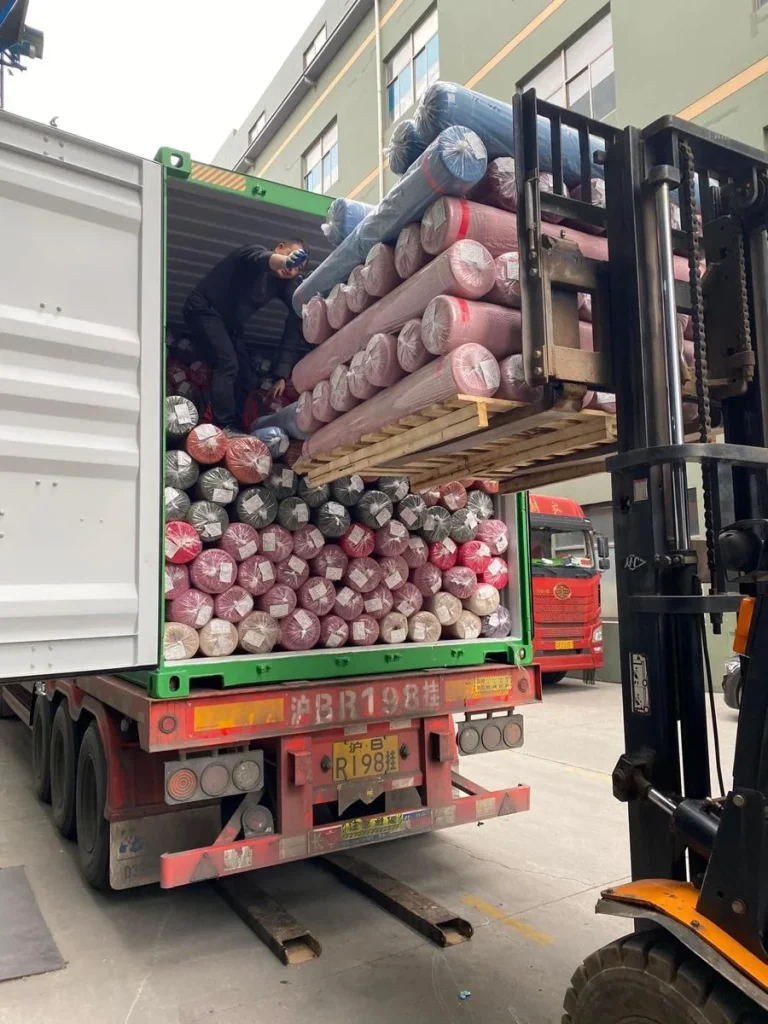
Garment fabric is typically shipped in standard dry containers; must be wrapped with moisture-proof film and rolled/stacked correctly to avoid mold, staining, or crease damage during long-distance transport.
Step 4: Customs declaration and specialized inspection registration
Open the VNACCS/VCIS declaration while simultaneously registering to take samples for formaldehyde and aromatic amine testing at a designated organization — this is a mandatory step specific to garment fabric compared to many other industrial goods.
Step 5: Clearance after receiving test results
Once the test result report confirms compliance and the import duty and VAT are fully paid, the customs authority will clear the shipment.
Step 6: Complete the conformity declaration, label the goods, and circulate them
Complete the conformity declaration at the Department of Industry and Trade, apply the Vietnamese supplementary label per regulations, receive the goods, and put them into production or sale. Keep complete documentation on file to support post-clearance inspection if requested by the authorities.
5. How to calculate import duty for garment fabric
Garment fabric is not subject to special consumption tax, only import duty and VAT. For example, take a shipment of polyester fabric imported from China (HS code 5407.61), with a CIF value of VND 800 million, comparing the case with and without a C/O Form E:
| Tax / Cost Item | No C/O (MFN 12%) | With C/O Form E (0%) |
|---|---|---|
| CIF Value | VND 800,000,000 | VND 800,000,000 |
| Import duty | 12% × 800M = VND 96,000,000 | 0% × 800M = VND 0 |
| VAT (8%, applicable through 2026) | 8% × (800+96)M = VND 71,680,000 | 8% × (800+0)M = VND 64,000,000 |
| Total tax payable | VND 167,680,000 (~167.7 million) | VND 64,000,000 (~64 million) |
| Savings with a C/O Form E | ~VND 103,680,000 — note that the current 8% VAT rate is a temporary preferential policy applicable through December 31, 2026; businesses should monitor for updates for shipments after this date. The cost of formaldehyde/aromatic amine testing and the conformity declaration fee are calculated separately and are not included in the tax table above. | |
From 3W Logistics’ real-world experience: With garment fabric, the most common mistake we see in the garment fabric import procedure is not about the HS code or tax, but businesses forgetting to register for formaldehyde/aromatic amine sample testing right when opening the declaration — leaving the shipment “stuck” at port awaiting supplementary procedures while container and storage demurrage fees pile up. Proactively registering for the specialized inspection in parallel with the customs declaration from the start significantly shortens clearance time. – Ms. Apple, CCO, 3W Logistics
6. Common risks in the garment fabric import procedure
| Risk | Manifestation | Prevention |
|---|---|---|
| Overlooking the conformity declaration requirement | Goods cleared through customs but no conformity declaration yet completed — not permitted for circulation or use in production | Register for formaldehyde/aromatic amine sample testing and prepare conformity declaration documentation in parallel with customs declaration |
| Wrong HS code between Chapters 50-60 | Confusion between cotton, synthetic fiber, and man-made fiber materials — customs reclassifies, collects the duty difference retroactively, and may impose a penalty several times the shortfall under Decree 128/2020/ND-CP | Request a fiber composition test report from the manufacturer before declaring; consult a forwarder experienced in textile goods |
| Fabric mold or staining during transport | Fabric rolls become damp, moldy, or stained due to substandard packing during long-distance transport | Require the supplier to use moisture-proof film wrapping, load the container correctly, and purchase full cargo insurance |
| Not tracking VAT policy changes | Calculating costs at the preferential 8% VAT rate for a shipment imported after the policy expires (December 31, 2026) — a cost estimation error | Closely track new VAT policy announcements before planning long-term imports |
| Product label missing mandatory information | Missing material composition or origin on the Vietnamese supplementary label — customs holds the goods and requests a supplementary label at the port | Prepare a complete supplementary label sample under Decree 43/2017/ND-CP and 111/2021/ND-CP before the goods reach port |
FAQ – Frequently asked questions about the garment fabric import procedure
Question 1: What documents does the garment fabric import procedure require?
The complete documentation package for the garment fabric import procedure includes: the Sales Contract; Commercial Invoice and Packing List; Bill of Lading; C/O (if needed); the formaldehyde/aromatic amine test result report; and the VNACCS/VCIS electronic customs declaration. After clearance, the business also needs to complete the conformity declaration documentation before circulation.
Question 2: Is garment fabric required to be tested for formaldehyde and aromatic amines?
Yes. This is the biggest difference in the garment fabric import procedure compared to many other industrial goods categories — all imported garment fabric must be tested for formaldehyde content and aromatic amines converted from azo dyes under QCVN 01:2017/BCT, and must undergo a conformity declaration before it can be circulated on the market.
Question 3: How many types of tax must be paid when importing garment fabric?
Garment fabric is subject to two layers of tax: (1) Import duty, calculated on the CIF value, ranging from 8-20% depending on the HS code under the MFN tariff schedule, which can be reduced to 0% with a valid FTA C/O (Form E, D, AK, VJ, etc.); and (2) VAT, currently 8%, applicable through December 31, 2026 under Decree 174/2025/ND-CP. Garment fabric is not subject to special consumption tax.
Question 4: How long does the garment fabric import procedure take?
The total time from signing the contract to the goods being eligible for circulation is typically 20-35 days, longer than some other industrial goods categories due to the wait for specialized test results. Within this: transport from China takes 5-10 days, from India/Bangladesh takes 20-25 days; customs declaration and clearance take 3-5 days; testing and conformity declaration take 5-10 working days.
How does 3W Logistics support the garment fabric import procedure?
With experience handling a wide range of imported textile and garment raw materials, and registered as an OTI-NVOCC with an FMC bond (Federal Maritime Commission) in the United States, 3W Logistics provides a full-package service for businesses on the garment fabric import procedure — from HS code determination advisory through to the goods being eligible for production use.
Full-package logistics service at 3W Logistics:
- Advisory on accurately determining the HS code by material composition: Correctly classifying across Chapters 50-60, avoiding the risk of reclassification and retroactive tax collection.
- Support registering for formaldehyde/aromatic amine testing: Connecting with a designated testing organization, registering for sample collection in parallel with customs declaration to shorten the timeline.
- Support with the conformity declaration: Preparing documentation and carrying out the conformity declaration procedure at the Department of Industry and Trade once test results confirm compliance.
- Expertise in transporting textile goods: Ensuring standard-compliant moisture-proof packing to protect fabric quality throughout the journey.
- Electronic customs declaration via VNACCS/VCIS and resolving issues at the border: Declaring the correct HS code, quickly handling any requests for supplementary documentation that arise.
Why choose 3W Logistics for your garment fabric import shipment? The garment fabric import procedure requires businesses to manage two workstreams simultaneously — standard customs declaration and specialized formaldehyde/aromatic amine inspection — and without smooth coordination, unplanned storage and demurrage costs can easily arise. We stand alongside you from the HS code determination step through to the goods being eligible for circulation — helping your business shorten customs clearance time and avoid unnecessary additional costs. Contact 3W for specific advice before signing your import contract.
Address: 34 Bach Dang, Tan Son Hoa Ward, Ho Chi Minh City
Hotline: +84 28 3535 0087
____________________________
3W Logistics Hanoi Branch
Address: 81A Tran Quoc Toan, Cua Nam Ward, Hanoi
Hotline: +84 24 3202 0482
____________________________
3W Logistics Hai Phong Branch
Address: 8A Lot 28 Le Hong Phong, Gia Vien Ward, Hai Phong
Hotline: +84 225 355 5939
____________________________
3W LOGISTICS CO., LTD – We here serve you there!
Email: info@3w-logistics.com
Website: www.3w-logistics.com

Ms. Apple is the CCO (Chief Commercial Officer) at 3W Logistics, with over 10 years of experience in sales and business operations management.
At 3W Logistics, Ms. Apple is responsible for commercial strategy, corporate customer development, managing a team of more than 50 sales professionals, and improving business performance in the logistics sector.
With practical experience in sales management and market development, Ms. Apple shares professional insights on business logistics solutions, international transportation, freight forwarding, customer management, trade lane development, and growth strategies in the logistics industry.


