
Export Wood Pellets in Vietnam 2026 (Sawdust Pellets)
In the context of the global energy transition, export wood pellets from Vietnam is becoming increasingly important as this product emerges as a key driver in the country’s forestry sector. However, to ensure smooth customs clearance and minimize risks, businesses must clearly understand the full export process—from legal requirements to documentation. This article provides the latest 2026 update on how to export wood pellets from Vietnam efficiently and in compliance with regulations.
1. Legal Framework for Export Procedures for Wood Pellets
Before preparing documentation, businesses must address two fundamental questions: Is this product allowed for export? and Which legal regulations govern this activity? Understanding these will help ensure a smooth process throughout the entire export procedure.
Are Wood Pellets Prohibited from Export?
The short answer is: No. Wood pellets are not included in Vietnam’s list of prohibited export goods.
In addition to the prohibited goods list, plantation timber and processed wood products such as plywood and wood pellets are fully permitted for export. The primary legal basis is Decree No. 69/2018/ND-CP (dated May 15, 2018) on the management of import and export goods, in which wood pellets are not listed under any prohibited or restricted categories.
However, there is one mandatory condition:
Wood and wood-based products can only be exported when legal timber documentation is fully provided in accordance with current regulations. Businesses must declare the quantity and type of goods to Customs authorities and take full responsibility for proving the legality of the timber source.
Conclusion: Wood pellet exports are allowed, but businesses must prove the legal origin of input materials. This is a common challenge for new exporters and will be explained in detail in the documentation section below.
⚠️ Additional note: Wood and wood products listed under CITES Appendices require a CITES permit issued by the Vietnam CITES Management Authority. Wood pellets produced from plantation timber typically do not fall under this category; however, businesses should verify raw material sources to avoid unexpected compliance issues.
Key Legal Documents for Wood Pellet Exports in 2026
Group 1 – Forestry Management and Timber Legality
Circular No. 26/2022/TT-BNNPTNT issued by the Ministry of Agriculture and Rural Development regulates forest product management, traceability, and documentation procedures. Chapter III outlines the requirements for proving legal harvesting, production, and export of forest products. This is the most critical regulation for wood pellet exporters.
Decree No. 102/2020/ND-CP establishes Vietnam’s Timber Legality Assurance System (VNTLAS), forming the basis for implementing commitments with the EU under the VPA/FLEGT Agreement to combat illegal logging.
Group 2 – Customs Procedures
Circular No. 38/2015/TT-BTC, amended by Circular No. 39/2018/TT-BTC, regulates customs procedures, inspection, and supervision for exported goods, including wood pellets.
Group 3 – HS Codes and Product Classification
Circular No. 11/2021/TT-BNNPTNT provides the HS code system for goods under the management of the Ministry of Agriculture and Rural Development, helping businesses correctly classify products for customs declaration.
Group 4 – Phytosanitary Requirements
Circular No. 30/2014/TT-BNNPTNT governs plant quarantine for exports, serving as the legal basis for obtaining a Phytosanitary Certificate before shipment.
2. HS Code and Tax in Export Procedures for Wood Pellets in Vietnam
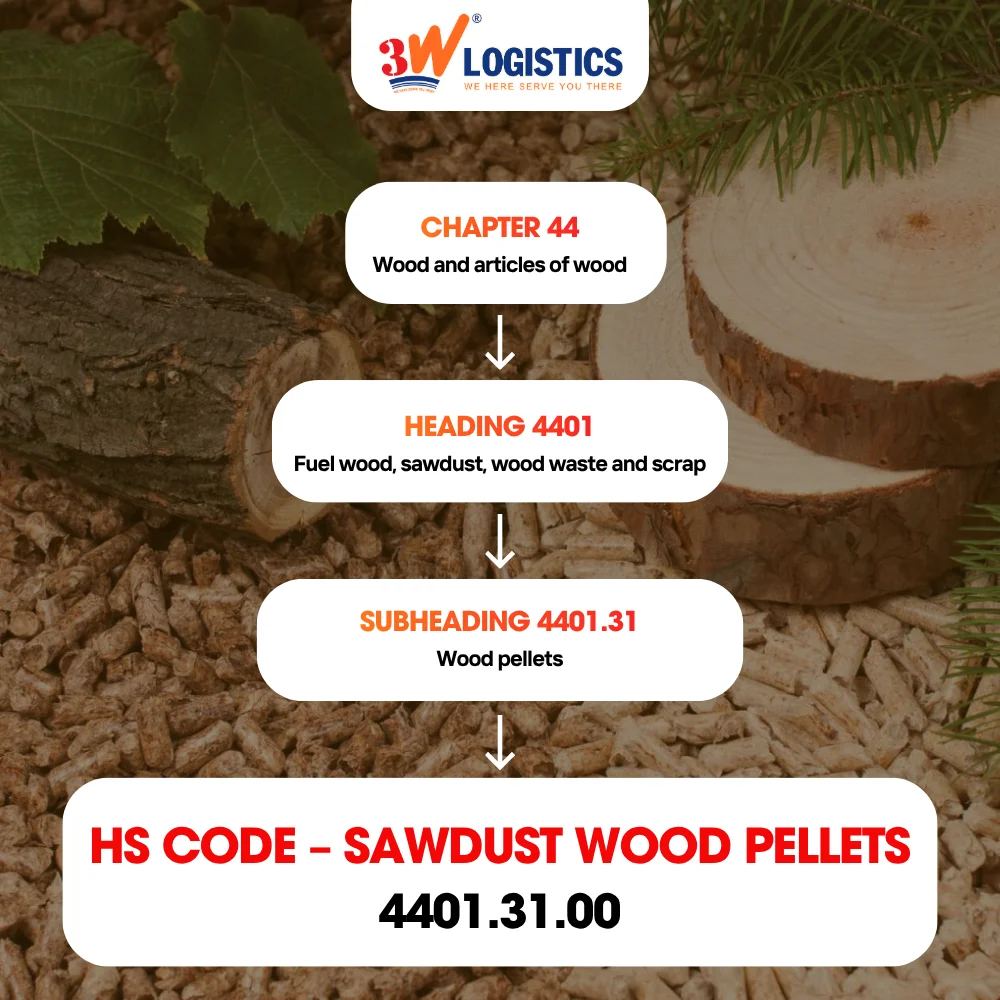
2.1 HS Code Lookup for Wood Pellets in Vietnam (44013100)
- HS Code: 4401.31.00
According to the current import-export tariff schedule, wood pellets are classified under Section IX – Chapter 44 (Wood and Articles of Wood).
Reference: https://caselaw.vn/chi-tiet-ma-hs/44013100
⚠️ Important Notes When Determining HS Code:
If your company’s pellets are made from a mixture of wood and non-wood materials, customs authorities may require composition analysis. To minimize risks, it is advisable to obtain certified laboratory test results verifying the raw material composition prior to export.
2.2 Export Duty and VAT
Wood pellets are NOT subject to export duty, which is a major advantage for businesses. Therefore, companies engaging in wood pellet exports are not required to pay any export tax.
3. Required Documentation
This is the step where many first-time exporters make mistakes. The documentation for wood pellet exports consists of two main groups: commercial documents (similar to other export goods) and forestry documentation (specific to wood products). Missing either group will prevent customs clearance.
3.1 Commercial Documents
These are the standard documents required for all export shipments, including wood pellets:
- Sales Contract: Must clearly state product name, HS code, unit price, Incoterms, and payment terms.
- Commercial Invoice: Information must match exactly with the Packing List and Bill of Lading. This is one of the most common reasons for customs delays.
- Packing List: Specifies number of bags/tons, net/gross weight, and container numbers.
- Bill of Lading (B/L): Issued by the shipping line after cargo is loaded. For wood pellet exports, Ocean B/L is typically used.
- Certificate of Origin (C/O Form B): Not mandatory under Vietnamese law but often required by importing markets for preferential tariffs. Issued by VCCI or the Ministry of Industry and Trade.
3.2 Legal Forestry Documentation
This is the key difference compared to regular export goods. Since wood pellets are made from wood or wood residues, businesses must prove the legality of the timber source in accordance with Circular 26/2022/TT-BNNPTNT and Decree 102/2020/ND-CP.
The Forest Product Declaration Form is the most critical document in this group. As regulated in Circular 26/2022, it includes details such as wood species, volume, unit of measurement, and origin. The head of the processing facility must sign and take legal responsibility for the declaration.
In addition, businesses must prepare:
- Input material invoices (sawdust, wood chips, factory residues): All invoices must be retained to demonstrate a legal supply chain.
- Proof of timber origin, depending on the type of raw materials used.
⚠️ Practical note: Many businesses purchase sawdust from small workshops without VAT invoices. In such cases, an internal purchase declaration must be prepared and signed by the supplier to ensure document validity.
3.3 Phytosanitary Certificate
Wood pellets are plant-based products and must undergo plant quarantine inspection before export in accordance with phytosanitary regulations. This step must be completed before stuffing cargo into containers.
Fumigation
Some importing markets require fumigation prior to export:
- Japan, South Korea: Typically require fumigation using Methyl Bromide or heat treatment.
- European Union: Depends on buyer requirements; not mandatory across all shipments but often included in contracts.
If fumigation is not required, a Phytosanitary Certificate alone is sufficient.
After fumigation, a Fumigation Certificate will be issued and included in the customs documentation together with the Phytosanitary Certificate.
4. Step-by-Step Export Procedures for Wood Pellets
The entire wood pellet export process consists of 6 steps that must be followed in order. Skipping or rearranging steps may result in customs rejection or cargo being held at the port.
Step 1: Register for Phytosanitary Inspection and Fumigation
This must be completed before container stuffing to ensure the inspection reflects the actual shipment.
Required documents:
- Phytosanitary application form
- Sales Contract
- Commercial Invoice + Packing List
Result: After inspection, the Phytosanitary Certificate is issued within 1–2 working days.
Step 2: Prepare Customs Documentation
Refer to the documentation requirements listed above.
Step 3: Submit Electronic Customs Declaration
Submit the declaration via the VNACCS/VCIS system (Vietnam’s national electronic customs system). Businesses can self-declare or authorize a customs broker.
⚠️ Note: Incorrect HS codes are the most common and time-consuming error. Always verify before submission, especially for mixed-material shipments.
Step 4: Declaration Submission and Channel Classification
After submission, VNACCS automatically assigns one of three channels: Green, Yellow, or Red, based on compliance history and shipment characteristics.
First-time exporters or those with limited compliance records are more likely to be assigned Yellow or Red channels. Over time, consistent compliance increases the likelihood of Green channel clearance.
Step 5: Physical Inspection and Customs Clearance
- Green/Yellow channel: Clearance is granted after document verification. Cargo is loaded onto the vessel.
- Red channel: Physical inspection of the container is required at the port.
Once approved, customs confirms: “Goods have passed the supervision area” and grants official clearance.
Step 6: Finalization and Export Confirmation
After the cargo is loaded and the vessel departs:
- Update export status: The exporter or customs broker updates shipment details (export date, B/L number, vessel name, voyage) in VNACCS. Customs confirms and closes the declaration.
- Obtain export confirmation (critical): This is essential for VAT refund claims. Without this document, input VAT cannot be reclaimed.
- Document retention: All export documents must be stored for at least 5 years in accordance with customs and tax regulations.
Estimated Processing Time
- Phytosanitary: 1–2 days
- Documentation preparation: 1 day
- Declaration & clearance: 1–3 days (depending on channel)
👉 Total: Approximately 3–6 working days for a smooth shipment.
5. FAQs on Export Procedures for Wood Pellets (FAQ)
Question 1: What additional documents are required for wood pellet exports to Japan, South Korea, and the EU?
Each market has its own requirements, but in general:
- Japan & South Korea: Require both a Phytosanitary Certificate and a Fumigation Certificate. Importers usually specify the permitted fumigation chemicals (commonly Methyl Bromide or Phosphine).
- EU: In addition to phytosanitary requirements, most EU buyers now require SBP (Sustainable Biomass Program) or FSC certification as a commercial condition. Some large contracts may also require ENplus/DINplus certificates to verify fuel quality.
⚠️ General note: Always confirm documentation requirements with the buyer before signing the contract to avoid unexpected costs later.
Question 2: Can wood pellet exports proceed without FSC certification?
Yes. FSC is not a mandatory requirement under Vietnamese law.
However, in practice:
- Buyers in the EU, UK, and Northern Europe often reject shipments without FSC or SBP
- Lack of certification may reduce selling prices by 5–15%
- Some EU ports may require additional declarations if sustainability certificates are missing
→ For buyers in Japan, South Korea, and Taiwan, FSC is generally not required, making these markets more suitable for businesses without certification.
Question 3: How long does the entire process take?
From warehouse readiness to vessel loading, the process typically takes 3–5 working days, including:
- Phytosanitary registration & issuance: 1–2 days
- Fumigation (if required): 1 day
- Customs declaration & clearance: 1–2 days (Green/Yellow channel; longer for Red channel)
- Container release & yard drop-off: 1 day
→ It is recommended to start preparing documents at least 1 week before the vessel cut-off date.
Question 4: Are wood pellets considered dangerous goods?
Wood pellets are classified as flammable cargo under IMO regulations when transported in large quantities by sea. This means:
- Proper declaration of dangerous goods name on the Bill of Lading and Manifest
- Some shipping lines have specific stowage requirements
- Moisture content must be controlled below 10%, and container ventilation must be ensured to prevent self-heating
→ Businesses should inform the freight forwarder in advance for proper booking arrangements.
6. 3W Logistics – Comprehensive Support for Wood Pellet Export Procedures
In practice, wood pellet export procedures go beyond document preparation—they require precision at every stage, from legal compliance and customs declaration to handling requirements from shipping lines and authorities.
Without experience, businesses may face delays, documentation errors, or unexpected costs.
Understanding these challenges, 3W Logistics provides a comprehensive solution to help businesses optimize the entire wood pellet export process efficiently and effectively. Specifically, 3W offers:
- Consulting on legal regulations and export conditions by market (Japan, South Korea, EU, etc.)
- Support in preparing and verifying complete and accurate export documentation
- Customs declaration and clearance handling to minimize risks
- Vessel booking and coordination of domestic and international transportation
- End-to-end shipment tracking with continuous updates
With practical experience and a professional team, 3W Logistics not only assists businesses in completing wood pellet export procedures but also optimizes cost and time, ensuring smooth operations from start to finish.
📞 Contact 3W Logistics for free consultation on wood pellet export procedures, freight quotations, and full-service logistics solutions.
CONTACT INFORMATION
Head Office – 3W Logistics Ho Chi Minh Branch
Address: 34 Bach Dang, Tan Son Hoa Ward, Ho Chi Minh City
Hotline: +84 28 3535 0087
____________________________
3W Logistics Hanoi Branch
Address: 8A, Lot 28 Le Hong Phong, Gia Vien Ward, Hai Phong
Hotline: +84 24 3202 0482
____________________________
3W Logistics Hai Phong Branch
Address: 81A Tran Quoc Toan, Cua Nam Ward, Hanoi
Hotline: +84 225 355 5939
____________________________
3W LOGISTICS CO., LTD – We here serve you there!
Email: quote@3w-logistics.com
Website: www.3w-logistics.com

Hello, I’m Nguyen Phuong Nhan (Ms. Nina)
I currently serve as Trade Lanes Supervisor at 3W Logistics, with more than 10 years of experience in international logistics and freight forwarding.
My primary responsibility is developing and managing global logistics partnerships, building strategic trade lanes, and working closely with overseas agents to provide reliable and competitive transportation solutions for customers.
I regularly collaborate with agents and logistics partners worldwide to explore new business opportunities, negotiate freight rates, develop trade routes, and support import-export shipments. I also work closely with our sales team to design logistics solutions tailored to specific markets and customer requirements.
My expertise includes Ocean Freight, Air Freight, Trade Lane Development, Global Agent Network Management, International Logistics Solutions, and Import-Export Support.
Through the articles I share on the 3W Logistics website, I aim to provide practical insights into the international logistics industry, global transportation trends, overseas agent cooperation, and effective logistics strategies that help businesses optimize their supply chain operations.
I believe that strong global partnerships and well-developed trade lanes are essential to delivering sustainable logistics solutions and long-term value to customers worldwide.


