

Export fruit packaging specifications are mandatory technical requirements that every growing region, packing facility, or fresh fruit exporting business must strictly comply with before loading goods into containers – especially in the context where China, the largest consumption market for Vietnamese fruit, has just signed an additional phytosanitary protocol for pomelo and lemon (April 15, 2026), and Vietnam has just issued a new legal framework on growing region codes and packing facility codes from early 2026.
In this article, 3W Logistics compiles the complete set of export fruit packaging specifications that meet current Vietnamese legal standards – from Decree 38/2026/ND-CP on growing region and packing facility codes, Resolution 36/2026/NQ-CP on procedure simplification, to bilateral phytosanitary protocols with each individual market – from the perspective of a forwarder with over 10 years of experience shipping agricultural export goods.
1. Why are export fruit packaging specifications critically important?
Fresh fruit is an extremely sensitive commodity – sensitive to temperature, humidity, mechanical impact, and natural ripening speed (due to ethylene gas produced during respiration) – throughout the shipping journey, ranging from a few days by sea to China or ASEAN, to 25-35 days to Europe or the US. Unlike rice or dried agricultural products, fresh fruit has no large “margin for error”: incorrect packaging can cause an entire shipment to become bruised, over-ripened, or spoiled before reaching the destination port, even when the initial quality was fully up to standard.
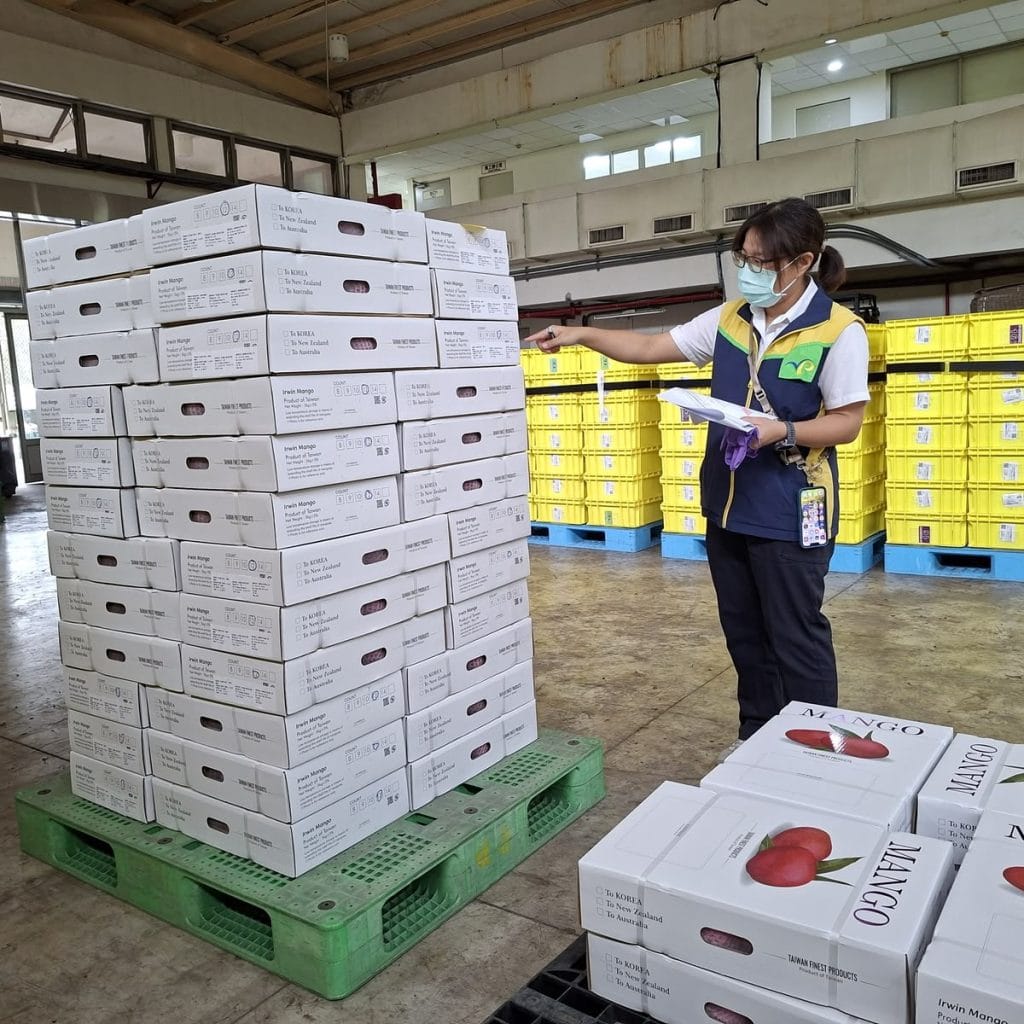
Export fruit packaging specifications today are governed simultaneously by three layers of regulation, making them significantly more complex than for dried agricultural products:
- Domestic legal requirements: Decree 38/2026/ND-CP dated January 24, 2026 regulates growing region codes and packing facility codes (replacing the previously scattered regulations in Circular 11/2021/TT-BNNPTNT), further simplified by Resolution 36/2026/NQ-CP dated July 31, 2026 toward digitalization – self-declaration – post-clearance inspection – traceability.
- Food safety and labeling requirements: Article 19 of Decree 15/2018/ND-CP on labeling, preservation, and packaging for products subject to food safety management; Decree 43/2017/ND-CP as amended by Decree 111/2021/ND-CP on mandatory content on export product labels.
- Specific requirements of each import market: Each bilateral protocol (China, Japan, Australia, the US…) sets out different detailed requirements regarding approved growing region/packing facility codes, quarantine treatment methods, packaging specifications, and even technical details such as the number of days of pre-harvest fruit bagging.
Important note: Under Decree 38/2026/ND-CP, packing facilities serving export must have a specific physical location, organize their workshop following a one-way flow principle, have clearly defined functional zones, be equipped for receiving – sorting – preliminary processing – packing – storage, and have a pest control process in place. Businesses may only export fruit from growing regions and packing facilities that already hold valid codes, issued by the specialized authority (Department of Crop Production and Plant Protection) and, depending on the market, that have also been approved by the customs/quarantine authority of the importing country before participating in export activities.
2. Distinguishing growing region codes from packing facility codes
This is a point that many businesses new to fruit export often confuse, even though both types of codes are prerequisites before even discussing specific packaging specifications.
| Item | Growing Region Code | Packing Facility Code |
|---|---|---|
| Management scope | The area where crops are grown – answers the question “where was the fruit grown” | The facility that receives, preliminarily processes, and packs – answers the question “where was the fruit processed and packed” |
| Main requirements | Appropriate production process, maintaining production-harvest records; if serving export, must also meet the importing country’s phytosanitary and food safety requirements | Hard, clean flooring, workshop arranged in a one-way flow, with a separate processing/treatment/storage area; the packing process must include sorting, cleaning, and removing diseased/damaged/deformed fruit and plant residue |
| Legal basis | Article 6, Decree 38/2026/ND-CP | Article 7, Decree 38/2026/ND-CP |
| Issuing/managing authority | Department of Crop Production and Plant Protection (via the provincial specialized agency that compiles the application) | Department of Crop Production and Plant Protection; for markets with their own protocol (China, Japan…), additional approval from the importing country’s quarantine authority is also required |
Since January 20, 2026, regional Plant Quarantine Sub-Departments have tightened quarantine procedures for fresh fruit shipments that are not exported directly by the owner of the growing region/packing facility code, after discovering that a number of durian and jackfruit shipments failed to comply with traceability requirements.
3. Fruit quality standards before packaging
Export fruit packaging specifications are only meaningful when the fruit entering the packing process already meets pre-processing standards – this is the decisive step ensuring the fruit does not get bruised, over-ripened, or infested with pests inside a sealed container over a long journey.
| Criterion | Standard Requirement | Rejected / Downgraded When |
|---|---|---|
| Harvest ripeness | Harvested at a physiological ripeness level suited to the shipping duration (typically 75-85% for distant markets); sorted for uniform ripeness within the same batch | Over-ripe harvesting bruises easily, generates heat, and accelerates ripening of surrounding fruit due to ethylene gas spreading inside sealed packaging |
| Appearance, defects | No bruising, scratches, cracked skin, or borer damage; removed immediately at the packing facility per Decree 38/2026/ND-CP before placement into secondary packaging | Diseased, deformed, or pest-infested fruit detected – the packing facility is required to remove it under the regulations |
| Pesticide residue (MRL) | Meets the MRL threshold set by the importing country; accompanied by a test report from a recognized testing laboratory, particularly for cadmium and Auramine O when exporting durian to China | Exceeds the MRL threshold of the destination market – the EU applies particularly strict controls and regularly tightens additional active ingredients under its multi-year monitoring program |
| Phytosanitary inspection | No live insects or insect eggs belonging to the importing country’s quarantine pest list; quarantine treatment measures (cold treatment, irradiation, fumigation…) applied if required by the importing country | Fruit flies or pests on the quarantine list detected – the shipment is rejected, returned, or forced into re-treatment at the destination port |
| Post-harvest hygiene | Washed clean and fully drained before packing (a minimum of a few hours, depending on the fruit type); branches, leaves, soil, and plant residue removed from the fruit surface | Packing while the fruit is still wet – accelerates mold growth and spoilage in the sealed environment of the packaging and container |
4. Packaging material standards for export fruit
This is the core section of export fruit packaging specifications, with major differences depending on the fruit type – thin-skinned fruit prone to bruising (rambutan, lychee, dragon fruit) requires an entirely different approach from thick-skinned fruit (durian, jackfruit, watermelon, pomelo).
| Packaging Parameter | Specific Requirement | Reason / Notes |
|---|---|---|
| Packaging material | 100% new corrugated cardboard boxes or foam (EPS) boxes for small-to-medium, thin-skinned fruit; woven PP sacks or breathable mesh bags for large, thick-skinned fruit (jackfruit, durian, watermelon) | Carton boxes must meet the burst strength test method per TCVN 7632:2007 (ISO 2759:2001, approximately 350-5,500 kPa depending on grade) to withstand stacking and impact during repeated handling |
| Ventilation holes | Boxes perforated with ventilation holes on the sides and bottom to release ethylene gas and moisture; the ventilation hole area typically accounts for 5-8% of the box’s surface area | A lack of ventilation holes causes ethylene to accumulate, accelerating ripening and generating localized heat – a common cause of mass spoilage inside sealed containers |
| Cushioning and shock-absorbing material | Paper lining or foam net wrapped around each individual fruit for thin-skinned, bruise-prone varieties; cardboard partitions dividing compartments so fruit does not rub directly against each other | Lack of cushioning causes fruit to collide during long-distance transport, particularly through multiple handling stages at transshipment ports |
| Packaging weight | Commonly 5 kg, 10 kg, 15-18 kg per carton for retail markets (EU, Japan, US, South Korea); larger sacks or boxes of 20-30 kg for China and ASEAN markets purchasing by truckload/container | Overly heavy boxes easily cause crushing of the bottom layer of fruit due to weight pressing down when stacked multiple tiers high inside a container |
| Pre-packaging preservation treatment | Washing with ozonated water or a food-safe disinfectant solution; waxing the stem area (for certain fruit types) to limit bacterial entry; pre-cooling before loading into a reefer container | Loading fruit that is still warm from recent harvest directly into a cold container causes condensation inside the packaging, creating conditions for mold growth |
| Container and shipping temperature | Refrigerated (reefer) container with a separate temperature setting for each fruit type (typically 5-13°C for fresh tropical fruit); for frozen fruit (frozen durian exported to China), it must be flash-frozen at -35°C for a minimum of 8 hours and maintain a core temperature of -18°C or lower throughout storage and transport | Temperature deviation inside reefer containers is the leading cause of quality complaints when fresh fruit travels by sea over long durations |
5. Mandatory labeling requirements on export fruit packaging
Labels on fruit packaging must comply simultaneously with Decree 43/2017/ND-CP (amended and supplemented by Decree 111/2021/ND-CP, effective from February 15, 2022) and the specific requirements of each market’s protocol:
| Label Information | Mandatory Content | Practical Notes |
|---|---|---|
| Product name | Specific fruit type, variety if applicable (Ri6 durian, Da Xanh pomelo, Cat Chu mango…) in Vietnamese and English or the importing country’s language | Per Article 10 of Decree 43/2017/ND-CP (amended by Decree 111/2021/ND-CP), the product name is the first mandatory item on every label of goods in circulation and export |
| Growing region and packing facility codes | Clearly printed growing region code and packing facility code issued under Decree 38/2026/ND-CP on each box/sack | Mandatory for markets with their own protocol such as China – a missing or incorrect code is a common cause of shipments being held at the border checkpoint |
| Business name and address | Name of the packing facility or exporting trader responsible for the goods; full address | The packing facility name on the label must match the registered packing facility code and align with the phytosanitary documentation accompanying the shipment |
| Product origin | “Product of Vietnam” or “Xuất xứ Việt Nam”, expressed using one of the prescribed phrases (made in, origin, product of…) along with the country/territory name | The origin on the label must match the C/O declared to customs to qualify for tariff preferences under FTAs such as ACFTA, EVFTA, and CPTPP |
| Net weight and packing date | Net weight (kg) clearly printed; packing date (DD/MM/YYYY) and recommended shelf life based on the specific storage characteristics of each fruit type | Since fresh fruit has a much shorter storage life than dried agricultural products, the packing date is important data for the partner to manage the product’s lifecycle once it arrives at the warehouse |
| Storage instructions and traceability code | Clearly stated storage conditions (recommended temperature, avoid direct sunlight); accompanied by a QR code or GS1 barcode linking growing region – packing facility – batch data | The nationwide traceability system is being digitized and synchronized under Decree 38/2026/ND-CP; QR codes are increasingly becoming a practical requirement even though not yet strictly mandatory for every market |
6. Export fruit packaging specifications by market
Export fruit packaging specifications vary significantly depending on the destination market, especially after Vietnam has continuously signed additional bilateral protocols over the past two years.
Chinese market (under signed protocols)
As of April 2026, Vietnam has officially exported over 16 types of fruits and vegetables to China through formal channels, many of which already have their own protocols: fresh durian, banana, mangosteen, passion fruit, watermelon, pomelo, lemon, chili, frozen durian, fresh coconut, and black jelly grass.
For pomelo specifically, the protocol signed on April 15, 2026 requires the growing region to apply GAP or equivalent standards, integrated pest management (IPM), fruit fly trapping, and, notably, mandatory pre-harvest fruit bagging for a minimum of 60 days; the packing facility must have hard flooring, separate functional zones, and a process for removing diseased fruit, branches, leaves, and soil before boxing.
For frozen durian, the packaging specification must meet the requirement of flash-freezing at -35°C for a minimum of 8 hours (for whole fruit with husk) and maintaining a core temperature of -18°C throughout the entire storage and transport process.
US, EU, Japan, Australia markets (stringent market group)
These markets require packaging to meet international food safety standards, often requiring additional quarantine treatment (hot water treatment, irradiation depending on the fruit type and the country) before export packaging, along with strict MRL controls – the EU is currently regarded as the market with the strictest pesticide residue controls, regularly updating its multi-year monitoring program and adding new active ingredients and products to its random sampling list. Packaging for these markets is typically small 5-10 kg carton boxes, with high aesthetic design, retail barcodes, suited to supermarket systems.
Regional markets (ASEAN, border trade)
For nearby markets shipped by short-duration road or sea transport, packaging specifications can be simpler (large boxes, sacks for thick-skinned fruit), but must still ensure sufficient growing region codes, packing facility codes, and phytosanitary certification meeting minimum requirements, to avoid shipment returns due to missing documentation even when actual quality meets requirements.
From 3W Logistics’ real-world experience: Among the fresh fruit shipments we handle to China and distant markets such as the US and EU, most issues arising at the destination port do not stem from fruit quality but from three preventable errors: the growing region or packing facility code on the label not matching the registered documentation, the container not set to the recommended temperature range for the specific fruit type causing over-ripening or chilling injury, and packaging lacking ventilation holes causing ethylene gas to accumulate and spoil the entire batch. These three errors can be entirely eliminated if the packaging control process and container settings are done correctly from the start. — Ms. Apple, CCO, 3W Logistics
7. Common mistakes in export fruit packaging specifications
| Common Mistake | Actual Consequence | Prevention |
|---|---|---|
| Packing fruit while still wet or still warm | Condensation builds up inside sealed packaging, accelerating mold growth and rapid spoilage within the first few days of transport | Allow fruit to fully drain after washing, and pre-cool before loading into a refrigerated container |
| Missing ventilation holes on packaging | Ethylene gas accumulates, causing mass over-ripening and spreading to surrounding fruit within the same box | Use carton boxes perforated with ventilation holes at the recommended surface area ratio for each fruit type |
| Incorrect refrigerated container temperature setting | Fruit suffers chilling injury if the temperature is too low, or over-ripens and spoils if the temperature is too high relative to the recommended range | Determine the correct temperature range for each fruit type before booking the container, and check the temperature log throughout the journey |
| Incorrect or missing growing region/packing facility code | The shipment is held at the border checkpoint for verification, particularly for markets with their own protocol such as China; in more serious cases, the import may be refused | Verify that the code on the label matches the registered documentation before bulk packing, and do not purchase fruit from growing regions that have not been issued a code |
| Stacking boxes without offset arrangement or without cushioning inside the container | Boxes collapse when the vessel rocks at sea, and fruit in the bottom layers gets crushed by the weight of the layers above | Stack according to the maximum permitted load guidance per stack, using pallets and partitions between box layers |
FAQ – Frequently asked questions about export fruit packaging specifications
Question 1: What codes does a business need before exporting fresh fruit?
Under Decree 38/2026/ND-CP (effective from January 24, 2026), businesses are required to export from a growing region holding a growing region code and through a packing facility holding a valid packing facility code, issued by the Department of Crop Production and Plant Protection. For markets with their own protocol such as China, both codes must also be approved by the importing country’s customs/quarantine authority (e.g., GACC) before participating in export.
Question 2: Why does export fruit packaging need ventilation holes?
Fresh fruit continues to respire and produce ethylene gas after harvest. If the packaging is completely sealed, ethylene will accumulate and accelerate ripening, causing mass spoilage inside the container. Ventilation holes allow ethylene gas and moisture to escape, while also supporting even circulation of cold air throughout the box during transport by reefer container.
Question 3: Is pre-harvest fruit bagging mandatory for pomelo exported to China?
Yes. Under the protocol on phytosanitary requirements for pomelo and lemon fruit signed on April 15, 2026 between Vietnam and China’s General Administration of Customs (GACC), bagging pomelo fruit for a minimum of 60 days before harvest is a mandatory requirement at the growing region, along with fruit fly trapping and applying good agricultural practices (GAP).
Question 4: How do packaging specifications for exported frozen fruit (such as frozen durian) differ from fresh fruit?
Yes, the biggest difference lies in the processing and storage temperature. Under the frozen durian protocol, the product must be flash-frozen at -35°C or lower for a minimum of 8 hours (for whole fruit with husk) or 1.5 hours (for husked pulp), then maintained at a core temperature of -18°C or lower throughout storage and transport – requiring deep-cold-resistant packaging and specialized freezer containers, entirely different from the chilled containers used for fresh fruit.
How does 3W Logistics support fruit export?
As a freight forwarding company registered as an OTI-NVOCC with FMC bond (Federal Maritime Commission) in the US, with over 10 years of experience shipping agricultural export goods, 3W Logistics provides an end-to-end service for businesses, growing regions, and fruit packing facilities – from consultation on export fruit packaging specifications through to customs clearance and delivery to the buyer’s warehouse in the importing country.
End-to-end export solutions from 3W Logistics:
- Packaging specification consultation and code verification before loading: Checking packaging, labeling, growing region/packing facility codes, and phytosanitary documentation before container loading – catching errors early instead of discovering them at the destination port.
- Reefer container booking and setting the correct recommended temperature range: Advising on the appropriate reefer temperature range for each fruit type, along with offset stacking and cushioning plans for each route.
- Sea freight, road transport to China, ASEAN, Europe, the US, and other markets: Optimizing routes, shipping time, and cost for each market and each type of fresh or frozen fruit.
- Customs declaration and coordination on phytosanitary processing: Preparing the full set of export documentation including C/O, Phytosanitary Certificate, and growing region/packing facility code records; coordinating with Vietnam’s plant quarantine authority to quickly resolve any issues that arise.
- Support for quality complaint handling and temperature logs: Maintaining full packaging photos, container temperature logs, and documentation for each batch to support quick resolution when import partners raise quality or shipping temperature complaints.
Why choose 3W Logistics for your fruit export shipment? Correct export fruit packaging specifications are only a necessary condition – the sufficient condition is that the entire logistics chain, from the growing region to the buyer, must be synchronously controlled for temperature, documentation, and shipping time. A perfectly packaged fruit shipment can still spoil if the container fails to maintain the correct temperature or if the growing region code does not match the registered documentation. We control the entire chain, not just booking the vessel and printing the declaration. Contact 3W for specific guidance on routing and cost before the harvest season begins.

Ms. Apple is the CCO (Chief Commercial Officer) at 3W Logistics, with over 10 years of experience in sales and business operations management.
At 3W Logistics, Ms. Apple is responsible for commercial strategy, corporate customer development, managing a team of more than 50 sales professionals, and improving business performance in the logistics sector.
With practical experience in sales management and market development, Ms. Apple shares professional insights on business logistics solutions, international transportation, freight forwarding, customer management, trade lane development, and growth strategies in the logistics industry.


