

Dried areca nut export procedures are attracting significant interest from Vietnamese farmers and businesses, as demand for dried areca nut in Asian markets – particularly China, India, and Pakistan — has continued to rise steadily in recent years.
Dried areca nuts are mainly used to produce areca nut candy, as a traditional chewing product, and as a raw material for medicinal use, creating a niche but economically valuable export market for areca-growing regions in Vietnam.
The biggest advantage in dried areca nut export procedures is that this product is not subject to specialized management, does not require an export license, and enjoys a 0% export duty. However, when exporting to demanding markets such as China, businesses still need to fully comply with the enterprise code registration requirements under GACC (China Customs) Decree 280, as well as moisture content and product quality standards.
The article below compiles the full legal basis, HS codes, procedures, costs, and common risks involved in dried areca nut export procedures, updated according to the latest applicable regulations.
1. Potential and export markets for Vietnamese dried areca nut
Areca palms are widely grown across many provinces in Vietnam, particularly in the Central region and the Mekong Delta, where climate and soil conditions are suitable for areca cultivation. After harvest, areca nuts are processed and dried for export, providing a stable source of income for many farming households, and this product is one the state encourages growing and harvesting as part of dried areca nut export procedures.
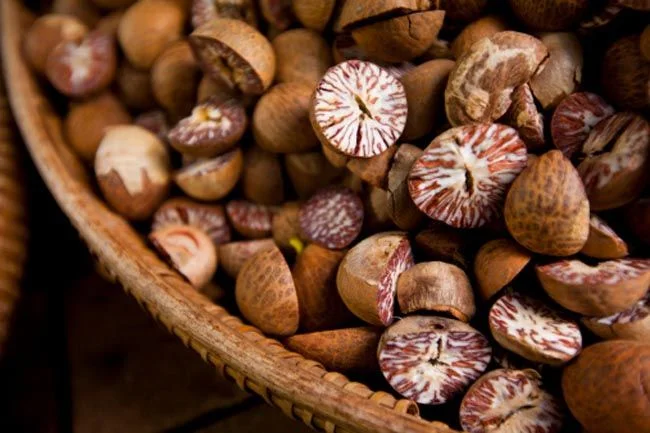
China is currently the largest consumer market thanks to its strongly developed areca nut candy industry, followed by India, Pakistan, Japan, and the Maldives — where dried areca nut is used as a traditional chewing food or as a valued medicinal ingredient in traditional medicine.
2. Legal basis governing dried areca nut export procedures
| Legal document | Content regulated |
|---|---|
| Decree 69/2018/ND-CP | Dried areca nut is not on the list of goods requiring an export license or prohibited from export, and can be freely exported |
| Circular 15/2018/TT-BNNPTNT | Issues the HS code list for products under the specialized management of the Ministry of Agriculture and Environment; dried areca nut is not subject to this specialized management |
| GACC Decree 280 (effective from June 1, 2026) | Regulates registration and management of agricultural and food product exporters to China under a new risk-assessment mechanism, replacing Orders 248 and 249 |
| Circular 38/2015/TT-BTC, amended by Circular 39/2018/TT-BTC | Customs procedures and supervision for exported goods |
This is the fundamental legal framework that businesses need to understand clearly in order to correctly carry out dried areca nut export procedures, avoiding unnecessary complications during customs procedures and enterprise code registration for the Chinese market.
3. Conditions and quality standards for exported dried areca nut
| Condition | Issuing/managing authority | Note |
|---|---|---|
| Product moisture control | Self-controlled by the business during drying and packing | Typically required to be under 10-12% to prevent mold growth during transport |
| GACC code registration (for export to China) | GACC, registered via the CIFER system | Mandatory for official customs clearance in the Chinese market under Decree 280 |
| Food safety and hygiene certification | Sub-Department of Food Safety and Hygiene | China may require this certification; a HACCP or ISO 22000 system is an additional advantage |
| Phytosanitary inspection (if required by the market) | Regional plant quarantine authority | Ensures the product is free from mold and harmful insects |
4. HS codes and export duties for dried areca nut
Dried areca nut falls under Chapter 08 — “Edible fruit and nuts; peel of citrus fruit or melons” — heading 08.02, “Other nuts, fresh or dried, whether or not shelled or peeled.” Correctly determining the HS code is an important step in dried areca nut export procedures, helping businesses declare customs accurately from the outset.
| Product type | HS code (Vietnam) | Vietnam export duty | Note |
|---|---|---|---|
| Dried areca nut (whole) | 0802.80 | 0% | The most common code group, no export license required |
| Areca nut, halved/sliced and dried | 0802.80.90 | 0% | Applies to areca nut processed by halving/quartering before drying |
| Fresh areca nut (not yet dried) | 0802.80.10 | 0% | Less common due to difficulty in preservation and long-distance transport |
Practical note: Export duty on dried areca nut in Vietnam is currently 0%, as the state encourages its cultivation and export to generate income for farmers. Businesses should note that this product is not subject to the specialized management of the Ministry of Agriculture and Environment under Circular 15/2018/TT-BNNPTNT, which makes the export procedure relatively simpler compared to many other agricultural products.
5. Documentation package for dried areca nut export procedures
| Document | When to prepare | Important note |
|---|---|---|
| Sales Contract | Before purchasing and packing | Must clearly state Incoterms, moisture content, and packing specifications (jute bags, cartons) |
| GACC enterprise registration code (for export to China) | Before the first export shipment | Registered via the CIFER system under Decree 280 |
| Phytosanitary Certificate | Before goods reach the port/border gate | Applied according to the specific requirements of each importing market |
| Food safety and hygiene certification | Before registering for export | China may require this certification as an additional condition |
| Commercial Invoice and Packing List | Before customs declaration | Value must match the contract and the bill of lading |
| Export customs declaration (VNACCS) | Before customs clearance | Declare the correct HS code 0802.80; no export license needs to be attached |
6. Dried areca nut export procedure steps
Step 1: Purchase, process, and dry the raw material
The business purchases fresh areca nut from growing regions, then processes, halves, and dries it to the standard moisture level (typically under 10-12%) — this is the foundational first step in dried areca nut export procedures, directly determining quality and long-term storage capability.
Step 2: Register the exporter enterprise code (for the Chinese market)
The business registers its code on GACC’s CIFER system under Decree 280, fully declaring business information, production facility details, and processing procedures to obtain approval before official export.
Step 3: Sign the contract and pack according to export specifications
Agree with the importer on moisture content, packing specifications (jute bags, cartons), and weight per unit, then proceed with packing according to the agreed standards.
Step 4: Register for phytosanitary inspection (if required by the market)
The business registers with the nearest regional plant quarantine authority to have samples taken, tested for microorganisms and insects, and to be issued a Phytosanitary Certificate within 24 hours if the standard is met.
Step 5: Complete the documentation package and declare customs export
The enterprise or its forwarder prepares the invoice and packing list, and declares the electronic customs declaration on the VNACCS system, attaching the quarantine certificate (if applicable) and the GACC registration code when exporting to China.
Step 6: International transport and import clearance in the destination country
Once the declaration is cleared, the goods are handed over to a road carrier through border gates (for China) or a sea carrier for more distant markets such as India and Pakistan.
7. Timeline, costs, and common risks
| Stage | Estimated time | Note |
|---|---|---|
| GACC code registration (one-time) | A few weeks to a few months | Only applicable when exporting to China |
| Registration and sample collection for phytosanitary inspection | Within 24 hours if the standard is met | Issuance of the Phytosanitary Certificate |
| Export customs declaration (VNACCS) | 0.5 – 1 day | Faster if the declaration is routed to the green channel |
| Road transport (China) | 1 – 3 days | Via northern border gates |
| Risk | Manifestation | Prevention |
|---|---|---|
| Product moisture content exceeding the permitted threshold | Mold develops during transport, goods rejected for import | Strictly control the drying process and measure moisture before packing |
| GACC code not yet registered when exporting to China | Shipment denied official customs clearance at the Chinese border | Proactively register the code early, before planning the first export shipment |
| Fluctuating domestic raw areca nut prices | Purchase prices fluctuate erratically based on demand from the Chinese market | Sign long-term contracts with importing partners, diversify export markets |
| Missing food safety certification required as an additional condition | Goods held for additional inspection at the destination port | Confirm each market’s specific requirements before signing large contracts |
8. FAQ – Frequently asked questions about dried areca nut export procedures
Question 1: Does exporting dried areca nut require a license?
No. Dried areca nut is not on the list of goods requiring an export license or prohibited from export, nor is it subject to the specialized management of the Ministry of Agriculture and Environment, making dried areca nut export procedures relatively simple.
Question 2: What is the current export duty on dried areca nut in Vietnam?
Dried areca nut (HS code 0802.80) enjoys a 0% export duty rate in Vietnam, falling under the group of products the state encourages growing and exporting.
Question 3: Does exporting dried areca nut to China require any special additional procedures?
Yes. Businesses need to register a code on the CIFER system under GACC Decree 280, and also prepare food safety and hygiene certification if required, since China remains one of the markets that manages agricultural imports fairly strictly.
Question 4: What is the standard moisture content for exported dried areca nut?
Moisture content for dried areca nut typically needs to be controlled under 10-12% to prevent mold growth during long-distance transport — this is an important criterion businesses need to strictly control in dried areca nut export procedures.
How does 3W Logistics support dried areca nut export procedures?
As a freight forwarding company registered as an OTI-NVOCC with an FMC bond in the United States, holding an SCAC Code to self-file AMS/ISF declarations directly, 3W Logistics supports businesses through the entire dried areca nut export procedure — from HS code advisory and GACC code registration through to customs clearance in the importing country.
Full-package logistics service at 3W Logistics:
- HS code advisory and export conditions by market: Guiding businesses in preparing GACC code registration documentation correctly when exporting to China.
- Support connecting to obtain the Phytosanitary Certificate: Coordinating with plant quarantine authorities so shipments are sampled, inspected, and certified quickly.
- Booking vessels and multimodal transport: Arranging road transport through border gates or sea transport to markets such as India, Pakistan, and Japan.
- Electronic customs declaration (VNACCS): A professional team handles declarations and cross-checks the correct HS code; as an OTI-NVOCC with FMC and an SCAC Code, 3W Logistics directly issues its own HBL and self-files AMS/ISF for shipments bound for the U.S.
Why choose 3W Logistics: With offices in Ho Chi Minh City, Hanoi, and Hai Phong, and a team knowledgeable in export regulations for agricultural products and medicinal materials, 3W Logistics ensures dried areca nut shipments clear customs on time and to standard, right from the very first export. – Ms. Apple, CCO of 3W Logistics
Head Office – 3W Logistics Ho Chi Minh City Branch
Address: 34 Bach Dang, Tan Son Hoa Ward, Ho Chi Minh City
Hotline: +84 28 3535 0087
____________________________
3W Logistics Hanoi Branch
Address: 81A Tran Quoc Toan, Cua Nam Ward, Hanoi
Hotline: +84 24 3202 0482
____________________________
3W Logistics Hai Phong Branch
Address: 8A Lot 28 Le Hong Phong, Gia Vien Ward, Hai Phong
Hotline: +84 225 355 5939
____________________________
3W LOGISTICS CO., LTD – We here serve you there!
Email: info@3w-logistics.com
Website: www.3w-logistics.com

Ms. Apple is the CCO (Chief Commercial Officer) at 3W Logistics, with over 10 years of experience in sales and business operations management.
At 3W Logistics, Ms. Apple is responsible for commercial strategy, corporate customer development, managing a team of more than 50 sales professionals, and improving business performance in the logistics sector.
With practical experience in sales management and market development, Ms. Apple shares professional insights on business logistics solutions, international transportation, freight forwarding, customer management, trade lane development, and growth strategies in the logistics industry.


