
Customs Broker: A-Z Guide to Customs Agency Services in Vietnam
Customs Broker (also known in Vietnamese as “đại lý hải quan” or “đại lý làm thủ tục hải quan”) is an enterprise that meets the conditions prescribed by law and, on behalf of the goods owner, performs all or part of the customs declarant’s obligations within an authorized scope. This is a critical link that helps import-export enterprises — especially those without customs declaration experience — complete customs clearance quickly and in full compliance with regulations.
Many businesses often confuse a Customs Broker with a Freight Forwarder, and are unclear about the conditions and procedures for becoming a licensed customs broker. The article below sets out the full definition, role, conditions, registration process, and current legal basis for Customs Brokers in Vietnam.
1. What Is a Customs Broker?
A Customs Broker, referred to in Vietnamese as “đại lý hải quan” or “đại lý làm thủ tục hải quan,” is an enterprise that satisfies the conditions set out in Clause 1, Article 20 of the Customs Law No. 54/2014/QH13, is recognized by the General Department of Customs, and, on behalf of the owner of exported or imported goods, carries out customs declaration within the scope authorized under an agency contract.
In essence, a Customs Broker is a professional intermediary specializing in customs declaration operations, using a dedicated agent-employee code to declare and carry out procedures with the customs authority on behalf of the goods owner.
Real-world example: An enterprise importing machinery for the first time, with no prior customs declaration experience, signed an authorization contract with a customs broker to file the declaration, prepare the documentation, and work directly with the local Customs Sub-Department to clear the shipment on schedule.
2. The Role of a Customs Broker
A Customs Broker helps import-export enterprises save time, reduce legal risk, and handle issues that arise during customs clearance in a professional manner.
- Filing customs declarations on the owner’s behalf: preparing and submitting electronic customs declarations accurately and on time.
- Working directly with the customs authority: handling situations such as physical inspection of goods, cargo examination, or explaining documentation when errors or missing paperwork occur.
- Advising on tax policy and product classification: helping determine HS codes, tax policy, and any specialized licenses required for the shipment.
- Supporting tax exemption and refund applications: for shipments that qualify under export-import tax regulations.
- Reducing legal risk: thanks to their in-depth understanding of customs regulations, a Customs Broker helps enterprises avoid errors that could lead to administrative penalties.
3. Customs Broker vs. Freight Forwarder vs. Self-Declaring Owner
Customs Broker, Freight Forwarder, and self-declaring goods owner are three concepts that are easily confused, even though the scope of work and responsibilities of each differ significantly.
| Criteria | Customs Broker | Freight Forwarder | Self-Declaring Owner |
|---|---|---|---|
| Scope of service | Customs declaration and procedures only | Full package: transport, documentation, customs, warehousing | Handles everything itself, no intermediary |
| Legal requirement | Must hold an agent-employee code issued by the General Department of Customs | Not required to hold a separate customs agent code | Enterprise bears full responsibility itself |
| Goods transport | Does not arrange transport | Organizes and coordinates transport | Arranges or hires transport separately |
| Legal basis | Article 20, Customs Law 2014; Circular 12/2015/TT-BTC | Decree 163/2017/ND-CP on logistics services | Article 25, Customs Law 2014 |
Note: In practice, many freight forwarding companies in Vietnam are simultaneously registered to operate as Customs Brokers (holding a customs agent code) in order to offer a full-package service, so the boundary between the two roles is sometimes not entirely separate within the same company.
4. Conditions for Becoming a Customs Broker
Under Clause 1, Article 20 of the Customs Law No. 54/2014/QH13, an enterprise seeking recognition as a customs procedure agent must fully satisfy the following conditions:
- Hold a Business Registration Certificate: the registered business lines must include freight forwarding services or customs procedure agency services.
- Have customs procedure agent staff: employees must be issued a customs procedure agent code by the General Department of Customs and meet the required professional standards.
- Have suitable IT infrastructure: capable of performing electronic customs declaration and connecting to the customs authority’s VNACCS/VCIS system.
5. Customs Broker Registration Process, Start to Finish
The process for an enterprise to be recognized as a customs broker consists of 5 main steps, from preparing the required conditions to being issued an official operating code.
Step 1: Prepare legal conditions and personnel
Ensure the Business Registration Certificate lists an appropriate business line, and that at least one employee meets the standard required to register for an agent-employee code.
Step 2: Prepare IT infrastructure
Set up computer systems, network connections, and electronic customs declaration software compatible with, and capable of connecting to, the VNACCS/VCIS system.
Step 3: Prepare the application file for recognition of operating conditions
Prepare a written request for recognition of eligibility to operate as a customs procedure agent, together with the application for an agent-employee code as required under Circular 12/2015/TT-BTC.
Step 4: Submit the application to the General Department of Customs
Submit the complete application file as required to the General Department of Customs for review and assessment of operating conditions.
Step 5: Receive the recognition decision and agent-employee code
Within 5 working days from receipt of a complete and valid application, the Director General of the General Department of Customs issues a decision recognizing the customs procedure agent, grants the agent-employee code, and updates the information on the General Department of Customs’ electronic portal.
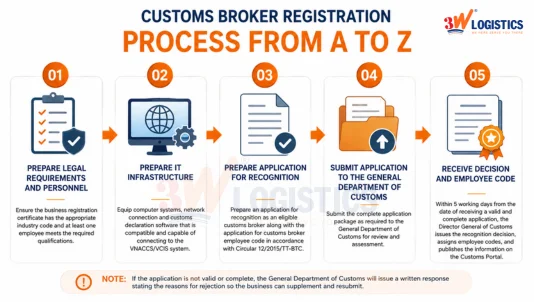
Note: If the application file does not yet meet the required conditions, the General Department of Customs will issue a written response clearly stating the reason so the enterprise can supplement and complete the file before resubmitting.
6. Rights and Obligations of a Customs Broker
Under Circular 12/2015/TT-BTC, which details the procedures for issuing the Customs Declaration Professional Certificate and issuing/revoking customs procedure agent-employee codes, the rights and obligations of a customs broker are set out as follows:
Rights of a customs broker:
- Require the goods owner to provide complete and accurate documentation and information necessary to carry out customs procedures.
- Request guidance from the customs authority on customs and tax procedures, and technical support when connecting to the customs authority’s network system.
- Attend training and professional development courses organized by the customs authority.
Obligations of a customs broker:
- Manage and use the assigned agent-employee code for its intended purpose only.
- Carry out customs declaration and procedures strictly within the scope authorized by the goods owner under the agency contract.
- Take responsibility for providing complete and timely information and documents related to the shipment as required by the customs authority.
- Where representing a foreign trader without a commercial presence in Vietnam, be responsible for exercising the rights and obligations of the goods owner in accordance with customs, tax, and other relevant laws.
7. Benefits of Using Customs Broker Services
Using a Customs Broker service helps import-export enterprises optimize time and cost while minimizing legal risk during customs clearance.
- Save time and cost: enterprises don’t need to train dedicated in-house staff for customs declaration.
- Limit legal risk: a Customs Broker’s regulatory expertise helps reduce errors that could lead to penalties or clearance delays.
- Handle unexpected issues professionally: experienced in working directly with customs authorities when goods are inspected or explanations are required.
- Support optimal tax policy outcomes: advising on cases eligible for tax exemption, reduction, or refund under current regulations.
8. Common Mistakes Businesses Make When Working With a Customs Broker
The most common mistakes when working with a Customs Broker are failing to verify a valid agent code, granting authorization with an unclear scope, or providing inaccurate documentation.
| Common Mistake | Consequence | How to Fix It |
|---|---|---|
| Not verifying a valid customs agent code | Working with an unqualified provider, affecting the legal validity of the declaration | Look up the agent-employee code on the General Department of Customs’ electronic portal before engaging a provider |
| Unclear scope of authorization in the contract | Difficult to assign responsibility when disputes or errors arise | Clearly state the scope of authorization and each party’s responsibilities in the agency contract |
| Providing inaccurate or incomplete documentation | Customs Broker declares incorrectly, causing the shipment to be routed to the yellow/red channel | Carefully review documentation before handing it over to the customs broker |
Real-world example: An enterprise authorized a provider without a valid customs agent code to file its declaration, resulting in the declaration being rejected and having to be re-filed from scratch — delaying clearance by more than a week.
9. Frequently Asked Questions About Customs Brokers
Is a Customs Broker required to hold a customs agent code?
Yes. Employees carrying out customs declarations at the agency must be issued an agent-employee code by the General Department of Customs under Circular 12/2015/TT-BTC.
Should small businesses hire a Customs Broker?
Yes, especially businesses without dedicated in-house customs staff, since a Customs Broker helps reduce the risk of errors and saves processing time.
How long does it take to be recognized as a customs broker?
Within 5 working days from receipt of a complete and valid application file, the Director General of the General Department of Customs issues the recognition decision.
Can a Customs Broker arrange transport of goods?
Not necessarily. A Customs Broker mainly focuses on declaration and customs procedures; arranging transport is typically handled by a Freight Forwarder.
Can a goods owner both self-declare and hire a Customs Broker?
Yes — depending on the shipment or stage, an enterprise can self-declare simpler shipments while authorizing a Customs Broker for more complex ones.
Is a Customs Broker liable for incorrect declarations?
Yes. A Customs Broker is responsible for the accuracy of the declared information within its authorized scope, although the obligation to provide original documents rests with the goods owner.
How can a business verify that a customs broker is legitimate?
Businesses can look up the issued agent-employee code on the General Department of Customs’ electronic portal before signing a contract.
What should businesses keep in mind when working with a Customs Broker?
Verify a valid agent code, clearly state the scope of authorization in the contract, and provide complete, accurate documentation for a smooth declaration process.
3W Logistics – Professional Customs Broker Services
With extensive experience in customs declaration, 3W Logistics partners with import-export enterprises to handle the entire clearance process quickly, accurately, and in full compliance with the law.
- A team of customs broker staff with valid agent codes: ensuring every declaration is filed correctly and transparently with the customs authority.
- In-depth knowledge of tax policy and product classification: helping businesses determine the correct HS code, tax policy, and any required specialized licenses.
- Fast handling of unexpected issues: hands-on experience working directly with local Customs Sub-Departments to minimize delays.
If your business needs Customs Broker services, please contact 3W Logistics today for tailored advice.
CONTACT INFORMATION:
Head Office – 3W Logistics Ho Chi Minh City Branch
Address: 34 Bach Dang, Tan Son Hoa Ward, Ho Chi Minh City
Hotline: +84 28 3535 0087
3W Logistics Hanoi Branch
Address: 81A Tran Quoc Toan, Cua Nam Ward, Hanoi
Hotline: +84 24 3202 0482
3W Logistics Hai Phong Branch
Address: 8A Lot 28 Le Hong Phong, Gia Vien Ward, Hai Phong
Hotline: +84 225 355 5939
3W LOGISTICS CO., LTD – We’re here to serve you there!
Email: info@3w-logistics.com
Website: www.3w-logistics.com

Hello, I’m Nguyen Phuong Nhan (Ms. Nina)
I currently serve as Trade Lanes Supervisor at 3W Logistics, with more than 10 years of experience in international logistics and freight forwarding.
My primary responsibility is developing and managing global logistics partnerships, building strategic trade lanes, and working closely with overseas agents to provide reliable and competitive transportation solutions for customers.
I regularly collaborate with agents and logistics partners worldwide to explore new business opportunities, negotiate freight rates, develop trade routes, and support import-export shipments. I also work closely with our sales team to design logistics solutions tailored to specific markets and customer requirements.
My expertise includes Ocean Freight, Air Freight, Trade Lane Development, Global Agent Network Management, International Logistics Solutions, and Import-Export Support.
Through the articles I share on the 3W Logistics website, I aim to provide practical insights into the international logistics industry, global transportation trends, overseas agent cooperation, and effective logistics strategies that help businesses optimize their supply chain operations.
I believe that strong global partnerships and well-developed trade lanes are essential to delivering sustainable logistics solutions and long-term value to customers worldwide.


