
Cosmetics importation is one of the fastest-growing business sectors in Vietnam in recent years, as consumer demand for skincare, makeup, and hair care products from foreign brands continues to rise significantly.
Many businesses and individuals only begin researching cosmetics import procedures after placing an order or even after goods have already arrived at the port only to discover missing product declaration documents, non-compliant labeling, or products that fall under the prohibited import category. The result: shipments held, destroyed, or re-exported at the importer’s full expense.
This article from 3W Logistics presents the complete cosmetics import procedures in accordance with current regulations – covering legal requirements, declaration documentation, HS codes, tax calculations, and real-world risks, from the perspective of a freight forwarding company with over 10 years of experience handling imported cosmetics.
1. Legal Requirements to Import Cosmetics into Vietnam
Imported cosmetics in Vietnam are regulated under Circular 06/2011/TT-BYT of the Ministry of Health and Circular 32/2019/TT-BYT, along with supplementary amendments. The core requirement of the entire cosmetics import procedure is:
- All imported cosmetic products must be declared to the Drug Administration of Vietnam (Ministry of Health)
- A Receipt Number for the Cosmetic Product Declaration Form must be obtained before customs clearance and market distribution are permitted. Download the cosmetic product declaration dossier here
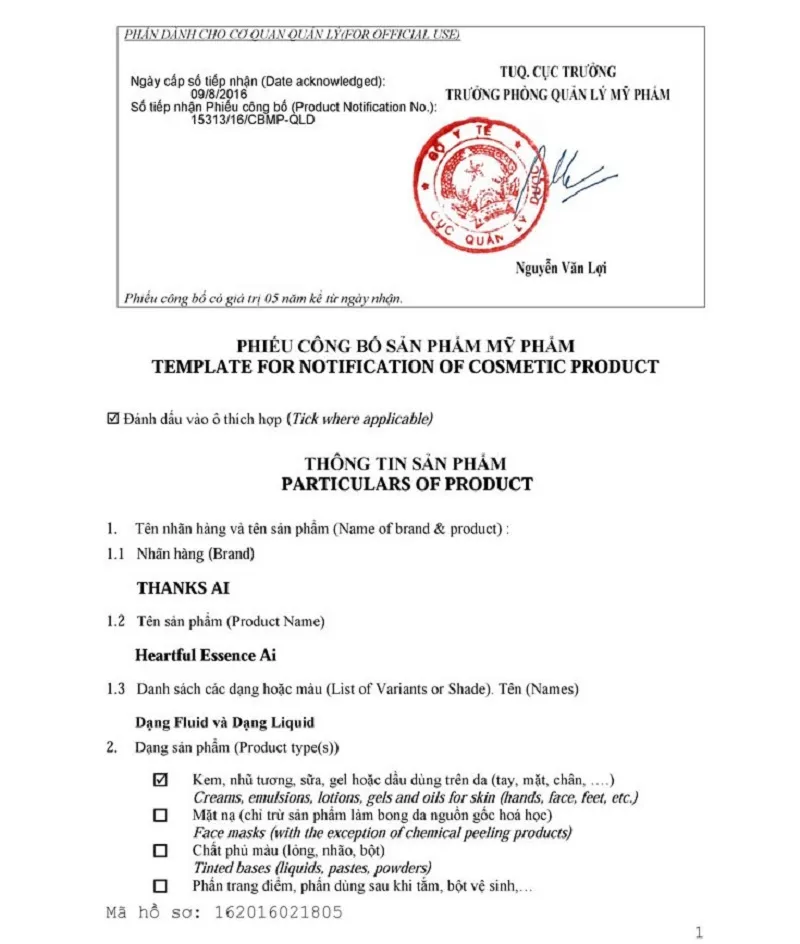
This is the most fundamental distinction from most other consumer goods categories without a Receipt Number, goods cannot clear customs even if all commercial documents are fully in order.
Cases Where Cosmetics Import is Not Permitted
| Prohibited / Restricted Case | Legal Basis | Practical Notes |
|---|---|---|
| Contains ingredients banned under the Ministry of Health’s list | Circular 06/2011/TT-BYT, Annex I | Check the Ingredient List against the prohibited list before placing an order – some whitening agents and preservatives commonly used abroad are banned in Vietnam |
| Contains restricted ingredients exceeding permitted concentrations | Circular 06/2011/TT-BYT, Annex II | Certain active ingredients such as hydroquinone and tretinoin at high concentrations are restricted – a Certificate of Analysis (CoA) from the manufacturer confirming actual concentrations is required |
| No Receipt Number for the Product Declaration Form | Article 4, Circular 06/2011/TT-BYT | Must be obtained before goods arrive at port – cannot be supplemented after customs clearance |
| Goods are expired or have no clear expiry date | Decree 69/2018/NĐ-CP | Customs and quality inspection authorities may hold goods if the remaining shelf life is too short relative to the import date |
| No compliant Vietnamese supplementary label | Decree 43/2017/NĐ-CP on product labeling | Supplementary labels must be affixed directly to the product before market distribution – many shipments are held because labels are not yet affixed or contain insufficient information |
2. HS Codes and Import Duties for Cosmetics
Imported cosmetics are classified primarily under Chapter 33 of the Vietnam Import-Export Tariff Schedule – Essential oils and resinoids; perfumery, cosmetic or toilet preparations. Accurately determining the HS code in the cosmetics import procedure is critical not only for tax calculation but also for determining the applicable level of specialized inspection.

Common HS codes include:
- 3304.10: Lip make-up preparations (lipstick, lip gloss…)
- 3304.20: Eye make-up preparations (mascara, eyeshadow, eyeliner…)
- 3304.30: Manicure or pedicure preparations (nail polish, nail polish remover…)
- 3304.91: Powders (pressed powder, loose powder, finishing powder…)
- 3304.99: Other cosmetics (moisturizer, foundation, sunscreen, serum…)
- 3305.10: Shampoos
- 3305.20: Preparations for permanent waving or straightening of hair
- 3305.30: Hair lacquers
- 3305.90: Other hair care preparations (conditioner, hair mask…)
- 3307.10: Shaving preparations (shaving cream, shaving gel…)
- 3307.20: Personal deodorants and antiperspirants
- 3307.90: Other toilet preparations (mouthwash, shower gel, body wash…)
Each cosmetic product within the cosmetics category will have a different HS code depending on its intended use – do not attempt to determine the HS code based on product name alone. Official lookup tools:
- General Department of Vietnam Customs: customs.gov.vn – search by name or code
- VNACCS/VCIS System: Direct lookup during electronic declaration
- Commodity Classification Consultation: Businesses may submit a written request to the provincial/city Customs Department for HS code confirmation prior to shipment to avoid future disputes
- HS Code Lookup System: https://caselaw.vn/tra-cuu-ma-hs – search by name or code
Cosmetics Import Duty Rates by Country of Origin
| Country of Origin | Applicable C/O | Reference Import Duty | Notes |
|---|---|---|---|
| South Korea | C/O Form KV (VKFTA) | 0–5% | The largest source of cosmetics imports into Vietnam; many HS codes have reached 0% under the VKFTA schedule |
| Japan | C/O Form JV (VJEPA) | 0–7% | Varies by specific HS code; benefits available under VJEPA or AJCEP |
| EU (France, Germany, Italy…) | C/O Form EUR.1 (EVFTA) | 0–12% | Reduction schedule under EVFTA; premium cosmetics from France and Germany are eligible for EVFTA preferential rates |
| Thailand, Indonesia (ASEAN) | C/O Form D (ATIGA) | 0–5% | Most cosmetics HS codes within ASEAN have reached 0–5% |
| USA, Australia, and non-FTA countries | No FTA C/O | 10–27% (MFN) | MFN duties on cosmetics are relatively high; plus 10% VAT |
Practical note: MFN import duties on cosmetics can reach up to 27% depending on the HS code – significantly higher than most other consumer goods categories. For cosmetics from South Korea and Japan – the two main import sources into Vietnam – C/O Form KV and C/O Form JV are the most important duty-saving documents that many businesses overlook when carrying out cosmetics import procedures.
3. Documentation Required for Cosmetics Import Procedures
The documentation set for cosmetics import procedures is considerably more complex than for ordinary goods, as it includes product declaration documents that must be completed before goods arrive at port. It is divided into two clear groups as follows:
| Document | When to Prepare | Key Notes |
|---|---|---|
| Cosmetic Product Declaration Form + Receipt Number | Before goods are shipped (submit to Drug Administration of Vietnam) | The most important and unique document for cosmetics – customs requires the Receipt Number for clearance; processing typically takes 15–30 working days |
| Authorization letter from the foreign manufacturer / distributor | Before submitting the declaration dossier | Must be consular legalized or apostilled without a valid authorization letter, the declaration dossier will be rejected immediately |
| Certificate of Free Sale (CFS) or equivalent | Before submitting the declaration dossier | Proves that the product is legally permitted for sale in the exporting country; consular legalization required |
| Sales Contract | Before placing a deposit | Must clearly state product name, ingredients (Ingredient List), packaging specifications, Incoterms, and C/O responsibility |
| Commercial Invoice & Packing List | Before goods are shipped | Product name, HS code, and value must be consistent with the C/O and Declaration Form – any discrepancy will result in the entire dossier being rejected |
| Bill of Lading / AWB | After goods are loaded onto vessel/aircraft | The product description on the B/L must be sufficiently detailed – do not simply write “cosmetics”; the specific product type must be stated to match the Declaration Form |
| C/O (Certificate of Origin) | Before goods are shipped (supplier to apply) | Determines whether FTA or MFN duty rates apply – particularly critical for cosmetics given that MFN rates can reach 27%; must be requested from the supplier from the outset |
| Vietnamese supplementary label | Before goods enter circulation (may be affixed after customs clearance) | Must contain all required information under Decree 43/2017: product name, ingredients, intended use, directions for use, manufacturing date, expiry date, manufacturer, and importer |
| Electronic customs declaration (VNACCS) | When all documentation is complete | Must include the Declaration Form Receipt Number – customs cannot process clearance if this information is missing from the declaration |
4. Step-by-Step Cosmetics Import Procedure
Step 1: Check Product Ingredients and Eligibility Before Placing an Order
This is the most important and most frequently overlooked step in the cosmetics import procedure. Before signing a contract, businesses must cross-reference the complete Ingredient List / INCI List of the product against the Ministry of Health’s list of prohibited and restricted ingredients. The correct HS code must also be identified to calculate duties and determine the applicable level of specialized inspection.
Step 2: Prepare Documentation and Submit the Cosmetic Product Declaration Form
This is the most distinctive and time-consuming step in the cosmetics import procedure. The business prepares the declaration dossier, which includes: the Declaration Form completed in accordance with the prescribed template, the manufacturer’s authorization letter (consular legalized), a Certificate of Free Sale (CFS), the complete product ingredient list, and the draft Vietnamese supplementary label. The entire dossier is submitted to the Drug Administration of Vietnam – Ministry of Health via the National Single Window portal or in person. Processing time ranges from 15–30 working days depending on the product and the status of the dossier.
Step 3: Receive the Receipt Number, Sign the Contract, and Place the Order
Only after receiving the Declaration Form Receipt Number from the Drug Administration of Vietnam should the business proceed to formally sign the contract and request the supplier to prepare the goods. It is important to include a C/O provision in the contract at this stage – this is the only point at which the supplier can be required to apply for a C/O before goods are loaded.
Step 4: Shipping and Receipt of B/L
Cosmetics are typically shipped by sea (FCL or LCL) or by air, depending on the value and volume of the shipment. Attention should be paid to storage conditions in the container, as some temperature-sensitive cosmetics may be affected in quality if transit times are long or routing passes through tropical regions. The forwarder books the vessel and issues the B/L after goods are loaded at the port of origin.
Step 5: Customs Declaration and Specialized Inspection
When goods arrive at a Vietnamese port, the forwarder files the electronic customs declaration on VNACCS, including the Declaration Form Receipt Number. Imported cosmetics are always routed to the Yellow or Red channel as they are subject to mandatory specialized inspection – there is no Green channel. The state quality inspection authority may take samples to test for quality and safety parameters if the shipment falls under scheduled inspection or shows signs of concern.
Step 6: Customs Clearance, Tax Payment, and Label Affixing
Once documentation is complete and specialized inspection is passed, customs confirms the tax obligations (import duty + VAT). The business pays the taxes, collects the Delivery Order (D/O), and transports goods to the warehouse. Vietnamese supplementary labels must be fully affixed before products are placed into market circulation – this can be done at the warehouse after customs clearance.
5. How to Calculate Cosmetics Import Duties
Import duties on cosmetics are among the highest in the consumer goods category – particularly for goods from countries without a Free Trade Agreement with Vietnam. Below is a worked example for a shipment of moisturizer imported from South Korea, CIF value USD 10,000, HS code 3304.99, MFN duty 20%, VKFTA duty 5%:
| Tax Component | Without C/O Form KV (MFN 20%) | With C/O Form KV (VKFTA 5%) |
|---|---|---|
| CIF Value | USD 10,000 | USD 10,000 |
| Import Duty | 20% × 10,000 = USD 2,000 | 5% × 10,000 = USD 500 |
| VAT (10%) | 10% × (10,000 + 2,000) = USD 1,200 | 10% × (10,000 + 500) = USD 1,050 |
| Total Tax Payable | USD 3,200 (~VND 81 million) | USD 1,550 (~VND 39 million) |
| Savings with C/O Form KV | USD 1,650 (~VND 42 million) – over 50% savings on total tax payable, from a single C/O that a Korean supplier can obtain at no cost. | |
From 3W Logistics’ practical experience: Cosmetics are the category where the duty gap between “with FTA C/O” and “without C/O” is the largest among all consumer goods we handle – potentially up to 15–20% on CIF value in import duty alone. In practice, many small businesses importing Korean cosmetics through intermediaries or from non-professional suppliers do not receive C/O Form KV because the seller either does not apply for it or does not know how. This is especially common with Korean indie cosmetic brands — small labels, contract manufacturers, unfamiliar with formal export procedures. Request the C/O at the negotiation stage, not after placing a deposit – that is the lesson from hundreds of cosmetics shipments we have handled. – Ms. Apple, CCO, 3W Logistics
6. Common Risks in Cosmetics Import Procedures
| Risk | How It Manifests | Prevention |
|---|---|---|
| No Receipt Number when goods arrive at port | Customs refuses clearance; goods are held at port, accruing demurrage and detention charges daily | Submit the declaration dossier at least 30–45 days before placing the order; do not place an order without the Receipt Number in hand |
| Authorization letter without consular legalization | Drug Administration of Vietnam rejects the declaration dossier must be resubmitted from scratch, losing an additional 1–2 months | Carefully verify consular legalization or apostille requirements for each document type before submitting the dossier |
| Ingredients contain banned substances or exceed permitted thresholds | Drug Administration of Vietnam refuses the declaration, or the quality inspection authority detects violations during sampling – the shipment must be destroyed or re-exported | Cross-reference the Ingredient List against the Ministry of Health’s prohibited list before placing an order; require a CoA from the manufacturer confirming actual concentrations |
| Non-compliant supplementary label | Goods held at port or penalized by market regulators after circulation; full recall and re-labeling required | Design supplementary labels in strict compliance with Decree 43/2017 and confirm label content before mass printing |
| No FTA C/O — paying high MFN duties | MFN duty of 10–27% instead of 0–7% FTA rate – the gap is particularly significant for cosmetics due to high MFN rates | Stipulate the correct FTA C/O requirement in the contract terms; do not place a deposit if the supplier cannot commit to providing C/O |
FAQ – Frequently Asked Questions About Cosmetics Import Procedures
Question 1: What documents are required for cosmetics import procedures?
The complete documentation set for cosmetics import procedures includes: the Cosmetic Product Declaration Form and Receipt Number from the Drug Administration of Vietnam; the manufacturer’s authorization letter with consular legalization; Certificate of Free Sale (CFS); Sales Contract, Commercial Invoice, and Packing List; Bill of Lading or AWB; C/O under the applicable FTA; and an electronic customs declaration filed on VNACCS.
Question 2: Do imported cosmetics require prior authorization?
Yes — this is a mandatory requirement. All imported cosmetic products must be declared to the Drug Administration of Vietnam and a Declaration Form Receipt Number must be obtained before customs clearance. This cannot be applied for retroactively after goods have arrived at port. This is what distinguishes cosmetics import procedures from most other consumer goods categories.
Question 3: How long does the cosmetics import procedure take?
The product declaration process at the Drug Administration of Vietnam typically takes 15–30 working days if the dossier is complete and meets all requirements. After receiving the Receipt Number, customs clearance at port takes an additional 5–10 working days. Total time from the start of documentation preparation to goods arriving at the warehouse is typically 45–75 days – businesses need to plan orders well in advance compared to ordinary goods.
Question 4: What is the import duty rate for cosmetics from South Korea?
With a valid C/O Form KV under the VKFTA agreement, import duties on cosmetics from South Korea range from 0–7% depending on the HS code, as opposed to the MFN rate which can reach 20–27%. In addition to import duty, there is a 10% VAT calculated on the CIF value plus import duty.
Question 5: Are imported cosmetics subject to quality inspection?
Yes. Imported cosmetics are subject to state quality inspection on a scheduled basis or at the request of regulatory authorities. Shipments are always routed to the Yellow or Red channel – there is no Green channel. The inspection authority may take samples to test safety and quality parameters, particularly for products being imported for the first time or from suppliers with no prior history in Vietnam.
How Does 3W Logistics Support Cosmetics Import Procedures?
As a freight forwarding company registered as an OTI-NVOCC with FMC bond (Federal Maritime Commission) in the USA and with over 10 years of experience handling imported cosmetics, 3W Logistics provides an end-to-end service for businesses navigating cosmetics import procedures – from advising on product eligibility before ordering to goods arriving at the warehouse and ready for distribution.
- Product eligibility consultation and pre-order ingredient review: Cross-referencing Ingredient Lists against the Ministry of Health’s prohibited and restricted substance lists; accurately determining HS codes and calculating duty costs by origin and applicable FTA – so businesses know the true landed cost before signing a contract.
- Support in preparing and submitting the cosmetic product declaration dossier: Advisory and assistance in preparing the complete declaration dossier, including guidance on consular legalization requirements for authorization letters and CFS, to ensure the dossier is accepted by the Drug Administration of Vietnam as quickly as possible.
- Support in obtaining the correct FTA C/O from suppliers: Guiding suppliers through the process of obtaining C/O Form KV (South Korea), Form JV (Japan), EUR.1 (EU), or Form D (ASEAN); reviewing C/O documents before acceptance to ensure 100% consistency with Invoice and B/L.
- Freight booking from major cosmetics source markets: Arranging FCL, LCL, or air freight from South Korea, Japan, France, Germany, Italy, the USA, and other markets to Hai Phong, Da Nang, and Cat Lai (Ho Chi Minh City) ports.
- Electronic customs declaration (VNACCS) and specialized inspection handling: A professional declaration team processes cosmetics import declarations, enters the correct Receipt Number, monitors channel assignment, and coordinates prompt resolution when quality inspection authorities take samples or request supplementary documentation.
- Support in designing and verifying Vietnamese supplementary label content: Reviewing supplementary label content against Decree 43/2017 before printing, to avoid the risk of market regulatory penalties after goods have entered circulation.
Why choose 3W Logistics for your cosmetics shipment? Cosmetics import procedures have many unique “bottlenecks” that non-specialized forwarders often fail to anticipate — from the product declaration dossier and consular legalization requirements to specialized inspection at the border gate. We don’t just book freight; we accompany you from the product ingredient review stage before ordering through to customs clearance and goods ready for the shelf. That is the difference that helps our clients avoid the costly mistakes that businesses new to cosmetics importation most commonly encounter. Contact 3W for a consultation before signing your purchase contract.
Address: 34 Bach Dang Street, Tan Son Hoa Ward, Ho Chi Minh City
Hotline: +84 28 3535 0087
____________________________
3W Logistics Hanoi Branch
Address: 81A Tran Quoc Toan Street, Cua Nam Ward, Hanoi
Hotline: +84 24 3202 0482
____________________________
3W Logistics Hai Phong Branch
Address: 8A Lot 28 Le Hong Phong Street, Gia Vien Ward, Hai Phong
Hotline: +84 225 355 5939
____________________________
3W LOGISTICS CO., LTD – We here serve you there!
Email: quote@3w-logistics.com
Website: www.3w-logistics.com

Ms. Apple is the CCO (Chief Commercial Officer) at 3W Logistics, with over 10 years of experience in sales and business operations management.
At 3W Logistics, Ms. Apple is responsible for commercial strategy, corporate customer development, managing a team of more than 50 sales professionals, and improving business performance in the logistics sector.
With practical experience in sales management and market development, Ms. Apple shares professional insights on business logistics solutions, international transportation, freight forwarding, customer management, trade lane development, and growth strategies in the logistics industry.


