
US-Iran Conflict: CMA CGM Confirms Cargo Vessel Targeted in Strait of Hormuz Attack
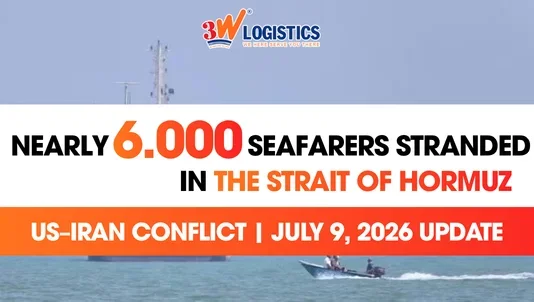
On July 8, 2026, the Strait of Hormuz once again became the epicenter of a global maritime crisis as renewed attacks left more than 6,000 seafarers stranded aboard hundreds of commercial vessels, sending shockwaves through the global energy market. The International Maritime Organization (IMO) called for “maximum restraint,” while the United Nations warned of “catastrophic consequences” should the US-Iran conflict escalate once again.
This article provides the latest updates on developments in the Strait of Hormuz, analyzes their direct impact on freight costs and global supply chains, and offers practical recommendations for Vietnamese import-export businesses.
US-Iran Conflict: Strait of Hormuz Update – July 8, 2026
The Strait of Hormuz witnessed another wave of attacks between July 7 and 8, 2026, with at least three commercial vessels reportedly struck while transiting one of the world’s most critical shipping lanes. IMO Secretary-General Arsenio Dominguez condemned the incidents as “reckless attacks” and urged shipowners and masters not to expose seafarers to unnecessary danger while navigating the region.
Among the targeted vessels, French shipping company CMA CGM confirmed that its container ship CMA CGM San Antonio was hit while transiting the Strait of Hormuz on May 6, 2026. Several crew members were injured and evacuated for medical treatment. This marks the first officially confirmed attack by one of the world’s leading container shipping companies, significantly escalating concerns over regional maritime security.
Background: Tensions escalated after the United States and Israel launched airstrikes against Iran on February 28, 2026, prompting Tehran to announce the closure of the Strait of Hormuz. A ceasefire agreement was reached on April 8, 2026, through Pakistani mediation, but negotiations in Islamabad failed to secure a lasting settlement. Since April 13, 2026, the United States has maintained a naval blockade targeting Iranian maritime activities in the Strait.
| Information | Details |
|---|---|
| Latest attacks | July 7–8, 2026 |
| Commercial vessels attacked | At least three |
| Confirmed vessel | CMA CGM San Antonio (CMA CGM, France) |
| Crew casualties | Several crew members injured and evacuated |
| Seafarers stranded | Approximately 6,000 aboard hundreds of vessels |
| Normal vessel traffic | Approximately 130 ships per day |
| Sources | IMO, CMA CGM, UN News, Anadolu Agency |
6,000 Seafarers Stranded Aboard Hundreds of Ships
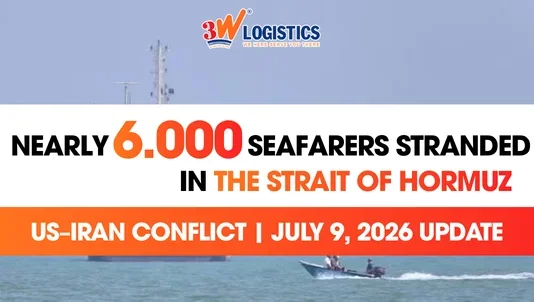
The estimated 6,000 stranded seafarers in the Strait of Hormuz represent one of the largest humanitarian maritime crises in decades. According to UN News (July 8, 2026), these crews remain trapped aboard hundreds of vessels that would normally transit the waterway, which typically handles around 130 ships per day—a figure that has now fallen dramatically.
IMO Secretary-General Arsenio Dominguez emphasized, “No seafarer should have to risk their life simply for doing their job.” The IMO, together with the United Nations, continues to call for “maximum restraint and de-escalation” from all parties. As of July 8, the IMO was also working to secure the release of 44 detained seafarers while food supplies aboard several vessels continued to diminish.
Real-world example: A container vessel stranded in the area for more than 90 days faces not only rising fuel and anchorage costs, but cargo owners also risk cargo deterioration, contract breaches, and insurance disputes. This scenario is already affecting numerous international shipments.
Impact on Vietnamese Import and Export Businesses
Although most Vietnamese imports and exports do not transit directly through the Strait of Hormuz, domestic businesses are far from immune. The crisis affects global trade through four major channels:
- Higher oil prices increase shipping fuel costs: Fuel accounts for approximately 40–60% of vessel operating expenses. As oil prices rise due to instability in Hormuz, shipping lines pass much of the additional cost to cargo owners through the Bunker Adjustment Factor (BAF).
- Expansion of War Risk Surcharges: Shipping companies operating in the Persian Gulf have introduced war risk surcharges. Rising costs in one region often spread across global freight markets.
- Vessel and container reallocation: Ships delayed or rerouted reduce transport capacity on other trade lanes, including Asia-Europe services widely used by Vietnamese exporters.
- Unstable sailing schedules: Shipping lines continue adjusting service networks, resulting in more blank sailings and delays at transshipment hubs, affecting delivery reliability.
Learn more: International Ocean Freight Services – 3W Logistics
United Nations Issues Warning
Dario Liguti, Director of the Sustainable Energy Division at UNECE, warned that elevated prices and supply volatility are likely to persist “for months.” If instability continues, the world should prepare for another surge in prices and a broader shortage of raw materials.
Compounding the situation, the extreme heat expected during the summer of 2026 is forecast to intensify as El Niño strengthens. Higher electricity demand for cooling is expected to place additional pressure on energy infrastructure, much of which depends on supplies originating from the Persian Gulf.
UN Secretary-General António Guterres described the renewed attacks over the previous 24 hours as “deeply alarming,” warning that they could undermine diplomatic progress achieved since the April ceasefire agreement. He stressed that “a return to full-scale conflict would have catastrophic consequences for the people of the region, international peace and security, and the global economy.”
Recommendations for Import and Export Businesses
As instability in the Strait of Hormuz continues and the United Nations warns of prolonged market volatility, Vietnamese import-export companies should consider the following actions:
- Confirm actual shipping routes: Consult your freight forwarder to verify whether your cargo will transit high-risk areas and obtain the latest sailing schedules.
- Allocate additional logistics budgets: BAF and War Risk Surcharges may increase rapidly. Businesses should consider setting aside an additional 10–15% logistics budget for shipments scheduled between July and September 2026.
- Review cargo insurance coverage: Ensure that insurance policies include War Risk and Piracy coverage with limits appropriate to the cargo’s value.
- Build buffer time into delivery schedules: Inform overseas buyers of potential delays and negotiate greater flexibility within commercial contracts.
- Monitor industry updates regularly: Stay informed through the IMO, UKMTO, and trusted logistics partners to respond quickly to changing circumstances.
3W Logistics – Supporting Your Supply Chain Through Global Uncertainty
Get Free Logistics Consultation →
Contact Information
3W Logistics – Ho Chi Minh City Headquarters
34 Bach Dang Street, Tan Son Hoa Ward, Ho Chi Minh City, Vietnam
Hotline: +84 28 3535 0087
3W Logistics – Hanoi Branch
81A Tran Quoc Toan Street, Cua Nam Ward, Hanoi, Vietnam
Hotline: +84 24 3202 0482
3W Logistics – Hai Phong Branch
8A Lot 28 Le Hong Phong Street, Gia Vien Ward, Hai Phong, Vietnam
Hotline: +84 225 355 5939
3W LOGISTICS CO., LTD – We Here Serve You There!
Email: quote@3w-logistics.com
Website: www.3w-logistics.com
This article is compiled from UN News (July 8, 2026), Anadolu Agency (May 6, 2026), official statements from IMO Secretary-General Arsenio Dominguez, and UNECE reports by Dario Liguti.

Hello, I’m Nguyen Phuong Nhan (Ms. Nina)
I currently serve as Trade Lanes Supervisor at 3W Logistics, with more than 10 years of experience in international logistics and freight forwarding.
My primary responsibility is developing and managing global logistics partnerships, building strategic trade lanes, and working closely with overseas agents to provide reliable and competitive transportation solutions for customers.
I regularly collaborate with agents and logistics partners worldwide to explore new business opportunities, negotiate freight rates, develop trade routes, and support import-export shipments. I also work closely with our sales team to design logistics solutions tailored to specific markets and customer requirements.
My expertise includes Ocean Freight, Air Freight, Trade Lane Development, Global Agent Network Management, International Logistics Solutions, and Import-Export Support.
Through the articles I share on the 3W Logistics website, I aim to provide practical insights into the international logistics industry, global transportation trends, overseas agent cooperation, and effective logistics strategies that help businesses optimize their supply chain operations.
I believe that strong global partnerships and well-developed trade lanes are essential to delivering sustainable logistics solutions and long-term value to customers worldwide.


