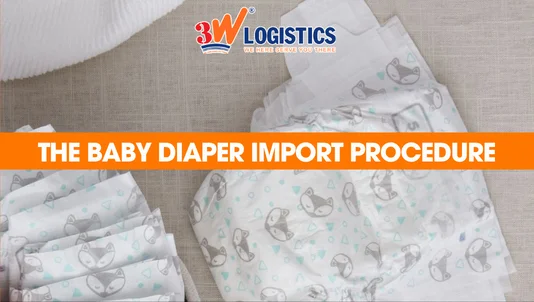
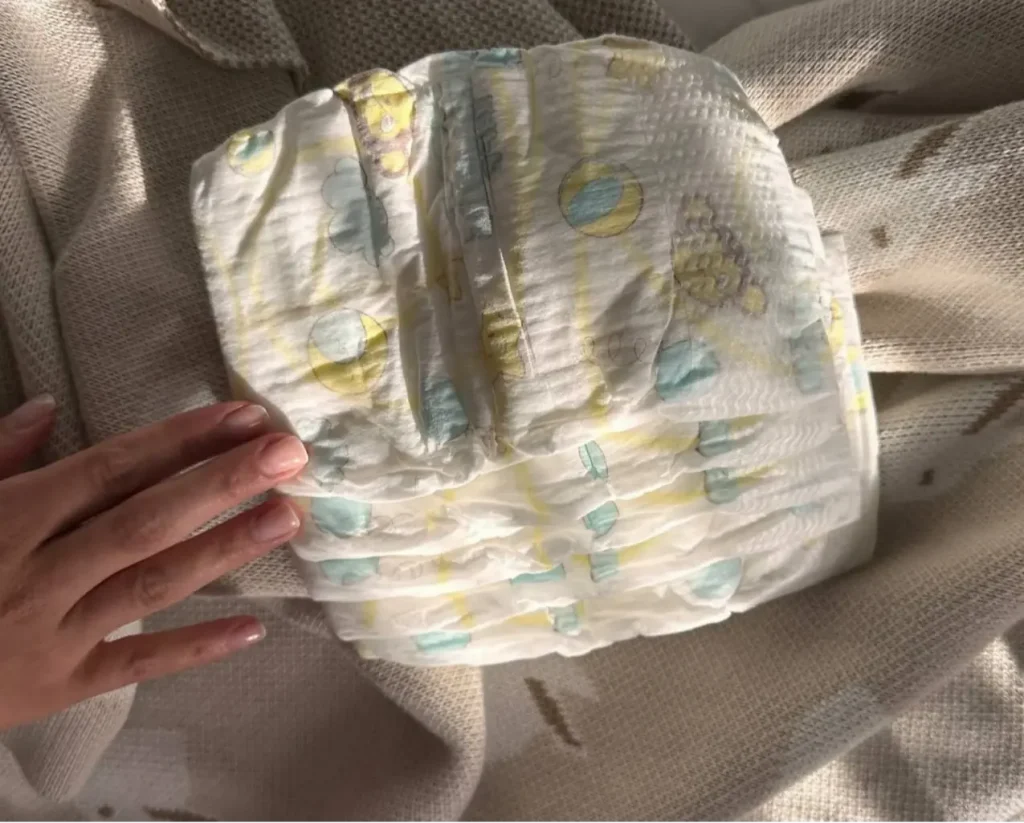
Importing baby diapers is a product category recording steady demand growth in the Vietnamese market, as birth rates and spending on baby care products continue to rise. Unlike many ordinary consumer goods, baby diapers are a category that comes into direct contact with a baby’s sensitive skin, and are therefore subject to close monitoring of quality, ingredients, and labeling, even though they are not on the list of goods prohibited from import.
In this article, 3W Logistics presents the complete baby diaper import procedure under the current legal regulations and the latest tariff schedule — from legal conditions, the 8-digit HS code, tax calculation, documentation, a step-by-step process, to real-world risks, from the perspective of a forwarder experienced in handling imported consumer goods.
1. Legal conditions for importing baby diapers into Vietnam
Baby diapers are not on the list of goods prohibited from import and are also not subject to mandatory specialized inspection before customs clearance; however, businesses still need to comply with certain conditions specific to consumer goods intended for infants before bringing the product to market.
| Condition | Detailed Content |
|---|---|
| Import policy | Brand-new baby diapers are permitted for normal import under current regulations |
| Product quality self-declaration | The manufacturer/importer self-declares a base standard (TCCS) applicable to the product under the Law on Product and Goods Quality and TCVN 10584:2014 — this is a mandatory step before commercial circulation, not a condition for customs clearance at port |
| Control of formaldehyde and aromatic amines | For diapers with an absorbent core made of textile material (code 96190011), businesses should note the technical regulation on formaldehyde and aromatic amine content applicable to textile products, to avoid complications during physical inspection |
| Product labeling | A Vietnamese supplementary label under Decree 43/2017/ND-CP and 111/2021/ND-CP, while keeping the original label intact: product name, origin, ingredients, instructions for use, and the entity responsible for quality |
| Specialized inspection | Baby diapers are currently not on the list of goods requiring specialized inspection during customs procedures, allowing for faster clearance than many other consumer goods categories |
Practical note: The most commonly misunderstood point in the baby diaper import procedure is that many businesses assume that because specialized inspection isn’t required, the product quality self-declaration step can be skipped. In fact, these are two independent requirements: customs procedures only relate to clearing the shipment, while the self-declaration is a mandatory legal condition before the product can be sold on the market. A business importing diapers for distribution or retail sale needs to complete both steps to avoid risk when the market surveillance authority conducts a post-clearance inspection.
2. 8-digit HS code and import duty for baby diapers
Baby diapers fall under heading 9619 (Sanitary towels/pads and tampons, napkins and napkin liners for babies, and similar articles) in the export-import tariff schedule. Correctly determining the 8-digit HS code depends on the material of the product’s absorbent core.
| 8-Digit HS Code | Detailed Description | Import Duty (MFN) | VAT |
|---|---|---|---|
| 9619.00.11 | Diapers/nappies with an absorbent core made of textile material | 5% | 8% |
| 9619.00.12 | Sanitary towels, pads, and tampons made of paper, paper pulp, cellulose wadding, or cellulose fiber webs | 15–20% | 8% |
| 9619.00.13 | Diapers and napkins for babies made of paper, paper pulp, cellulose wadding, or cellulose fiber webs | 15–20% | 8% |
| 9619.00.14 | Other types of diapers made of paper, paper pulp, cellulose wadding, or cellulose fiber webs | 15–20% | 8% |
| 9619.00.19 | Other, not specified under the codes above | 15–20% | 8% |
Important note on HS code and duty: Most of the common baby diaper lines on the market (paper surface, absorbent core made of paper pulp/cellulose) fall under code 9619.00.13 or 9619.00.14, carrying a fairly high MFN import duty, while textile-core diapers (9619.00.11) only carry 5%. This is why declaring the wrong HS code within heading 9619 can result in a significant duty discrepancy for a business. Regarding tariff preferences, a C/O Form E from China (ACFTA) can bring most tariff lines down to 0%; a Form AJ or CPTPP C/O from Japan, or a Form AK from South Korea, can also significantly reduce the duty payable. Regarding VAT, under Decree 174/2025/ND-CP and Resolution 204/2025/QH15, baby diapers are currently benefiting from a preferential VAT rate of 8% (instead of 10%), applicable through December 31, 2026.
3. Documentation for the baby diaper import procedure
The documentation package for the baby diaper import procedure is relatively lean compared to product categories requiring specialized inspection, per the guidance in Circular 39/2018/TT-BTC, amending Circular 38/2015/TT-BTC.
| Document | When to Prepare | Important Note |
|---|---|---|
| Sales Contract | Before placing a deposit | Must clearly state the brand, packing specifications, absorbent core material, and C/O provision terms |
| Commercial Invoice & Packing List | Before the goods are shipped | Must fully state the product name, size (S/M/L/XL), and quantity per packing specification |
| Bill of Lading | After the goods are loaded onto the vessel | Baby diapers are typically shipped in dry containers; must be kept dry to prevent moisture from affecting the product’s absorbency |
| C/O (Certificate of Origin) | Before the goods are shipped | Not mandatory, but is the key to enjoying special preferential tariffs from countries with an FTA with Vietnam |
| Product quality self-declaration | Before commercial circulation | Self-prepared and declared by the business under TCVN 10584:2014; not part of the customs documentation, but mandatory before selling on the market |
| Electronic customs declaration (VNACCS/VCIS) | Once documentation is complete | Declare the correct HS code under heading 9619 and the C/O number (if applicable) on the declaration |
4. Step-by-step baby diaper import procedure
Step 1: Negotiate the contract and determine the HS code
Sign the contract to purchase baby diapers, requesting the supplier to provide detailed information on the absorbent core material to correctly determine the 8-digit HS code within heading 9619, avoiding an incorrect code that leads to an import duty discrepancy.
Step 2: Prepare documentation and the C/O
Collect the complete contract, invoice, and packing list; request the supplier to issue the appropriate C/O (Form E, Form AJ, Form AK, etc.) if seeking FTA tariff preference.
Step 3: Transport the goods to a Vietnamese port
Baby diapers are shipped in standard dry containers; must be sealed tightly and kept away from moisture so as not to affect the absorbent core’s quality during long-distance transport.
Step 4: Customs declaration
Open the VNACCS/VCIS declaration with the complete HS code and C/O number (if applicable). The system returns a green, yellow, or red channel classification corresponding to the level of physical inspection required.
Step 5: Handling at port based on the channel classification
For the green channel, goods are cleared immediately; the yellow channel requires detailed documentation review; the red channel requires physical inspection of the goods. The business brings the import documentation set together with the declaration to the customs branch to complete the official declaration.
Step 6: Pay duties, clear customs, and complete self-declaration before circulation
Pay the import duty and VAT per the cleared declaration, receive the goods, and transport them to the warehouse. Before bringing the product to market, the business completes the product quality self-declaration and applies the full Vietnamese supplementary label.
5. How to calculate import duty for baby diapers
Baby diapers are not subject to special consumption tax, only import duty and VAT. For example, take a shipment of baby diapers under HS code 9619.00.13 imported from China, with a CIF value of VND 500 million, comparing the case with and without a C/O Form E:
| Tax / Cost Item | No C/O (MFN 15%) | With C/O Form E (0%) |
|---|---|---|
| CIF Value | VND 500,000,000 | VND 500,000,000 |
| Import duty | 15% × 500M = VND 75,000,000 | 0% × 500M = VND 0 |
| VAT (8%) | 8% × (500+75)M = VND 46,000,000 | 8% × (500+0)M = VND 40,000,000 |
| Total tax payable | VND 121,000,000 (~121 million) | VND 40,000,000 (~40 million) |
| Savings with a C/O | ~VND 81,000,000 — a very significant difference from just one valid C/O document, especially meaningful for businesses importing large volumes for retail distribution. | |
From 3W Logistics’ real-world experience: With baby diapers, the most common mistake we see is businesses applying a single HS code across their entire imported product range, when in reality each diaper line has a different absorbent core material, and the duty rates differ significantly between codes. We always recommend clients provide a catalogue or detailed technical specifications right from the contract negotiation stage, to correctly determine the HS code for each product line and avoid customs reclassification with retroactive tax collection after clearance. In addition, businesses should complete the product quality self-declaration in parallel with the shipping time, so that once the goods reach the warehouse, they can go to market immediately without further waiting. – Ms. Apple, CCO, 3W Logistics
6. Common risks in the baby diaper import procedure
| Risk | Manifestation | Prevention |
|---|---|---|
| Wrong HS code within heading 9619 | Confusion between subheadings based on absorbent core material — customs reclassifies and collects the duty difference retroactively under Decree 128/2020/ND-CP | Request the supplier provide clear absorbent core material information before declaring the HS code |
| Missing the self-declaration step | Goods cleared through customs but no product quality self-declaration in place — penalized when the market surveillance authority conducts a post-clearance inspection | Complete the self-declaration under TCVN 10584:2014 before bringing the goods to market |
| Confusing new diapers with used diapers | Importing overstock or seal-broken goods from abroad — violates the list of goods prohibited from import | Only import 100% brand-new products, with clear origin documentation from the manufacturer |
| Goods affected by moisture, reduced quality during transport | Water intrusion or high humidity in the container during long-distance transport reduces the product’s absorbency | Require sealed packing, use moisture-absorbing bags, and purchase full cargo insurance |
| Product label missing mandatory information | Missing ingredients, origin, or instructions for use on the Vietnamese supplementary label — customs holds the goods and requests the label be supplemented at the port | Prepare a complete supplementary label sample under Decree 43/2017/ND-CP and 111/2021/ND-CP before the goods reach port |
FAQ – Frequently asked questions about the baby diaper import procedure
Question 1: What documents does the baby diaper import procedure require?
The complete documentation package for the baby diaper import procedure includes: the Sales Contract; Commercial Invoice and Packing List; Bill of Lading; C/O (if seeking FTA preference); and the VNACCS/VCIS electronic customs declaration. After clearance, the business also needs to complete the product quality self-declaration before circulating the product.
Question 2: Can used baby diapers be imported?
No. Used diapers and nappies are on the list of goods prohibited from import into Vietnam. A business carrying out the baby diaper import procedure is only permitted to import 100% brand-new products from the manufacturer.
Question 3: How many types of tax must be paid when importing baby diapers?
Baby diapers are subject to only two layers of tax: (1) Import duty, calculated on the CIF value, ranging from 5-20% under MFN depending on the HS code, mostly dropping to 0% with a valid FTA C/O (Form E, Form AJ, Form AK); and (2) 8% VAT, calculated on the total CIF plus import duty, applicable under Decree 174/2025/ND-CP through December 31, 2026. Baby diapers are not subject to special consumption tax.
Question 4: How long does the baby diaper import procedure take?
Since this product is not subject to specialized inspection, the total time from the goods arriving at port to customs clearance is typically only 1-3 days for the green or yellow channel. The total time from signing the contract to the goods arriving at the warehouse mainly depends on transit time: 7-15 days from Asia, 25-35 days from Europe/the U.S., plus the time needed to complete the self-declaration before circulation.
How does 3W Logistics support the baby diaper import procedure?
With experience handling a wide range of imported consumer goods, and registered as an OTI-NVOCC with an FMC bond (Federal Maritime Commission) in the United States, 3W Logistics provides a full-package service for businesses on the baby diaper import procedure — from HS code advisory through to the goods arriving at the distribution warehouse.
Full-package logistics service at 3W Logistics:
- Advisory on accurately determining the HS code by absorbent core material: Correctly cross-checking the subheadings within heading 9619, avoiding the risk of reclassification and retroactive tax collection.
- Support obtaining the correct FTA-form C/O from the supplier: Guiding Chinese suppliers in applying for Form E, Japanese suppliers in applying for Form AJ/CPTPP, and Korean suppliers in applying for Form AK, to optimize import duty costs.
- Advisory on the product quality self-declaration process: Helping businesses prepare self-declaration documentation under TCVN 10584:2014 in parallel with shipping time.
- Expertise in transporting moisture-sensitive consumer goods: Ensuring sealed packing that avoids moisture to preserve product quality upon arrival at the warehouse.
- Electronic customs declaration via VNACCS/VCIS and resolving issues at the border: Declaring the correct HS code, supporting fast clearance for the shipment.
Why choose 3W Logistics for your baby diaper import shipment? The baby diaper import procedure requires simultaneously handling accurate HS code classification by product material, optimizing the FTA C/O, and preparing the product quality self-declaration before circulation. We stand alongside you from the HS code advisory step through to the goods arriving at the warehouse — helping your business shorten customs clearance time and avoid unnecessary additional costs. Contact 3W for specific advice before signing your import contract.

Ms. Apple is the CCO (Chief Commercial Officer) at 3W Logistics, with over 10 years of experience in sales and business operations management.
At 3W Logistics, Ms. Apple is responsible for commercial strategy, corporate customer development, managing a team of more than 50 sales professionals, and improving business performance in the logistics sector.
With practical experience in sales management and market development, Ms. Apple shares professional insights on business logistics solutions, international transportation, freight forwarding, customer management, trade lane development, and growth strategies in the logistics industry.


