

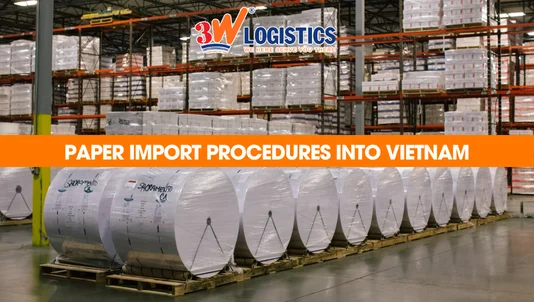
Import procedures for paper carry a moderate level of complexity, since paper is divided into several product lines (printing paper, cardboard/carton paper, tissue paper, recycled raw paper…) and each line is subject to different specialized inspection conditions. Businesses need to correctly identify the product category to know whether it falls under environmental permit requirements, conformity declaration, or simply standard commercial documentation.
Many businesses handling paper import procedures for the first time often confuse recycled raw paper (waste paper) with finished paper products – these two groups have completely different legal conditions. Applying the wrong HS code or missing the environmental permit can cause the shipment to be held at customs clearance, or even forced re-export.
In this article, 3W Logistics presents the process of paper import procedures – covering legal conditions, HS codes, tax calculation, documentation, step-by-step procedures, and practical risks from the perspective of a forwarder with years of experience handling paper shipments.
1. Legal conditions for importing paper
Not all types of paper are subject to the same conditions. This is the first point to clarify in paper import procedures, since each product group is tied to a different specialized regulatory authority.
| Paper Group | Applicable Conditions |
|---|---|
| Waste paper, recovered paper scrap | Must have a Certificate of Environmental Protection Eligibility for scrap material imports and place a deposit guarantee at a credit institution before the goods arrive at port, per Decree 08/2022/ND-CP |
| Printing paper, writing paper, photocopy paper | No specialized permit required, but the specific type and grammage (gsm) must be accurately declared on the documents |
| Food-contact paper | Must undergo conformity declaration/self-declaration of food safety under Decree 15/2018/ND-CP before circulation |
| Wood pulp, industrial cardboard | No specific permit required, but phytosanitary inspection is needed if the raw material comes from wood that has not undergone heat treatment |
Practical note: In paper import procedures, the most common mistake is importing waste paper for recycling without first obtaining the environmental permit and deposit guarantee, which results in the shipment being held at port with the risk of forced re-export. For ordinary finished paper, the conditions are much lighter, but the correct product type must still be declared to avoid HS code scrutiny.
2. HS Code and import duty for paper
Paper and paper products fall under Chapter 48 of the Import-Export Tariff Schedule. Correctly identifying the 8-digit sub-heading within this chapter directly affects the applicable duty rate when carrying out paper import procedures.
| Paper Type | Reference HS Code | Import Duty (MFN) |
|---|---|---|
| Newsprint (roll/sheet) | 4801.00.00 | 0-5% |
| Uncoated printing/writing paper | 4802.56 / 4802.57 | 10-15% |
| Toilet paper, tissue paper (parent rolls) | 4803.00.30 | 15-20% |
| Kraft paper for packaging | 4804.11 / 4804.21 | 8-10% |
| Cardboard (testliner, medium) | 4805.24 / 4805.25 | 3-5% |
| Coated paper | 4810.13 / 4810.19 | 10-18% |
| Waste paper, recovered paper scrap | 4707.10 / 4707.90 | 0% |
Note on HS codes: When declaring under paper import procedures, the grammage (gsm), whiteness level, and whether the paper is coated must be clearly stated – these are the parameters that determine the exact 8-digit sub-heading. Many shipments are misclassified due to confusing uncoated paper (heading 4802) with coated paper (heading 4810), leading to duty discrepancies.
Regarding origin: paper from Indonesia/Thailand enjoys a 0% rate with C/O Form D (ATIGA); from China, 0-5% with C/O Form E (ACFTA); from Japan/Korea, 0-8% with Form JV/KV; goods from the US and Canada, which have no FTA, are subject to the MFN rate of 10-20%.
3. Documentation for paper import procedures
The documentation set for paper import procedures is fairly compact for standard finished paper, but additional documents are required for recycled waste paper or food-contact paper.
| Document | When to Prepare | Important Notes |
|---|---|---|
| Sales contract | Before making a deposit | Clearly state the paper type, grammage, roll/sheet specification, quantity, and the C/O provision clause |
| Commercial Invoice & Packing List | Before the goods are shipped | Fully state the product name, expected HS code, grammage, packaging specification, and weight of each shipment |
| Bill of Lading | After the goods are loaded onto the vessel | Paper is typically shipped in 20′ or 40′ containers; verify the container and seal numbers match the booking |
| C/O (Certificate of Origin) | Before the goods are shipped | Important for enjoying preferential duty rates from ASEAN, China, Japan, and Korea; must match 100% with the Invoice and B/L |
| Environmental Certificate (waste paper only) | Before signing the contract | Mandatory for waste paper and recovered paper scrap used as raw material; must be accompanied by the deposit guarantee certificate |
| VNACCS customs declaration | Once documentation is complete | Declare the correct HS code based on grammage and paper type; include the C/O number and environmental permit number if applicable |
4. Step-by-step process for paper import procedures
Step 1: Identify the paper type and legal conditions
Before signing the contract, it is necessary to clearly determine whether the shipment is finished paper or recycled waste paper. This step determines the entire direction of the import procedures for paper, since waste paper requires an environmental permit and deposit guarantee before the order is even placed.
Step 2: Negotiate the contract, determine the HS code, and require a C/O
Sign the paper purchase contract, clearly stating the grammage, specifications, and requiring a C/O under the corresponding FTA in the contract terms – a key condition for enjoying preferential duty rates.
Step 3: Obtain the environmental permit and deposit guarantee (for waste paper)
The Certificate of Environmental Protection Eligibility and the deposit guarantee at a credit institution must be completed before the goods arrive at port – the most time-consuming step for this product group.
Step 4: Transport and customs declaration at the port
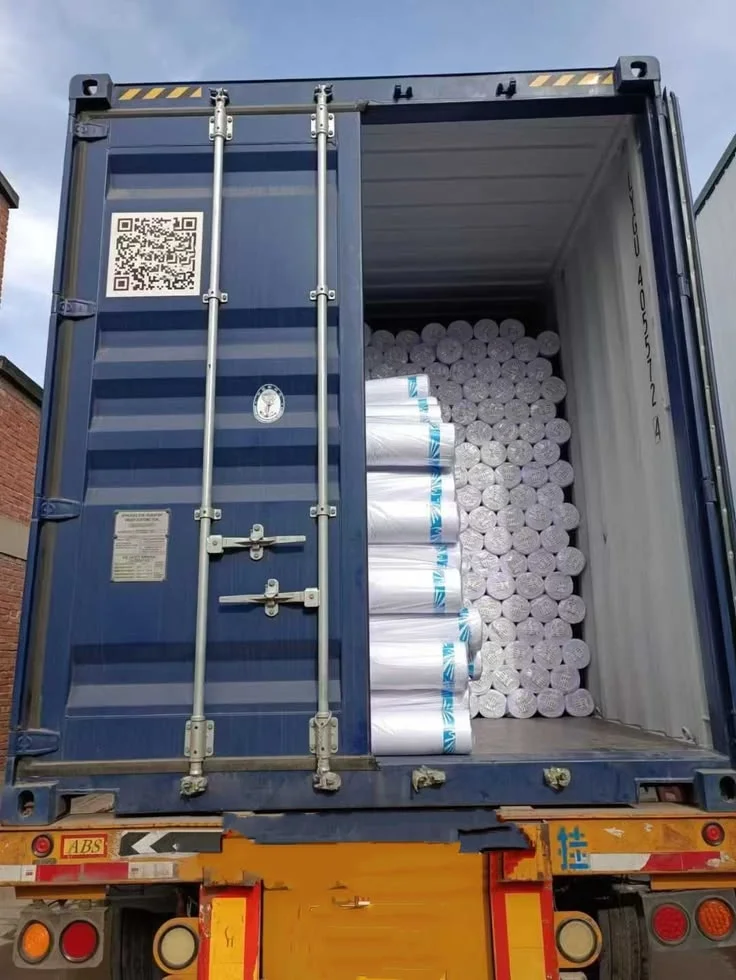
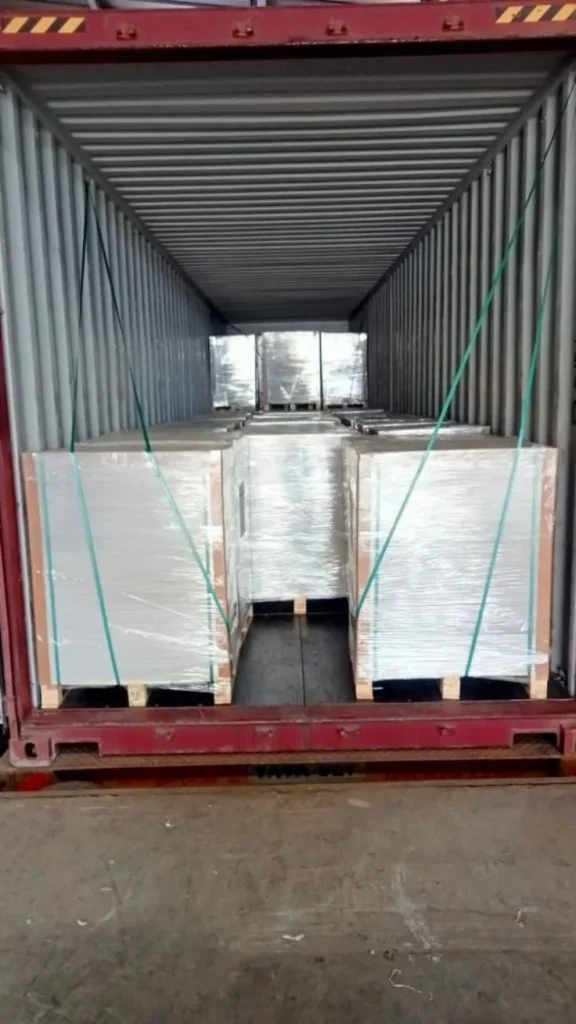
Imported paper is mainly transported in 20′ or 40′ containers. Once the vessel arrives at port, the forwarder opens the VNACCS declaration with the full HS code, C/O number, and environmental permit (if applicable); waste paper is typically subject to mandatory physical inspection.
Step 5: Customs clearance and delivery to warehouse
After completing duty payment and inspection, customs clears the shipment, and the business receives the D/O and transports the paper to the warehouse. For food-contact paper, the conformity declaration must be completed before distribution to the market.
5. How to calculate import duty for paper
Ordinary imported paper is only subject to two layers of tax – import duty and 10% VAT – lighter than product groups subject to special consumption tax. For example, a shipment of kraft paper imported from Indonesia with a CIF value of 2 billion VND:
| Tax Item | Without C/O (MFN 10%) | With C/O Form D (0%) |
|---|---|---|
| CIF price | 2,000,000,000 VND | 2,000,000,000 VND |
| Import duty | 200,000,000 VND | 0 VND |
| VAT (10%) | 220,000,000 VND | 200,000,000 VND |
| Total tax payable | 420,000,000 VND | 200,000,000 VND |
| Savings from C/O | 220,000,000 VND – a significant difference from a single C/O Form D, so it should always be requested right from the contract negotiation stage in paper import procedures. | |
From 3W Logistics’ practical experience: The most common issue in the paper product group is waste paper – because businesses are often unaware that the deposit guarantee and environmental permit requirements must be completed before the goods are shipped, not after they arrive at port. For ordinary finished paper, the main issue comes from misapplying the HS code between coated and uncoated paper, causing duty discrepancies and time-consuming explanations. Preparing the correct documentation from the start significantly shortens clearance time. – Ms. Apple, CCO, 3W Logistics
6. Common risks in paper import procedures
| Risk | Manifestation | Prevention |
|---|---|---|
| Missing environmental permit | Waste paper shipment arrives at port without a permit or deposit guarantee – the declaration cannot be opened, risking forced re-export | Complete the permit and deposit guarantee before signing the purchase contract |
| No valid C/O | Must pay the higher MFN duty instead of the preferential FTA rate | Require the C/O directly in the contract; check that it matches the Invoice and B/L before the goods are shipped |
| Incorrect HS code | Confusing coated with uncoated paper – customs reclassifies the goods and collects back-duties | Confirm the HS code based on accurate specifications before opening the declaration |
FAQ – Frequently Asked Questions about Paper Import Procedures
Question 1: What documents are needed for paper import procedures?
The basic documentation set includes: Sales Contract, Commercial Invoice, Packing List, Bill of Lading, C/O under the corresponding FTA, and VNACCS customs declaration. Waste paper additionally requires an Environmental Certificate and a deposit guarantee certificate.
Question 2: Does imported waste paper require a special permit?
Yes. Waste paper imported as recycling raw material must have a Certificate of Environmental Protection Eligibility and a deposit guarantee before the goods arrive at port – the biggest difference compared to ordinary finished paper.
Question 3: What taxes apply to paper imports?
Finished paper is subject to two layers of tax: import duty (0-20% depending on type and origin) and 10% VAT. Waste paper carries a 0% HS code rate but incurs deposit and inspection costs.
Question 4: How long do paper import procedures take?
For finished paper with complete documentation and a valid C/O, clearance typically takes only 2-5 days. For waste paper, the total time is longer, usually 30-45 days, due to the need to complete the environmental permit and deposit guarantee before the goods are shipped.
How does 3W Logistics support paper import procedures?
With many years of experience handling paper and waste paper imports, 3W Logistics provides a full-service solution – from classification consulting to delivery of cleared goods to the warehouse.
- Paper classification and legal condition consulting: Determine whether the shipment is finished paper or waste paper requiring an environmental permit.
- HS code determination and duty calculation before ordering: Based on grammage, coating, and paper type; calculate duties for each origin and FTA.
- Support in obtaining the correct FTA-form C/O: Guiding ASEAN suppliers to obtain Form D, Chinese suppliers Form E, and Japanese/Korean suppliers Form JV/KV.
- Container booking and shipping: From ASEAN, China, Japan, and Korea to Hai Phong, Da Nang, and Cat Lai (Ho Chi Minh City) ports.
- Electronic customs declaration: Correctly declare the HS code for each paper type and quickly resolve requests for additional documentation from customs.
Why choose 3W Logistics? Although paper import procedures are not as complex as product groups with special conditions, they still carry HS code and environmental risks if the specific characteristics of each product type are not well understood. We accompany you from classification through to delivery at the warehouse – helping businesses optimize costs and shorten clearance time.
Address: 34 Bach Dang, Tan Son Hoa Ward, Ho Chi Minh City
Hotline: +84 28 3535 0087
____________________________
3W Logistics Hanoi Branch
Address: 81A Tran Quoc Toan, Cua Nam Ward, Hanoi
Hotline: +84 24 3202 0482
____________________________
3W Logistics Hai Phong Branch
Address: 8A Lot 28 Le Hong Phong, Gia Vien Ward, Hai Phong
Hotline: +84 225 355 5939
____________________________
3W LOGISTICS CO., LTD – We here serve you there!
Email: quote@3w-logistics.com
Website: www.3w-logistics.com

Ms. Apple is the CCO (Chief Commercial Officer) at 3W Logistics, with over 10 years of experience in sales and business operations management.
At 3W Logistics, Ms. Apple is responsible for commercial strategy, corporate customer development, managing a team of more than 50 sales professionals, and improving business performance in the logistics sector.
With practical experience in sales management and market development, Ms. Apple shares professional insights on business logistics solutions, international transportation, freight forwarding, customer management, trade lane development, and growth strategies in the logistics industry.


