Customs procedures for importing clothing from China are a common need among fashion businesses, wholesale distributors, e-commerce platforms, and retail shop owners in Vietnam – especially as China remains the largest, most diverse, and most price-competitive supplier of garments compared to any other market.
However, importing clothing from China carries no shortage of risks that first-time importers often overlook: from mandatory Vietnamese-language labeling requirements to quality inspection rules for certain product categories, to incorrect HS code declarations that result in tax clawbacks or cargo held at port.
Many businesses only begin researching clothing import procedures from China after the container has already arrived at port, only to discover missing Vietnamese supplementary labels, missing product standard declarations, or incorrect origin declarations – leading to prolonged container storage costs and the risk of administrative penalties.
This article by 3W Logistics walks through the complete clothing import procedures from China in accordance with current regulations – covering product classification, HS codes, labeling requirements, documentation, tax calculation, and real-world risks from the perspective of a freight forwarder with over 10 years of experience handling consumer goods and garment imports.
1. Are there import conditions for clothing from China?
Clothing and garments in general are not on the list of prohibited imports and do not require a specialized import license. However, clothing import procedures from China still requires compliance with several important conditions that businesses should understand before placing orders:
| Product Group | Examples | Special Requirements |
|---|---|---|
| General adult clothing | T-shirts, jeans, dresses, jackets, sportswear… | No license required; mandatory Vietnamese supplementary label before market distribution |
| Children’s clothing (under 3 years old) | Bodysuits, newborn sets, children’s sleepwear, infant clothing… | Product safety quality inspection required under QCVN 21:2015/BCT – testing for formaldehyde content, azo dyes, and color fastness |
| Protective workwear | Protective uniforms, reflective vests, fire-resistant clothing… | Must meet technical standards under Ministry of Labour regulations; conformity certification required |
| General mixed garments | Fashion accessories, scarves, socks, adult underwear… | No mandatory sector-specific inspection; follow standard clothing import procedures from China as for general consumer goods |
Practical note: The quality inspection requirement for children’s clothing under 3 years old is a step that many first-time importers completely overlook. When importing clothing from China, if a shipment includes both adult and children’s garments, two separate documentation streams must be handled for the same shipment – this must be planned before signing the supplier contract.
2. HS Code and import duties for clothing from China
Accurate HS code classification is the most critical step in clothing import procedures from China. Clothing and garments fall primarily under Chapter 61 (knitted or crocheted) and Chapter 62 (not knitted or crocheted), with relatively high MFN duty rates if no C/O Form E is presented under the ACFTA agreement.
| Clothing Type | Reference HS Code | Reference MFN Duty |
|---|---|---|
| Men’s T-shirts, polo shirts (knitted, 100% cotton) | 6109.10.10 | 20% |
| Men’s T-shirts (knitted, synthetic fibers / polyester) | 6109.90.20 | 20% |
| Women’s T-shirts (knitted, synthetic fibers / polyester) | 6109.90.30 | 20% |
| Hoodies, cardigans, cotton knitwear (knitted) | 6110.20.00 | 20% |
| Hoodies, fleece jackets (knitted, synthetic fibers) | 6110.30.00 | 20% |
| Children’s knitted clothing (cotton) – including under 3 years old | 6111.20.00 | 20% |
| Children’s knitted clothing (synthetic fibers) | 6111.30.00 | 20% |
| Men’s woven shirts (cotton) | 6205.10.00 | 20% |
| Men’s woven shirts (man-made fibers / polyester) | 6205.20.00 | 20% |
| Men’s jeans, woven denim trousers (cotton) | 6203.42.00 | 20% |
| Women’s jeans, woven denim trousers (cotton) | 6204.62.00 | 20% |
| Men’s jackets, non-waterproof outerwear (woven, cotton) | 6201.10.00 | 20–30% |
| Women’s woven dresses (cotton / synthetic fibers) | 6204.49.00 | 20% |
| Men’s underwear (briefs, boxers – knitted, cotton) | 6107.11.00 | 20–30% |
| Women’s underwear (panties – knitted, cotton) | 6108.11.00 | 20–30% |
| Brassieres (all materials) | 6212.10.00 | 20–30% |
| Sportswear, tracksuit sets (knitted) | 6112.11.00 | 20% |
Each material category within garment classification – by classification type, age group, fiber content, and construction method – carries a different HS code. Do not attempt to determine HS codes based solely on product name. Authoritative lookup tools include:
- Vietnam General Department of Customs: customs.gov.vn – search by name or code
- VNACCS/VCIS system: Look up directly during electronic declaration
- HS classification consultation: Importers may submit a written request to the provincial/city Customs Department for pre-import HS code confirmation to avoid future disputes
- HS Code lookup system: https://caselaw.vn/tra-cuu-ma-hs – search by name or code
Important note on C/O Form E: For goods sourced from China – the primary market in clothing import procedures from China – C/O Form E under the ACFTA agreement can reduce import duty from the MFN rate of 20% down to 0–12% depending on the HS code and tariff reduction schedule. This is the single most impactful cost-saving document that many small businesses overlook simply by failing to request it from the supplier at the outset.
Import duty rates for clothing from China by certificate of origin type
| Certificate of Origin | Trade Agreement | Import Duty | Notes |
|---|---|---|---|
| No C/O (MFN rate) | — | 20–30% | Base duty rate when no valid certificate of origin is presented |
| C/O Form E | ACFTA (ASEAN–China) | 0–12% | The most important duty-saving document in clothing import procedures from China |
| C/O Form D (ASEAN) | ATIGA (intra-ASEAN) | 0–5% | Applies to goods originating from Thailand, Cambodia, Indonesia, Myanmar… |
3. Documentation for importing clothing from China
The complete documentation set for clothing import procedures from China consists of two groups: commercial documents prepared before the goods ship, and specialized documentation for children’s garments. Consistency in product description, quantity, and marks between all documents is an absolute requirement – even a minor discrepancy between the Invoice and the Packing List is sufficient for customs to demand a physical inspection, extending clearance time significantly.
| Document | When to Prepare | Key Notes |
|---|---|---|
| Sales Contract | Before placing deposit | Clearly state fabric composition (cotton, polyester, blend…), size range, colors, quality standards, and a clause requiring C/O Form E; also specify labeling and packaging requirements |
| Commercial Invoice | Before shipment | Must include full detail: garment type, fabric composition, gender, age group, unit of measure, and unit price per SKU – generic descriptions such as “clothing” or “garments” are insufficient for customs to determine the correct HS code |
| Packing List | Before shipment | Detail per carton: quantity, color, size, weight – fashion shipments typically carry many SKUs, and a vague Packing List commonly triggers full physical inspection of the entire lot |
| Bill of Lading / AWB | After goods are loaded | Cargo description should specify the main garment type in the shipment; consignee must match exactly the company name on the customs declaration |
| C/O Form E (ACFTA) | Supplier applies before shipment | Must be requested during contract negotiation; C/O Form E reduces duty from 20% to 0–12%; verify carefully that the goods description and HS code on the C/O match the Invoice 100% |
| Vietnamese supplementary label | Before market distribution | Per Decree 43/2017/NĐ-CP: must include product name, fabric composition, care instructions, country of origin, and importer name in Vietnamese – may be affixed before customs clearance or before goods are placed on sale |
| Quality test results (children’s clothing under 3 years old) | Before goods arrive at port | Mandatory under QCVN 21:2015/BCT: testing for formaldehyde, azo dyes, pH level, and color fastness at a Ministry of Industry and Trade-designated testing body; results typically take 10–20 working days |
| Electronic customs declaration (VNACCS) | Once all documents are ready | Declare the correct HS code per fabric group and garment type; mixed-product shipments require multiple line items on the same declaration |
4. Step-by-step clothing import procedures from China
Step 1: Determine HS codes and import conditions before placing the order
Before contacting any supplier, importers must accurately identify the HS code for each clothing category in the shipment, because HS codes are determined by fiber composition (cotton, polyester, wool…), construction method (knitted vs. woven), gender, and age group – not by commercial product name. This is the foundation of the entire clothing import procedures from China – an incorrect HS code here cascades into incorrect duty rates and incorrect inspection routing.
Step 2: Send quality testing samples (for children’s clothing under 3 years old)
If the shipment includes children’s garments for those under 3 years old, importers must send samples to Vietnam for testing at a Ministry of Industry and Trade-designated laboratory under QCVN 21:2015/BCT. Only after obtaining a passing test result should the main production order be placed. Testing and result issuance typically takes 10–20 working days.
Step 3: Sign the contract and request C/O Form E
Include a clause in the contract explicitly requiring C/O Form E under the ACFTA agreement. This is the most important cost-optimization step in clothing import procedures from China – if not requested upfront, Chinese suppliers typically do not issue C/O documents automatically, and the importer will bear the full MFN duty rate. At the same time, require the supplier to attach labels with information compliant with Vietnamese regulations, or prepare the Vietnamese supplementary labels in advance.
Step 4: Shipping and packaging
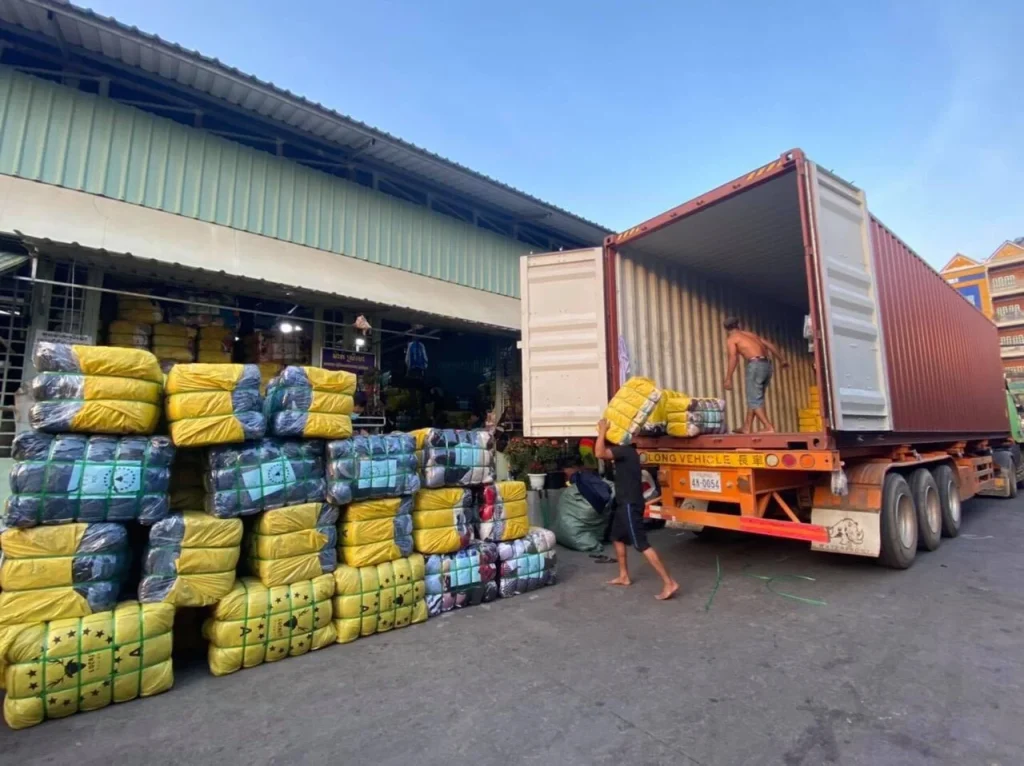
Garments are typically shipped by sea as LCL (less than container load) or FCL (full container load) depending on volume. For fashion shipments with many SKUs, require the supplier to pack by color and size separately, and label the outside of each carton with barcode or SKU code – this speeds up customs counting during physical inspection and prevents warehouse mix-ups.
Step 5: Customs declaration and inspection at port of entry
When goods arrive at port, the forwarder files a VNACCS declaration with separate HS codes for each garment group. Ordinary adult clothing shipments may be assigned to the green channel (immediate clearance) if documentation is complete and the importer has a good compliance record. Shipments containing children’s clothing for under 3 years old will be assigned to the yellow or red channel pending quality test result verification. Customs may also require physical inspection of high-value shipments or those where the Invoice product description is insufficiently detailed.
Step 6: Clearance, duty payment, supplementary labeling, and delivery to warehouse
Upon clearance, the importer pays import duty and 10% VAT, receives the Delivery Order, and arranges transport to the warehouse. Vietnamese supplementary labels per Decree 43/2017/NĐ-CP must be affixed to each product before distribution – mandatory information includes: product name, fiber composition, care instructions, country of origin, and the name of the Vietnam importer.
5. How to calculate import duties for clothing from China
Example: A knitted T-shirt shipment imported from China, CIF value USD 15,000, HS code 6109.10.00, MFN duty 20%, ACFTA duty 10%:
| Tax Item | Without C/O Form E (MFN 20%) | With C/O Form E (ACFTA 10%) |
|---|---|---|
| CIF Value | USD 15,000 | USD 15,000 |
| Import duty | 20% × 15,000 = USD 3,000 | 10% × 15,000 = USD 1,500 |
| VAT (10%) | 10% × (15,000 + 3,000) = USD 1,800 | 10% × (15,000 + 1,500) = USD 1,650 |
| Total duties payable | USD 4,800 (~VND 122 million) | USD 3,150 (~VND 80 million) |
| Savings with C/O Form E | USD 1,650 (~VND 42 million) — over 34% of total duties payable, simply by requesting one C/O document from the Chinese supplier at no additional cost. | |
From 3W Logistics’ hands-on experience: In clothing import procedures from China, we regularly see two compounding issues among first-time importers: a single shipment containing both adult clothing and infant garments declared under one HS code – customs then demands full physical inspection of the container and pursues a duty differential clawback. Simultaneously, no C/O Form E is available because the supplier was never asked for one, resulting in MFN duty at 20% across the entire shipment. On a clothing lot valued at USD 15,000, the duty gap of over USD 1,600 is entirely avoidable with the right preparation at the contract stage. – Ms. Apple, CCO, 3W Logistics
6. Common risks in clothing import procedures from China
| Risk | How It Manifests | How to Prevent It |
|---|---|---|
| Missing quality test results for children’s garments | Shipment containing children’s clothing for under 3 years old is held at port pending sample collection and testing; container storage costs accumulate for 10–20 days | Send test samples and obtain passing results before placing the main production order; do not combine children’s and adult garments in the same shipment without test results in hand |
| Incorrect HS code by fiber composition | Multiple garment types declared under a single HS code – customs reclassifies, pursues duty differential, and significantly extends clearance time | Declare separate HS codes for each fiber group and garment type; consult an experienced forwarder before filing declarations for multi-SKU shipments |
| No C/O Form E — paying full MFN duty | Importer pays MFN duty at 20% instead of 10% FTA rate – the difference is especially significant for high-value shipments | Include C/O Form E as a contractual requirement from the outset; verify that the received C/O matches the Invoice and B/L 100% before goods depart |
| Importing counterfeit branded clothing | Customs detects logos or trademarks without authorization – shipment is detained, intellectual property violation investigated, goods potentially destroyed, and heavy penalties imposed | Only import branded goods with a valid authorization letter; importing unbranded goods or goods under the importer’s own brand is a safer approach |
| Missing Vietnamese supplementary label at point of sale | Market surveillance inspects business premises and finds clothing without Vietnamese supplementary labels – administrative fine issued and product recall required | Prepare Vietnamese supplementary labels compliant with Decree 43/2017/NĐ-CP; affix labels to all products before goods leave the warehouse for distribution – do not ship unlabeled stock |
FAQ – Frequently asked questions about importing clothing from China
Question 1: What documents are required to clothing import procedures from China?
The complete documentation set includes: a sales contract, Commercial Invoice (specifying garment type, fabric composition, and quantity per SKU), detailed Packing List, Bill of Lading or AWB, C/O Form E under the ACFTA agreement, Vietnamese supplementary labels, and an electronic customs declaration filed through VNACCS. For children’s clothing under 3 years old, add a quality test result issued under QCVN 21:2015/BCT by a Ministry of Industry and Trade-designated testing body.
Question 2: Do children’s garments imported from China require quality inspection?
Yes – mandatory for children’s clothing under 3 years old under QCVN 21:2015/BCT. Importers must submit samples to a designated testing body and obtain a passing result before the main shipment arrives at port. Adult garments are not subject to mandatory sector-specific inspection. This is the single most important distinction in clothing import procedures from China that first-time importers consistently overlook.
Question 3: What are the import duty rates for clothing from China?
The standard MFN rate is 20% for most garment categories; certain items such as outerwear and lingerie may reach 30%. With a valid C/O Form E under the ACFTA agreement, the rate drops to 0–12% depending on the HS code. In addition to import duty, importers pay 10% VAT calculated on the CIF value plus import duty.
Question 4: Can I import clothing bearing well-known brand names from China?
Legally, importing garments bearing another brand’s trademark without a valid authorization letter constitutes intellectual property infringement. Customs has the authority to detain and destroy non-compliant shipments. Importers should source unbranded goods or goods carrying their own brand, or import only genuine goods through an authorized distribution channel.
Question 5: How long does the clothing import procedures from China take?
For standard adult garments with a complete documentation set, customs clearance at port typically takes 3–7 working days. For children’s clothing requiring sector-specific inspection, add 10–20 days if test results are not already in hand. With test results prepared in advance, port inspection time is reduced to 3–5 days. Total lead time from order placement to warehouse receipt (by sea from China) is typically 25–45 days depending on the port of origin.
How 3W Logistics supports clothing imports from China
As a freight forwarding company registered as an OTI-NVOCC with FMC Bond (Federal Maritime Commission) and with over 10 years of experience handling consumer goods and garment imports, 3W Logistics provides end-to-end services for businesses navigating clothing import procedures from China – from advisory on product classification and import conditions through to delivery at the distribution warehouse.
- HS code classification advisory and import condition review before ordering: Identify the correct HS code for each garment group by fiber content and end user; determine whether any items in the shipment fall under mandatory sector-specific inspection; calculate actual duty costs with and without C/O Form E so businesses have accurate numbers before supplier price negotiation.
- Sample coordination and quality testing follow-up for children’s garments: Connect clients with Ministry of Industry and Trade-designated testing laboratories; monitor progress to ensure passing results are in hand before the main shipment arrives at port.
- Support for Chinese suppliers in issuing compliant C/O Form E: Guide suppliers through the correct ACFTA C/O Form E application process; verify the received C/O against the Invoice and B/L for 100% consistency before acceptance, preventing rejection of preferential duty treatment at declaration.
- Freight booking and transport from major Chinese ports: Arrange FCL or LCL shipments from Guangzhou, Shanghai, Ningbo, Qingdao, and other ports to Hai Phong, Da Nang, and Cat Lai (Ho Chi Minh City) on optimized sailing schedules.
- Electronic customs declaration (VNACCS) by individual HS code: File separate HS codes for each garment group; monitor channel assignment and coordinate rapid response when customs requests physical inspection or supplementary documentation at the port.
- Vietnamese supplementary label advisory per Decree 43/2017: Guide clients on compliant label content; connect with label printing providers and support the labeling process before goods are released for distribution.
Why choose 3W Logistics for your clothing shipments from China? Importing clothing from China requires managing multiple compliance layers simultaneously: accurate HS classification by fiber and end user, sector-specific quality inspection for children’s garments, duty optimization through C/O Form E, and product labeling compliance. A multi-SKU fashion shipment handled by an inexperienced forwarder can go wrong at every layer at once. We work alongside clients from the pre-order classification stage through to warehouse-ready, distribution-ready delivery. Contact 3W for specific advice before signing your contract with a Chinese supplier.
Address: 34 Bach Dang Street, Tan Son Hoa Ward, Ho Chi Minh City
Hotline: +84 28 3535 0087
____________________________
3W Logistics Hanoi Branch
Address: 81A Tran Quoc Toan Street, Cua Nam Ward, Hanoi
Hotline: +84 24 3202 0482
____________________________
3W Logistics Hai Phong Branch
Address: 8A Plot 28 Le Hong Phong Street, Gia Vien Ward, Hai Phong
Hotline: +84 225 355 5939
____________________________
3W LOGISTICS CO., LTD – We here serve you there!
Email: quote@3w-logistics.com
Website: www.3w-logistics.com

Ms. Apple is the CCO (Chief Commercial Officer) at 3W Logistics, with over 10 years of experience in sales and business operations management.
At 3W Logistics, Ms. Apple is responsible for commercial strategy, corporate customer development, managing a team of more than 50 sales professionals, and improving business performance in the logistics sector.
With practical experience in sales management and market development, Ms. Apple shares professional insights on business logistics solutions, international transportation, freight forwarding, customer management, trade lane development, and growth strategies in the logistics industry.


