
Blog
The Certificate of Origin (C/O) is one of the most important documents in import-export activities, directly affecting tariff preferences, customs procedures, and the customs clearance capability of goods in the importing country. A clear understanding of what a C/O is, its different types, and the issuance process helps businesses minimize the risk of document rejection or the loss of tariff incentives.
In this article, 3W Logistics will help you explore in detail the concept of C/O, the role of the Certificate of Origin, common C/O forms, eligibility requirements, issuance procedures, and common mistakes when preparing C/O documents, thereby optimizing costs and improving export efficiency.
1. What is C/O? Distinguishing Preferential and Non-Preferential C/O
C/O (Certificate of Origin), also known as the Certificate of Origin of Goods, is one of the key documents in import-export and international trade activities. A C/O certificate is issued by a competent authority in the exporting country to certify the country or territory where the goods are produced, processed, or extracted.
In practice, C/O is divided into 2 main groups, each serving a different purpose. Properly understanding and distinguishing each type of Certificate of Origin is essential for businesses to maximize tariff benefits while avoiding mistakes during customs procedures.
- Preferential C/O: This type of Certificate of Origin is used to help goods enjoy preferential tariff rates under Free Trade Agreements (FTAs).
To obtain this type of C/O, the product must fully comply with the rules of origin specified under each agreement.
- Non-preferential C/O: This type of C/O certificate is mainly used to certify the origin of goods and is not intended for tariff preference purposes.
Businesses typically use this Certificate of Origin (C/O) to meet the importing country’s requirements, support trade statistics, or prove origin in cases related to trade remedies.
In import-export activities, the Certificate of Origin (C/O) is one of the most critical documents, directly affecting import duties, customs clearance capability, business credibility, and eligibility for FTA preferences. In particular, from May 1, 2026, the Ministry of Industry and Trade has amended and supplemented 33 C/O issuance procedures, requiring businesses to update the new process to avoid documentation errors.
If you are searching for “What is C/O?”, this section will help you clearly understand the concept, classification, mandatory information required on a C/O, and the common mistakes businesses often make.
2. The Role and Purpose of the Certificate of Origin (C/O)
The C/O (Certificate of Origin) plays a core role in verifying the origin of products before they circulate in the international market. Through the C/O certificate, customs authorities and relevant parties can identify the country where the goods were produced or extracted, thereby applying the correct legal regulations and bilateral or multilateral trade commitments.
In practice, using the Certificate of Origin (C/O) brings many important values to businesses, including:
Tariff Preferences
One of the most important purposes of a C/O certificate is to help goods qualify for preferential tariff rates under Free Trade Agreements (FTAs).
By proving valid origin, businesses can significantly reduce import tax costs and strengthen their competitive advantage.
Support for Anti-Dumping and Anti-Subsidy Measures
A C/O also serves as the basis for authorities to verify the origin of goods in cases related to anti-dumping, anti-subsidy, or anti-circumvention tax investigations.
This is especially important for industries that are frequently subject to strict control, such as wood, steel, textiles, or furniture.
Trade Statistics and Quota Management
Information from the Certificate of Origin helps authorities compile more accurate import-export statistics. It also serves as the basis for developing quota policies, regulating trade, and promoting exports by market.
Greater Transparency and Consumer Protection
Beyond tax and procedural aspects, a C/O certificate also helps improve transparency regarding product origin. As a result, goods circulating in the market can better meet requirements for safety, quality, and traceability, thereby protecting consumer rights.
3. Classification of Common C/O Certificates and Scope of Use
Choosing the correct C/O form for each export market is a crucial factor in helping goods enjoy tariff preferences under FTAs. Each agreement corresponds to a specific type of Certificate of Origin.
Non-preferential C/O
Unlike the above group, non-preferential C/O only serves the function of certifying the origin of goods and is not used for enjoying special preferential tariff rates.
Common forms include:
- Form B C/O: the most common non-preferential Certificate of Origin, used for many export markets
- Industry-specific C/O for coffee, textiles, etc.: issued according to the specific regulations of each industry or relevant international organizations
This type of C/O certificate is often required when the importing country needs to verify origin, support trade statistics, or conduct trade remedy investigations.
Preferential C/O
This is the group of Certificates of Origin (C/O) used when businesses want to enjoy preferential tariff rates under Free Trade Agreements.
Some common preferential C/O forms include:
- Form D C/O: applicable to goods exported within ASEAN under ATIGA
- Form E C/O: used for goods exported to China and ASEAN countries under ACFTA
- Form AK C/O: applicable to the South Korea and ASEAN markets under AKFTA
- Form AJ C/O: used for goods exported to Japan under AJCEP
- Form VJ C/O: for shipments to Japan under the VJEPA agreement
- Form EUR.1 C/O: applicable to the EU market under EVFTA
- CPTPP C/O: used for CPTPP member countries
- Form A C/O: applied under the Generalized System of Preferences (GSP)
This group of preferential C/O certificates is commonly used by businesses when exporting to ASEAN, China, South Korea, Japan, the EU, and CPTPP countries.
4. Conditions for Obtaining a Certificate of Origin (C/O)
Choosing the appropriate C/O form depends on the export product and the import market. Businesses need to compare the preferential tariff schedules under each agreement to determine the most suitable Certificate of Origin, thereby optimizing tariff benefits for each shipment.
According to Article 6 of Decree 31/2018/ND-CP, goods are considered originating if they fall into one of the following two cases:
Wholly Obtained Goods
This refers to goods that are entirely grown, extracted, harvested, or produced within a specific country or territory.
Typical examples include agricultural products, seafood, or minerals that originate 100% from the exporting country.
Non-Wholly Obtained Goods
For goods using imported materials, a Certificate of Origin (C/O) can still be issued if the product satisfies the origin criteria under product-specific rules, commonly including:
Minimum Regional Value Content (RVC/LVC) as prescribed
A change in the HS code of input materials compared to the finished product, usually assessed at the 4-digit level (CTH)
Or compliance with specific product rules issued by the Ministry of Industry and Trade
5. Procedures for Applying for a Certificate of Origin (C/O) – Latest Update 2026
5.1 C/O Issuance Procedure
Under current regulations, the application process for a Certificate of Origin (C/O) is generally carried out in the following 3 basic steps:
Step 1: Submit the electronic declaration
After determining that the goods meet the origin criteria, the business proceeds to declare the application dossier for the C/O certificate on the electronic system of the Ministry of Industry and Trade or the authorized issuing organization.
For first-time registration, the business must complete its trader profile before being eligible for a C/O for the shipment.
Step 2: Prepare the C/O application dossier
The application dossier for a Certificate of Origin typically includes:
- Application form for C/O issuance
- Commercial Invoice
- Packing List
- B/L or AWB
- Export customs declaration
- Completed C/O form
- Documents proving the origin of raw materials and finished goods
Depending on the product, businesses may need to provide additional documents such as a bill of materials, import declarations for input materials, or origin commitments from the manufacturer. The dossier requirements are regulated under Article 15 of Decree 31/2018/ND-CP.
Step 3: Wait for approval and receive the result
Businesses may submit the C/O dossier in 3 ways:
- Online submission: electronic dossiers must include a digital signature, with results usually issued within 6 working hours
- Direct submission: hard-copy dossiers, processing time is approximately 8 working hours
- Submission by post: results are generally returned within 24 hours
Once the dossier is valid, the issuing authority will provide the Certificate of Origin for use in the export documentation set.
5.2 C/O Issuance Fee – Latest Update 2026
The C/O issuance fee varies depending on the type of Certificate of Origin and the regulations of the competent authority at each point in time. Businesses should check directly with the issuing organization to obtain the most accurate fee applicable to each dossier.
Currently, from 01/07/2025 to 31/12/2026, the C/O certification fee has been reduced by 50%, equivalent to approximately 30,000 VND per newly issued set and 15,000 VND per reissued set.
5.3 Which authorities or organizations are authorized to issue C/O?
In Vietnam, the authority to issue C/O currently belongs to the Ministry of Industry and Trade and organizations designated or authorized by the Ministry depending on each type of Certificate of Origin. Depending on the C/O form, businesses will submit dossiers to the Import-Export Department, regional Import-Export Management Offices, or other assigned issuing units.
Previously, VCCI was authorized to issue certain non-preferential C/O certificates. However, part of this authority has been adjusted and reassigned to agencies under the Ministry of Industry and Trade since 2025.
5.4 Forms of C/O Issuance
In addition to classification by usage purpose, C/O can also be distinguished based on the form of issuance, depending on the actual route of the shipment.
Directly Issued C/O
This type of Certificate of Origin is issued by the competent authority of the actual country of origin, which is also usually the exporting country.
This form is common for shipments transported directly from the producing country to the importing country.
Back-to-back C/O
A back-to-back C/O is a type of C/O certificate issued by an intermediate or re-exporting country, based on the original C/O from the initial country of origin.
This form usually arises when goods pass through a transshipment country before reaching the final import market.
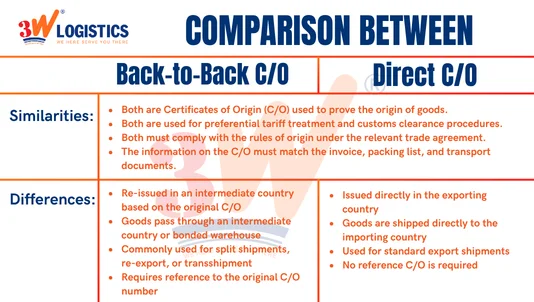
Comparison between back-to-back CO and direct CO
6. Mandatory Information Required on a C/O
For a Certificate of Origin (C/O) to be valid and accepted by customs authorities, the document must include all of the following mandatory information:
- Applicable C/O form under the relevant agreement or rule of origin
- Name and address of the exporter and importer
- Transport information: means of transport, port of loading/discharge, bill of lading number or AWB
- Goods information: product name, quantity, weight, packaging specifications, and value
- Origin information: country of origin and origin determination criteria
- Confirmation by the issuing authority: signature, stamp, or electronic authentication
These details are the basis for customs authorities to verify the validity of the C/O certificate and determine whether the shipment is eligible for preferential tariff treatment.
7. Frequently Asked Questions About C/O and How to Handle Them
Question 1: Why is C/O rejected? How to handle a rejected C/O
A C/O may be rejected, usually due to inconsistent information (product name, quantity), missing documents proving origin, invalid C/O form, or failure to meet origin criteria. As a result, the goods may not qualify for preferential tariff rates, higher taxes may apply, and customs clearance may be delayed.
Why was my C/O rejected?
- Inconsistent information: Information on the C/O does not match the Invoice, Bill of Lading, or customs declaration.
- Formal errors: The C/O contains erasures, lacks a stamp, lacks a signature, or uses the wrong form (for example, using Form D instead of Form E).
- Failure to meet criteria: The goods do not satisfy the rules of origin (PSR, RVC, CTC) or only undergo simple processing/assembly.
- Expired: The C/O is submitted beyond the validity period applicable to the specific form.
- Conflicting content: The goods description is unclear or lacks supporting documents.
For detailed reasons, please refer to Decision 467/QD-CHQ in 2025
How to handle a rejected C/O:
- Check the reason: Request customs authorities to clearly state the reason for rejection and sign/stamp the original document.
- Amend / Re-issue: Correct the information and apply for a new C/O or a revised C/O.
- Temporary tax payment: If the new C/O cannot be obtained in time, the business may temporarily pay the higher tax rate and later request a tax refund once a valid C/O is available.
Question 2: How to handle an expired C/O?
A Certificate of Origin (C/O) is generally valid for 12 months from the date of issuance. However, this validity period may vary depending on the C/O form, the trade agreement (FTA), or the specific regulations of the importing country.
When a C/O expires, the business should quickly check whether it falls under cases eligible for re-issuance or retroactive issuance (Issued Retroactively / Issued Retrospectively). Under current regulations, the dossier may be submitted online through the EcoSys system of the Ministry of Industry and Trade or via the National Public Service Portal.
If eligible for re-issuance, the new C/O will be certified with statements such as:
- “CERTIFIED TRUE COPY” for certified true copies
- “THIS C/O REPLACES THE C/O NO… DATED…” for replacement issuance
- “ISSUED RETROACTIVELY” for retroactive issuance
Important note: If the C/O has exceeded 1 year from the date of issuance, the competent authority may refuse re-issuance under current regulations.
Therefore, as soon as a C/O is found to be nearing expiry or already expired, businesses should handle it promptly to avoid affecting customs procedures, import tariff incentives, and cargo clearance timelines.
For detailed re-issuance procedures, dossier requirements, and processing times, businesses may refer to the National Public Service Portal: View C/O re-issuance procedure
Question 3: Can I apply for a C/O after the vessel’s ETD?
Yes, you can absolutely apply for a C/O after the vessel has departed (after ETD). Under the regulations, a C/O may be issued retroactively, provided it is issued within 1 year from the shipment date. In such cases, the C/O must be marked in the “Issued Retroactively” box.
If you have any questions or need consultation regarding C/O, customs procedures, import-export taxes, or international shipping solutions, please contact 3W Logistics for a free consultation.
With a team of professionals having more than 10 years of industry experience, we are ready to support you 24/7 whether you already have shipments or not!
CONTACT INFORMATION:
Head Office – 3W Logistics Ho Chi Minh Branch
Address: 34 Bach Dang Street, Tan Son Hoa Ward, Ho Chi Minh City, Vietnam
Hotline: +84 28 3535 0087
____________________________
3W Logistics Hanoi Branch
Address: 8A Lot 28 Le Hong Phong, Gia Vien Ward, Hai Phong, Vietnam
Hotline: +84 24 3202 0482
____________________________
3W Logistics Hai Phong Branch
Address: 81A Tran Quoc Toan, Cua Nam Ward, Hanoi, Vietnam
Hotline: +84 225 355 5939
Website: www.3w-logistics.com
Note: Regulations related to C/O, customs procedures, and import-export taxes may be updated from time to time. Therefore, the content of this article is for reference purposes only. Businesses should always compare with the latest legal documents or consult experts to ensure proper application in each practical case.


