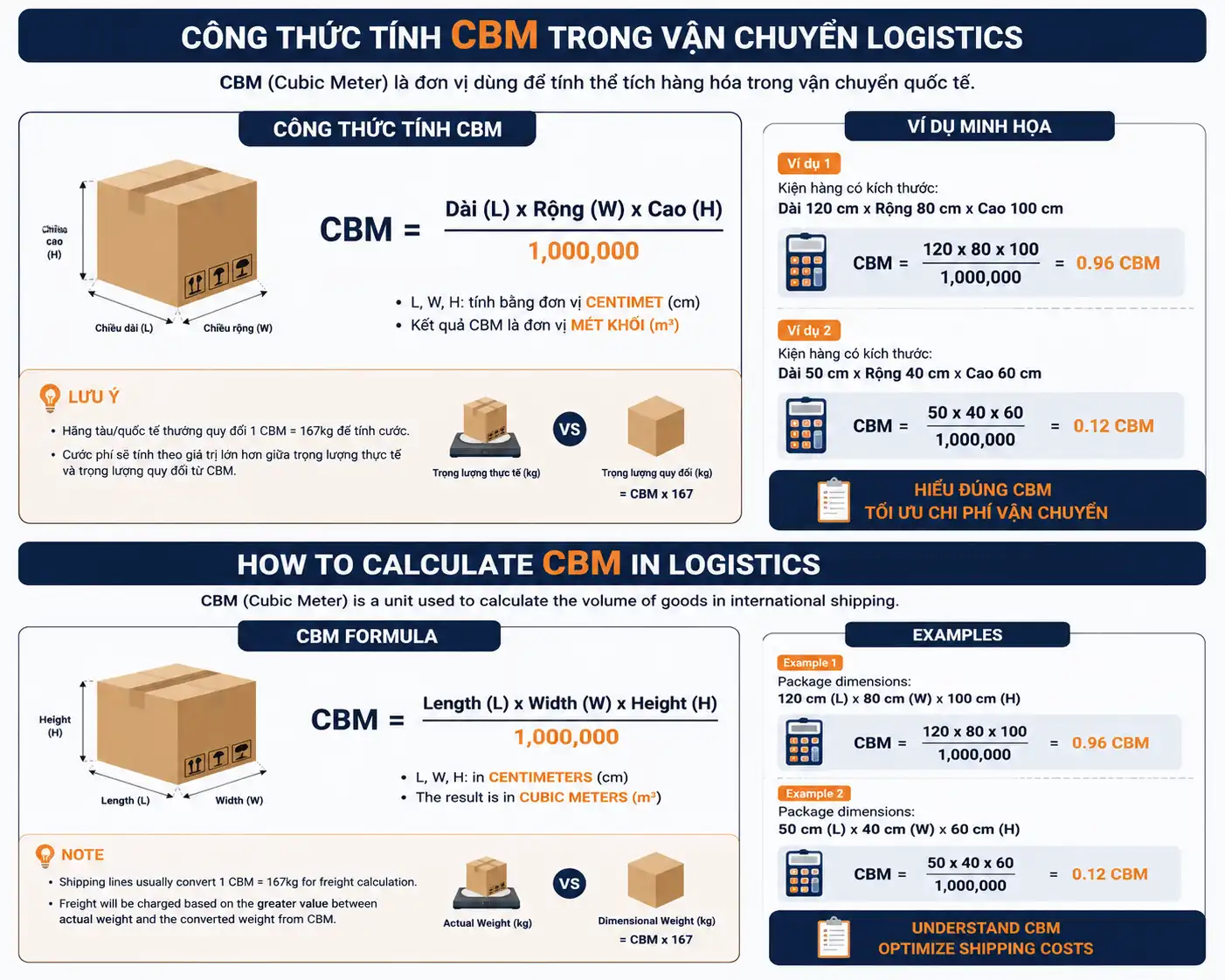
What Is CBM?
CBM (short for
Cubic Meter) is a unit used to measure cargo volume in the metric system, equivalent to
1 cubic meter (m³). In logistics and international shipping, CBM is used to determine the actual space a shipment occupies inside a container, warehouse, or aircraft cargo hold.Simply put:
1 CBM = a box measuring 1m × 1m × 1m.CBM is the basis for freight forwarders and carriers to calculate charges by volume — especially important for bulky cargo, meaning shipments with large volume but light actual weight.

Basic CBM Calculation Formula
The CBM calculation formula applies generally to all rectangular box-shaped cargo:
CBM = Length (m) × Width (m) × Height (m) × Number of packages
Example: You have 10 cartons, each measuring 60cm × 40cm × 50cm.
- Convert to meters: 0.6m × 0.4m × 0.5m
- CBM per carton: 0.6 × 0.4 × 0.5 = 0.12 CBM
- Total for 10 cartons: 0.12 × 10 = 1.2 CBM
Note: If the dimensions are in cm, divide each side by 100 before multiplying. If they are in inches, multiply each side by 0.0254 to convert to meters.
How to Calculate CBM for Sea Freight
What Is CBM Used for in Sea Freight?
In sea freight, CBM is a core metric used to:
- Determine whether a shipment falls under FCL (Full Container Load) or LCL (Less than Container Load — consolidated cargo)
- Calculate LCL freight charges based on W/M (Weight or Measurement) — meaning charges are based on weight or volume, whichever is higher
- Estimate container loading capacity to avoid additional costs for hiring extra containers
LCL Freight Charging Rule: W/M
For consolidated cargo (LCL), ocean freight is usually quoted based on
W/M, meaning:
- Charges are calculated by actual weight (tons) or by volume (CBM)
- The freight forwarder will choose the higher number to apply the charge
Practical example: A shipment weighs 500kg, has a volume of 2 CBM, and the freight rate is $25/W/M.
- By weight: 0.5 tons → $12.5
- By volume: 2 CBM → $50
- → The freight charge is $50 (the higher value is used)
Reference Maximum Container Volume
| Container type | Internal dimensions (L×W×H) | Maximum capacity |
|---|
| 20′ DC (Dry Container) | 5.9m × 2.35m × 2.39m | ~33 CBM |
| 40′ DC | 12.03m × 2.35m × 2.39m | ~67 CBM |
| 40′ HC (High Cube) | 12.03m × 2.35m × 2.70m | ~76 CBM |
In practice: Cargo can usually only be loaded up to 85–90% of the theoretical capacity due to irregular shapes, pallets, straps, and other factors. For LCL cargo, you pay only for the actual CBM of your shipment and do not need to hire a full container.
When Should You Choose FCL Instead of LCL?
Generally, if your shipment reaches
15 CBM or more (for a 20′ container) or
25–28 CBM (for a 40′ container), hiring a full container under FCL is often cheaper than using LCL consolidation. However, this figure depends on the route and timing — you should consult your freight forwarder to compare specific costs.
How to Calculate CBM for Air Freight
Dimensional Weight (Chargeable Weight)
Unlike sea freight, air freight is not charged purely by CBM. Instead, it uses the concept of
Chargeable Weight. This is the higher value between:
- Actual weight (Gross Weight, measured in kg)
- Volumetric weight (Volumetric Weight / Dimensional Weight, measured in kg)
Formula for Calculating Air Freight Volumetric Weight
Most airlines and freight forwarders use the conversion factor
1 CBM = 167 kg (equivalent to 6,000 cm³ = 1 kg):
Volumetric Weight (kg) = Length (cm) × Width (cm) × Height (cm) ÷ 6,000 × Number of packages
Example 1 — Cargo heavier than its volume: 5 cartons, each measuring 60cm × 50cm × 40cm, with an actual weight of 80 kg.
- Volumetric Weight = (60 × 50 × 40 ÷ 6,000) × 5 = 10 kg/package × 5 = 50 kg
- Actual weight: 80 kg
- Chargeable Weight = max(80, 50) = 80 kg → freight is charged based on 80 kg
Example 2 — Bulky cargo: 3 foam boxes, each measuring 100cm × 80cm × 60cm, with an actual weight of 15 kg.
- Volumetric Weight = (100 × 80 × 60 ÷ 6,000) × 3 = 80 kg/package × 3 = 240 kg
- Actual weight: 15 kg
- Chargeable Weight = max(15, 240) = 240 kg → freight is charged based on 240 kg
This is why lightweight but bulky items (furniture, toys, foam products, etc.) often incur very high air freight costs — you are paying for the space occupied, not the weight.
What Is the 6,000 Conversion Factor?
The number 6,000 is an aviation industry convention (IATA standard) for regular commercial cargo. Some routes or special cargo types may use a factor of
5,000 (commonly seen with some express carriers such as DHL, FedEx, and UPS for certain services). When receiving a quotation, you should clearly confirm which factor your freight forwarder is using.
Comparison of Sea vs. Air Freight Calculation
| Criteria | Sea Freight | Air Freight |
|---|
| Charging unit | CBM or ton (W/M) | Chargeable Weight (kg) |
| Volume formula | L(m) × W(m) × H(m) | L(cm) × W(cm) × H(cm) ÷ 6,000 |
| Conversion factor | 1 CBM ≈ 1 ton (W/M) | 1 CBM = 167 kg |
| Which value is used | The higher value between tons and CBM | The higher value between gross weight and volumetric weight |
| Best suited for | Heavy or large cargo, not urgent | Lightweight, high-value, urgent cargo |
How to Calculate CBM for Special Cargo Types
Round Cargo (Pipes, Rolls, Drums)
Convert it to an
outer bounding box — meaning the outside diameter is used as both the length and the width:
CBM = Diameter (m) × Diameter (m) × Height/Length (m) × Quantity
This is how freight forwarders and ports calculate space for container loading. You will “pay” for the square space surrounding the round shape, not the actual circular area.
Oversized and Heavy Cargo (OOG — Out of Gauge)
Cargo exceeding standard container dimensions (machinery, industrial equipment, wind turbine blades, etc.) must use
Open Top or
Flat-rack containers. CBM is still calculated using the basic formula, but the freight rate will include additional OOG surcharges and may be calculated by
container slot instead of purely by CBM.
Palletized Cargo
If the cargo has already been packed on pallets, calculate CBM based on the
total dimensions including the pallet (including the height of the wooden pallet, usually 12–15cm). This is the actual space occupied inside the container or warehouse.
LCL Cargo with Multiple Packages of Different Sizes
Calculate the CBM of each package group separately, then add them together:
Total CBM = CBM group 1 + CBM group 2 + CBM group 3…
Frequently Asked Questions (FAQ)
Is there any difference between CBM and m³?
No. CBM (Cubic Meter) and m³ (cubic meter) are the same unit of measurement. In the logistics industry, people often use “CBM” instead of “m³” as a common international trade convention.
How many kg is 1 CBM in air freight?
According to the most common IATA standard, 1 CBM = 167 kg volumetric weight (equivalent to the factor of 6,000 cm³/kg). Some carriers or express services may use a factor of 5,000, meaning 1 CBM = 200 kg. Always confirm with your freight forwarder before estimating costs.
How do I know whether my cargo should go by Sea or Air?
Compare the Chargeable Weight under both shipping methods and multiply it by the corresponding rate. In general: heavy cargo that is not urgent → sea freight is much more cost-effective. Lightweight cargo that is urgent and high-value (electronics, components, seasonal fashion items) → air freight, although more expensive, may make better business sense.
Does CBM affect THC and CFS fees?
Yes. THC (Terminal Handling Charge) for LCL cargo is usually calculated by CBM or ton (W/M), similar to ocean freight. CFS (Container Freight Station) fees for consolidating/deconsolidating LCL cargo are also calculated by CBM. Therefore, the total LCL cost usually = ocean freight W/M + THC W/M + CFS W/M + fixed charges (B/L, AMS, etc.).
At how many CBM should I hire FCL instead of LCL?
There is no absolute threshold, but in the Vietnamese market, from
15 CBM or more for a 20′ container, or from
25 CBM for a 40′ container, switching to FCL is often more cost-effective in terms of freight. However, FCL also depends on the route, seasonality, and actual LCL rates from each freight forwarder. Consult directly with a specialist for an accurate comparison.
Conclusion
CBM is a metric you will encounter in every international shipping transaction — from the first quotation with a freight forwarder to the final invoice when the cargo reaches the consignee. Mastering how to calculate CBM helps you verify quotations, estimate costs before negotiation, and avoid surprises related to bulky cargo surcharges.In summary:
- Sea Freight: CBM = L × W × H (meters) × quantity; LCL freight is calculated by W/M (CBM or tons, whichever is higher)
- Air Freight: Volumetric Weight = L × W × H (cm) ÷ 6,000 × quantity; Chargeable Weight = max(gross weight, volumetric weight)
Need shipping consultation for cargo to the United States or Canada?The
3W Logistics team, an NVOCC with
FMC License #029003, specializing in Vietnam–U.S./Canada routes, is ready to support you today.