Blog
What is a PO? Definition of Purchase Order
PO stands for Purchase Order — a formal commercial document issued by the Buyer and sent officially to the Seller/Supplier to confirm the intent to purchase goods or services under mutually agreed terms and conditions.
In the field of logistics and supply chain management, a PO is far more than a simple order form — it serves as the “legal starting point” of the entire operational chain: from the moment goods have yet to be produced to the point they arrive at the buyer’s warehouse. All subsequent activities, including freight booking (sea/air), customs declaration, commercial invoice issuance, and accounts reconciliation, revolve around the PO number as a central reference identifier.
In terms of terminology, Purchase Order is a standard concept in international trade, widely used within Incoterms, UCP 600 (L/C payment) frameworks and ERP platforms such as SAP and Oracle. No single individual is credited with coining the term — PO evolved naturally from Western industrial commerce in the early 20th century, as businesses sought to standardize internal procurement processes and maintain budget control.
What Information Does a PO Contain?
1. Order Identification
- Purchase Order Number (PO Number): A unique reference code used for tracking and cross-referencing with invoices, packing lists, and bills of lading. ERP systems such as SAP and Oracle auto-generate PO numbers according to internal company standards.
- Issue Date: The date on which the buyer officially confirms the order, serving as the reference point for lead time calculation and delivery scheduling.
- Effective Date & Expiry Date: Critical in blanket POs or standing orders.
2. Party Information
- Buyer: Company name, registered address, tax identification number, and name of the procurement officer in charge.
- Supplier/Vendor: Supplier name, address, vendor code in the system, and account manager contact details.
- Ship-to Address: The warehouse delivery address, which may differ from the billing address — particularly relevant in cross-docking or drop-shipment models.
- Bill-to Address: The address to which the financial invoice is issued.
3. Line Item Details
This is the core section of the PO, comprising:
- Item Description & SKU/Part Number: Detailed product descriptions along with internal item codes and supplier part numbers to prevent errors during picking and packing.
- HS Code (Harmonized System Code): Mandatory in international import/export POs, directly affecting tariff classification and customs clearance procedures.
- Quantity: Unit of measure must be clearly stated (pcs, carton, kg, MT), including MOQ (Minimum Order Quantity) where applicable.
- Unit Price & Total Amount: Agreed unit price, subtotal per line item, and overall PO value.
- Currency: USD, EUR, VND, etc. — must be consistent with the commercial contract.
4. Trade & Delivery Terms
- Incoterms: EXW, FOB, CIF, DAP, DDP, etc. — clearly defines the point of risk transfer and cost responsibilities between buyer and seller; an indispensable clause in any international logistics PO.
- Delivery Date / Required Ship Date: The committed delivery date at the port of loading or receiving warehouse, used as the basis for measuring On-Time Delivery (OTD) KPIs.
- Port of Loading / Port of Discharge: Origin and destination ports for sea or air freight shipments.
- Mode of Transport: Sea freight, air freight, road transport, or multimodal transport.
- Carrier Instruction: Buyer-nominated preferred carrier/airline, or authorization for the supplier to arrange independently.
5. Payment Terms
- Payment Method: T/T (Telegraphic Transfer), L/C (Letter of Credit), D/P, D/A, Open Account, etc.
- Payment Timeline: Net 30, Net 60, 30% deposit – 70% prior to shipment, etc.
- Banking Details: Supplier’s bank account information (typically attached or referenced from vendor master data).
6. Documentation & Packaging Requirements
- Required Documents: Commercial Invoice, Packing List, Bill of Lading/Airway Bill, Certificate of Origin (C/O), Phytosanitary Certificate, Test Report, MSDS, etc.
- Packaging Instructions: Packaging specifications, marking and labeling requirements, palletization standards (ISPM-15 for export shipments), units per carton, gross/net weight, and dimensions.
- Barcode/Label Requirements: Particularly critical for retail supply chain POs (GS1, SSCC labels, etc.).
7. Legal & Special Terms
- Quality Standards & Inspection: AQL levels, third-party inspection requirements (SGS, Bureau Veritas, etc.), and the right to reject non-conforming goods.
- Penalty Clause: Penalties for late delivery or failure to meet quality specifications.
- Warranty Terms: Warranty period and return/exchange conditions.
- Force Majeure: Provisions covering unforeseeable circumstances beyond either party’s control.
- Governing Law: Applicable jurisdiction and dispute resolution body.
8. Authorization
- Signature or company seal from an authorized approving officer (Procurement Manager, CFO, depending on PO value).
- In modern ERP environments, this is replaced by a digital approval workflow with a full audit trail.
- Supplier Acknowledgement: Some organizations require the supplier to countersign the PO (PO Acknowledgement) within 24–48 hours of receipt.
Common Types of Purchase Orders in Logistics
In logistics and supply chain operations, not all procurement transactions share the same nature or scale. For this reason, purchase orders are categorized into several types to accommodate specific operational requirements.
- Standard Purchase Order (SPO) is the most common type, used for one-time purchases with clearly defined quantities, prices, and delivery dates — typically applied when a company procures raw materials or goods on a per-lot basis.
- Blanket Purchase Order (BPO), also known as a framework PO, allows a company to pre-commit to a large volume of goods with a supplier over an extended period (usually 6–12 months), optimizing negotiation costs and securing a stable supply — a strategic choice in Just-In-Time (JIT) inventory management.
- Planned Purchase Order is similar to a BPO but includes a predetermined delivery schedule, making it suitable for manufacturers that need to synchronize raw material inputs with production planning.
- Contract Purchase Order (CPO) is tied to a long-term master agreement in which legal terms, payment conditions, and quality standards are pre-negotiated — commonly found in international supply chains involving multiple stakeholders.
- Digital or Electronic Purchase Order (ePO) is integrated directly into ERP or TMS (Transportation Management System) platforms, enabling procurement process automation, minimizing manual errors, and shortening document processing lead times. Selecting the appropriate type of purchase order not only impacts warehouse and transportation efficiency but also directly affects cash flow, supplier risk management, and the overall agility of the supply chain.
What is the PO Creation Process in Import-Export?
Step 1: Purchase Requisition Confirmation
Before a PO is created, the Procurement department receives a Purchase Requisition (PR) from the Sales, Production, or Warehouse department. The PR must clearly specify: commodity type, required quantity, Required Delivery Date, and approved budget. At this stage, the logistics team needs to back-calculate from the required delivery date to determine a realistic Latest Shipment Date, avoiding late PO issuance that could cause the entire supply chain to fall behind schedule.
Step 2: RFQ, Negotiation, and Terms Finalization
The Buyer sends a Request for Quotation (RFQ) to one or more suppliers. Upon receiving quotations (Quotation/Proforma Invoice), the procurement team analyzes and negotiates key commercial terms:
- Incoterms determine the point of risk transfer and freight responsibility — selecting incorrect Incoterms can lead to serious disputes when cargo is lost or damaged in transit.
- Payment terms directly impact the cash flow of both parties.
- Production lead time and vessel booking window with carriers, especially during Peak Season when vessels are typically fully booked 2–3 weeks in advance.
Step 3: Internal PO Creation and Approval
The PO is drafted within an ERP system (SAP, Oracle, NetSuite, etc.) or a procurement management platform. The approval workflow is typically tiered based on PO value:
- POs below a defined threshold: approved by the Procurement Manager
- High-value POs: require sign-off from the Finance Director or CFO
- POs involving Letter of Credit (L/C): require coordination with the Finance department to open the L/C prior to PO issuance
Step 4: Official PO Issuance to Supplier
The PO is formally transmitted to the seller via email or a B2B portal (EDI — Electronic Data Interchange). The Supplier is required to issue a PO Acknowledgement/PO Confirmation within the stipulated timeframe, confirming the ability to deliver the correct quantity by the agreed deadline. Any exceptions raised by the Supplier — including short shipment, delayed delivery, or specification changes — must be communicated immediately, and both parties must agree on amendments in writing before production commences.
Standard Purchase Order (PO) Template
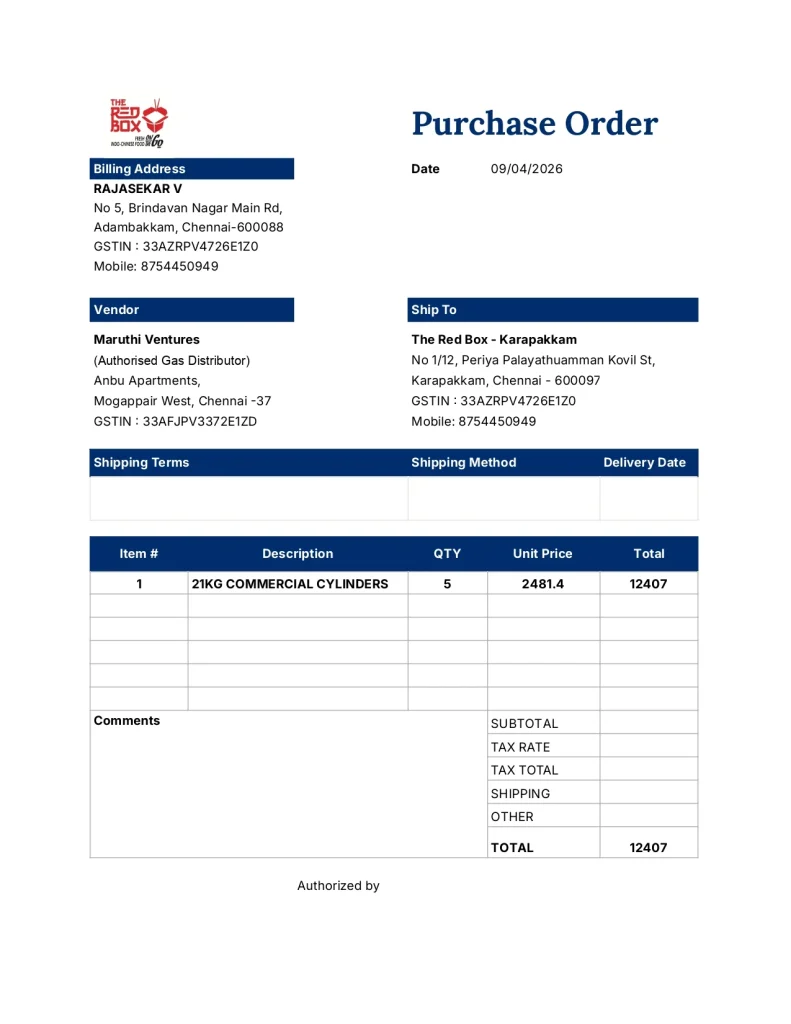
Standard PO (Purchase Order) Template
Distinguishing PO (Purchase Order) from Invoice in Logistics
What is a Purchase Order (PO)? By reading this far, you probably already have the answer to what a PO is. Now, let’s do a quick comparison between a PO (Purchase Order) and an Invoice with 3W. A Purchase Order (PO) and an Invoice are two core commercial documents in the supply chain, yet they are frequently confused due to their similar appearance and format.
In terms of nature, a PO is a document issued by the buyer before the transaction takes place, expressing the intent to purchase and outlining agreed terms such as quantity, unit price, delivery conditions (Incoterms), and payment method. In contrast, a Commercial Invoice is issued by the seller after the goods have been delivered or the services have been rendered, confirming the actual payment obligation that has arisen.
In logistics and import-export operations, the distinction between these two documents carries clear legal and operational significance. A PO serves as the legal foundation binding the sales contract, enabling the procurement department to control budgets, manage suppliers, and track order progress within ERP/WMS systems.
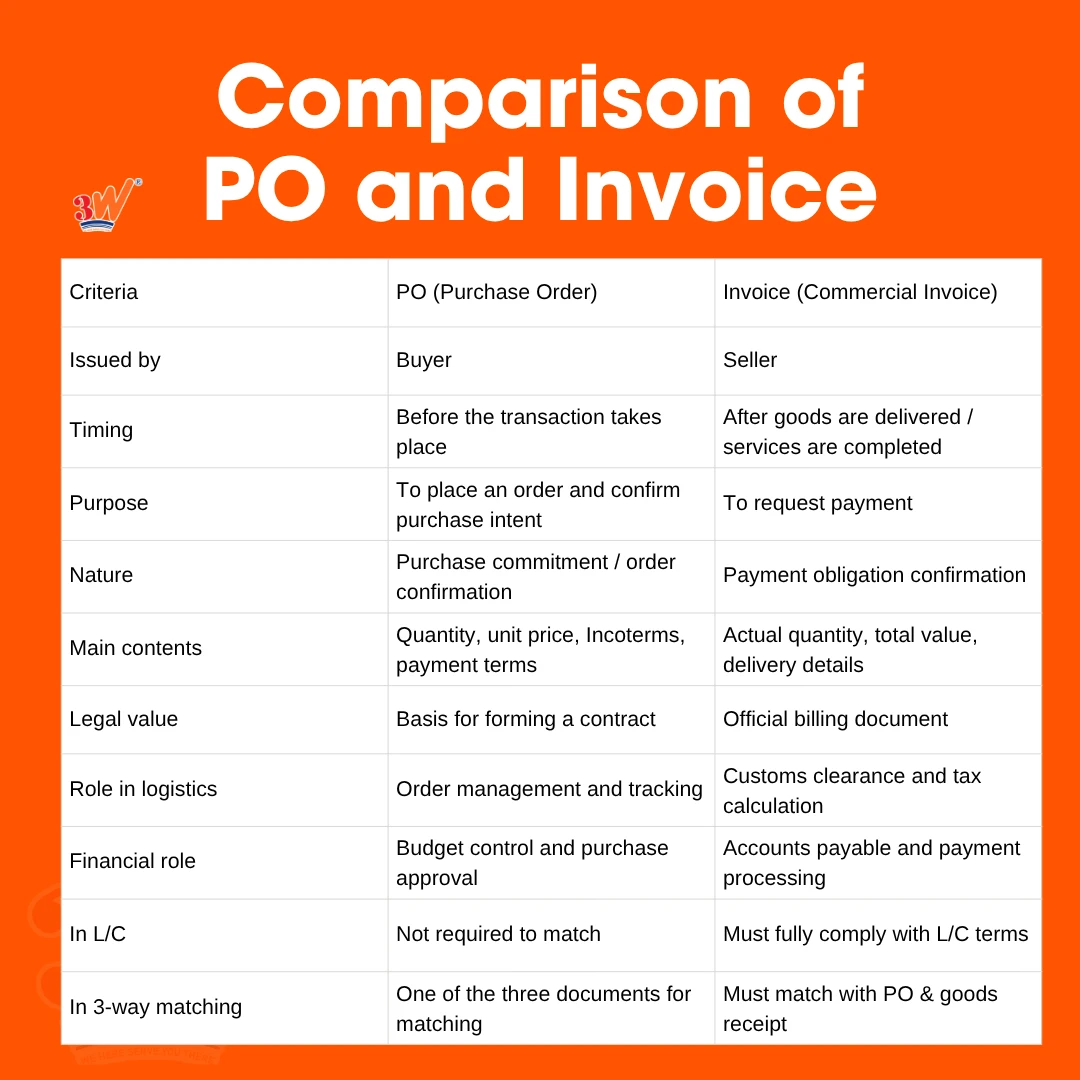
Quick comparison image of a Purchase Order (PO) and an Invoice.
An Invoice, particularly a Commercial Invoice, is a mandatory document in the customs documentation package. It is used by customs authorities to determine dutiable value, verify HS Codes, and cross-check against import/export declarations. Furthermore, in international payments under a Letter of Credit (L/C), the Invoice must fully comply with all terms stated in the credit; any discrepancy may result in a documentary discrepancy and the risk of non-payment.
A critical distinction lies in the 3-way matching process — a three-way reconciliation procedure widely adopted by logistics and international trade enterprises — whereby the finance system matches the PO, Packing List/Goods Receipt, and Invoice prior to approving payment.
If the quantity or unit price on the Invoice does not match the original PO, the transaction will be placed on hold for resolution, directly impacting cash flow and supplier relationships. A clear understanding of the role of each document enables businesses to optimize their procurement processes, minimize the risk of commercial disputes, and ensure customs compliance in import-export operations.
Quick Comparison:
| Criteria | PO (Purchase Order) | Invoice (Commercial Invoice) |
|---|---|---|
| Issued by | Buyer | Seller |
| Timing | Before the transaction takes place | After delivery / service completion |
| Purpose | Place an order, confirm purchase intent | Request payment |
| Nature | Offer to purchase (commitment to buy) | Confirmation of amount payable |
| Key Content | Quantity, unit price, Incoterms, payment method | Actual quantity, payable amount, shipment details |
| Legal Standing | Basis for contract formation | Official payment document |
| Role in Logistics | Order management, progress tracking | Customs clearance, duty calculation |
| Financial Relevance | Budget control, purchase approval | Accounts payable recording, payment processing |
| Under L/C | Not required to match | Must comply 100% with L/C terms |
| In 3-Way Matching | One of the three documents for reconciliation | Must match PO & goods received |
Frequently Asked Questions About PO (Purchase Order) in Logistics
What is a PO in logistics?
A PO (Purchase Order) is an official purchasing document issued by the buyer to a supplier, formally confirming the commitment to purchase a specific quantity of goods at an agreed price, quantity, delivery conditions, and payment terms. In the supply chain, a PO serves as a legally binding document between both parties, and is also the source document used to verify against the Invoice, Packing List, and Bill of Lading during customs clearance.
How is a PO different from a PI (Proforma Invoice)?
A PI is a preliminary quotation issued by the supplier before a contract is signed — it is indicative in nature and carries no binding legal obligation. A PO, on the other hand, is a document proactively issued by the buyer after accepting the commercial terms, and serves as an official order confirmation. In international logistics workflows, the PO is typically created first, after which the supplier issues a Commercial Invoice based on the PO contents.
What is the role of a PO number in freight transportation?
A PO number (purchase order reference number) is a tracking reference used throughout the entire lifecycle of a shipment — from order placement, production, and warehouse release, through transportation, to delivery and payment. Freight forwarders, customs authorities, warehouses, and accounting departments all rely on the PO number to look up, cross-reference, and process shipping documents. An incorrect or missing PO number on import/export documentation can result in customs clearance delays, payment holds, or cargo rejection.
What mandatory information must a PO include?
A standard PO in logistics must include:
- Name and address of the buyer and seller
- PO number
- Issue date
- Goods description (product name, HS code if applicable)
- Quantity
- Unit price
- Total value
- Currency
- Incoterms trade terms (FOB, CIF, EXW, etc.)
- Port/point of delivery
- Delivery timeline (estimated ETD/ETA)
- Payment terms (T/T, L/C, D/P, etc.) and any special requirements regarding packaging or labeling.
When is a PO considered completed (PO Closed)?
A PO is considered closed when all goods in the order have been fully delivered and received, the documentation has been verified and matched (document matching), and payment has been completed in accordance with the agreed terms. In ERP systems such as SAP or Oracle, the PO closed status is automatically updated once both the Goods Receipt (GR) and Invoice Verification (IV) are confirmed — a critical step for period-end accounting close and inventory reconciliation.
Is a PO mandatory in import/export operations?
From a customs regulatory standpoint, a PO is not a mandatory declaration document submitted to customs authorities in the same way as a Commercial Invoice or Packing List. However, in practical logistics operations, customs authorities in certain countries — particularly the US, EU, and Australia — may request a PO to verify customs valuation under the GATT/WTO Customs Valuation Agreement, especially when there is suspicion of undervaluation of the shipment.
If you have read this far, you likely already have a clear answer to the question what is a PO, right? 3W hopes this knowledge will be valuable to you as you begin your journey in the Logistics industry.
Start Optimizing Your PO Process With 3W Logistics Today
In an increasingly complex supply chain environment, effective Purchase Order (PO) management is no longer a competitive advantage — it is a fundamental requirement for businesses to survive and grow sustainably. A properly processed PO enables businesses to control costs, minimize legal risks in international trade, and ensure goods are cleared through customs quickly and on schedule.
At 3W Logistics, we do more than simply handle documentation — we partner with businesses throughout the entire order lifecycle: from PO creation and cross-referencing with Commercial Invoices and Packing Lists, to cargo oversight at the port and completion of customs procedures.
The logistics experts at 3W Logistics possess deep expertise in Incoterms, import/export regulations, and international trade compliance requirements, helping your business avoid costly errors in the execution of commercial contracts.
Whether you operate a B2B import/export model, manage a multi-tier supply chain, or are seeking an integrated 3PL solution to optimize your entire cargo flow — 3W Logistics has the capability, experience, and systems to deliver.
Contact 3W Logistics today for a free consultation on PO management processes and comprehensive logistics solutions — helping your business operate with precision, reduce costs, and never miss a shipment.
3W Logistics Co.,Ltd
- Facebook: www.facebook.com/3w.logisticscompany
- Hotline: 028 3535 0087
- Email: info@3w-logistics.com
- Website: www.3w-logistics.com
- Adress: 34 Bach Đang, Tan Son Hoa Ward, HCMC


